
The operating principle of strain wave gearing, also known as harmonic drive, hinges on the controlled elastic deformation of a flexible component. This unique mechanism provides exceptional advantages, including high reduction ratios within a compact envelope, high positional accuracy, and excellent torque-to-weight ratios. At the heart of this system lies the flexspline, a thin-walled, flexible gear that undergoes cyclical deformation. Its performance and fatigue life are therefore critical to the overall reliability and longevity of the strain wave gear assembly.
Traditional designs often employ a cup-type flexspline, characterized by a long, cylindrical barrel section connecting the toothed rim to the output interface. While effective, this design presents several inherent challenges. The elongated barrel contributes to increased material usage and cost, adds to the overall axial length of the gearbox, and introduces a secondary stress concentration zone at the fillet where the barrel meets the diaphragm or base. This secondary stress riser can become a potential site for fatigue crack initiation, potentially limiting the component’s service life. In response to these limitations, an alternative configuration known as the short cylindrical (or “hat-type”) flexspline has been developed. This design fundamentally alters the power transmission path and offers a more compact and potentially more robust solution.
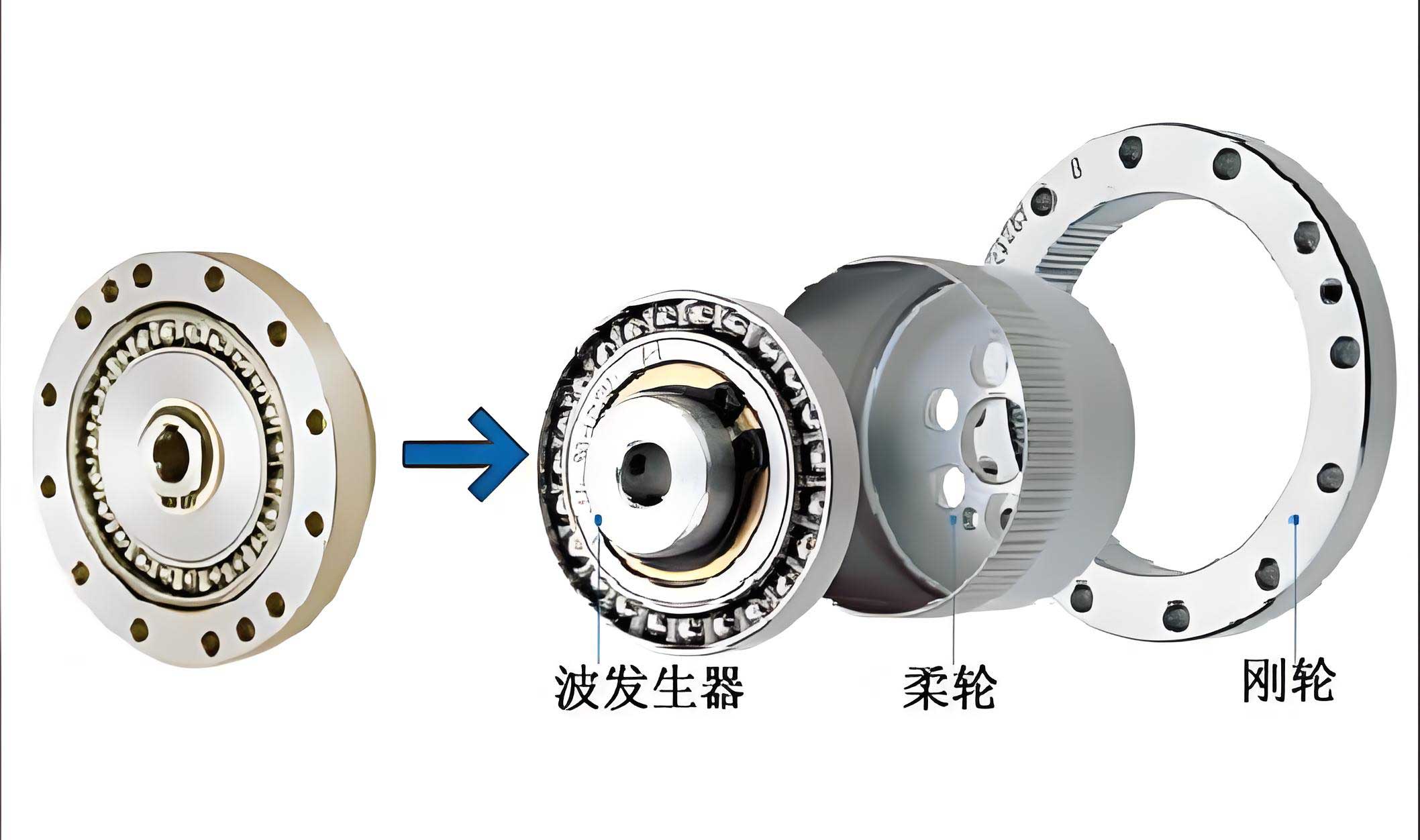
The short cylindrical flexspline, as analyzed in this context, eliminates the long barrel. Instead, it features a relatively short toothed cylinder. The connection to the output is not via a diaphragm but typically through a splined or keyed interface directly on its outer or inner diameter near the open end. This configuration inherently avoids the diaphragm stress concentration. The fundamental kinematics of the strain wave gear remain unchanged: a wave generator (usually an elliptical ball bearing or cam) deforms the flexspline, causing its external teeth to mesh progressively with the internal teeth of a rigid circular spline. The key innovation lies in the addition of a second, output circular spline. The flexspline meshes simultaneously with a fixed circular spline and an output circular spline with an equal number of teeth. The motion is transmitted via a gear-key principle, where the elliptical wave motion is converted into rotation of the output circular spline through the flexspline’s deformation, without affecting the fundamental gear ratio. The standard reduction ratio formula for a strain wave gear still applies:
$$ i = -\frac{Z_f}{Z_c – Z_f} $$
where $Z_f$ is the number of teeth on the flexspline and $Z_c$ is the number of teeth on the fixed circular spline. The negative sign indicates opposite rotation directions between the wave generator and the flexspline (if the flexspline is considered the output in a traditional design; interpretation may vary in this dual-spline configuration).
The structural differences between the conventional cup-type and the short cylindrical flexspline are significant and are summarized in the table below:
| Feature | Cup-type Flexspline | Short Cylindrical Flexspline |
|---|---|---|
| Primary Shape | Cup with long barrel and diaphragm base. | Short cylinder, open at both ends or with a simple flange. |
| Stress Concentration Zones | 1. Tooth root region. 2. Diaphragm fillet/transition region. |
Primarily in the tooth root region and contact zone with the wave generator. Eliminates diaphragm fillet. |
| Axial Length | Longer due to the barrel. | Shorter, leading to a more compact overall strain wave gear assembly. |
| Manufacturing Complexity | Higher due to deep drawing and machining of thin-walled cup. | Potentially simpler as it resembles a straightforward cylindrical gear segment. |
| Power Transmission Path | Through the diaphragm to the output shaft. | Through a gear-key/spline connection to the output circular spline. |
This analysis focuses on the finite element modeling and stress analysis of a short cylindrical flexspline within a strain wave gear system. The objective is to characterize its stress distribution under load from an elliptical cam wave generator, providing insight for design optimization.
Finite Element Modeling in ABAQUS
The analysis of a strain wave gear component involves significant geometric and material nonlinearities. The deformation of the flexspline is large relative to its wall thickness, and contact between the wave generator and the flexspline’s inner surface is highly nonlinear. ABAQUS/Standard was selected for this study due to its robust capabilities in handling complex nonlinear static problems, including sophisticated contact algorithms and large-strain formulations.
Model Geometry and Parameters
The analysis considers a specific short cylindrical flexspline design. For computational efficiency and clarity of the core stress patterns, the detailed gear teeth are often simplified in initial stress studies. The toothed region is modeled as a plain, thin-walled cylinder with an equivalent thickness that represents the stiffness of the toothed section. A common approximation for the equivalent wall thickness $S_{eq}$ of the toothed region is derived from the flexspline’s nominal wall thickness $S$ and the gear module $m$:
$$ h_{eq} = \sqrt[3]{1.67 \cdot S \cdot m^2} $$
However, for a focused stress analysis of the cylinder body under deformation, a constant wall thickness is frequently assumed, with the understanding that peak stresses in the tooth roots will be higher and require separate, localized analysis. The key parameters for the modeled flexspline are:
| Parameter | Symbol | Value |
|---|---|---|
| Number of Teeth | $Z_f$ | 200 |
| Module | $m$ | 0.2 mm |
| Inner Diameter | $d_i$ | 40.0 mm |
| Wall Thickness | $S$ | 0.6 mm |
| Cylinder Length | $L$ | 12.0 mm |
| Radial Deformation (Wave Generator Amplitude) | $w_0$ | 0.2 mm |
The wave generator is an elliptical cam. The prescribed radial deformation $w$ of the flexspline’s neutral axis as a function of the angular coordinate $\theta$ (measured from the major axis of the ellipse) is given by:
$$ w(\theta) = w_0 \cdot \cos(2\theta) $$
This equation defines the elliptical shape imposed on the flexspline.
Model Assumptions and Simplifications
To construct a manageable yet representative finite element model, the following assumptions were made:
- Rigid Wave Generator: The wave generator (cam) is modeled as a discrete rigid body. Its stiffness is orders of magnitude higher than that of the flexspline, making this a valid assumption.
- Small Strain, Large Displacement: While the flexspline undergoes large rotations and displacements (geometric nonlinearity), the material strain is assumed to remain within the elastic, small-strain regime for this static analysis.
- Simplified Tooth Geometry: The explicit gear teeth are not modeled. The focus is on the bulk stress field in the cylindrical body induced by the elliptical deformation. Stresses are evaluated on the inner and outer surfaces representing the root circle diameter.
- Material Model: The flexspline material is modeled as linear elastic, isotropic, with properties typical of high-strength alloy steel used in strain wave gearing (e.g., 30CrMnSiA or similar). Young’s Modulus $E = 206$ GPa and Poisson’s ratio $\nu = 0.3$.
Mesh, Contacts, and Boundary Conditions
The finite element model was built in ABAQUS/CAE.
- Mesh: The short cylindrical flexspline was meshed with 8-node linear brick, reduced integration elements (C3D8R). A fine, structured mesh was used, particularly in the circumferential direction to capture the stress gradients, resulting in over 3000 elements. The rigid cam was meshed with 4-node 3D rigid elements (R3D4).
- Contact Definition: A surface-to-surface contact pair was defined to simulate the interaction between the cam and the flexspline’s inner bore. The rigid cam surface was the master surface, and the flexspline’s inner surface was the slave surface. A “hard” contact pressure-overclosure relationship was used for normal behavior, and a penalty friction formulation with a low coefficient ($\mu = 0.05$) was applied for tangential behavior to model possible slight sticking/sliding.
- Boundary Conditions and Load Step: The analysis simulated the assembly process. In the initial step, the cam and flexspline were positioned such that the cam’s major axis was aligned with the flexspline but not yet inserted. The ends of the cylindrical flexspline were constrained from rigid body motion. In a single static, general step, the cam was displaced axially to its final position inside the flexspline, forcing the flexspline to conform to the cam’s elliptical profile. The final deformed shape is the result of the nonlinear static solution.
Stress Analysis Results and Discussion
The primary outcome of the finite element analysis is the stress field within the short cylindrical flexspline under the static load from the elliptical wave generator. The most critical stress component for thin-walled cylinders under bending is the hoop stress, but von Mises equivalent stress is commonly examined to evaluate yield criteria under multi-axial stress states.
The contour plot of von Mises stress reveals a highly systematic pattern characteristic of the strain wave gear deformation mechanism. The maximum stress is concentrated in the regions of the flexspline wall that are in direct contact with the major and minor axes of the elliptical cam. Specifically, the highest stress concentrations appear at the ends of the major axis (where radial deformation and curvature are greatest). The stress distribution is symmetric about both the major and minor axes.
A more quantitative understanding is gained by plotting the hoop stress or von Mises stress around the circumference at the mid-length of the flexspline. The stress profile follows a waveform with a period of 180 degrees (or $\pi$ radians), directly corresponding to the $\cos(2\theta)$ deformation function. The table below summarizes the key stress observations at characteristic locations:
| Angular Location, $\theta$ | Radial Deformation, $w(\theta)$ | Stress State | Physical Cause |
|---|---|---|---|
| $0^\circ$ (Major Axis) | $+w_0$ (Maximum outward) | Maximum Tensile Hoop Stress / von Mises Stress. Peak contact pressure. | Maximum bending curvature and direct radial expansion. |
| $45^\circ$ | $0$ | Low/Moderate Stress. Often near zero hoop stress (neutral axis). | Transition region with minimal curvature change. |
| $90^\circ$ (Minor Axis) | $-w_0$ (Maximum inward) | High Compressive Hoop Stress. High von Mises Stress. | Maximum inward bending curvature. |
| $135^\circ$ | $0$ | Low/Moderate Stress. | Transition region. |
For the analyzed model, the maximum von Mises stress was found to be approximately 97 MPa, located at the inner surface of the flexspline at the major axis contact points. This value is well within the yield strength of high-performance flexspline materials for a static load. However, in a functioning strain wave gear, this stress is cyclical. The flexspline material experiences a fully reversed stress cycle as every point on its circumference rotates through the high-tension (major axis) and high-compression (minor axis) zones with each revolution of the wave generator. The stress range $\Delta \sigma$ is therefore a critical parameter for fatigue life calculation and is approximately twice the amplitude of the stress variation seen in the static plot.
The fatigue life $N_f$ of the flexspline can be estimated using the material’s S-N curve (stress-life approach) or, more accurately for notch-sensitive regions, using strain-life analysis with the Coffin-Manson relation:
$$ \frac{\Delta \epsilon}{2} = \frac{\sigma_f’}{E}(2N_f)^b + \epsilon_f'(2N_f)^c $$
where $\Delta \epsilon$ is the total strain range, $\sigma_f’$ is the fatigue strength coefficient, $b$ is the fatigue strength exponent, $\epsilon_f’$ is the fatigue ductility coefficient, and $c$ is the fatigue ductility exponent. The stress or strain range obtained from the FEA, often with a concentration factor applied for the tooth root geometry, is the primary input for such calculations.
Advantages of the Short Cylindrical Design in Strain Wave Gearing
The finite element results clearly demonstrate the primary mechanical advantage of the short cylindrical flexspline design: the elimination of the high-stress diaphragm fillet. In a cup-type design, the stress field is bi-axial and complex at the cup’s closed end, often leading to a localized stress peak that rivals or exceeds the tooth root stress. The short cylinder design avoids this entirely. The stress field is more uniform along the axial direction, with peaks only at the contact lines with the wave generator. This simplification of the stress state is beneficial for fatigue life prediction and design for reliability in strain wave gear applications.
Furthermore, the shortened length reduces the mass and inertia of the flexspline, which can improve the dynamic response of the strain wave gear system. The compact form factor also allows for more integrated and space-efficient gearbox designs.
Considerations and Potential Challenges
While the short cylindrical design offers clear benefits, it introduces other design challenges that must be addressed:
- Connection Design: The gear-key or splined connection to the output member becomes a new critical area. Stress concentrations at the root of these connection splines must be carefully managed through fillet design and surface treatment.
- Bearing Support: The open structure may require different strategies for supporting and aligning the flexspline relative to the wave generator and circular splines.
- Dynamic Analysis: The static analysis presented here is foundational. A complete design validation for a strain wave gear must include dynamic analysis to assess vibrations, especially at high input speeds, and the impact of torque loading on the stress distribution and tooth engagement.
Conclusion
This detailed analysis has explored the structural mechanics of a short cylindrical flexspline for use in strain wave gearing through nonlinear finite element methods. The model, implemented in ABAQUS/Standard, successfully simulated the assembly process and the resulting static stress field induced by an elliptical cam wave generator. The results confirm the theoretically expected stress distribution: a symmetric, cos(2θ)-patterned variation with maximum stresses at the major and minor axes of deformation. Crucially, the analysis highlights the fundamental advantage of this design—the elimination of the secondary stress concentration zone associated with the diaphragm of a traditional cup-type flexspline. This leads to a more predictable and potentially more favorable stress state focused primarily in the working region of the gear teeth.
The successful implementation of this flexspline configuration contributes to the ongoing evolution of strain wave gear technology, pushing towards lighter, more compact, and more reliable actuators for precision motion control applications in fields such as robotics, aerospace, and advanced manufacturing. Future work would logically extend this static analysis to include explicit tooth modeling for root stress calculation, full dynamic simulation under torque load, and thermo-mechanical analysis to account for operational heat generation. The methodology established here provides a robust framework for the design optimization and validation of innovative components within the strain wave gear family.