
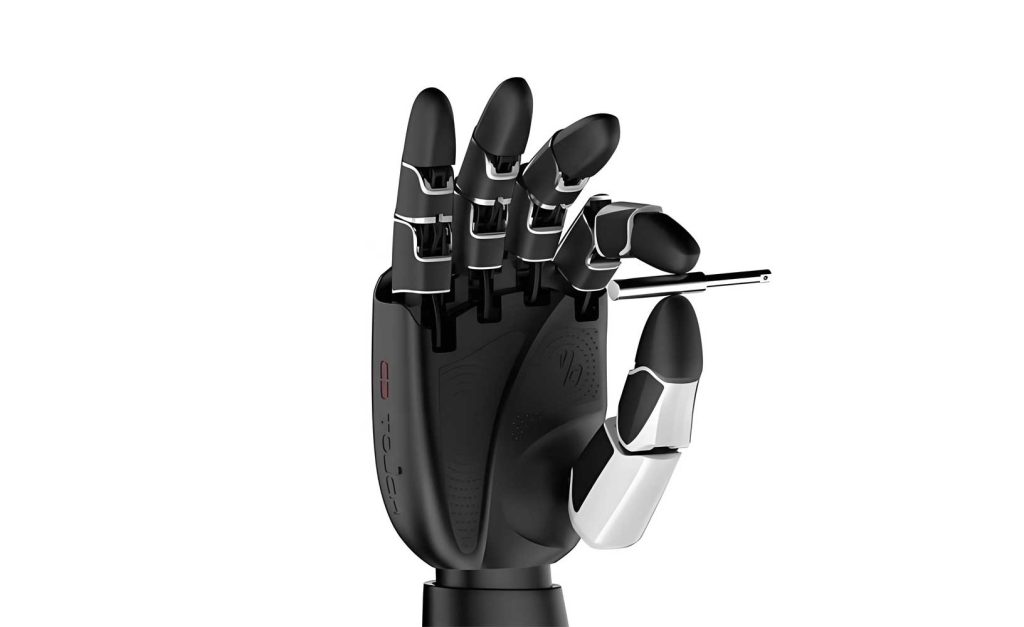
Grasping and dexterous manipulation remain core challenges in robotics, essential for enabling robots to interact with the physical world. The performance of a dexterous robotic hand in stably holding an object against external loads is critically dependent on the efficient distribution of forces among its joints. For a given grasp configuration and set of contact points, the joint torques must be synthesized to satisfy three fundamental conditions: the generated contact forces can equilibrate the external wrench applied to the object; these contact forces must lie within the friction cones (or more complex friction constraints) at each contact point; and the joint torques themselves must be capable of generating these contact forces through the hand’s kinematics. Since joint torques are the direct actuation variables, and contact forces are the passive, intermediate result, multiple valid joint torque distributions exist for a single external load. This necessitates an optimization framework to identify the most efficient set.
Current methodologies for joint torque optimization typically follow two main paradigms. The first involves optimizing in the contact force space to find the minimal grasp forces, which are then mapped to joint torque space via the hand’s Jacobian transpose. This approach often employs Linear Programming (LP) by linearizing friction cones or resorts to more complex Nonlinear Programming (NLP) to handle exact nonlinear friction constraints. While effective in minimizing contact forces, a key limitation is that the optimal contact force set does not necessarily map to the optimal joint torque set, as the mapping via the Jacobian is not isometric. The second paradigm directly addresses optimization within the joint torque space itself. This is more aligned with actuator constraints but often faces computational challenges due to the nonlinear nature of friction constraints, particularly for sophisticated contact models like the soft-finger model, potentially affecting the convergence and real-time performance of iterative algorithms.
The soft-finger contact model, which accounts for tangential forces and a torsional moment about the contact normal, provides a more realistic description of contact for a dexterous robotic hand with compliant fingertips. However, its friction constraint is ellipsoidal and nonlinear, posing a significant hurdle for fast optimization. This work presents a method for joint torque optimization that emphasizes computational efficiency and real-time feasibility. The core idea is to linearize the soft-finger friction constraints, formulate all equilibrium and contact constraints as linear inequalities with joint torques as variables, and construct a quadratic objective function minimizing the sum of squared joint torques. This transforms the problem into a Quadratic Programming (QP) problem with purely linear constraints—a convex optimization problem that can be solved efficiently and reliably.
1. Linearization of the Soft-Finger Contact Model
The friction constraint for a soft-finger contact point \(i\) is given by the following nonlinear inequality:
$$ \frac{\sqrt{f_{ix}^2 + f_{iy}^2}}{\mu_1} + \frac{|m_{iz}|}{\mu_2} \leq f_{iz}, \quad f_{iz} > 0 $$
where \(f_{ix}, f_{iy}\) are the tangential force components, \(f_{iz}\) is the normal force, \(m_{iz}\) is the torsional moment, \(\mu_1\) is the tangential friction coefficient, and \(\mu_2\) is the torsional friction coefficient. This describes an ellipsoidal cone in the force-moment space.
To linearize this constraint, we first equivalently rewrite it as:
$$ \sqrt{f_{ix}^2 + f_{iy}^2} \leq \mu_1 f_{iz} – \frac{\mu_1}{\mu_2} |m_{iz}|, \quad f_{iz} > 0 $$
Geometrically, the feasible set of \((f_{ix}, f_{iy}, m_{iz})\) forms a double cone. We approximate this double cone by a polyhedral double cone, which is the intersection of a set of half-spaces. This is achieved by inscribing a regular \(N\)-sided polygon (\(N \geq 3\)) into the circular cross-section of the cone at a specific height. The resulting polyhedral cone is defined by \(2N\) linear inequalities, which, combined with the positive normal force constraint, give \(2N+1\) linear constraints per contact.
Let \( s_j = \sin(2\pi j / N) \) and \( c_j = \cos(2\pi j / N) \) for \( j = 1, 2, …, N \), and \( s_N = \sin(2\pi / N) \). The \(2N\) linear inequalities approximating the friction cone for contact \(i\) are:
$$
\begin{aligned}
&\mu_2(s_{j+1} – s_j)f_{ix} + \mu_2(c_j – c_{j+1})f_{iy} – \mu_1\mu_2 s_N f_{iz} + \mu_1 s_N m_{iz} \leq 0 \\
&\mu_2(s_{j+1} – s_j)f_{ix} + \mu_2(c_j – c_{c+1})f_{iy} – \mu_1\mu_2 s_N f_{iz} – \mu_1 s_N m_{iz} \leq 0
\end{aligned}
$$
for \( j = 1, …, N \) (with \( s_{N+1}=s_1, c_{N+1}=c_1 \)). The positive normal force constraint is simply:
$$ -f_{iz} < 0 $$
Therefore, for a grasp with \(p\) contact points, the complete set of linearized contact constraints can be written in matrix form as:
$$ \mathbf{S}_{(2Np+p) \times 4p} \mathbf{f}_{4p \times 1} \leq \mathbf{0} $$
where \(\mathbf{f} = [\mathbf{f}_1^T, \mathbf{f}_2^T, …, \mathbf{f}_p^T]^T\) is the concatenated vector of contact wrenches (each \(\mathbf{f}_i = [f_{ix}, f_{iy}, f_{iz}, m_{iz}]^T\)), and \(\mathbf{S}\) is the coefficient matrix constructed from the inequalities above for all contacts. The choice of \(N\) offers a trade-off between approximation accuracy and computational load; a larger \(N\) yields a tighter approximation at the cost of more constraint inequalities.
2. Formulating Linear Joint Torque Constraints
For a dexterous robotic hand to maintain a stable grasp, the contact forces \(\mathbf{f}\) and the joint torques \(\boldsymbol{\tau}\) must satisfy the force equilibrium equations. Let \(\mathbf{w} \in \mathbb{R}^6\) be the external wrench acting on the object. The grasp matrix \(\mathbf{G}\) maps contact forces to the object wrench, and the transpose of the hand’s Jacobian matrix \(\mathbf{J}^T\) maps joint torques to contact forces:
$$ \mathbf{G} \mathbf{f} = \mathbf{w} $$
$$ \mathbf{J}^T \mathbf{f} = \boldsymbol{\tau} $$
The combined system can be solved to express the contact force vector \(\mathbf{f}\) explicitly as a function of the external wrench \(\mathbf{w}\) and the joint torque vector \(\boldsymbol{\tau}\):
$$ \mathbf{f} = \mathbf{M}_1 \mathbf{w} + \mathbf{M}_2 \boldsymbol{\tau} $$
Here, \(\mathbf{M}_1\) and \(\mathbf{M}_2\) are coefficient matrices derived from \(\mathbf{G}\) and \(\mathbf{J}\), which depend solely on the grasp geometry and the kinematics of the dexterous robotic hand.
This expression for \(\mathbf{f}\) inherently satisfies the force balance constraints of Eqs. (1) and (2). To also satisfy the linearized contact friction constraints from Eq. (3), we substitute Eq. (4) into Eq. (3):
$$ \mathbf{S} (\mathbf{M}_1 \mathbf{w} + \mathbf{M}_2 \boldsymbol{\tau}) \leq \mathbf{0} $$
Rearranging terms, we obtain a set of linear inequality constraints solely in terms of the joint torque vector \(\boldsymbol{\tau}\):
$$ \mathbf{S} \mathbf{M}_2 \boldsymbol{\tau} \leq -\mathbf{S} \mathbf{M}_1 \mathbf{w} $$
For a fixed external wrench \(\mathbf{w}\), Eq. (5) defines a convex polyhedral set of feasible joint torques in \(\mathbb{R}^m\), where \(m\) is the number of actuated joints. Any \(\boldsymbol{\tau}\) within this set guarantees that the resulting contact forces will balance \(\mathbf{w}\) and remain within the linearized soft-finger friction cones.
3. Objective Function and Convex Optimization Problem
Within the feasible polyhedron defined by Eq. (5), we seek the optimal joint torque distribution. The objective function should reflect practical considerations for the actuation system of a dexterous robotic hand, such as minimizing actuator effort, reducing energy consumption, or maximizing the margin to torque saturation. A common and mathematically tractable objective is to minimize the sum of squares of the joint torques, which tends to distribute the load smoothly among actuators and minimize the overall Euclidean norm of the torque vector. This is formulated as:
$$ \min_{\boldsymbol{\tau}} \quad \delta(\boldsymbol{\tau}) = \sum_{i=1}^{m} \tau_i^2 = \boldsymbol{\tau}^T \boldsymbol{\tau} $$
Combined with the linear constraints from Eq. (5), the complete joint torque optimization problem becomes:
$$
\begin{aligned}
& \underset{\boldsymbol{\tau}}{\text{minimize}}
& & \boldsymbol{\tau}^T \boldsymbol{\tau} \\
& \text{subject to}
& & \mathbf{S} \mathbf{M}_2 \boldsymbol{\tau} \leq -\mathbf{S} \mathbf{M}_1 \mathbf{w}
\end{aligned}
$$
This is a Quadratic Programming (QP) problem. Crucially, the Hessian of the objective function (the identity matrix) is positive definite, and the constraint set is convex (a polyhedron). Therefore, the problem is a convex QP, which guarantees that any local minimum is also a global minimum. Furthermore, such a QP problem can be efficiently solved using active-set methods or, by formulating its optimality conditions (the Karush-Kuhn-Tucker conditions), it can be transformed into a Linear Complementarity Problem (LCP) or solved directly by specialized convex optimizers. This structure ensures both computational efficiency and solution reliability, which are vital for the real-time control of a dexterous robotic hand.
The geometric interpretation for a two-jointed system is illustrative. The constraints \(\mathbf{S} \mathbf{M}_2 \boldsymbol{\tau} \leq -\mathbf{S} \mathbf{M}_1 \mathbf{w}\) form a polygon in the \((\tau_1, \tau_2)\) plane. The objective function \(\tau_1^2 + \tau_2^2\) represents concentric circles centered at the origin. The optimal solution is the point within the polygon that lies on the smallest possible circle, i.e., the point where the smallest circle touches the polygon. This is typically a vertex or a point on a facet of the polygon.
| Parameter | Description | Value |
|---|---|---|
| \(\mu_1\) | Tangential friction coefficient (both fingers) | 0.5 |
| \(\mu_2\) | Torsional friction coefficient (both fingers) | 0.2 |
| \(N\) | Number of sides for polygon approximation | 3 |
| \(\mathbf{w}\) | External wrench (\([F_x, F_y, F_z, M_x, M_y, M_z]\)) | \([0, -1\text{N}, 1\text{N}, 0.5\text{N·m}, 0, 0]^T\) |
| \(\tau_{max}\) | Joint torque limits for joints 1 & 3 | 10.0 N·m |
| \(\tau_{max}\) | Joint torque limits for joints 2 & 4 | 5.0 N·m |
4. Case Study: Planar Grasp with a Two-Finger Dexterous Robotic Hand
To validate the proposed method, we consider a planar grasping example using a two-finger dexterous robotic hand, where each finger has two revolute joints, grasping an elliptical object. The initial grasp configuration and contact points are defined. The goal is to find the optimal joint torques to resist the given external wrench \(\mathbf{w}\). The relevant parameters are summarized in Table 1.
First, the grasp matrix \(\mathbf{G}\) and the transposed Jacobian \(\mathbf{J}^T\) are constructed based on the grasp geometry. For the planar case with two soft-finger contacts, the contact force vector is \(\mathbf{f} = [f_{1x}, f_{1y}, f_{1z}, m_{1z}, f_{2x}, f_{2y}, f_{2z}, m_{2z}]^T\). The matrices \(\mathbf{M}_1\) and \(\mathbf{M}_2\) are computed from \(\mathbf{G}\) and \(\mathbf{J}\). The linearizing matrix \(\mathbf{S}\) is built using \(N=3\), resulting in \((2*3+1)*2 = 14\) linear inequality constraints for the two contact points.
Substituting these matrices and the external wrench \(\mathbf{w}\) into the joint torque constraint inequality (Eq. 5) and the quadratic objective function (Eq. 6) forms the specific QP instance for this grasp. This problem is solved using a standard convex QP solver (equivalent to an active-set method solvable via the simplex method for the related optimality conditions).
| Joint Torque | Method from Literature [6] (N·m) | Proposed QP Method (N·m) | Reduction |
|---|---|---|---|
| \(\tau_1\) | 5.40 | 3.98 | 26.3% |
| \(\tau_2\) | 1.00 | 0.86 | 14.0% |
| \(\tau_3\) | -5.40 | -3.98 | 26.3% |
| \(\tau_4\) | -0.29 | -0.25 | 13.8% |
| Norm \(||\boldsymbol{\tau}||_2\) | 7.66 | 5.66 | 26.1% |
The optimal joint torque vector found by the proposed method is:
$$ \boldsymbol{\tau}_{opt} = [3.98, 0.86, -3.98, -0.25]^T \, \text{N·m} $$
Table 2 compares this result with the optimal torques obtained from a prior, iterative nonlinear optimization method applied to the same problem. The computation time for the proposed QP-based method was less than 0.1 seconds on a standard desktop computer, demonstrating excellent real-time potential.
The results clearly show that the proposed convex QP approach finds a more efficient torque distribution. The torque magnitude for every joint is lower than the previous method’s result, with a significant reduction in the overall torque norm (26.1%). This implies that for the same external load, the dexterous robotic hand using our method can operate with smaller actuators or lower energy expenditure. Conversely, for a hand with given actuator limits, this method allows it to grasp objects subject to larger external forces, thereby increasing its load-bearing capacity.
5. Discussion and Conclusion
This paper presented an efficient method for joint torque optimization in dexterous robotic hand grasping, specifically addressing the realistic soft-finger contact model. The key innovation lies in the linearization of the nonlinear soft-finger friction constraints, which transforms the complex force feasibility region into a convex polyhedron. By combining this with the fundamental force balance equations, we derived a set of linear inequality constraints that directly define the feasible set of joint torques.
Formulating the objective as the minimization of the sum of squared joint torques leads to a convex Quadratic Programming problem. This class of problems is well-understood, guarantees a unique global minimum, and can be solved very efficiently using established numerical algorithms. The transformation from a nonlinear, potentially non-convex problem to a convex QP is the major contributor to the gains in computational speed and reliability.
The case study of a planar two-fingered grasp substantiated the advantages of the method. The optimization was performed swiftly, and the resulting joint torques were significantly lower than those from a comparative nonlinear optimization technique. This demonstrates both the correctness and the practical benefit of the approach: it enables a dexterous robotic hand to execute stable grasps with minimal actuator effort or to extend its operational range for a given actuator set.
Future work could explore several extensions. Different objective functions could be investigated, such as minimizing the maximum joint torque (a min-max problem that can be reformulated as an LP) or incorporating energy consumption models. The method could also be integrated into a grasp planning framework, where it can be used to evaluate and select grasp configurations based on their optimal torque efficiency. Finally, experimental validation on a physical dexterous robotic hand platform would be the crucial next step to confirm the real-time performance and robustness under real-world conditions, including sensor noise and model uncertainties.