
In the field of precision servo systems, such as those used in aerospace, robotics, and defense applications, the strain wave gear system has become a critical component due to its high torque output, compact structure, minimal backlash, and excellent transmission accuracy. As integrated modular strain wave gear assemblies—which combine motors, strain wave gears, sensors, bearings, and electrical interfaces—gain widespread engineering use, there is a growing need for effective modeling methods to predict system performance and facilitate control design. In this paper, we address this need by developing a comprehensive modeling approach for precision strain wave gear systems. We consider the primary factors influencing system behavior, establish both dynamic and simulation models, propose efficient parameter identification techniques, and validate the models through time-frequency domain analyses. Our goal is to provide a practical tool for engineers to simulate and optimize strain wave gear system performance without extensive physical testing.
The core of our work lies in capturing the essential dynamics of a strain wave gear system. Typically, such a system can be abstracted as a two-mass model connected by an elastic element, representing the motor side and the load side with the strain wave gear transmission in between. This simplification allows us to derive fundamental equations governing the system’s motion. Let us denote the motor inertia as $J_m$, motor output torque as $T_m$, motor angular displacement as $\theta_m$, and load inertia as $J_l$, load angular displacement as $\theta_l$, with the strain wave gear reduction ratio as $K_w$ and transmission stiffness as $K_s$. The torque transmitted through the strain wave gear, $T_s$, can be expressed as $T_s = K_s (K_w \theta_m – \theta_l)$. Based on force balance, the dynamic equations are:
$$ J_m \ddot{\theta}_m = T_m – T_{md} – T_s $$
$$ J_l \ddot{\theta}_l = T_s’ – T_{ld} $$
$$ T_s’ = \frac{T_s}{K_w} $$
For the motor drive, we consider a DC servo motor with electrical circuit equations. If $u$ is the input voltage, $i$ the armature current, $R$ the resistance, $L$ the inductance (often negligible for simplicity), $K_m$ the torque constant, and $K_e$ the back-EMF constant, we have:
$$ T_m = K_m i $$
$$ u = iR + L \frac{di}{dt} + K_e \dot{\theta}_m $$
Combining these, the linear part of the system dynamics can be described by differential equations that account for electromechanical coupling. However, real-world strain wave gear systems exhibit significant nonlinearities that must be incorporated to achieve accurate modeling. We categorize these nonlinear factors into several key aspects: current saturation in drivers, sensor resolution limitations, friction and damping effects, mass unbalance moments, and the nonlinear meshing stiffness and backlash inherent in strain wave gears. Each of these factors can be modeled separately and integrated into an overall system model.
For instance, friction and damping moments, which arise from both motor and load sides, are captured using a Stribeck model. This model includes static friction $T_s^+$ and $T_s^-$, Coulomb friction $T_C^+$ and $T_C^-$, viscous damping coefficient $B$, and Stribeck velocity $\Omega$. The friction torque $T_f$ as a function of angular velocity $\dot{\theta}$ and applied torque $T_M$ is given by:
$$ T_f(\dot{\theta}, T_M) = \begin{cases}
T_m & \text{if } \dot{\theta} = 0 \text{ and } T_s^- < T_m < T_s^+ \\
T_s^+ & \text{if } \dot{\theta} = 0 \text{ and } T_m \geq T_s^+ \\
T_s^- & \text{if } \dot{\theta} = 0 \text{ and } T_m \leq T_s^- \\
T_{\text{Stribeck}}^+(\dot{\theta}) = T_C^+ + (T_s^+ – T_C^+) e^{-(\dot{\theta}/\Omega^+)^{\delta}} + B^+ \dot{\theta} & \text{if } \dot{\theta} > 0 \\
T_{\text{Stribeck}}^-(\dot{\theta}) = T_C^- + (T_s^- – T_C^-) e^{-(\dot{\theta}/\Omega^-)^{\delta}} + B^- \dot{\theta} & \text{if } \dot{\theta} < 0
\end{cases} $$
Mass unbalance on the load side produces a disturbance torque $T_{nb}$ that varies sinusoidally with angular position $\theta$: $T_{nb} = k m g \rho \sin(\alpha_0 + \theta)$, where $m$ is the equivalent unbalanced mass, $g$ gravity, $\rho$ the distance from the rotation center, and $\alpha_0$ an initial phase offset. Another critical nonlinearity is the meshing stiffness of the strain wave gear, which often shows hysteresis due to elastic deformation and contact conditions. We approximate this hysteresis curve with a piecewise linear model, dividing the torque range into segments with different stiffness values $K_1$, $K_2$, $K_3$ at torque thresholds $T_1$ and $T_2$. The stiffness $K_s$ is then:
$$ K_s = \begin{cases}
K_1 & \text{if } |T_s’| \leq T_1 \\
K_2 & \text{if } T_1 < |T_s’| \leq T_2 \\
K_3 & \text{if } |T_s’| > T_2
\end{cases} $$
Backlash, denoted $\Delta$, is modeled by introducing a dead zone in the load angular displacement output $\theta_l’$ relative to the ideal displacement $\theta_l$, depending on the direction of motion and displacement magnitude. Sensor resolution, particularly from encoders, limits the precision of measured angles and velocities. For an encoder with line count $n_e$ and interpolation factor $N$, the angular resolution is $\delta \theta = 2\pi / (N \times n_e)$ rad, and velocity resolution from direct differentiation is $\delta \omega = 2\delta \theta / t_s$ rad/s, where $t_s$ is the sampling interval. Current saturation in drivers is represented with a clipping function that limits current to maximum $I_{\max}$ and minimum $I_{\min}$ values.
Integrating all these elements, we construct a comprehensive block diagram of the strain wave gear system control model. This includes the driver with current controller $C$ and feedback gain $K_h$, motor dynamics, strain wave gear transmission with nonlinear stiffness and backlash, load dynamics, and disturbance inputs. This model serves as the foundation for developing a simulation environment. We implement this in MATLAB Simulink, creating modules for each component: motor driver, motor armature, motor rotor, load, friction function, stiffness function, backlash function, mass unbalance function, and encoder simulation. The parameters required for the simulation can be divided into two categories: those directly obtainable from component datasheets and those requiring experimental identification.
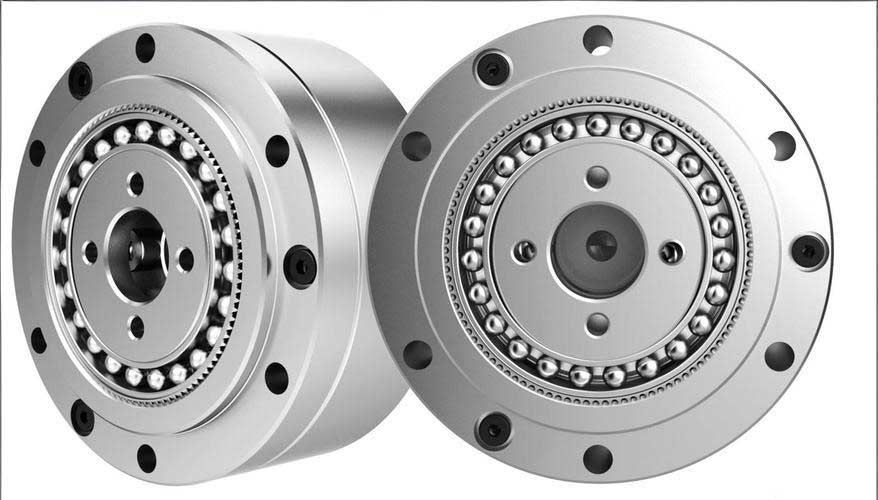
The table below summarizes key parameters typically found in datasheets for a strain wave gear system. These values are used directly in the simulation model to ensure consistency with real hardware.
| Component | Parameter | Typical Value |
|---|---|---|
| Motor | Armature Resistance $R$ | 5.6 Ω |
| Torque Constant $K_m$ | 0.517 N·m/A | |
| Back-EMF Constant $K_e$ | 0.517 V·s/rad | |
| Rotor Inertia $J_m$ | 6.82 × 10⁻⁴ kg·m² | |
| Inductance $L$ | 2.8 × 10⁻³ H (often neglected) | |
| Driver | Current Limits $I_{\max}$, $I_{\min}$ | 3 A, -3 A |
| Encoder | Line Count $n_e$ | 18,000 |
| Interpolation Factor $N$ | 40 | |
| Strain Wave Gear | Reduction Ratio $K_w$ | 80 |
| Meshing Stiffness $K_s$ | 5.4 × 10⁵ N·m/rad (low torque) 8.8 × 10⁵ N·m/rad (medium torque) 9.8 × 10⁵ N·m/rad (high torque) |
|
| Backlash $\Delta$ | 2.2 × 10⁻⁴ rad | |
| Load | Load Inertia $J_l$ | 2.35 × 10⁻² kg·m² |
Parameters not readily available from datasheets, such as the current controller transfer function $C$, feedback gain $K_h$, and friction/damping parameters ($T_s^+$, $T_s^-$, $T_C^+$, $T_C^-$, $B$), as well as load inertia $J_l$ and mass unbalance product $mg\rho$, require identification from experimental data. Traditional methods involve static or quasi-static tests with specialized fixtures, which are time-consuming and costly. To streamline this, we propose an efficient identification procedure that estimates all unknown parameters from a single frequency sweep test. This approach not only reduces cost but also enhances practicality for engineering applications.
First, for the driver parameters $C$ and $K_h$, we apply a frequency sweep or random input signal to the driver, record input-output data, and use basic least-squares identification to fit a transfer function model. For friction parameters like static friction $T_s^+$ and $T_s^-$, we measure the maximum drive torque corresponding to the dead zone in the response during the sweep. To identify $T_C^+$, $T_C^-$, $B$, $J_l$, and $mg\rho$, we simplify the system model by combining the driver, motor armature, and back-EMF effects into a linear gain $K_a$, assuming the current loop bandwidth is high relative to the mechanical dynamics. The strain wave gear is treated as a fixed reduction ratio $K_w$ for identification purposes, and disturbances are aggregated into an equivalent load disturbance torque $T_d$. The simplified model relates load angular velocity $\omega_l(s)$ to input voltage $u(s)$:
$$ \omega_l(s) = \frac{K_a K_m K_w}{J_l s + B} \left[ u(s) – \frac{T_d(s)}{K_a K_m K_w} \right] $$
Discretizing with zero-order hold and sampling time $t_s$, we obtain a difference equation:
$$ \omega_l(k) = e^{-(B/J_l) t_s} \omega_l(k-1) + \frac{K_a K_m K_w}{B} (1 – e^{-(B/J_l) t_s}) \left[ u(k-1) – \frac{T_d(k-1)}{K_a K_m K_w} \right] $$
The disturbance torque $T_d$ incorporates Coulomb friction and mass unbalance, modeled as $T_d = P(\omega_l(k)) T_C^+ + N(\omega_l(k)) T_C^- + mg\rho \sin(\alpha_0 + \theta(k))$, where $P(\cdot)$ and $N(\cdot)$ are sign-based functions activated above Stribeck velocity $\Omega$. Defining a parameter vector $\Theta$ and data matrices $\Phi$ and $Y$ from sampled input-output data, we form a linear regression equation $Y = \Phi \Theta + E$, where $E$ is prediction error. The least-squares estimate $\hat{\Theta} = (\Phi^T \Phi)^{-1} \Phi^T Y$ yields values from which we can extract:
$$ \hat{J}_l = \frac{K_a K_m K_w t_s (\hat{\Theta}_1 – 1)}{\hat{\Theta}_2 \ln(\hat{\Theta}_1)} $$
$$ \hat{B} = \frac{K_a K_m K_w (\hat{\Theta}_1 – 1)}{\hat{\Theta}_2} $$
$$ \hat{T}_C^+ = \frac{K_a K_m K_w \hat{\Theta}_3}{\hat{\Theta}_2} $$
$$ \hat{T}_C^- = \frac{K_a K_m K_w \hat{\Theta}_4}{\hat{\Theta}_2} $$
$$ \widehat{mg\rho} = \frac{K_a K_m K_w \hat{\Theta}_5}{\hat{\Theta}_2} $$
This method allows for rapid parameter estimation with minimal experimental effort, making it suitable for iterative design and validation processes in strain wave gear system development.
To validate the accuracy of our modeling approach, we perform both time-domain and frequency-domain simulations using the Simulink model and compare results with experimental data from a physical strain wave gear system. In open-loop tests, we input a 5V, 1Hz square wave signal and a 5V sine sweep from 1 to 100Hz. The simulated and experimental responses show strong agreement. For example, the open-loop square wave response matches with approximately 89% normalized correlation, calculated as $p = 1 – \frac{\sum_{i=1}^n (x_{ei} – x_{si})^2}{\sum_{i=1}^n x_{ei}^2}$, where $x_{ei}$ are experimental values and $x_{si}$ simulated values. Frequency response comparisons reveal matches of 96% in magnitude and 72% in phase for open-loop, and 86% in magnitude and 70% in phase for closed-loop with a velocity controller. These high matching degrees confirm that the model effectively captures the essential dynamics of the strain wave gear system.
The table below summarizes key time-frequency domain performance metrics derived from both simulation and experimentation, demonstrating the model’s predictive capability.
| Performance Metric | Experimental Result | Simulation Result |
|---|---|---|
| Bandwidth (Hz) | 70 | 75 |
| Rise Time (s) | 0.012 | 0.011 |
| Overshoot (%) | 25 | 30 |
| Settling Time (s) | 0.05 | 0.06 |
| Accuracy (arcseconds) | 6 | 6 |
Minor discrepancies in low-frequency and high-frequency regions are attributed to simplifications in friction modeling (static Stribeck model vs. dynamic models like LuGre) and slight differences between datasheet stiffness values and actual strain wave gear meshing stiffness. These can be refined with more advanced identification techniques if higher precision is required. Nonetheless, the overall consistency validates our modeling methodology as a robust tool for strain wave gear system analysis.
In conclusion, we have presented a comprehensive modeling framework for precision strain wave gear systems that integrates both linear and nonlinear factors affecting performance. By developing dynamic equations and a Simulink simulation model, we provide a practical platform for control algorithm design and performance prediction. The parameter identification method, based on least-squares estimation from a single frequency sweep, offers an efficient way to obtain unknown parameters, reducing time and cost compared to traditional methods. Experimental validation shows that the simulation model closely matches real system behavior in both time and frequency domains, with all results exceeding 70% matching degree. This work underscores the value of systematic modeling in advancing the application of strain wave gear technology in high-precision servo systems. Future efforts could focus on enhancing nonlinear models, such as incorporating dynamic friction or adaptive stiffness representations, to further improve accuracy for demanding applications involving strain wave gear components.