
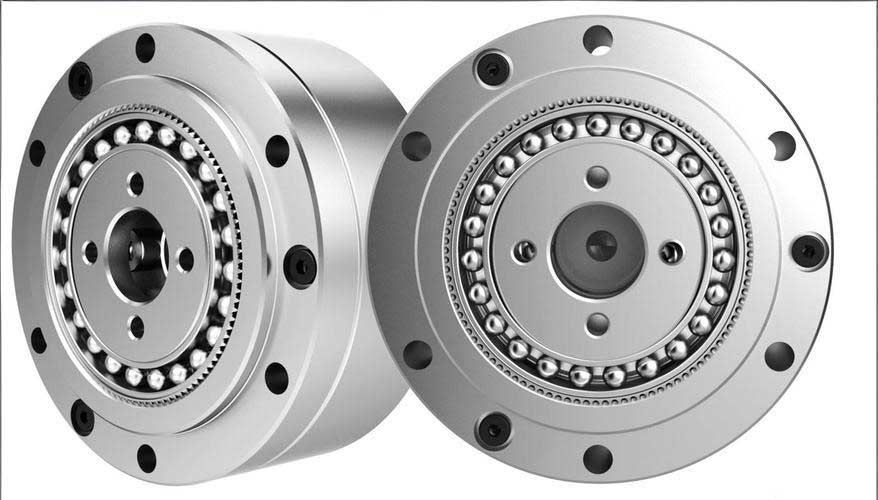
In the field of precision gear transmission, the strain wave gear, also known as harmonic drive, has garnered significant attention due to its high reduction ratio, compact size, and zero-backlash characteristics. With increasing demands from robotics and aerospace applications for lighter and more compact systems, there is a pressing need to develop strain wave gears with shorter axial dimensions. Traditional strain wave gears with standard flexspline length-to-diameter ratios face challenges when scaled down, particularly in terms of reduced meshing area and lower transmission stiffness. This article presents a comprehensive study on a novel design and manufacturing process for short flexspline strain wave gears, aiming to enhance transmission stiffness through innovative tooth profiles and advanced processing techniques. We explore the theoretical foundations, practical implementations, and experimental validations, with a focus on improving the performance of strain wave gear systems in high-precision applications.
The core of our approach lies in redesigning the tooth profiles of both the flexspline and circular spline. For the flexspline, we adopt a double-arc tooth profile, which has been proven to improve meshing performance in strain wave gears. The mathematical representation of this profile is given by the following equations for the upper and lower arcs, respectively:
$$ \vec{R_1} = (\rho_a \cos(\alpha_1) – l_a)\vec{i} + (\rho_a \sin(\alpha_1))\vec{j} $$
$$ \vec{R_2} = (l_f – \rho_f \cos(\alpha_2))\vec{i} + (\rho_f \sin(\alpha_2) + b_f)\vec{j} $$
Here, $\rho_a$ and $\rho_f$ represent the radii of the upper and lower arcs, while $l_a$, $l_f$, and $b_f$ are geometric parameters defining the tooth shape. This double-arc design facilitates better load distribution and reduces stress concentrations, which is critical for the durability of strain wave gear components. For the circular spline, we derive a conjugate tooth profile using the envelope method, which ensures optimal meshing with the flexspline under deformation. The coordinate transformation from the flexspline to the circular spline system is expressed as:
$$ M_{gr} = \begin{bmatrix} \cos \varphi_{12} & \sin \varphi_{12} & \rho \sin \gamma \\ -\sin \varphi_{12} & \cos \varphi_{12} & \rho \cos \gamma \\ 0 & 0 & 1 \end{bmatrix} $$
where $\varphi_{12}$ is the angle between the flexspline and circular spline axes, $\rho$ is the polar radius of the deformation curve, and $\gamma$ is the angle difference between the rotations. The envelope condition for generating the circular spline tooth profile is given by:
$$ \frac{\partial x_{gr}}{\partial t} \cdot \frac{\partial y_{gr}}{\partial \varphi} – \frac{\partial x_{gr}}{\partial \varphi} \cdot \frac{\partial y_{gr}}{\partial t} = 0 $$
This equation is solved numerically to obtain the precise tooth coordinates, ensuring high accuracy in meshing. To address the reduced contact area in short flexspline strain wave gears, we introduce an axial inclination angle to the circular spline teeth. This tilt increases the effective meshing area, thereby enhancing load capacity and stiffness. The inclination angle $\alpha$ is optimized through finite element analysis, with values such as $0.1^\circ$, $0.2^\circ$, and $0.3^\circ$ evaluated based on contact stress and area. Our analysis indicates that an inclination of $0.2^\circ$ provides the best balance, significantly improving meshing performance without compromising structural integrity.
The manufacturing process for these advanced strain wave gear components relies on high-precision Wire Electrical Discharge Machining with Low Speed (WEDM-LS). This method allows for the accurate fabrication of both flexspline and circular spline teeth, overcoming limitations associated with traditional gear cutting tools, especially for small module gears below 0.25 mm. For the flexspline, we designed a specialized fixture that enables continuous cutting of the external teeth without interrupting the process. The fixture includes a base, a mandrel, and a reference plate, ensuring precise alignment and rotation during machining. The circular spline teeth are cut with the desired inclination using the WEDM-LS machine’s taper cutting capability, which adjusts the wire path based on upper and lower surface coordinates. This process ensures that the tilted teeth are produced with high dimensional accuracy, critical for maintaining the performance of the strain wave gear system.
To validate our design, we developed prototypes of short flexspline strain wave gears with length-to-diameter ratios of 1/4 and 1/2, based on a 50-size model. The key design parameters are summarized in the following table:
| Parameter | Value | Description |
|---|---|---|
| Transmission Ratio (i) | 100 | Reduction ratio of the strain wave gear |
| Number of Waves (u) | 2 | Double-wave configuration for the strain wave gear |
| Module (m) | 0.25 mm | Tooth module for both flexspline and circular spline |
| Flexspline Teeth (Z_r) | 200 | Number of teeth on the flexspline |
| Circular Spline Teeth (Z_g) | 202 | Number of teeth on the circular spline |
| Flexspline Material | 30CrMnSiA | Alloy steel with high strength and fatigue resistance |
| Circular Spline Material | 45 Steel | Carbon steel for durability and machinability |
The material properties for these components are critical for withstanding the cyclic stresses in strain wave gear applications. The table below details the mechanical characteristics after heat treatment:
| Material | Hardness (HRC) | Tensile Strength (σ_b, MPa) | Yield Strength (σ_s, MPa) | Fatigue Limit (σ_{-1}, MPa) |
|---|---|---|---|---|
| 30CrMnSiA | 55 | 1800 | 1600 | 670 |
| 45 Steel | 30-36 | 700 | 500 | 340 |
Finite element analysis was conducted to optimize the inclination angle of the circular spline teeth. By simulating the meshing contact under load, we evaluated the contact area percentage and stress distribution. The results for different inclination angles are presented in the following table, demonstrating the improvement in meshing performance:
| Circular Spline Tooth Inclination | Contact Area Percentage (%) | Number of Meshing Tooth Pairs |
|---|---|---|
| No Inclination (0°) | 12.60 | 30 |
| 0.1° | 13.71 | 30 |
| 0.2° | 17.03 | 30 |
| 0.3° | 12.93 | 30 |
The analysis shows that an inclination of $0.2^\circ$ increases the contact area by approximately 35.1% compared to the non-inclined design, which is expected to enhance the transmission stiffness of the strain wave gear. This optimization is crucial for ensuring that the short flexspline strain wave gear can handle higher loads without premature failure.
For experimental validation, we focused on transmission stiffness testing of the prototypes. The setup consisted of a DC servo motor connected to the strain wave gear input shaft via a rigid coupling, with the output shaft locked using a clamping device. The motor operated in torque control mode, allowing direct measurement of input torque $T_1$ through current readings, while the input rotation angle was captured via an encoder. The output torque and angle were derived from these measurements, and the torque-angle curves were plotted to assess stiffness. The transmission stiffness coefficient $C$ is defined as:
$$ C = \frac{dT}{d\phi} $$
where $T$ is the output torque in N·m and $\phi$ is the output rotation angle in degrees. The testing involved cyclic loading and unloading up to the rated torque of 28 N·m, with multiple repetitions to ensure consistency. The results for the prototype with a $0.2^\circ$ inclination angle are summarized in the table below, comparing it to a non-inclined design:
| Circular Spline Tooth Inclination | Transmission Stiffness Phase 1 (N·m/°) | Transmission Stiffness Phase 2 (N·m/°) | Overall Improvement |
|---|---|---|---|
| 0.2° | 98.72 | 182.78 | Significant increase |
| No Inclination | 55.64 | 131.48 | Baseline |
The torque-angle curves exhibit hysteresis loops typical of strain wave gears, due to factors like tooth clearance and elastic deformation. However, the inclined tooth design shows a steeper slope, indicating higher stiffness. Specifically, the transmission stiffness increased by 77.4% in the first phase and 39.01% in the second phase compared to the non-inclined design. This demonstrates that our novel approach effectively addresses the stiffness limitations of short flexspline strain wave gears. The enhanced performance can be attributed to the increased meshing area and optimized tooth contact, which distribute loads more evenly and reduce deflection.
In conclusion, this study presents a comprehensive framework for designing and manufacturing short flexspline strain wave gears with improved transmission stiffness. By combining double-arc tooth profiles for the flexspline and inclined conjugate teeth for the circular spline, we have developed a strain wave gear system that offers superior performance in compact applications. The use of WEDM-LS processing ensures high precision and repeatability, overcoming traditional manufacturing constraints. Experimental results confirm that the proposed design increases stiffness by over 39%, making it suitable for demanding fields like robotics and aerospace. Future work may explore further optimization of tooth profiles, material advancements, and dynamic testing to fully characterize the strain wave gear behavior under operational conditions. The innovations detailed here contribute to the ongoing evolution of strain wave gear technology, enabling more efficient and reliable power transmission systems.