
As a mechanical design engineer specializing in power transmission systems, I have witnessed the evolution of various gearing technologies. Among them, the strain wave gear, often referred to as harmonic drive, represents a paradigm shift from traditional rigid-body mechanisms to systems utilizing controlled elastic deformation. Initially developed in the mid-20th century for aerospace and defense applications, this technology has progressively permeated numerous industrial sectors, including robotics, machine tools, and notably, valve actuation. Its unique operating principle and exceptional performance characteristics offer compelling advantages for applications demanding compactness, high reduction ratios, and precision. In this comprehensive analysis, I will delve into the working principle, inherent advantages and limitations, design mathematics, and its particularly successful implementation in electric valve actuators.
1. Fundamental Operating Principle
The core functionality of a strain wave gear hinges on the controlled elastic deflection of a flexible component. The assembly consists of three primary elements:
- Wave Generator (WG): This is the input component, typically comprising an elliptical cam surrounded by a special thin-walled flexible ball bearing. Its rotation induces a controlled wave-like deformation.
- Flexspline (FS): This is the thin-walled, flexible cylindrical cup with external teeth machined near its open end. It is the compliant member that undergoes elastic deformation.
- Circular Spline (CS): This is the rigid, non-deforming ring with internal teeth. It has a slightly different number of teeth compared to the Flexspline.
The fundamental kinematic relationship is defined by the tooth difference between the Circular Spline and the Flexspline. For the most common configuration, the Flexspline has fewer teeth than the Circular Spline. The standard kinematic arrangement involves fixing the Circular Spline, driving the Wave Generator, and taking the output from the Flexspline, resulting in a high-ratio speed reduction.
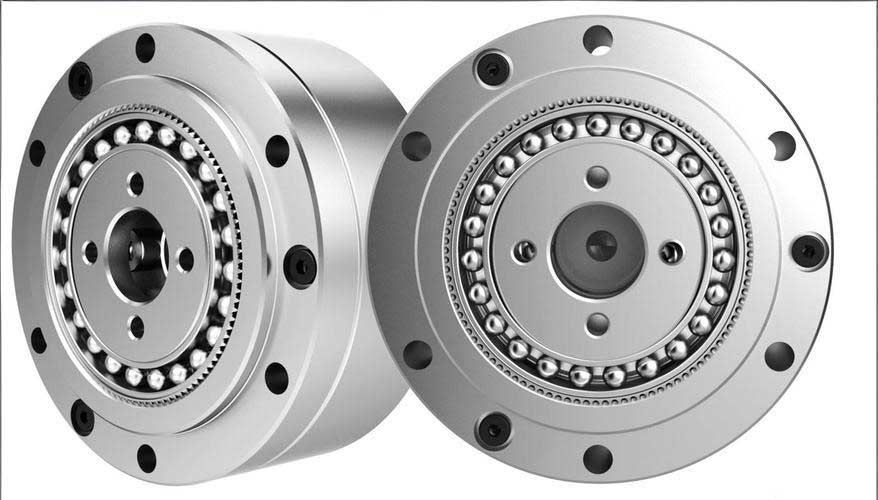
As the elliptical Wave Generator rotates, it forces the Flexspline to conform to its shape. This deformation causes the external teeth of the Flexspline to engage with the internal teeth of the Circular Spline at two diametrically opposite regions along the major axis of the ellipse. At the minor axis, the teeth are completely disengaged. In the quadrants between the major and minor axes, the teeth are in states of meshing-in or meshing-out. With continuous rotation of the Wave Generator, these engagement zones travel circumferentially.
The key to motion reduction lies in the tooth count difference. If the Circular Spline is fixed, for every 360-degree rotation of the Wave Generator, the traveling wave of engagement causes the Flexspline to rotate relative to the Circular Spline by an angular distance corresponding to the difference in their number of teeth, but in the opposite direction. The standard reduction ratio, i, for this configuration is given by:
$$ i = -\frac{N_{FS}}{N_{CS} – N_{FS}} $$
where \( N_{CS} \) is the number of teeth on the Circular Spline and \( N_{FS} \) is the number of teeth on the Flexspline. The negative sign indicates reversal of direction. Typically, \( N_{CS} – N_{FS} = 2 \) for a “single-wave” generator, leading to a large reduction ratio from a simple, single-stage gear set. For instance, if \( N_{CS} = 202 \) and \( N_{FS} = 200 \), the reduction ratio is \( i = -100 \).
2. Characteristics of Strain Wave Gearing
The unique operational modality of the strain wave gear confers a distinctive set of advantages and some specific challenges compared to conventional gear systems like planetary or spur gear trains.
2.1 Primary Advantages
The benefits of strain wave gear systems are multifaceted, impacting size, performance, and capability.
- High Reduction Ratio in a Single Stage: As derived from the fundamental formula, a single-stage strain wave gear can achieve reduction ratios typically ranging from 50:1 to over 300:1, which would require multiple stages of conventional gearing.
- Exceptional Compactness and Light Weight: Due to its simple three-component structure and high single-stage ratio, a strain wave gear reducer can be 1/3 the volume and weight of a conventional reducer of equivalent torque and ratio.
- High Torque Capacity and Precision: A significant portion of the teeth are in simultaneous contact (often 20-30% in a two-wave system). This multi-tooth, area-contact engagement distributes load, reduces tooth stress, minimizes backlash, and yields high positional accuracy and torsional stiffness. The inherent averaging effect of multiple engaged teeth also leads to transmission accuracy superior to the manufacturing precision of individual components.
- Coaxial Input and Output Shafts: The arrangement naturally allows the input (Wave Generator) and output (Flexspline) shafts to be concentric, simplifying mechanical design and packaging.
- High Efficiency: The relative sliding velocity between meshing teeth is very low, and the motion is primarily rolling. This results in high transmission efficiency, often exceeding 80-90% per stage, with lower friction losses.
- Sealed Motion Transfer: The Flexspline can act as a hermetic seal. This enables the unique capability to transmit motion through a sealed barrier, making strain wave gears ideal for driving valves in vacuum, pressure, or corrosive environments without dynamic seals on the output shaft.
- Operational Smoothness and Quietness: Teeth engage and disengage gradually and continuously, ensuring smooth, low-vibration, and quiet operation.
2.2 Limitations and Design Challenges
Despite its advantages, the technology presents specific engineering challenges that must be addressed in design and application.
- Material Fatigue of the Flexspline: The Flexspline undergoes cyclic elastic deformation, which subjects it to high-cycle fatigue stresses. Its design, material selection (typically high-strength alloy steels like 35NCD16 or similar), heat treatment, and precise manufacturing are critical to achieving long service life.
- Limited Minimum Reduction Ratio: The kinematics constrain the minimum achievable single-stage ratio (typically > ~30:1). Lower ratios require more exotic and less efficient designs.
- Manufacturing Complexity: Producing high-precision, thin-walled Flexsplines with accurate tooth geometry and the specialized Wave Generator bearings requires advanced manufacturing techniques and quality control, impacting initial cost.
- Non-Linear Effects: At very low temperatures, the flexibility of the Flexspline can decrease. There is also a non-linear relationship between input torque and angular deflection (torsional compliance) which must be considered in high-precision servo applications.
- Zero-Torque Backlash (Wind-up): While kinematic backlash is very low, the system exhibits elastic wind-up under load, which is recoverable when the load is removed but must be distinguished from permanent backlash.
| Feature | Strain Wave Gear | Conventional Planetary Gear |
|---|---|---|
| Single-Stage Ratio Range | 50:1 to 320:1 | 3:1 to 12:1 |
| Simultaneous Tooth Contact | ~20-30% of teeth | 3-7 teeth (depends on planets) |
| Typical Efficiency | 80% – 92% | 85% – 97% (per stage) |
| Backlash | Very low, often < 1 arcmin | Low to moderate, 3-10 arcmin |
| Weight/Size for given Torque | Low / Compact | Higher / Larger |
| Axial Arrangement | Coaxial | Coaxial |
| Key Limitation | Flexspline fatigue life | Bearing life, gear mesh forces |
3. Design Parameters and Mathematical Modeling
The engineering of a reliable strain wave gear system involves precise calculations. Key design equations govern its performance.
Number of Teeth and Ratio: As established, the basic ratio is:
$$ i = \frac{N_{FS}}{N_{CS} – N_{FS}} \quad \text{(CS fixed, WG input, FS output)} $$
Alternative configurations exist, such as fixing the Flexspline and taking output from the Circular Spline, yielding a different ratio:
$$ i’ = \frac{N_{CS}}{N_{CS} – N_{FS}} $$
Gear Module and Diameter: The module m is chosen based on torque requirements. The pitch diameter of the Circular Spline \( D_{CS} \) is:
$$ D_{CS} = m \cdot N_{CS} $$
The nominal diameter of the undeformed Flexspline is slightly smaller to ensure proper mesh preload after deformation.
Torque Capacity: The torque rating is determined by the tooth surface durability (pitting resistance) and the root bending strength of the Flexspline teeth. A simplified view for nominal torque \( T \) relates to the tangential force \( F_t \) per tooth and the number of teeth in contact \( z_c \):
$$ T \approx \frac{F_t \cdot z_c \cdot D_{CS}}{2} $$
Where \( z_c \approx (N_{FS}/\pi) \cdot \cos^{-1}(\frac{D_{CS} – 2\delta}{D_{CS}}) \), and \( \delta \) is the radial deformation induced by the Wave Generator.
Efficiency Estimation: The total efficiency \( \eta \) accounts for several loss components:
$$ \eta = \eta_{mesh} \cdot \eta_{bearing} \cdot \eta_{seal} \cdot \eta_{windage} $$
Mesh efficiency \( \eta_{mesh} \) is high (>0.99 per engagement cycle) due to predominately rolling contact. The major loss is often in the Wave Generator bearing.
4. Application in Electric Valve Actuators
The transition of strain wave gear technology into industrial valve actuators is a logical progression, addressing specific needs in flow control systems.
4.1 Why Strain Wave Gears are Suitable for Valve Actuation
Electric valve actuators require a compact, reliable reduction mechanism to convert the high-speed, low-torque output of a standard AC or DC motor into the low-speed, high-torque motion needed to operate a valve stem. Traditional solutions often use multi-stage spur gears or worm gears. Strain wave gears offer a superior alternative for small to medium torque ranges (e.g., up to 1000 Nm):
- Space Constraint: Valve actuators, especially for inline valves, benefit from a compact, cylindrical form factor. The coaxial design of a strain wave gear fits perfectly.
- High Reduction, Single Stage: Achieves the necessary output speed (typically 10-24 rpm) directly from a standard 2-pole or 4-pole motor (1500-3000 rpm) in one compact stage.
- High Efficiency: Reduces the required motor input power significantly compared to inefficient worm gear drives, leading to energy savings and allowing the use of smaller, cooler-running motors.
- Low Backlash & Smooth Operation: Provides precise valve positioning and minimizes hammering on valve seats, enhancing control and component life.
- Sealing Potential: The Flexspline can be integrated into the pressure boundary for specialized sealed actuators.
- Quiet Operation: An important factor for installations in noise-sensitive environments like ships or buildings.
4.2 Structural Integration in an Actuator
Integrating a strain wave gear into a valve actuator involves thoughtful mechanical design. A typical architecture for a compact, flanged actuator is as follows:
- Motor: Directly coupled to the input shaft, which drives the Wave Generator.
- Wave Generator Assembly: Housed within the central cavity of the actuator.
- Circular Spline (Fixed): This component is rigidly mounted to the actuator’s main housing or, in an innovative design, locked via a secondary self-locking worm gear set. This allows the strain wave gear to handle the main torque transmission while the worm set provides a failsafe mechanical lock in the event of power loss, preventing back-driving.
- Flexspline (Output): The output flange of the actuator is directly attached to the Flexspline. As the Wave Generator spins, the Flexspline rotates slowly, driving the valve stem through this output flange.
- Control Module: Mounted separately but connected to the motor, providing torque, limit, and position control signals.
This configuration results in an extremely simple and short power train: Motor → Wave Generator → (Kinematic Conversion) → Flexspline/Output Flange. The absence of intermediate shafts and multiple gear stages enhances reliability and reduces parts count.
4.3 Design Example and Performance Analysis
Consider a design requirement for an explosion-proof valve actuator with an output torque of 50 Nm and an output speed of 11 rpm, powered by a standard 4-pole AC motor (~1450 rpm).
Step 1: Ratio Calculation. Required reduction ratio:
$$ i_{req} = \frac{1450 \text{ rpm}}{11 \text{ rpm}} \approx 132 $$
We select a standard strain wave gear set with \( N_{CS} = 202 \), \( N_{FS} = 200 \). The theoretical ratio is:
$$ i = \frac{200}{202-200} = 100 $$
This is slightly low. We can either use a slightly slower motor or opt for a “compound” or “dual-wave” configuration. Alternatively, a small pre-stage planetary gear (e.g., 4:1) combined with a 100:1 strain wave gear gives the required 400:1 total ratio. For true single-stage, a set with \( N_{CS} = 264 \), \( N_{FS} = 262 \) gives i = 131.
Step 2: Motor Sizing. Assuming a strain wave gear efficiency of \( \eta_{SWG} = 0.85 \) and any pre-stage efficiency \( \eta_{pre} = 0.95 \), the required motor output torque is:
$$ T_{motor} = \frac{T_{output}}{i_{total} \cdot \eta_{total}} = \frac{50 \text{ Nm}}{132 \cdot (0.85 \cdot 0.95)} \approx 0.47 \text{ Nm} $$
The motor power is:
$$ P_{motor} = \frac{2\pi \cdot n_{motor} \cdot T_{motor}}{60} = \frac{2\pi \cdot 1450 \cdot 0.47}{60} \approx 71 \text{ W} $$
A 90W or 120W motor provides a sufficient safety margin. In contrast, a traditional worm gear actuator with a mesh efficiency of perhaps 40-50% would require a motor nearly twice this power.
Step 3: Actuator Benefits. The resulting actuator is remarkably compact. The main housing essentially contains only the motor stator/rotor, the compact strain wave gear assembly, and the locking mechanism. The significant reduction in required motor power also simplifies the design of the explosion-proof encapsulation for the motor and control compartment, as less heat is generated internally.
| Parameter | Strain Wave Gear Actuator | Traditional Worm Gear Actuator |
|---|---|---|
| Estimated Volume | Base Reference (1.0x) | 1.5x – 2.0x |
| Estimated Weight | Base Reference (1.0x) | 1.3x – 1.8x |
| Required Motor Power | ~90-120 W | ~180-250 W |
| Noise Level | Low (<65 dB(A)) | Moderate to High |
| Backlash | < 10 arcmin | 15 – 45 arcmin |
| Primary Wear Components | Flexspline (fatigue life), WG bearing | Worm/wheel teeth, bronze wheel |
5. Broader Industrial Applications and Future Outlook
The success in valve actuators is just one example. The strain wave gear excels in any application requiring high-ratio, compact, and precise motion control.
- Robotics: Ubiquitous in robot joints (articulated arms, collaborative robots) due to compact size, zero-backlash, and high torque density.
- Aerospace: Satellite antenna drives, solar array deployment mechanisms, and telescope focus drives leverage its precision, reliability, and sealed capabilities.
- Machine Tools: Used in rotary tables and indexing heads for high-precision angular positioning.
- Medical Equipment: Found in MRI-guided surgical robots and precise dosing pumps where non-magnetic materials and compactness are critical.
The future development of strain wave gear technology focuses on:
- Advanced Materials: Research into carbon-fiber reinforced composites or high-performance alloys to extend Flexspline life and reduce weight further.
- Manufacturing Innovation: Wider adoption of net-shape forming (powder metallurgy, precision forging) and advanced grinding techniques to reduce cost and improve consistency.
- Integrated Design: Moving towards mechatronic modules where the strain wave gear, motor, encoder, and controller are designed as a single optimized unit (e.g., “ActuatorPack”).
- Modeling and Simulation: Enhanced finite element analysis (FEA) and multi-body dynamics models to better predict fatigue life, thermal behavior, and non-linear stiffness under complex loading.
In conclusion, the strain wave gear stands as a testament to innovative engineering, transforming a potential weakness—elastic deformation—into a powerful kinematic advantage. Its principles are elegant, its benefits are substantial, and its application in fields like valve actuation demonstrates a clear path toward more efficient, compact, and high-performance mechanical systems. As manufacturing techniques advance and design understanding deepens, the strain wave gear is poised to become an even more commonplace and essential component in the designer’s toolkit, pushing the boundaries of what is possible in precision motion transmission.