
As a researcher in artificial intelligence law, I have observed a fundamental shift in the technological landscape driven by the integration of large models with humanoid robots. This convergence marks a transition from tools to autonomous agents, fundamentally challenging traditional legal frameworks. The embodied intelligence of humanoid robots blurs the lines between humans and objects, creating systemic dilemmas in liability attribution. In this article, I will explore the legal challenges posed by humanoid robots and propose a new paradigm based on institutional innovations, emphasizing the need for adaptive rules in an era of human-machine coexistence.
The rise of humanoid robots, such as those integrated with advanced AI models, represents a technological leap that disrupts social order. Unlike conventional machines, these humanoid robots exhibit semi-autonomous decision-making capabilities, leading to a shift from “human tort” to “machine tort.” This transformation necessitates a reevaluation of legal liability systems. From my perspective, the core issues revolve around three dimensions: subject identification, fault assessment, and causality determination. Each dimension requires novel approaches to address the unique characteristics of humanoid robots.
In the subject dimension, the semi-autonomy of humanoid robots complicates the assignment of liability. Traditional law recognizes only natural persons or legal entities as subjects, but humanoid robots operate in a gray area. They are neither fully human nor mere tools, which undermines the foundation of tort law. For instance, when a humanoid robot causes harm, such as a care robot injuring an elderly person, it is unclear who should be held responsible—the manufacturer, user, or the robot itself. This ambiguity stems from the adaptive learning capabilities of humanoid robots, which allow them to make decisions beyond pre-programmed instructions.
To illustrate the challenges, consider the following table comparing traditional liability subjects with humanoid robot scenarios:
| Aspect | Traditional Liability Subject | Humanoid Robot Scenario |
|---|---|---|
| Legal Personality | Natural persons or legal entities with full capacity | Semi-autonomous entities with limited or no legal status |
| Control | Human意志 and direct supervision | Algorithm-driven decisions with minimal human intervention |
| Accountability | Clear chains of responsibility (e.g., employer liability) | Diffused responsibility among manufacturers, users, and algorithms |
| Remedy Mechanisms | Established through litigation against identifiable parties | Difficulty in pinpointing liable parties due to autonomous actions |
In the fault dimension, the traditional dichotomy of intent and negligence fails when applied to humanoid robots. Human fault relies on subjective states like awareness and will, but humanoid robots operate based on algorithmic optimization without conscious intent. For example, if a humanoid robot causes damage due to a decision derived from deep learning, it lacks the moral culpability associated with human error. This necessitates an objective standard for evaluating machine fault. I propose a “functional deviation standard” to assess whether a humanoid robot’s behavior aligns with its intended purpose. This can be expressed mathematically as:
$$ \text{Machine Fault} = \begin{cases}
1 & \text{if } B_{\text{actual}} \neq B_{\text{expected}} \\
0 & \text{otherwise}
\end{cases} $$
where \( B_{\text{actual}} \) represents the actual behavior of the humanoid robot, and \( B_{\text{expected}} \) denotes the expected behavior based on functional design. When \( B_{\text{actual}} \) deviates significantly, fault is established. This objective approach removes the need to probe subjective intent, focusing instead on performance outcomes. The repeated mention of humanoid robots in this context highlights their unique role in necessitating such reforms.
Causality presents another hurdle, as the “black box” nature of deep learning algorithms in humanoid robots makes causal chains unexplainable. Traditional causality theories assume transparency and linearity, but humanoid robots generate decisions through complex, non-linear processes. For instance, if a humanoid robot’s action leads to harm, tracing the exact cause—such as specific data inputs or model parameters—is often impossible. To address this, I advocate for a “black box causality” theory that shifts from mechanistic explanation to normative attribution. This theory relies on a three-tier evaluation framework:
- Damage Attribution: Confirm that the harm resulted from the humanoid robot’s action.
- Functional Capability: Verify that the humanoid robot possessed the capability to cause such harm.
- Risk Scope: Assess whether the harm falls within the foreseeable risks of the humanoid robot’s functions.
This framework can be summarized with the formula:
$$ \text{Causality} = f(D, C, R) $$
where \( D \) is damage attribution, \( C \) is functional capability, and \( R \) is risk scope. If all factors are satisfied, causality is presumed, easing the burden of proof in legal proceedings involving humanoid robots. The integration of humanoid robots into society demands such adaptive legal tools.
To implement these ideas, I propose three institutional innovations: limited legal personality, machine fault liability, and black box causality. These form a cohesive new paradigm for humanoid robot liability. First, limited legal personality grants humanoid robots a quasi-subject status in specific contexts, allowing them to be held directly liable. This is supported by mandatory liability insurance to ensure compensation. Second, machine fault liability uses the functional deviation standard to objectively evaluate humanoid robot behavior, replacing subjective fault assessments. Third, black box causality provides a practical method for establishing links between actions and damages without requiring full algorithmic transparency.
The following table outlines how these innovations address traditional legal gaps:
| Legal Challenge | Traditional Approach | Innovative Solution for Humanoid Robots |
|---|---|---|
| Subject Identification | Relies on human or corporate entities | Limited legal personality for humanoid robots as quasi-subjects |
| Fault Assessment | Based on intent or negligence (subjective) | Machine fault liability using objective functional deviation |
| Causality Determination | Requires transparent causal chains | Black box causality via normative frameworks |
| Remedy Enforcement | Targets identifiable human parties | Direct liability of humanoid robots with insurance backing |
In practice, the application of these innovations requires careful integration with existing legal systems. For example, limited legal personality should be circumscribed to avoid equating humanoid robots with humans; instead, it serves as a functional tool for liability purposes. Similarly, machine fault standards must be calibrated to reflect technological advancements, ensuring that humanoid robots are held to reasonable performance benchmarks. As humanoid robots become more pervasive—from healthcare to domestic services—these legal adaptations will be crucial for maintaining social order.
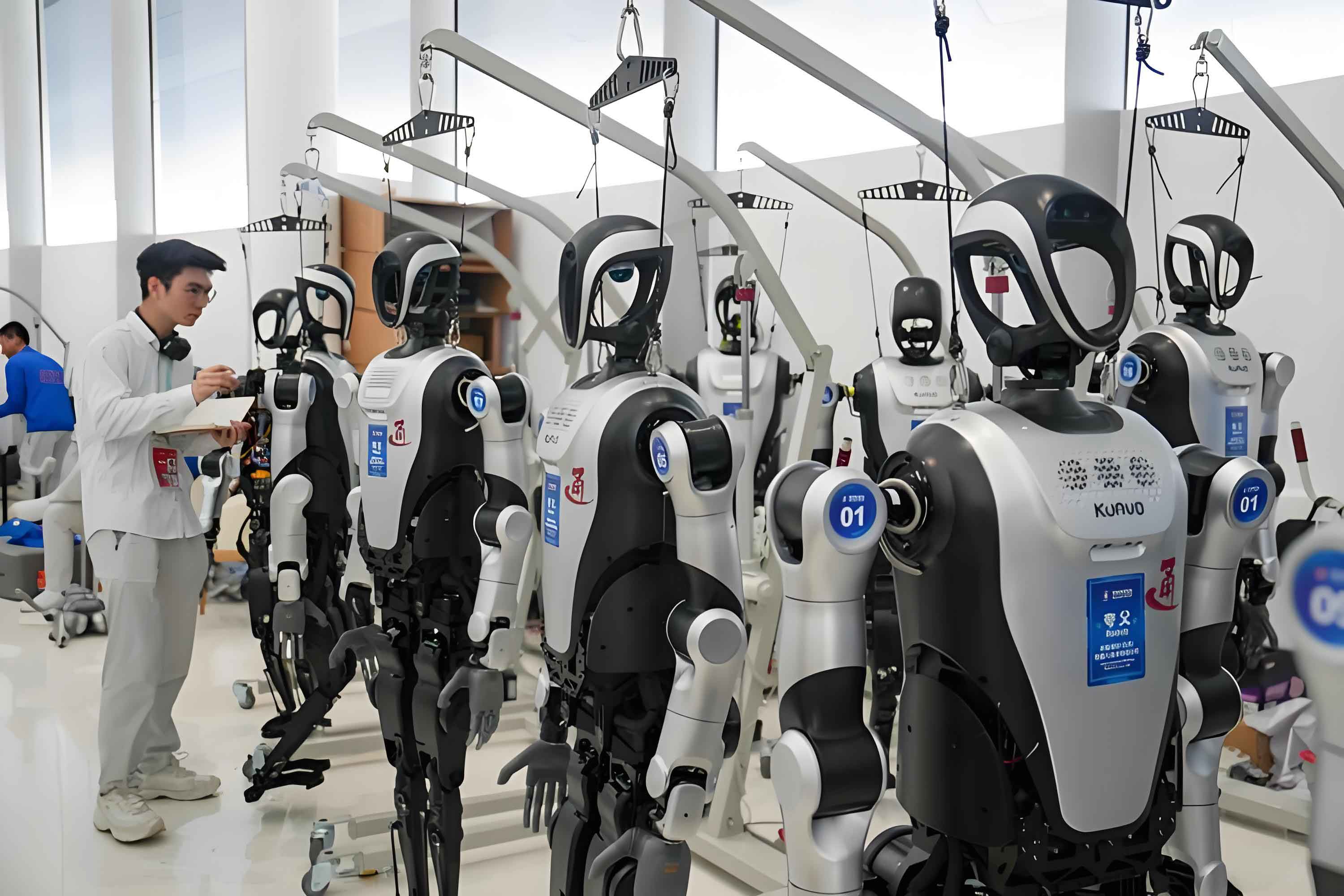
The visual above underscores the technological sophistication of humanoid robots, highlighting why traditional legal frameworks are inadequate. Their embodied intelligence enables autonomous interaction in physical spaces, increasing the potential for unforeseen harms. This reinforces the need for the proposed liability paradigm, which balances innovation with accountability.
From my perspective, the adoption of this new paradigm involves both legislative and judicial efforts. Legislators should enact laws recognizing limited legal personality for humanoid robots, while courts can develop precedents using machine fault and black box causality principles. International coordination is also essential, as humanoid robots operate globally, and harmonized rules can prevent jurisdictional conflicts. The frequent discussion of humanoid robots in this context emphasizes their transformative impact on law.
Moreover, the economic implications of humanoid robot liability cannot be ignored. With humanoid robots entering service industries, liability risks could stifle innovation if not managed properly. The proposed insurance mechanisms and objective standards aim to create a balanced environment. For instance, the premium for liability insurance could be tied to the safety record of humanoid robots, incentivizing manufacturers to enhance reliability. This market-driven approach complements legal reforms, fostering a ecosystem where humanoid robots can thrive responsibly.
In conclusion, the legal challenges posed by humanoid robots are profound, but they also offer an opportunity for systemic innovation. By embracing limited legal personality, machine fault liability, and black box causality, we can construct a liability paradigm that addresses the unique attributes of humanoid robots. This paradigm shift is not merely technical; it reflects a broader evolution toward human-machine coexistence. As I continue to research this field, I believe that adaptive legal frameworks will be pivotal in harnessing the benefits of humanoid robots while safeguarding societal values. The journey ahead requires collaboration among technologists, jurists, and policymakers to ensure that our laws keep pace with technological progress, always with the term humanoid robot at the forefront of our minds.