
In this study, we address the challenges of automated harvesting for Korla fragrant pears, a specialty fruit known for its crisp and thin skin, which makes it prone to mechanical damage during manual picking. The goal is to develop an end effector that integrates gripping and twisting motions with controlled pressure to minimize fruit injury and enhance harvesting efficiency. The end effector design is based on a thorough analysis of the pear’s physical and mechanical properties, incorporating feedback mechanisms for precise control. This article presents the design principles, mechanical analysis, control system, and experimental results of the end effector, highlighting its performance in real orchard conditions.
Korla fragrant pears are highly valued for their unique texture and flavor, but their delicate nature complicates mechanical harvesting. Traditional methods rely on manual labor, which is time-consuming and costly. Recent advancements in agricultural robotics have led to various fruit-harvesting end effectors, yet few cater to fruits with such fragility. Our work focuses on creating an end effector that combines gripping and twisting actions, with pressure control to adapt to the pear’s characteristics. The end effector is designed to handle pears from the calyx end, using a three-fingered mechanism for enveloping grip and a rotary component for stem detachment. Through iterative testing, we optimize parameters to achieve high success rates and low damage.
The physical characteristics of Korla fragrant pears are crucial for designing an effective end effector. We measured geometric properties such as mass, vertical axis diameter, horizontal axis diameter, and the distance from the horizontal diameter to the calyx end. These parameters influence the gripping position and force distribution. For instance, the gripping point is typically located at approximately 0.6 times the vertical axis diameter from the calyx end. A summary of the geometric properties is presented in Table 1, based on measurements from sample pears categorized into different grades. This data guides the dimensions of the end effector components to ensure compatibility with various pear sizes.
| Grade | Mass (g) | Vertical Axis Diameter (mm) | Horizontal Axis Diameter (mm) | Distance to Calyx End (mm) | Ratio (Distance/Diameter) |
|---|---|---|---|---|---|
| Premium | 134.56 | 66.84 | 61.57 | 27.63 | 0.41 |
| First | 109.04 | 62.34 | 57.52 | 25.47 | 0.41 |
| Second | 98.13 | 58.17 | 55.34 | 23.26 | 0.40 |
Additionally, the angle between the gripping position and the pear’s vertical axis, denoted as α, was measured. Statistical analysis shows an average α of 18.55°, with low variability, indicating consistent pear shape. This angle affects the force distribution during gripping, as the normal force from the end effector fingers has both horizontal and vertical components. Assuming a circular cross-section for simplification, the gripping force FP can be decomposed as follows: $$ F_{Ph} = F_P \cdot \sin \alpha $$ $$ F_{Pv} = F_P \cdot \cos \alpha $$ where FPh and FPv are the horizontal and vertical components, respectively. These equations inform the design of the gripping mechanism to prevent slippage and excessive pressure.
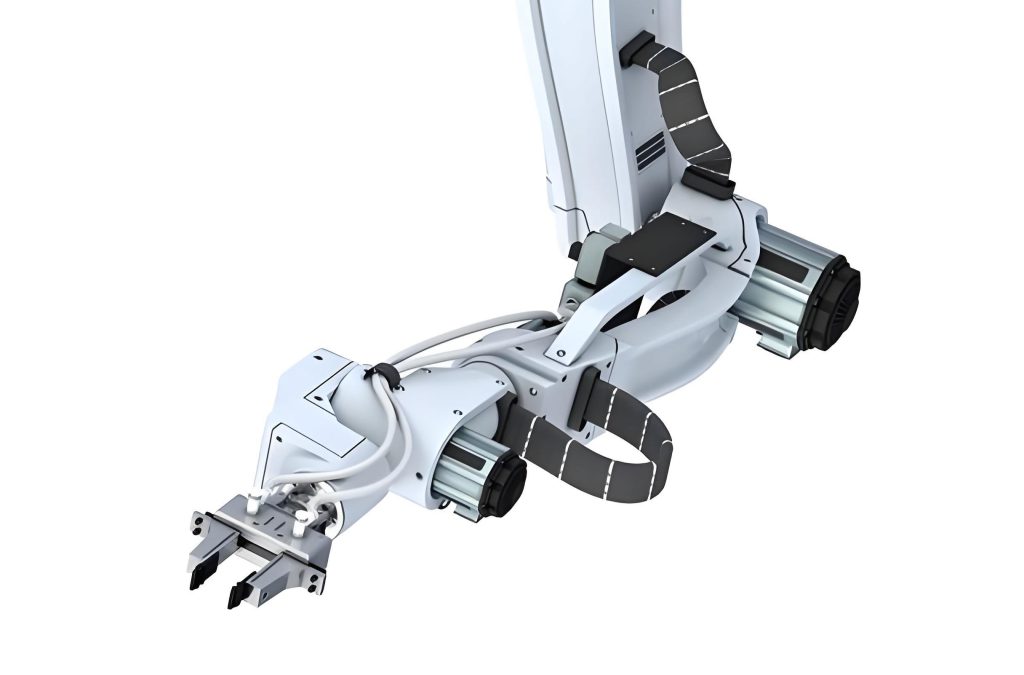
The end effector is composed of several key units: a gripping unit, a twisting unit, a pressure feedback unit, and a control unit. The gripping unit uses a lead screw mechanism driven by a stepper motor to actuate three fingers that pivot around a fixed axis. Each finger includes a sensor mount and a movable plate that adapts to the pear’s contour, with silicone padding to reduce damage and increase friction. The twisting unit employs a digital servo motor and a double-rocker mechanism to rotate the entire gripping assembly, thereby twisting the pear stem for detachment. The pressure feedback unit incorporates thin-film sensors to monitor gripping force, enabling real-time adjustments. The control unit, based on a microcontroller, coordinates the sequences for gripping, twisting, and release. This integrated design ensures that the end effector can handle pears gently and efficiently.
Mechanical analysis of the end effector involves modeling the forces during gripping and twisting. When the pear is gripped, three symmetric points of contact are established, each separated by 120° in projection. The forces at each point include the normal force FP from the finger and the support force FN from the base. For equilibrium in the vertical direction, we have: $$ \sum F_v = F_N – G – F_{Pv1} – F_{Pv2} – F_{Pv3} = 0 $$ where G is the pear’s weight, and FPv1, FPv2, FPv3 are the vertical components from each finger. To avoid damage, FN is limited to 50 N based on prior studies. For a pear mass of 140 g and α = 19°, each FP is approximately 17.1 N. This analysis helps set the pressure thresholds for the end effector.
During twisting, the friction force Ff between the silicone padding and the pear generates a torque Tf to detach the stem. The relationship is given by: $$ T_f = F_f \cdot R $$ where R is the radius at the gripping point. The maximum static friction depends on the coefficient of friction μ (0.4 to 0.6 for silicone) and FP: $$ F_{fmax} = \mu \cdot F_P $$ For FP = 17.1 N and μ = 0.4, Ffmax = 6.8 N, leading to a torque of 0.27 N·m per finger. The total torque required from the servo motor, considering three fingers, is at least 0.81 N·m. The servo motor selected provides 15 kg·cm (approximately 1.47 N·m), ensuring sufficient power for the end effector.
The stem detachment process involves torsional stress at the stem-fruit junction. The shear stress τ can be expressed as: $$ \tau = \frac{F_{fmax}}{W_P} $$ where WP is the torsional section modulus of the stem. Alternatively, τ relates to the shear modulus Ems and the twist angle γ: $$ \tau = E_{ms} \cdot \gamma $$ As pears ripen, WP and Ems decrease, reducing the required stress for detachment. Increasing γ enhances stress but prolongs the twisting time. Thus, optimizing the twist angle is critical for the end effector’s efficiency.
The control system of the end effector is designed to automate the harvesting sequence. It uses a microcontroller to manage the stepper motor for gripping and the servo motor for twisting. The flow involves: positioning the end effector at the pear’s calyx end, initiating gripping until the pressure sensor reaches a set threshold, activating twisting to detach the stem, moving to a deposit area, and releasing the pear by reversing the motors. To minimize cycle time, the release phase operates at twice the speed of the gripping and twisting phases. The pressure feedback ensures that the end effector applies just enough force to secure the pear without causing damage, a key feature for handling delicate fruits.
Experiments were conducted in an orchard to evaluate the end effector’s performance. The tests focused on optimizing gripping pressure and twist angle, with success rate, gripping-twisting time, and release time as metrics. For pressure optimization, thresholds from 4 N to 8.5 N were tested with a fixed twist angle of 150°. Results, summarized in Table 2, show that pressures at or above 7 N yielded 100% success without damage, confirming the robustness of the end effector. Lower pressures led to reduced success due to inadequate grip.
| Pressure (N) | Successful Picks | Damaged Pears |
|---|---|---|
| 4.0 | 9 | 0 |
| 4.5 | 18 | 0 |
| 5.0 | 26 | 0 |
| 5.5 | 34 | 0 |
| 6.0 | 38 | 0 |
| 6.5 | 40 | 0 |
| 7.0 | 50 | 0 |
| 7.5 | 50 | 0 |
| 8.0 | 50 | 0 |
| 8.5 | 50 | 0 |
For twist angle optimization, the pressure was fixed at 7 N, and angles from 40° to 100° were tested. The success rate peaked at 96% for 60°, indicating this as the optimal angle for the end effector. Variations in success were attributed to differences in pear ripeness and stem diameter, but 60° provided a reliable balance between effectiveness and speed. This optimization ensures that the end effector can efficiently detach pears across a range of conditions.
Performance testing involved harvesting 150 pears with the optimized parameters (7 N pressure, 60° twist angle). The gripping-twisting time t1 and release time t2 were recorded using a stopwatch. The results, shown in Table 3, demonstrate that the end effector achieves fast operation with an average t1 of 1.21 s and t2 of 0.69 s, leading to a total average cycle time of 1.90 s per pear. The success rate was 94.6%, with failures mainly occurring in less ripe pears where stems were tighter. These metrics highlight the end effector’s potential for high-speed, low-damage harvesting.
| Metric | Gripping-Twisting Time (s) | Release Time (s) | Total Time (s) |
|---|---|---|---|
| Average | 1.21 | 0.69 | 1.90 |
| Maximum | 1.75 | 0.91 | 2.66 |
| Minimum | 1.01 | 0.43 | 1.44 |
The design of the gripping mechanism in the end effector is based on kinematic principles. The fingers rotate around a fixed axis, driven by a lead screw and nut assembly. The relationship between the nut displacement and finger angle is derived from geometry. Let dh and dv be the horizontal and vertical distances from the pivot to the nut, and lc be the connecting rod length. For the open and closed states, we have: $$ d_h^2 + d_v^2 = l_c^2 $$ where dh and dv vary with the nut position. Solving for the nut travel range, we determined an effective lead screw stroke of 9 mm, which accommodates the finger rotation of 27° needed to grip pears from different grades. This kinematic analysis ensures that the end effector can adapt to size variations without complex adjustments.
The twisting mechanism uses a double-rocker linkage to convert the servo motor’s rotation into the gripping assembly’s twist. The torque transmission model considers the lengths of the driving and driven links, l1 and l2 + r, where r is an offset distance. The angular velocity is consistent across links, so the output torque TM relates to the friction torque Tf as: $$ T_M = 3T_f $$ given three fingers. With Tf = 0.27 N·m, TM = 0.81 N·m, which is within the servo motor’s capacity. This design allows the end effector to generate sufficient torque for stem detachment while maintaining compact dimensions.
Material selection for the end effector components is critical to minimize weight and wear. The fingers are made of lightweight aluminum alloy, while the contact surfaces are coated with silicone to enhance grip and protect the pears. The sensors are thin-film types that provide accurate force feedback without adding bulk. The control electronics are housed in a sealed box to withstand orchard environments. These choices contribute to the end effector’s durability and reliability in field conditions.
In terms of scalability, the end effector can be integrated into a robotic arm or a mobile platform for autonomous harvesting. The control system can be expanded to include vision sensors for fruit detection and positioning, further automating the process. The modular design allows for easy maintenance and part replacement, which is advantageous for commercial applications. By focusing on a specialized end effector for Korla fragrant pears, we provide a solution that can be adapted to other delicate fruits with similar characteristics.
The economic implications of this end effector are significant. Reducing reliance on manual labor can lower harvesting costs and increase efficiency. The high success rate and low damage potential help preserve fruit quality, leading to better market value. Future work could involve mass production and field trials in different orchards to validate the end effector’s performance under varied conditions. Additionally, integrating machine learning algorithms could optimize parameters in real-time based on fruit ripeness and environmental factors.
From a mechanical engineering perspective, the end effector exemplifies the application of kinematics and dynamics in agricultural robotics. The force analysis and control strategies demonstrate how theoretical models can be translated into practical designs. The use of pressure feedback exemplifies closed-loop control, which is essential for handling unpredictable natural objects like fruits. This approach can inspire similar innovations in other agricultural domains, such as vegetable harvesting or pruning.
In conclusion, the gripping pressure-controlled end effector developed in this study offers an effective solution for automated Korla fragrant pear harvesting. By combining gripping and twisting motions with real-time pressure feedback, the end effector achieves high success rates and minimal fruit damage. The optimized parameters of 7 N gripping pressure and 60° twist angle result in fast cycle times and reliable performance. This end effector serves as a foundational component for future harvesting robots, contributing to the advancement of precision agriculture. Further enhancements could include wireless communication, energy-efficient actuators, and advanced sensing technologies to make the end effector even more versatile and autonomous.