
In modern mechanical transmission systems, the strain wave gear, also known as harmonic drive, has gained widespread adoption due to its compact design, high reduction ratios, and exceptional torque capacity. As a researcher in mechanical engineering, I have focused on enhancing the design methodologies for these components by integrating reliability principles with advanced optimization techniques. Traditional design approaches often lead to over-engineered solutions with excessive weight and volume, while failing to account for uncertainties inherent in material properties, loading conditions, and manufacturing tolerances. To address this, I propose a comprehensive framework that combines reliability analysis, optimization algorithms, and sensitivity studies to achieve optimal strain wave gear designs that meet specific performance criteria with minimized mass and cost. This article delves into the development of reliability models for strain wave gears, their optimization using genetic algorithms, and the analysis of how design variables influence structural reliability, all from a first-person perspective as I explore these methodologies.
The core of a strain wave gear system consists of three primary components: the flexspline (a thin-walled flexible cup with external teeth), the circular spline (a rigid ring with internal teeth), and the wave generator (an elliptical cam that deforms the flexspline). This unique configuration allows for motion transmission through elastic deformation of the flexspline, resulting in advantages such as zero backlash, high precision, and compactness. However, the flexspline is susceptible to various failure modes, including tooth surface wear, buckling of the cylindrical shell under torque, and fatigue failure due to cyclic stresses. Ensuring reliability against these failures is paramount, especially in critical applications like aerospace, robotics, and medical devices. In my work, I consider these failure mechanisms and incorporate stochastic variables to model real-world uncertainties, thereby moving beyond deterministic design limits.
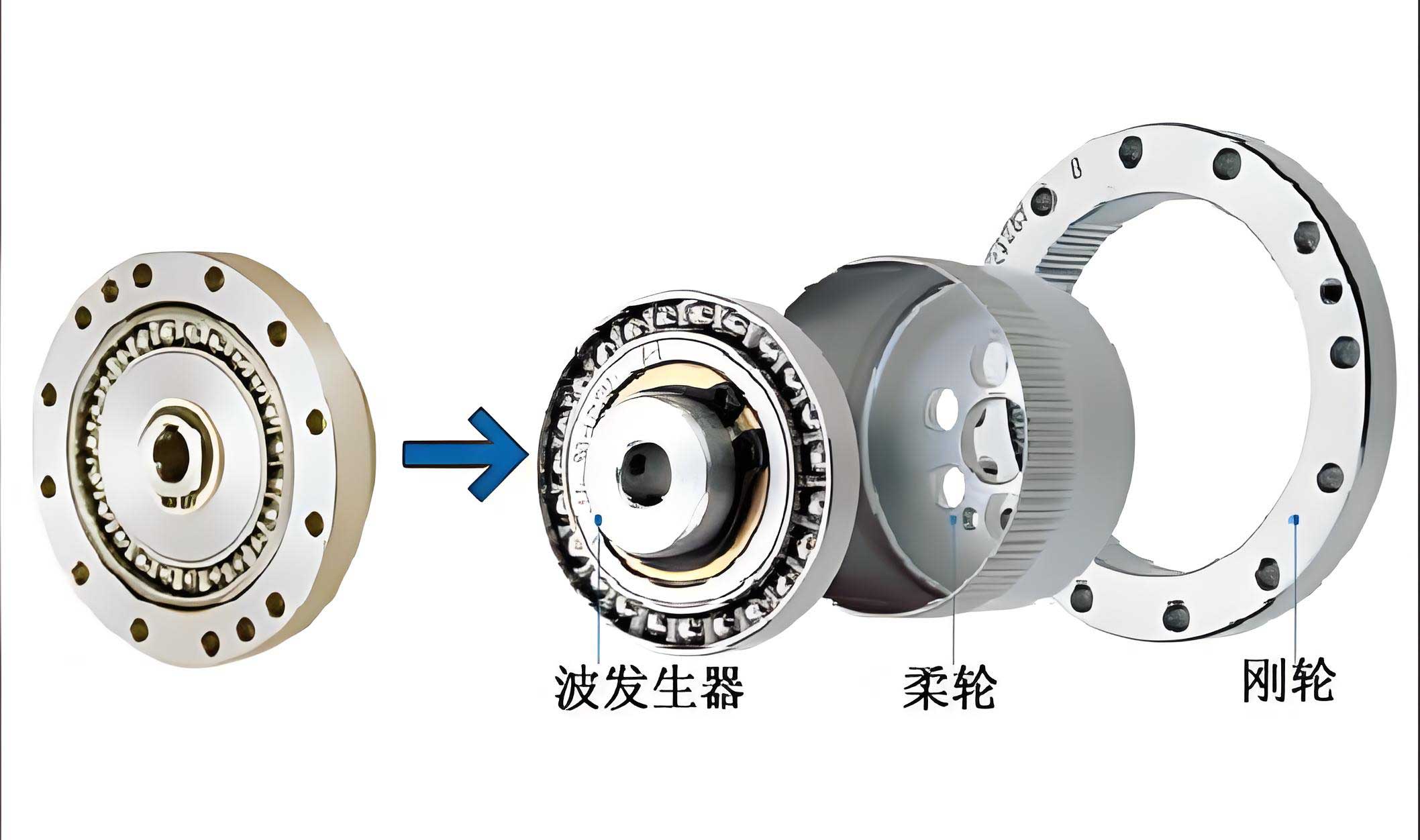
To establish a foundation for reliability assessment, I define state functions for each failure mode based on stress-strength interference theory. For tooth surface wear, the state function is derived from contact pressure limits. Let $X = ([P], T, K, \epsilon, \phi_m, \mu)^T$ represent the vector of random variables, where $[P]$ is the allowable specific pressure, $T$ is the torque on the flexspline, $K$ is the load factor, $\epsilon$ is the percentage of teeth in engagement, $\phi_m$ is the face width coefficient, and $\mu$ is a coefficient typically ranging from 1.4 to 1.6. The state function $g_1(X)$ for wear resistance is:
$$g_1(X) = m – \sqrt[3]{\frac{2KT}{\epsilon \phi_m \mu Z_1 [P]}},$$
where $m$ is the module and $Z_1$ is the number of teeth on the flexspline. Failure occurs when $g_1(X) \leq 0$, indicating excessive wear.
For preventing buckling of the flexspline cylindrical shell under torque, the state function $g_2(X)$ is based on critical stability torque. With $X = (E, \delta, L, \nu, m, K_s, K_d, T)^T$, where $E$ is Young’s modulus, $\delta$ is the wall thickness at the tooth root, $L$ is the shell length, $\nu$ is Poisson’s ratio, $K_s$ is a shear stress distribution coefficient (1.5–1.8), and $K_d$ is a dynamic load coefficient (1.1–1.4), the function is:
$$g_2(X) = T_{cr} – T,$$
with $T_{cr}$ calculated as:
$$T_{cr} = K_s K_d \frac{\pi E \delta^2 L}{\sqrt{3(1-\nu^2)} r_0},$$
where $r_0$ is the neutral radius of the flexspline. Additionally, a constraint on the torque ratio ensures safety: $g_3(X) = T_{cr}/T – 2 \geq 0$.
Fatigue strength of the flexspline is critical due to cyclic loading from the wave generator. The state function $g_4(X)$ incorporates bending and shear fatigue limits. Let $X = (\sigma_{-1}, \tau_{-1}, L, \delta, K_\sigma, K_M, K_\tau, K_d, K_t, \epsilon, C_\sigma, C_\tau, \omega_0, E, T)^T$, where $\sigma_{-1}$ and $\tau_{-1}$ are fatigue limits under symmetric cycling, $K_\sigma$ and $K_\tau$ are stress concentration factors, $K_M$ accounts for load characteristics and wave generator stiffness, $C_\sigma$ and $C_\tau$ are stress coefficients, and $\omega_0$ is the maximum radial deformation of the flexspline (equal to $m$ for standard designs). The function is:
$$g_4(X) = n – 1.5,$$
where $n$ is the safety factor derived from:
$$n = \frac{n_\sigma n_\tau}{\sqrt{n_\sigma^2 + n_\tau^2}},$$
with $n_\sigma = \sigma_{-1} / \sigma_a$ and $n_\tau = \tau_{-1} / \tau_a$. The stress amplitudes $\sigma_a$ and $\tau_a$ are:
$$\sigma_a = \frac{K_\sigma + 0.2}{\pi K_M K_d C_\sigma \omega_0 \delta^2 + K_t K_d T L}, \quad \tau_a = \frac{K_\tau}{\pi K_M K_d C_\tau \omega_0 \delta^2 + K_t K_d T L}.$$
These state functions form the basis for reliability analysis, where I treat all parameters as random variables with known means and variances, often assuming normal distributions for simplicity.
Reliability design hinges on computing the probability that the state function $g(X)$ exceeds zero. For a set of random variables $X = (X_1, X_2, \dots, X_n)^T$ with joint probability density $f_X(x)$, the reliability $R$ is:
$$R = \int_{g(X) > 0} f_X(x) \, dx.$$
In practice, exact integration is challenging, so I employ the first-order second-moment (FOSM) method via random perturbation techniques. Given the mean $E[X]$, variance $\text{Var}[X]$, and higher moments, I approximate the mean and variance of $g(X)$ as:
$$E[g] \approx g(\mu_X), \quad \text{Var}[g] \approx \left( \frac{\partial g}{\partial X} \bigg|_{\mu_X} \right)^2 \text{Var}[X],$$
where $\mu_X = E[X]$. The reliability index $\beta$ is then:
$$\beta = \frac{E[g]}{\sqrt{\text{Var}[g]}}.$$
Under the assumption of normality for $g(X)$, the reliability is estimated as $R = \Phi(\beta)$, where $\Phi(\cdot)$ is the standard normal cumulative distribution function. For non-normal variables, transformations can be applied, but in my initial approach, I assume normality to simplify calculations while acknowledging that advanced methods like Monte Carlo simulation can validate results.
To optimize the strain wave gear design, I formulate a reliability-based optimization model. The goal is to minimize the volume of the flexspline—a proxy for mass and cost—while ensuring reliability constraints. The design variables are $Y = (\delta, m, b, L)^T$, representing wall thickness, module, face width, and length, respectively. The objective function $F(Y)$ is the total volume of the flexspline, expressed as:
$$F(Y) = \pi \delta L \left[ m Z_1 + 2m(x_1 – 2h_a^* – 2c^*) – \delta \right] + \pi m Z_1 \left[ \frac{m Z_1}{2} \cos \alpha_0 + \sqrt{ \left( \frac{m Z_1}{2} \cos \alpha_0 \right)^2 + (r_0 – \delta)^2 – \left( \frac{m Z_1}{2} \right)^2 } \right],$$
where $h_a^*$ is the addendum coefficient, $c^*$ is the clearance coefficient, $x_1$ is the shift coefficient, and $\alpha_0$ is the pressure angle. The constraints include reliability requirements for each failure mode and practical design limits. Let $R_i = P(g_i(X) \geq 0)$ be the reliability for the $i$-th failure mode, with $i=1,2,3,4$. Given a target reliability $R_0 = 0.95$, the optimization problem is:
$$\begin{aligned}
\min_{Y} \quad & F(Y) \\
\text{s.t.} \quad & R_i \geq R_0 \quad \text{for } i=1,2,3,4, \\
& q_j(Y) \geq 0 \quad \text{for } j=1,\dots,8,
\end{aligned}$$
where $q_j(Y)$ are inequality constraints such as $m \geq 0.3$, $b \geq 0.1d$, and $L \leq 1.2d$, with $d$ being the pitch diameter. This constrained nonlinear probabilistic optimization is complex due to the implicit nature of reliability constraints. To solve it, I use a genetic algorithm (GA), a global search method inspired by natural selection that excels in handling non-convex spaces and probabilistic objectives.
The genetic algorithm operates by evolving a population of candidate solutions over generations. I encode each design variable into a chromosome, typically using real-valued representation. The fitness function combines the objective $F(Y)$ with penalty terms for constraint violations, transforming the problem into an unconstrained one. Specifically, I define a penalized fitness $H(Y)$ as:
$$H(Y) = F(Y) + \omega \sum_{i=1}^{4} \left[ \min(0, R_i – R_0) \right]^2 + \omega \sum_{j=1}^{8} \left[ \min(0, q_j(Y)) \right]^2,$$
where $\omega$ is a large penalty coefficient (e.g., 500,000). The GA parameters include a population size of 100, crossover probability of 0.8, mutation probability of 0.1, and a maximum of 500 generations. Through selection, crossover, and mutation, the algorithm converges to an optimal design that minimizes volume while satisfying reliability and geometric constraints. The stochastic nature of GA allows it to escape local minima, making it suitable for reliability optimization where objective functions can be noisy due to probabilistic evaluations.
To understand the influence of design parameters on reliability, I conduct a sensitivity analysis. This involves computing the derivatives of reliability $R$ with respect to the means and variances of the random variables $X$. Using matrix differential calculus, the sensitivity of $R$ to the mean vector $\mu_X$ is:
$$\frac{\partial R}{\partial \mu_X} = \frac{\partial R}{\partial \beta} \frac{\partial \beta}{\partial \mu_X},$$
where $\frac{\partial R}{\partial \beta} = \phi(\beta)$ (the standard normal density) and $\frac{\partial \beta}{\partial \mu_X} = \frac{1}{\sqrt{\text{Var}[g]}} \frac{\partial E[g]}{\partial \mu_X}$. Similarly, sensitivity to variance $\text{Var}[X]$ is:
$$\frac{\partial R}{\partial \text{Var}[X]} = \frac{\partial R}{\partial \beta} \frac{\partial \beta}{\partial \text{Var}[X]},$$
with $\frac{\partial \beta}{\partial \text{Var}[X]} = -\frac{1}{2} \frac{E[g]}{(\text{Var}[g])^{3/2}} \frac{\partial \text{Var}[g]}{\partial \text{Var}[X]}$. These sensitivities quantify how changes in material properties or loads affect reliability, guiding design adjustments for robustness. For instance, a high sensitivity to torque $T$ suggests that controlling load variations is crucial for the strain wave gear’s reliability.
I demonstrate the proposed methodology through a numerical example. Consider a strain wave gear reducer with an output torque $T = 600 \, \text{N·m}$, transmission ratio $i = 100$, pressure angle $\alpha_0 = 20^\circ$, and flexspline material made of 20Cr2Ni4A steel. The wave generator is a cam-type with flexible rolling bearings, rotating at 30,000 rpm. Initial design parameters are $(\delta, m, b, L) = (2.2, 0.8, 28, 158) \, \text{mm}$. From the transmission ratio, the teeth numbers are $Z_1 = 200$ for the flexspline and $Z_2 = 202$ for the circular spline. Other constants include $h_a^* = 1$, $c^* = 0.25$, and $x_1 = 3.95$.
I assume all random variables follow normal distributions; their probabilistic characteristics are summarized in Table 1. This table includes means and coefficients of variation (COV) for parameters such as $E$, $[P]$, $K$, $\sigma_{-1}$, and others, derived from engineering handbooks or experimental data. For example, the elastic modulus $E$ has a mean of 210 GPa and COV of 0.05, reflecting typical material variability.
| Variable | Mean | Coefficient of Variation | Description |
|---|---|---|---|
| $E$ (GPa) | 210 | 0.05 | Young’s modulus |
| $[P]$ (MPa) | 150 | 0.10 | Allowable specific pressure |
| $T$ (N·m) | 600 | 0.08 | Torque on flexspline |
| $K$ | 1.2 | 0.05 | Load factor |
| $\epsilon$ | 0.75 | 0.03 | Engagement percentage |
| $\phi_m$ | 0.5 | 0.04 | Face width coefficient |
| $\mu$ | 1.5 | 0.03 | Wear coefficient |
| $\delta$ (mm) | 2.2 | 0.02 | Wall thickness |
| $L$ (mm) | 158 | 0.02 | Shell length |
| $\nu$ | 0.3 | 0.03 | Poisson’s ratio |
| $K_s$ | 1.6 | 0.05 | Shear stress coefficient |
| $K_d$ | 1.25 | 0.04 | Dynamic load coefficient |
| $\sigma_{-1}$ (MPa) | 500 | 0.08 | Bending fatigue limit |
| $\tau_{-1}$ (MPa) | 300 | 0.08 | Shear fatigue limit |
| $K_\sigma$ | 1.8 | 0.06 | Bending stress concentration |
| $K_M$ | 1.3 | 0.05 | Load characteristic factor |
| $K_\tau$ | 1.7 | 0.06 | Shear stress concentration |
| $K_t$ | 1.1 | 0.04 | Temperature factor |
| $C_\sigma$ | 0.9 | 0.03 | Bending stress coefficient |
| $C_\tau$ | 0.8 | 0.03 | Shear stress coefficient |
| $\omega_0$ (mm) | 0.8 | 0.02 | Max radial deformation |
Applying the genetic algorithm, I optimize the design with $R_0 = 0.95$. After 500 generations, the optimal design variables are found as $Y = (2.000, 0.863, 9.351, 92.644) \, \text{mm}$. Compared to the initial design, the volume reduction is approximately 28.46%, demonstrating significant mass savings while maintaining reliability. The reliability for each failure mode exceeds 0.95, as verified through FOSM calculations. For instance, the reliability for tooth wear $R_1$ is 0.999, for buckling $R_2$ is 0.998, and for fatigue $R_4$ is 0.997, all satisfying the target.
To validate these results, I use Monte Carlo simulation (MCS), a robust sampling-based method that approximates reliability by generating random samples according to the distributions of $X$. With 10^6 samples, the MCS reliability estimates align closely with FOSM results, yielding an overall system reliability of 0.9999 for the optimized strain wave gear. This high reliability indicates that the optimization successfully balances performance and safety, though it may be conservative; in practice, lower targets could be set for cost-critical applications.
The sensitivity analysis reveals intriguing insights. For tooth surface wear, reliability is most sensitive to the module $m$, with a positive derivative $\partial R_1 / \partial m \approx 0.12$, meaning increasing $m$ enhances wear resistance. Other parameters like $T$ and $[P]$ have negligible sensitivities (e.g., $\partial R_1 / \partial T \approx -1.5 \times 10^{-5}$), suggesting that wear reliability is robust to load and material variations in this model. In contrast, fatigue strength shows higher sensitivities: $\partial R_4 / \partial m \approx 0.065$ (positive), while $\partial R_4 / \partial T \approx -0.014$ and $\partial R_4 / \partial K_M \approx -0.018$ (negative). This implies that fatigue life is strongly influenced by torque and load characteristics, necessitating precise control in manufacturing and operation. The table below summarizes key sensitivity coefficients for the fatigue state function.
| Variable | Sensitivity $\partial R_4 / \partial \mu_X$ | Interpretation |
|---|---|---|
| $m$ (module) | 0.065 | Increasing module improves fatigue reliability |
| $T$ (torque) | -0.014 | Higher torque reduces fatigue reliability |
| $\sigma_{-1}$ (fatigue limit) | 0.002 | Better material enhances reliability |
| $K_M$ (load factor) | -0.018 | Stiffer wave generator increases stress, lowering reliability |
| $\delta$ (wall thickness) | 0.001 | Thicker walls slightly improve reliability |
These findings guide design improvements. For instance, to boost fatigue reliability, one could increase the module or select materials with higher fatigue limits, while minimizing torque fluctuations and optimizing the wave generator’s stiffness. The sensitivity analysis thus serves as a tool for informed decision-making in the design of strain wave gears.
In discussing the broader implications, I recognize that my approach assumes normal distributions and uses FOSM, which may not capture tail behaviors accurately for highly skewed variables. Future work could incorporate advanced reliability methods like second-order approximations or subset simulation to improve accuracy. Additionally, the genetic algorithm, while effective, requires careful tuning of parameters to avoid premature convergence. Alternative optimization techniques such as particle swarm or gradient-based methods could be explored for faster computations. The integration of machine learning for surrogate modeling might further accelerate reliability assessments, enabling real-time design iterations.
From an application perspective, the methodology is not limited to strain wave gears; it can be adapted to other mechanical components like bearings, shafts, and gears in various industries. The key is defining appropriate state functions and gathering probabilistic data for input variables. In robotics, where strain wave gears are prevalent due to their compactness and precision, this reliability-based optimization can lead to lighter manipulators with longer service lives, reducing maintenance costs and downtime.
In conclusion, I have presented a comprehensive framework for reliability-based optimization of strain wave gears using genetic algorithms. By developing probabilistic models for wear, buckling, and fatigue failures, and combining them with optimization and sensitivity analysis, I achieve designs that minimize volume while meeting reliability targets. The numerical example demonstrates a 28.46% volume reduction with high reliability, validated by Monte Carlo simulation. Sensitivity results highlight critical parameters for design robustness. This approach offers a practical and effective alternative to traditional over-design, paving the way for more efficient and reliable strain wave gear systems in advanced engineering applications. As I continue this research, I aim to incorporate multi-objective optimization and uncertainty quantification for even more resilient designs.