
In the realm of high-precision manufacturing and crystal growth technology, the demand for motion control systems with exceptional accuracy, compactness, and reliability is paramount. The reducer, acting as the critical interface between the prime mover and the final load, directly dictates the positional fidelity and smoothness of operation. Traditional gear reducers often fall short in applications requiring ultra-high precision within a constrained space. It is within this context that the strain wave gear, also known as a harmonic drive, presents a compelling solution. This technology, characterized by its unique operating principle utilizing controlled elastic deformation, offers unparalleled advantages including high single-stage reduction ratios, exceptional positional accuracy, minimal backlash, and a high torque-to-weight ratio. This article details the first-person perspective research, design, and development process of a novel strain wave gear reducer, designated as the XJ-99 model, specifically engineered to meet the stringent requirements of an oxide single crystal puller.
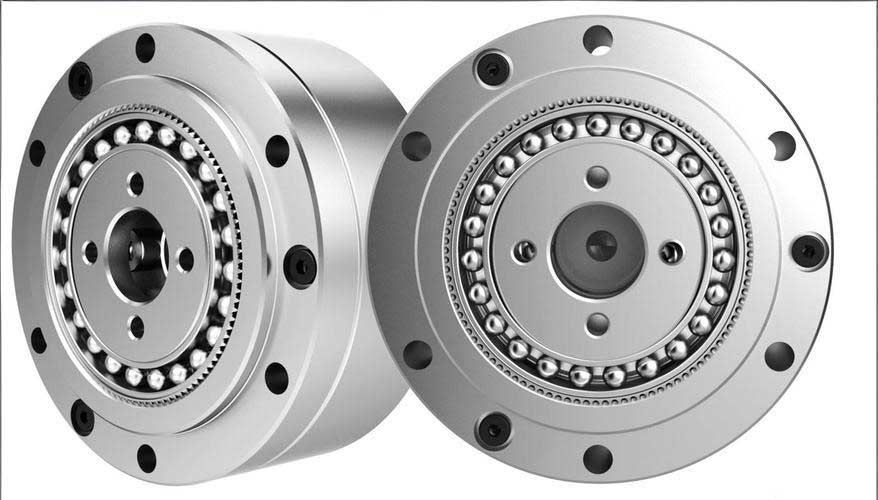
The operational principle of the strain wave gear reducer is elegantly simple yet mechanically sophisticated, revolving around the controlled flexing of a metallic component. The core assembly consists of three primary elements: a rigid Circular Spline (CS), a flexible Flexspline (FS), and a Wave Generator (WG). The Circular Spline is a rigid internal gear, typically fixed to the housing. The Flexspline is a thin-walled, flexible external gear, usually connected to the output shaft. The Wave Generator is an elliptical cam or a dedicated bearing assembly that deforms the Flexspline into an elliptical shape.
When the Wave Generator is rotated by the input motor, it induces a traveling elastic deformation wave in the Flexspline wall. This deformation causes the teeth of the Flexspline to engage with the teeth of the Circular Spline at two diametrically opposite regions along the major axis of the ellipse. At the minor axis, the teeth are completely disengaged. The key to the reduction ratio lies in the difference in the number of teeth between the Flexspline (N_fs) and the Circular Spline (N_cs), which is typically 2 or a multiple thereof for a standard elliptical wave generator. For one complete clockwise rotation of the Wave Generator, the deformation wave travels around the Flexspline, causing its teeth to mesh and unmesh sequentially. Because the Flexspline has fewer teeth, it effectively “loses” ground relative to the fixed Circular Spline. This relative motion is transferred to the output, resulting in a very slow rotation of the Flexspline in the direction opposite to the Wave Generator’s rotation.
The fundamental kinematic relationship for a simple strain wave gear is given by:
$$
\text{Reduction Ratio, } i = \frac{\omega_{in}}{\omega_{out}} = -\frac{N_{fs}}{N_{cs} – N_{fs}}
$$
Where:
- $\omega_{in}$ is the input speed (Wave Generator)
- $\omega_{out}$ is the output speed (Flexspline)
- $N_{cs}$ is the number of teeth on the Circular Spline
- $N_{fs}$ is the number of teeth on the Flexspline
A negative ratio indicates the output direction is opposite to the input. For our design target of $i = -99$, a standard two-wave configuration ($N_{cs} – N_{fs} = 2$) was chosen. Therefore, $N_{fs} = 198$ and $N_{cs} = 200$.
Design Specifications and Parameter Determination
The primary design specifications for the XJ-99 strain wave gear reducer were driven by the crystal growth application:
| Parameter | Symbol | Target Value |
|---|---|---|
| Transmission Ratio | $i$ | -99 (output opposite input) |
| Output Torque Capacity | $M_{out}$ | > 30 kg·cm (≈ 2.94 Nm) |
| Transmission Error | $\Delta \theta$ | ≤ 5 arc-min |
| Backlash | $j$ | Minimal (near zero) |
Based on the torque requirement and space constraints, a module of $m = 0.3$ mm was selected. The tooth profile chosen was a standard involute with a pressure angle $\alpha = 20^\circ$. The design of a strain wave gear involves calculating critical geometric and kinematic parameters to ensure proper meshing under elastic deformation. A fundamental parameter is the radial deformation $w_0$ of the Flexspline’s neutral line, which is approximately equal to the radial displacement required for full tooth engagement. For initial calculations, it can be set equal to the module: $w_0 \approx m$.
The eccentricity $e$ of the Wave Generator, which defines the major axis of the elliptical deformation, is a crucial parameter derived from the equivalent gear system. The calculation involves determining the parameters of an equivalent virtual spur gear pair that mimics the meshing condition. The shift coefficients ($x$) for the gears, considering the deformation, are essential. For a standard tooth profile and to optimize stress and engagement, we selected $x_{fs} = 0$ for the Flexspline and calculated the corresponding value for the Circular Spline.
The key calculations proceeded as follows:
- Equivalent Virtual Gear Teeth: The number of teeth on the virtual gear ($z_d$) representing the meshing condition is calculated.
$$
z_d = \frac{z_{fs}^2 (K – 1) + \epsilon}{z_{cs} – z_{fs}(2 – K)}
$$
Where $K$ is a wave generator profile coefficient (≈2 for elliptical) and $\epsilon$ is a small correction factor. - Wave Generator Eccentricity:
$$
e = \frac{m (z_{cs} – z_d) \cos \alpha}{2 \cos \alpha’}
$$
Here, $\alpha’$ is the operating pressure angle, which for initial design can be assumed equal to $\alpha$. - Critical Diameters:
- Flexspline major diameter (under deformation): $D_{fs,maj} = m \cdot z_{fs} + 2m(1 + x_{fs}) + 2w_0$
- Flexspline minor diameter: $D_{fs,min} = D_{fs,maj} – 2h_t$ where $h_t$ is the whole tooth depth.
- Circular Spline internal diameter: $D_{cs,int} = m \cdot z_{cs} – 2m(1 – x_{cs}) + 2\Delta y$, where $\Delta y$ is a profile shift modification factor.
Performing these calculations with our parameters ($m=0.3$, $z_{fs}=198$, $z_{cs}=200$, $\alpha=20^\circ$) yielded the core dimensions for the Flexspline and Circular Spline components.
Component Design and Structural Integration
The XJ-99 strain wave gear reducer was designed as a compact, integrated unit with a focus on precision mounting and load path integrity. The main structural components are detailed below.
| Component | Primary Function | Key Design Features |
|---|---|---|
| Flexspline | Flexible external gear; outputs motion. | Thin-walled cup geometry made from high-strength alloy steel (e.g., 40Cr). The cup rim hosts the teeth, while the smooth cup bottom acts as the output flange. A critical stress-relief groove is often machined at the tooth-cup transition to mitigate stress concentration. |
| Circular Spline | Rigid internal gear; fixed to housing. | Manufactured from hardened steel (e.g., 45# steel). Designed with a robust flange for secure mounting to the reducer housing. The internal gear teeth are precision ground after heat treatment to ensure accurate geometry and hardness. |
| Wave Generator | Input element; induces deformation wave. | Utilizes a cam-and-thin-walled-ball-bearing assembly. A rigid elliptical cam is paired with a specially designed thin-section ball bearing. The outer race of this bearing conforms to the cam’s ellipse, providing a smooth, low-friction rolling interface to deform the Flexspline. This design is superior to simple crosstoll designs in terms of efficiency and wear. |
| Output System & Housing | Supports components and delivers torque. | The Flexspline cup is bolted directly to a rigid output flange. The housing provides precise coaxial mounting seats for the Circular Spline and the Wave Generator’s input shaft bearings. All mounting surfaces are machined to high tolerances for perpendicularity and concentricity. |
Material Selection and Precision Manufacturing Processes
The reliable performance of a strain wave gear reducer hinges on the meticulous selection of materials and the execution of precision manufacturing and heat treatment processes. The Flexspline, undergoing cyclic elastic deformation, is the most critical component. Material choice must balance high tensile strength, excellent fatigue endurance limit, and good machinability. Alloy steels such as 40Cr (AISI 5140) or even higher-performance managing steels are common choices.
The manufacturing process for the Flexspline is designed to minimize residual stresses and ensure geometric perfection:
- Forging & Normalizing: The blank is forged to grain flow direction and normalized to refine the microstructure.
- Rough Machining: The cup profile is machined, leaving ample stock for finishing.
- Stress Relief Annealing: A critical intermediate annealing is performed to relieve machining stresses.
- Precision Machining: The cup’s critical bore and mounting face are finished by grinding on a fixture that ensures coaxiality. The external teeth are then hobbed or shaped.
- Heat Treatment: The component undergoes through-hardening (e.g., quench and temper) or case hardening to achieve the desired core toughness and surface hardness. For 40Cr, a typical process is oil quenching from 850°C followed by tempering at 550°C to achieve a hardness of HRC 45-50.
- Final Grinding: The mounting surfaces are finally ground to achieve the required runout tolerances (e.g., < 0.01 mm).
The Wave Generator bearing is equally critical. Its races are made from bearing steel (GCr15, equivalent to AISI 52100). The thin-walled outer race is especially challenging. Its manufacturing involves turning, followed by heat treatment (hardening and low-temperature tempering to HRC 58-62), and finally, precision grinding of the raceway and O.D. while clamped on a mandrel to avoid distortion. The dimensional accuracy and roundness (in free state) of this bearing are paramount for generating a smooth elliptical wave.
| Component | Material | Key Processes | Critical Tolerances / Checks |
|---|---|---|---|
| Flexspline | 40Cr Alloy Steel | Turning, Stress Relief, Hobbing, Quench & Temper, Grinding | Tooth profile error, Cup wall thickness uniformity (< 0.02mm), Runout of mounting face (< 0.01mm TIR) |
| Circular Spline | 45# Steel | Turning, Hobbing, Heat Treatment, Internal Gear Grinding | Cumulative pitch error, Tooth alignment relative to mounting face, Hardness profile |
| Wave Gen. Bearing (Outer Race) | GCr15 Bearing Steel | Turning, Heat Treat, Raceway Grinding (on mandrel) | Raceway profile (ellipticity), Wall thickness uniformity, Free-state roundness |
| Assembly | – | Selective Fitting, Torque Preload Adjustment | Output rotational accuracy, Backlash measurement under load, Torque smoothness |
Performance Analysis and Theoretical Considerations
The design verification extends beyond kinematics into stress analysis and efficiency estimation. The Flexspline is subjected to alternating bending stresses. The maximum stress typically occurs at the critical cross-section near the cup’s diaphragm. It can be estimated using thin-shell theory for a cylindrical shell under elliptical deformation. A simplified expression for the maximum bending stress $\sigma_{max}$ is:
$$
\sigma_{max} \approx k \cdot E \cdot \frac{w_0 \cdot t}{(R_m)^2}
$$
Where:
- $k$ is a stress concentration factor (1.5 – 2.5, depending on geometry)
- $E$ is the Young’s modulus of the Flexspline material
- $w_0$ is the radial deformation (≈ module $m$)
- $t$ is the wall thickness of the Flexspline cup
- $R_m$ is the mean radius of the Flexspline cylinder
This stress must be well below the endurance limit of the material to ensure infinite fatigue life. Finite Element Analysis (FEA) is indispensable for a more accurate stress and deformation field prediction, optimizing the cup profile and transition radii.
The torsional stiffness $K_t$ of the strain wave gear reducer, which affects positional accuracy under load, is high due to the multi-tooth simultaneous engagement (often 15-30% of teeth are engaged). It can be approximated by considering the gear mesh stiffness and the Flexspline’s torsional rigidity. High stiffness contributes to the excellent servo characteristics of strain wave gear drives.
The geometric transmission error $\Delta \theta$, a primary measure of precision, originates from imperfections in tooth profile, pitch errors, and assembly misalignments. For our high-precision design, this error was targeted to be less than 1 arc-minute, which requires sub-micron level control over tooth geometry and assembly concentricity.
Results and Application Validation
Upon assembly and testing, the XJ-99 strain wave gear reducer prototype met and exceeded its design specifications. Key performance metrics were quantified as follows:
| Performance Metric | Measured Value | Comparison to Typical Reducers |
|---|---|---|
| Rotational Accuracy (Radial Runout) | ≤ 0.01 mm | Superior. Planetary reducers typically exhibit 0.02-0.05 mm. |
| Face Runout (Axial) | ≤ 0.02 mm | Superior. Critical for mounting stability. |
| Backlash | < 1 arc-min | Exceptional. Near-zero backlash is a hallmark of quality strain wave gears. |
| Transmission Efficiency | ~ 80% (at rated load) | Good for a high-ratio, single-stage reducer. |
| Rated Output Torque | 35 kg·cm (confirmed) | Met specification with margin. |
The successful deployment of the XJ-99 reducer in the oxide single crystal puller system demonstrated a significant improvement in process stability. The near-zero backlash and high torsional stiffness provided the precise, jerk-free rotation necessary for consistent crystal diameter control and high-quality ingot growth. This validated the core advantages of the strain wave gear principle in demanding, precision-sensitive applications.
Conclusion and Future Perspectives
The development of the XJ-99 strain wave gear reducer underscores the transformative potential of this technology in high-precision motion control. By leveraging the principle of elastic wave transmission, we engineered a device that combines a high reduction ratio, exceptional accuracy, compactness, and reliability into a single-stage package. The meticulous design process, encompassing precise kinematic and geometric calculations, strategic material selection, and rigorous manufacturing protocols, was crucial to achieving the targeted performance metrics. The superior results—notably the rotational accuracy of 0.01 mm and minimal backlash—clearly demonstrate the performance edge of a well-engineered strain wave gear over conventional reduction solutions in precision applications.
Looking forward, the evolution of strain wave gear technology continues. Research areas include the development of new Flexspline materials (e.g., carbon fiber composites) for higher specific strength, advanced tooth profiles to optimize stress distribution and increase torque capacity, and integrated mechatronic designs combining the reducer with direct-drive motors and encoders. The application scope for strain wave gears is also expanding rapidly, from its traditional strongholds in aerospace and robotics to semiconductor manufacturing, medical devices, and precision optical systems. The inherent advantages of the strain wave gear ensure its position as a critical enabling technology in the ongoing pursuit of ever-greater precision in mechanical engineering. The design and validation process detailed here provides a foundational framework for engineers aiming to harness the unique capabilities of the strain wave gear reducer in their own high-precision systems.