
As a researcher in digital interaction design, I have focused on integrating technology with child psychology to foster holistic growth. The core of my work revolves around developing a companion robot that seamlessly blends education and entertainment, aiming to support children’s mental and emotional well-being. This companion robot is not merely a toy but an interactive partner designed to provide psychological guidance, mood regulation, and joy through intelligent engagement. In this article, I will elaborate on the design philosophy, technical implementation, and evaluative frameworks behind this companion robot, emphasizing its role in promoting “edutainment”—where learning and play converge.
The impetus for this project stems from recognizing the growing need for tools that address children’s psychological health in an increasingly digital world. Traditional methods often separate education from recreation, but this companion robot bridges that gap by leveraging advanced digital interfaces. My goal is to create a companion robot that interacts naturally with children, using conversation, play, and artistic elements to deliver personalized support. By embedding psychological knowledge and aesthetic principles, the companion robot becomes a responsive entity that adapts to each child’s unique emotional state.
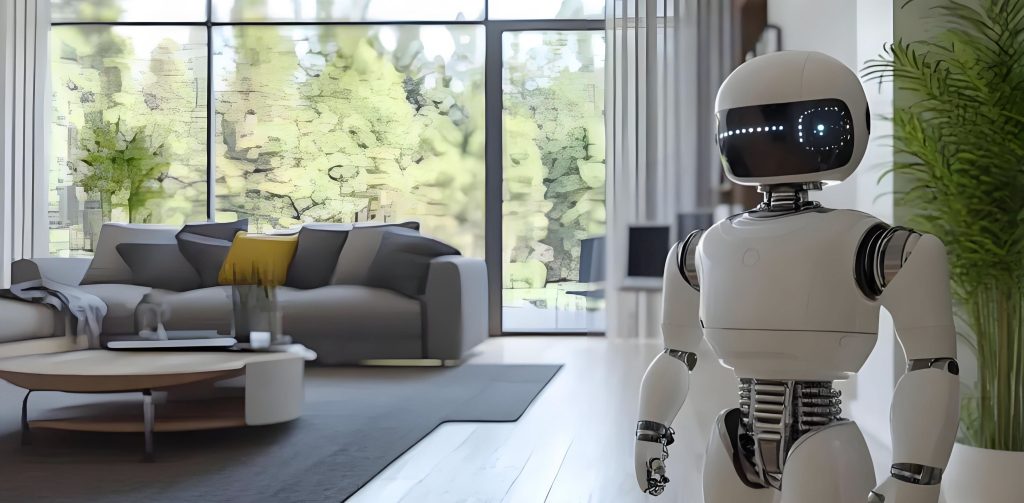
To achieve this, the companion robot relies on a sophisticated digital and intelligent interaction framework. At its heart lies a psychological counseling corpus—a curated database of therapeutic dialogues and educational content—combined with artistic aesthetics to enhance engagement. The interaction process begins with the companion robot capturing the child’s speech or behavior through sensors. Using natural language processing (NLP) algorithms, it analyzes the input to identify emotional cues and cognitive patterns. This analysis is compared against the corpus database to determine the child’s psychological state, enabling the companion robot to tailor its responses. For instance, if a child expresses sadness, the companion robot might initiate a comforting dialogue, play an uplifting video, or engage in a dance movement to lighten the mood.
The technical architecture of the companion robot can be summarized through mathematical models that govern its decision-making. Let me define the interaction as a function where the robot’s response $R$ is derived from the child’s input $I$, the psychological corpus $C$, and aesthetic parameters $A$. The overall system can be represented as:
$$ R = f(I, C, A) = \alpha \cdot \text{NLP}(I) + \beta \cdot \text{Match}(I, C) + \gamma \cdot \text{AestheticBoost}(A) $$
Here, $\alpha$, $\beta$, and $\gamma$ are weighting coefficients that balance the contributions of language processing, corpus matching, and artistic elements. The NLP component involves tokenizing and parsing the input, which can be expressed as:
$$ \text{NLP}(I) = \sum_{i=1}^{n} w_i \cdot \text{emb}(t_i) $$
where $t_i$ represents tokens from the child’s speech, $\text{emb}$ is an embedding function that maps tokens to semantic vectors, and $w_i$ are weights assigned based on emotional salience. The matching function $\text{Match}(I, C)$ computes the similarity between the input and corpus entries using cosine similarity:
$$ \text{Match}(I, C) = \max_{j} \left( \frac{\mathbf{v}_I \cdot \mathbf{v}_{C_j}}{\|\mathbf{v}_I\| \|\mathbf{v}_{C_j}\|} \right) $$
where $\mathbf{v}_I$ and $\mathbf{v}_{C_j}$ are vector representations of the input and the $j$-th corpus entry, respectively. This ensures the companion robot selects the most relevant psychological guidance. The aesthetic component $\text{AestheticBoost}(A)$ integrates art-based interactions, such as music or visual stimuli, to enhance emotional resonance, modeled as a reinforcement factor that adjusts based on the child’s engagement level.
To illustrate the system’s components, I have compiled a table outlining the key modules of the companion robot and their functions. This table encapsulates how each part contributes to the edutainment experience.
| Module | Function | Description |
|---|---|---|
| Speech Recognition | Captures child’s verbal input | Uses microphone arrays and noise-cancellation algorithms to transcribe speech for analysis. |
| Emotion Analysis Engine | Identifies emotional states | Applies machine learning classifiers (e.g., SVM or neural networks) to detect joy, sadness, anger, etc., from speech patterns. |
| Psychological Corpus Database | Stores therapeutic and educational content | Contains curated dialogues, stories, and activities aligned with child psychology principles, updated regularly. |
| Aesthetic Interaction Manager | Handles artistic elements | Controls video playback, music selection, and robotic movements (e.g., dance) to create engaging experiences. |
| Response Generator | Produces tailored outputs | Combines analysis results to generate speech, visual media, or physical actions for intervention. |
| Learning Adaptivity Module | Adjusts to child’s progress | Uses reinforcement learning to refine interactions over time, ensuring the companion robot evolves with the child’s needs. |
The development of this companion robot involved iterative testing with children to refine its交互 design. I observed that the companion robot’s ability to blend play with education significantly increased engagement. For example, during a session, the companion robot might start with a game that subtly incorporates math puzzles, then transition to a storytelling mode that addresses empathy. This fluidity is key to the companion robot’s effectiveness, as it prevents the child from perceiving the interaction as purely instructional. The psychological corpus is built from evidence-based practices, including cognitive-behavioral techniques and positive psychology, ensuring that the companion robot’s guidance is both scientifically sound and age-appropriate.
Another critical aspect is the role of art and aesthetics in the companion robot’s design. By integrating visual arts, music, and movement, the companion robot appeals to children’s creative senses, making psychological疏导 more palatable. The aesthetic parameters are quantified through metrics like color harmony scores and rhythmic complexity, which influence the robot’s output. For instance, when the companion robot detects anxiety, it might play a calming video with soothing colors and gentle music, derived from an aesthetic model that optimizes for relaxation. This can be expressed as:
$$ A_{\text{relax}} = \arg \min_{A} \left( \text{StressMetric}(I) – \text{CalmScore}(A) \right)^2 $$
where $A_{\text{relax}}$ is the aesthetic configuration that minimizes the stress indicator. Such formulas ensure the companion robot’s responses are data-driven yet emotionally intelligent.
In terms of implementation, the companion robot utilizes a cloud-edge computing architecture to handle real-time interactions. The edge device (the robot itself) processes basic sensor data, while complex analysis is offloaded to the cloud where the psychological corpus resides. This allows the companion robot to maintain low latency while accessing a vast knowledge base. The interaction flow can be summarized in another table, detailing the steps from input to response.
| Step | Process | Outcome |
|---|---|---|
| 1. Input Acquisition | Child speaks or interacts with the robot | Raw audio/visual data is captured and preprocessed. |
| 2. Feature Extraction | NLP and emotion analysis applied | Emotional labels and semantic vectors are generated. |
| 3. Corpus Matching | Similarity search in psychological database | Best-matching guidance content is identified. |
| 4. Aesthetic Integration | Artistic elements are selected based on context | Video, music, or movement plans are formulated. |
| 5. Response Synthesis | All components are combined into a cohesive output | The companion robot delivers speech, plays media, or performs actions. |
| 6. Feedback Loop | Child’s reaction is monitored for adaptation | Learning algorithms update parameters for future interactions. |
The efficacy of this companion robot hinges on its adaptive learning capabilities. Using reinforcement learning, the companion robot refines its策略 based on the child’s long-term progress. The reward function $R_{\text{learn}}$ is defined to maximize positive psychological outcomes, such as improved mood or reduced anxiety, measured through periodic assessments. This can be modeled as:
$$ \pi^* = \arg \max_{\pi} \mathbb{E} \left[ \sum_{t=0}^{T} \gamma^t R_{\text{learn}}(s_t, a_t) \right] $$
where $\pi$ is the policy governing the companion robot’s actions, $s_t$ is the state (e.g., child’s emotional state), $a_t$ is the action taken by the companion robot, and $\gamma$ is a discount factor. Through this, the companion robot becomes more personalized over time, enhancing its role as a trusted companion.
In practical applications, the companion robot has shown promise in various scenarios. For instance, in home settings, it assists with daily emotional regulation, while in educational environments, it supplements traditional teaching by making learning playful. The companion robot’s design also considers safety and privacy, with all data encrypted and anonymized to protect the child’s information. By fostering a secure and engaging interaction, the companion robot builds trust, which is crucial for effective psychological support.
Looking ahead, I envision expanding the companion robot’s capabilities through interdisciplinary collaborations. Integrating more advanced AI, such as generative models for creative storytelling, could further enrich the edutainment experience. Additionally, longitudinal studies are needed to assess the long-term impact of the companion robot on child development. The potential for scaling this companion robot to assist children with special needs or in therapeutic contexts is vast, underscoring its versatility as a digital tool.
In conclusion, the development of this companion robot represents a convergence of technology, psychology, and art. By prioritizing “edutainment,” it offers a novel approach to child well-being, where the companion robot serves as both a playmate and a guide. The mathematical frameworks and modular design ensure scalability and effectiveness, making the companion robot a promising innovation in digital交互 design. As I continue to refine this companion robot, the focus remains on creating meaningful interactions that nurture children’s minds and hearts, proving that technology, when thoughtfully applied, can be a force for good in shaping future generations.
The journey of designing this companion robot has reinforced my belief in the power of intelligent systems to augment human experiences. Through continuous iteration and user-centered design, the companion robot evolves to meet the dynamic needs of children, embodying the principle that learning should be joyful and supportive. The integration of tables and formulas in this discussion highlights the rigorous methodology behind the companion robot, ensuring that its development is both creative and evidence-based. Ultimately, this companion robot stands as a testament to the potential of digital innovation to foster healthier, happier childhoods.