
In the era of rapid technological advancement and the proliferation of artificial intelligence, intelligent companion robots for children have gained significant popularity in modern households. These companion robots are designed to provide children with multifaceted functions such as entertainment, education, and safety, serving as reliable partners during their growth. As a researcher in this field, I aim to delve into the emotional design of children’s intelligent companion robots, focusing on creating products that can genuinely attract children and establish emotional bonds. This study is driven by the need to understand children’s psychological and behavioral characteristics deeply, integrating emotional design principles to develop companion robots that are not only functional but also warm and engaging. Through this exploration, I seek to offer a more intelligent, personalized, and interactive companionship experience for children, leveraging emotional expressions and communication methods.
The core of this research lies in the concept of emotional design, which was pioneered by the American psychologist Donald Norman. Emotional design emphasizes that people’s evaluations of products are not solely based on functionality and appearance but are also influenced by emotional factors. Emotional design is structured into three levels: the visceral level, the behavioral level, and the reflective level. The visceral level primarily focuses on the product’s appearance and sensory experiences, such as color, shape, and texture, aiming to attract attention and evoke positive emotional responses. The behavioral level stresses practicality and usability, centering on user experience by enhancing convenience and fluidity during interaction to strengthen emotional connections. The reflective level delves into the cultural, social, and environmental contexts of the product, seeking to augment emotional value and cultural significance through thought-provoking elements. In this study, I apply these levels to the design of children’s intelligent companion robots, ensuring that each aspect resonates with young users.
Children’s intelligent companion robots are a form of artificial intelligence interactive robots specifically crafted for children. These companion robots integrate technologies such as AI, voice recognition, and natural language processing, exhibiting several standout features. First, they enable voice interaction, allowing children to issue voice commands, with the companion robot understanding and responding accordingly—for instance, by answering questions, telling stories, or singing songs. This makes interaction more accessible for children. Second, these companion robots possess robust natural language processing capabilities, enabling them to comprehend and respond to children’s queries in natural language, rather than relying solely on pre-set answers. This fosters more free-flowing communication. Third, companion robots incorporate learning functionalities, teaching children knowledge and assisting in their education. Additionally, they can engage in interactive games, puzzles, and other fun activities with children. The integration of these features positions companion robots as versatile tools for child development.
To ground this research in practical insights, I conducted extensive user and product surveys. In the user survey, I employed an online questionnaire system to gather opinions from 50 consumers or potential consumers in this market. The results are summarized in the table below:
| Survey Item | Number of Respondents | Percentage |
|---|---|---|
| Post-90s Generation | 25 | 50% |
| Post-80s Generation | 20 | 40% |
| Other Age Groups | 5 | 10% |
| Prioritize Functionality | 25 | 50% |
| Prioritize Price | 18 | 36% |
| Prioritize Appearance | 7 | 14% |
| Acceptable Price Below 10,000 | 10 | 20% |
| Acceptable Price 10,001–20,000 | 31 | 62% |
| Acceptable Price Above 20,001 | 9 | 18% |
From this table, I observe that the consumer base for children’s intelligent companion robots primarily consists of the post-90s generation, accounting for half of the respondents, followed by the post-80s generation at 40%. These age groups are generally more receptive to new technologies. Additionally, half of the consumers prioritize functionality when purchasing, while 36% focus on price, and only 14% emphasize appearance. Most consumers are willing to pay up to 20,000 units, indicating a demand for affordable yet functional companion robots. This insight guides my design approach to balance features with cost-effectiveness.
Furthermore, I developed a user experience map to visualize children’s interactions with companion robots. This map, derived from interviews, outlines the stages of interaction—from initial contact to ongoing use—highlighting pain points and opportunities for enhancement. For example, children often seek immediate emotional feedback from the companion robot, which underscores the need for responsive design. The user experience map can be represented mathematically as a function of engagement over time: $$E(t) = \int_{0}^{T} [S(t) + F(t) + R(t)] \, dt$$ where \(E(t)\) is the overall engagement, \(S(t)\) denotes sensory appeal (visceral level), \(F(t)\) represents functional ease (behavioral level), and \(R(t)\) signifies reflective value (reflective level). This formula encapsulates the cumulative emotional experience during interaction with the companion robot.
In terms of product research, I analyzed market demand, competition, and technological characteristics. The market for children’s intelligent companion robots is growing, driven by rising family incomes and increased parental focus on child education. Competitors include major tech companies, both domestic and international, who have invested heavily in R&D. Technologically, these companion robots leverage AI, machine learning, and sensor technologies to offer personalized experiences. A key aspect is the emotional intelligence of the companion robot, which can be modeled using an emotion recognition algorithm: $$E_{rec} = \sum_{i=1}^{n} \alpha_i \cdot f_i(v, a, t)$$ where \(E_{rec}\) is the recognized emotion, \(\alpha_i\) are weights for different cues, and \(f_i\) functions process visual (v), auditory (a), and textual (t) inputs from the child. This allows the companion robot to adapt its responses based on emotional cues.
Building on these insights, I formulated an emotional design framework for children’s intelligent companion robots, structured around the three levels of emotional design. At the visceral level, the design focuses on immediate sensory appeal. The companion robot should have a cute and interesting appearance, with colors and materials that are safe and appealing to children. For instance, using soft, non-toxic materials and vibrant colors can stimulate positive reactions. The sound design should be clear and pleasant, fostering a sense of warmth. This can be quantified through a sensory attractiveness score: $$S_{score} = w_c \cdot C + w_s \cdot S + w_t \cdot T$$ where \(C\) is color harmony, \(S\) is sound quality, \(T\) is texture, and \(w\) are weighting factors based on child preferences.
At the behavioral level, the companion robot must excel in usability and interaction. This includes emotional interaction, behavior guidance, learning assistance, entertainment, and intelligent perception. For example, the companion robot can use natural language processing to engage in meaningful dialogues, encouraging language development. The effectiveness of interaction can be measured by a usability metric: $$U = \frac{\sum_{j=1}^{m} T_{success}}{T_{total}} \times 100\%$$ where \(T_{success}\) is the number of successful interactions, and \(T_{total}\) is the total interaction attempts. Additionally, the companion robot should incorporate adaptive learning to personalize experiences, enhancing emotional bonds over time.
At the reflective level, the design considers deeper emotional and cultural connections. The companion robot should understand children’s emotional needs, offering companionship, care, and guidance. This involves using psychological principles to design expressions, voices, and actions that convey empathy. For instance, the companion robot can share stories that promote moral values, fostering reflection. The reflective impact can be assessed through a long-term satisfaction index: $$R_{index} = \beta_1 \cdot L + \beta_2 \cdot E + \beta_3 \cdot C$$ where \(L\) is learning progress, \(E\) is emotional engagement, and \(C\) is cultural relevance, with \(\beta\) coefficients derived from user feedback.
In the practical design phase, I addressed both functional and aesthetic aspects. For functionality, the companion robot includes several key features: intelligent dialogue for natural conversations, emotional exchange through voice and expressions, educational assistance in subjects like math and art, entertainment interactions via games, health monitoring for diet and sleep, and remote companionship for parents. These features ensure that the companion robot serves as a comprehensive partner. The functional integration can be summarized in a feature matrix table:
| Feature Category | Specific Functions | Emotional Design Level |
|---|---|---|
| Interaction | Voice commands, natural language processing | Behavioral |
| Emotional Response | Facial expressions, comforting sounds | Visceral and Reflective |
| Education | Tailored lessons, interactive quizzes | Behavioral and Reflective |
| Entertainment | Games, storytelling, music playback | Visceral and Behavioral |
| Health & Safety | Activity tracking, emergency alerts | Behavioral |
| Remote Connectivity | Video calls, parent notifications | Reflective |
For appearance design, I considered form, color, size, and materials. The form of the companion robot is humanoid, with a torso, head, and limbs, designed to be简约可爱 (simple and cute) while integrating functional components. The color scheme uses silver-white to highlight a metallic质感 (texture), appealing to children’s curiosity and sense of exploration. The size is based on the average height of six- to seven-year-old children, ensuring the companion robot is neither intimidating nor too small. The dimensions can be expressed through a set of equations: $$H_{total} = 1200 \, \text{mm}, \quad W_{shoulder} = 337 \, \text{mm}, \quad H_{head} = 142 \, \text{mm} \times 237 \, \text{mm}$$ $$L_{arm} = 541 \, \text{mm}, \quad L_{leg} = 635 \, \text{mm}$$ These proportions facilitate comfortable interaction. Materials are selected for safety and durability, including rust-proof alloys like aluminum and titanium, and non-metallic options such as ceramics and high-polymer materials like PP and PE, which are non-toxic and child-friendly. The material selection process involves a safety score: $$S_{material} = \sum_{k} \gamma_k \cdot P_k$$ where \(P_k\) are properties like non-toxicity and耐磨性 (wear resistance), and \(\gamma_k\) are importance weights.
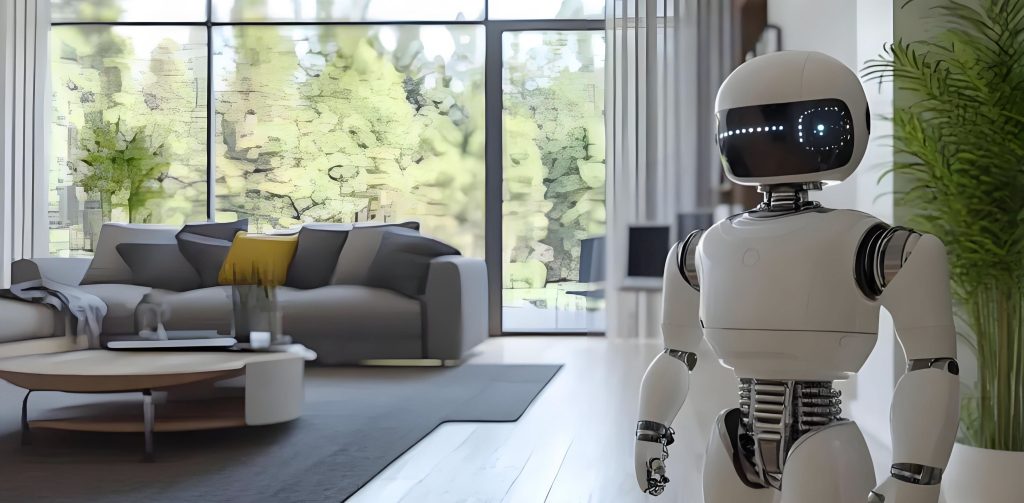
The integration of these design elements results in a companion robot that not only meets functional needs but also fosters emotional connections. For instance, the companion robot’s ability to recognize and respond to emotions can be enhanced through machine learning models. Consider an emotion adaptation algorithm: $$A_{emo} = \arg\max_{a} \left[ \sum_{s} P(s|e) \cdot U(a, s) \right]$$ where \(A_{emo}\) is the optimal action, \(P(s|e)\) is the probability of emotional state \(s\) given evidence \(e\), and \(U(a, s)\) is the utility of action \(a\) in state \(s\). This allows the companion robot to choose responses that maximize positive emotional outcomes for the child.
Moreover, the companion robot’s learning capabilities can be framed as a reinforcement learning problem: $$Q(s,a) \leftarrow Q(s,a) + \alpha [r + \gamma \max_{a’} Q(s’,a’) – Q(s,a)]$$ where \(Q(s,a)\) represents the value of taking action \(a\) in state \(s\), \(r\) is the reward (e.g., child’s smile), \(\alpha\) is the learning rate, and \(\gamma\) is the discount factor. Over time, the companion robot optimizes its interactions to better suit the child’s preferences, strengthening the companionship bond.
In terms of market implementation, the companion robot must balance cost and features. Based on the survey, a price point below 20,000 units is ideal. To achieve this, I propose a cost function: $$C_{total} = C_{materials} + C_{tech} + C_{manufacturing}$$ where \(C_{materials}\) is minimized by selecting affordable yet safe materials, \(C_{tech}\) covers AI and sensor costs, and \(C_{manufacturing}\) is optimized through scalable production. The value proposition of the companion robot can be calculated as: $$V = \frac{F_{score}}{C_{total}}$$ where \(F_{score}\) is a weighted sum of functionality scores. Targeting a high \(V\) ensures competitiveness.
Throughout this study, I have identified several innovations in the design of children’s intelligent companion robots. First, the companion robot achieves real-time emotion recognition and feedback, using multimodal sensors to assess child affect. Second, it offers personalized interactions through adaptive algorithms, catering to individual interests and needs. Third, safety is paramount, with features like emergency stop functions and non-toxic materials. However, limitations exist. Current technology cannot fully simulate genuine human emotions, which may affect the depth of emotional connection. Data privacy concerns arise from the collection of children’s interaction data. Over-reliance on the companion robot might impede social skills development. Additionally, cultural differences in child-rearing practices require localized design adjustments.
To address these challenges, future work should focus on advancing AI emotional models, implementing robust data encryption, and incorporating parental controls to moderate usage. Cross-cultural studies can inform adaptations for global markets. The companion robot’s design should also integrate with educational curricula, promoting balanced development. In summary, this research underscores the potential of emotional design in creating effective children’s intelligent companion robots. By blending technology with empathy, we can develop companion robots that are not only smart but also heartfelt companions for the next generation.
The emotional design framework for companion robots can be extended to other domains, such as elder care or special needs education. The principles of visceral, behavioral, and reflective design remain applicable, with adjustments for target user groups. As AI continues to evolve, the capabilities of companion robots will expand, offering even more nuanced emotional interactions. I envision a future where companion robots become integral to daily life, providing companionship that is both intelligent and emotionally resonant. This study lays a foundation for such advancements, emphasizing the importance of human-centered design in the age of automation.
In conclusion, the design of children’s intelligent companion robots is a multidisciplinary endeavor that merges industrial design, psychology, and artificial intelligence. Through emotional design, we can create products that transcend mere functionality, becoming beloved partners in childhood. The journey involves continuous iteration based on user feedback and technological progress. As I reflect on this research, I am optimistic about the role of companion robots in enhancing children’s lives, offering safe, engaging, and educational experiences. The companion robot, as conceptualized here, represents a step toward a future where technology and emotion harmoniously coexist for the betterment of society.