
The pursuit of high-performance motion control in demanding applications such as aerospace actuation, precision machine tools, and industrial robotics has driven the development of advanced screw mechanisms. Among these, the Planetary Roller Screw Mechanism (PRSM) has emerged as a superior alternative to traditional ball screws, offering significant advantages in load capacity, stiffness, and operational lifespan. A prominent variant within this family is the Inverted Planetary Roller Screw Mechanism (IPRSM), characterized by its compact design where the nut acts as the rotating input and the screw translates axially. This configuration provides a favorable combination of high speed and long stroke. However, the very features that grant the IPRSM its performance—multiple interacting components, concurrent multi-point thread contacts, and combined gear engagements—create a complex dynamic system that is notoriously difficult to model and analyze with high fidelity. Accurately predicting its transmission characteristics, including contact forces, load distribution, and dynamic error, is a critical challenge in its design and optimization.
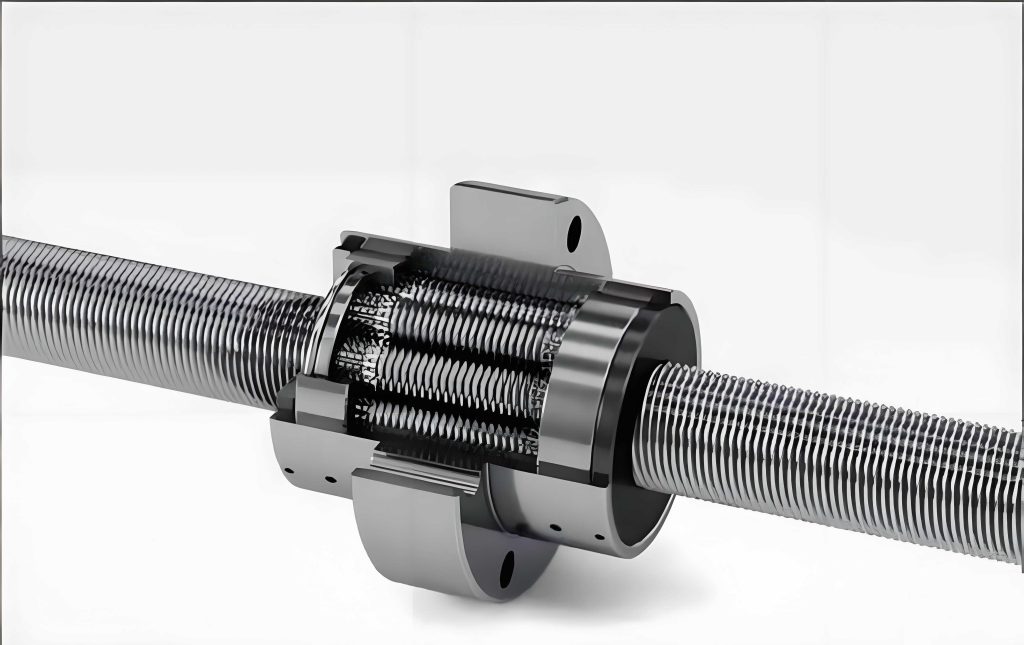
Traditional analytical models for the planetary roller screw often rely on significant simplifications of the contact mechanics and kinematic constraints between components. While providing valuable insights, these simplifications can lead to discrepancies between predicted and actual dynamic behavior, particularly under varying operational loads and speeds. The contact deformations at the threaded interfaces and gear meshes, coupled with the frictional interactions and the constraint provided by the cage, induce phenomena such as roller tilt and pitch circle deviation. These effects result in uneven load sharing among the rollers and their contact points, which directly influences fatigue life, positioning accuracy, and dynamic response. Therefore, developing a high-fidelity dynamic model that accounts for these intricate interactions is paramount for advancing the design and application of the inverted planetary roller screw.
This article presents a detailed methodology for constructing and validating a multi-body dynamic model of an inverted planetary roller screw mechanism using a commercial simulation software, RecurDyn. The model meticulously incorporates the complex contact relationships between the nut, rollers, screw, and cage. Following a rigorous validation against theoretical kinematic principles, the model is employed to conduct a parametric investigation into the传动特性 (transmission characteristics). The influence of key operational parameters—namely, the input nut rotational speed and the output screw axial load—on the average contact forces and the transmission error is quantitatively analyzed. The findings provide critical insights into the internal load distribution and dynamic performance of the planetary roller screw, offering a robust foundation for its structural optimization and reliability assessment.
1. Structural Configuration and Theoretical Kinematics of the IPRSM
The core components of the studied inverted planetary roller screw are the nut, the screw, multiple planetary rollers, and a cage that maintains the angular spacing of the rollers. In this configuration, the nut is the driving component, constrained to rotate about its axis. The screw is the driven component, constrained to translate axially without rotation. The planetary rollers are the intermediate elements; they engage with both the nut and the screw via threaded contacts and with the screw via end-face gear teeth. The cage, interacting with the roller journals, orchestrates the planetary motion of the rollers. For the kinematic analysis, we first establish the theoretical relationships assuming ideal, rigid-body motion without slip or deformation.
Let \( \omega_N \) be the angular velocity of the nut. The roller performs a compound motion: a revolution (or “orbit”) around the screw axis with angular velocity \( \omega_P \), and a rotation about its own axis with angular velocity \( \omega_R \). The gear engagement at the ends synchronizes the motion. Defining the ratio of the screw pitch diameter \( d_S \) to the roller pitch diameter \( d_R \) as \( k_m = d_S / d_R \), the theoretical angular velocities are given by:
$$ \omega_P = \frac{k_m + 2}{2(k_m + 1)} \omega_N $$
$$ \omega_R = \frac{k_m (k_m + 2)}{2(k_m + 1)} \omega_N $$
Since the screw and rollers have the same helix angle and the rollers experience no net axial displacement relative to the screw, the conversion from nut rotation to screw translation is direct. The axial displacement \( L_S \) of the screw is related to the nut rotation by:
$$ L_S = \frac{\omega_N t}{2\pi} n_N P $$
where \( t \) is time, \( n_N \) is the number of nut thread starts, and \( P \) is the pitch. Differentiating with respect to time gives the theoretical screw translation velocity \( v_{Sz} \):
$$ v_{Sz} = \frac{\omega_N}{2\pi} n_N P $$
These theoretical equations serve as the benchmark for validating the dynamic model’s fundamental kinematic output before introducing complex contact dynamics.
| Component | Pitch Diameter (mm) | Pitch (mm) | Number of Starts | Number of Gear Teeth | Gear Module (mm) |
|---|---|---|---|---|---|
| Screw | 22.5 | 1.5 | 3 | 45 | 0.5 |
| Nut | 37.5 | 1.5 | 3 | – | – |
| Roller | 7.5 | 1.5 | 1 | 15 | 0.5 |
2. High-Fidelity Dynamic Modeling in RecurDyn
The dynamic modeling process aims to replicate the physical behavior of the planetary roller screw as closely as possible within a computational environment. This involves defining appropriate kinematic joints, implementing realistic force-based contact models, and applying operational boundary conditions.
2.1 Definition of Kinematic Joints and Constraints
While power is transmitted through contacts, certain degrees of freedom must be constrained to reflect the mechanism’s function. A revolute joint is applied to the nut, allowing only rotation about its axis. A translational joint is applied to the screw, allowing only axial displacement. Components like lock nuts and spacers are fixed to the screw using fixed joints. The cage is not explicitly joined to the screw or nut; its motion emerges entirely from its contact interactions with the roller journals and axial stops. This joint configuration correctly defines the input and output motions while leaving the complex internal interactions to be governed by contact forces.
2.2 Implementation of Nonlinear Contact Forces
The accuracy of the planetary roller screw model hinges on the correct representation of contacts. Five critical contact pairs are defined: 1) Nut thread vs. Roller thread, 2) Screw thread vs. Roller thread, 3) Screw gear vs. Roller gear, 4) Roller journal vs. Cage hole, and 5) Cage face vs. Spacer face. For each pair, a force-based contact algorithm in RecurDyn is used.
The normal contact force \( f_n \) is computed based on an improved Hertzian contact theory, which accounts for both elastic and damping effects via a penalty formulation:
$$ f_n = k \delta^{m_1} + c \frac{\dot{\delta}}{|\dot{\delta}|} \delta^{m_2} \dot{\delta}^{m_3} $$
where \( \delta \) is the penetration depth, \( \dot{\delta} \) is its rate, \( k \) is the contact stiffness coefficient, \( c \) is the damping coefficient, and \( m_1, m_2, m_3 \) are exponents determining the force characteristics.
The tangential friction force \( f_f \) is modeled as a function of the normal force and a velocity-dependent friction coefficient \( \mu(v) \):
$$ f_f = \mu(v) |f_n| $$
The friction coefficient transitions smoothly from a static value \( \mu_s \) to a dynamic value \( \mu_d \) based on the relative sliding velocity \( v \), with defined thresholds \( v_s \) and \( v_d \). This model captures the stick-slip transition essential for dynamic analysis.
| Parameter Category | Symbol | Value | Unit |
|---|---|---|---|
| Normal Force | Stiffness Coefficient, \( k \) | 1.0e5 | N/mm |
| Damping Coefficient, \( c \) | 10 | N/(m/s) | |
| Stiffness Exponent, \( m_1 \) | 2 | – | |
| Damping Exponent, \( m_2 \) | 1 | – | |
| Indentation Exponent, \( m_3 \) | 2 | – | |
| Friction | Static Friction Coefficient, \( \mu_s \) | 0.15 | – |
| Dynamic Friction Coefficient, \( \mu_d \) | 0.10 | – | |
| Static Threshold Velocity, \( v_s \) | 1.0 | mm/s | |
| Dynamic Threshold Velocity, \( v_d \) | 1.5 | mm/s |
2.3 Application of Operational Boundary Conditions
To simulate realistic operation and ensure numerical stability, the applied nut speed and screw load are ramped up smoothly from zero to their target values over the first full revolution (360°) of the nut. The conditions are then held constant for the subsequent analysis phase (nut rotation from 360° to 1080°). This two-stage approach prevents unrealistic transient shocks at the simulation start.
2.4 Model Validation
The completed dynamic model of the inverted planetary roller screw mechanism is simulated under a baseline condition of 1200 rpm nut speed and 20,000 N screw load. The outputs for roller orbit speed \( \omega_P \), roller spin speed \( \omega_R \), and screw translation velocity \( v_{Sz} \) are compared against the theoretical values calculated from Eqs. (1), (2), and (5).
The simulation results show excellent agreement with theory. The roller orbit and spin speeds match their predicted averages closely. The screw translation velocity aligns perfectly with the theoretical line. Notably, the roller spin speed exhibits periodic fluctuations due to the discrete engagement of the end-face gears, a detail captured by the dynamic model but absent in the steady-state theoretical equations. The average relative errors for all compared parameters during the steady-state phase are below 2%, successfully validating the fundamental kinematic correctness of the established planetary roller screw dynamic model.
| Parameter | Simulation Result | Theoretical Value | Average Relative Error |
|---|---|---|---|
| Roller Orbit Speed, \( \omega_P \) | 77.63 rad/s | 78.50 rad/s | 1.1% |
| Roller Spin Speed, \( \omega_R \) | 232.79 rad/s | 235.50 rad/s | 1.2% |
| Screw Translation Velocity, \( v_{Sz} \) | 89.47 mm/s | 89.95 mm/s | 0.5% |
3. Analysis of Transmission Characteristics Under Variable Operating Conditions
With the validated model, a systematic investigation into the传动特性 (transmission characteristics) of the inverted planetary roller screw is conducted. Two key performance metrics are analyzed: 1) the average contact forces at critical interfaces (threads, gears, journals), which relate directly to stress, wear, and fatigue life; and 2) the transmission error, which affects positioning accuracy. The influence of nut speed and screw load is studied separately.
The average contact force \( \bar{F} \) over the steady-state phase is calculated from \( n \) sampled instantaneous force values \( F_i \):
$$ \bar{F} = \frac{1}{n} \sum_{i=1}^{n} F_i $$
The instantaneous axial transmission error \( \Delta L_S \) is defined as the difference between the simulated screw displacement \( L’_S \) and the theoretical displacement \( L_S \) from Eq. (4):
$$ \Delta L_S = L’_S – L_S $$
The peak-to-peak value of \( \Delta L_S \) over the analysis interval represents the magnitude of the dynamic transmission error.
| Study Purpose | Case Group | Nut Speed (rpm) | Screw Axial Load (N) |
|---|---|---|---|
| Speed Effect | 1 | 300 | 20,000 |
| 2 | 600 | 20,000 | |
| 3 | 900 | 20,000 | |
| 4 (Baseline) | 1200 | 20,000 | |
| Load Effect | 5 | 1200 | 5,000 |
| 6 | 1200 | 10,000 | |
| 7 | 1200 | 15,000 | |
| 4 (Baseline) | 1200 | 20,000 |
3.1 Influence of Nut Rotational Speed
Figure X shows the effect of increasing nut speed on the average thread contact forces. The forces between the rollers and both the screw and nut threads show a mild positive correlation with speed. This increase is attributed to heightened inertial effects and vibration within the planetary roller screw assembly, leading to more pronounced impact forces at the contacting surfaces. The force on the nut-thread interface is consistently slightly higher than on the screw-thread interface, indicating a load distribution bias caused by the complex equilibrium of forces and moments in the deformed state.
Figure Y presents the average contact forces on the left and right flanks of the end-face gear teeth. In an ideal, rigid planetary roller screw, these gears should experience minimal load, serving only for phasing. However, the dynamic model reveals significant and uneven flank loads. Contact deformations cause roller tilt and axis misalignment, breaking the perfect kinematic condition and forcing the gears to carry load. The left and right flanks carry different loads, confirming the uneven loading condition. The gear contact forces also increase with nut speed due to greater dynamic excitation.
Figure Z displays the contact forces at the left and right journals of a roller against the cage holes. A pronounced asymmetry is observed. The load is not equally shared between the two journals, a direct consequence of roller tilting induced by the off-ideal contact conditions within the planetary roller screw. Interestingly, the asymmetry is more severe at lower speeds (300 rpm), suggesting that the stabilizing centripetal effects at higher speeds may slightly mitigate the tilt. The left journal force increases with speed while the right decreases, further illustrating the speed-dependent dynamic equilibrium.
The transmission error of the planetary roller screw, plotted in Figure W, oscillates within a band of approximately ±3 μm for all speeds. The peak-to-peak error amplitude shows a clear increasing trend with nut speed, as summarized in Table 5. Higher speeds exacerbate vibrations and transient deformations, thereby increasing the deviation from ideal kinematic motion.
| Nut Speed (rpm) | Min Instantaneous Error (μm) | Max Instantaneous Error (μm) | Peak-to-Peak Error (μm) |
|---|---|---|---|
| 300 | -1.82 | 1.23 | 3.05 |
| 600 | -2.10 | 1.48 | 3.58 |
| 900 | -1.41 | 2.41 | 3.82 |
| 1200 | -2.24 | 1.66 | 3.90 |
3.2 Influence of Screw Axial Load
Figure A demonstrates a strong, linear relationship between the applied axial load and the average thread contact forces in the planetary roller screw. This is expected, as the thread interfaces are the primary load-bearing paths. Doubling the load approximately doubles the thread contact force. The bias where the nut-thread force is higher than the screw-thread force persists across all load levels.
The gear flank contact forces, shown in Figure B, exhibit a different trend. The forces increase from the 5,000 N to the 10,000 N case but then stabilize or increase only marginally at higher loads (15,000 N and 20,000 N). This suggests that the misalignment and roller tilt causing the gear load may reach a saturated state; beyond a certain primary load, the additional force is carried predominantly by the threads, not by further increasing the gear mesh interference. Load has a less dramatic effect on gear forces compared to speed.
The journal contact forces in Figure C show that load significantly exacerbates the asymmetry between the left and right journals. Higher external load increases the overall contact deformations, which amplifies the roller tilting moment, leading to a greater disparity in journal reactions. This uneven load distribution on the journals is a critical factor for cage wear and roller guidance stability in a heavily loaded planetary roller screw.
As seen in Figure D and Table 6, the transmission error amplitude also increases with the applied axial load. Higher loads cause larger elastic deflections at all contact interfaces. These time-varying deflections, synchronized with the rotation, manifest as a larger deviation from the ideal screw displacement, directly degrading the positioning accuracy of the planetary roller screw mechanism.
| Screw Axial Load (N) | Min Instantaneous Error (μm) | Max Instantaneous Error (μm) | Peak-to-Peak Error (μm) |
|---|---|---|---|
| 5,000 | -1.48 | 1.82 | 3.30 |
| 10,000 | -1.81 | 1.83 | 3.64 |
| 15,000 | -1.63 | 2.13 | 3.76 |
| 20,000 | -2.24 | 1.66 | 3.90 |
4. Conclusions
This study successfully addresses the challenge of high-fidelity dynamic modeling for the complex inverted planetary roller screw mechanism (IPRSM). A detailed multi-body dynamics model was constructed in RecurDyn, explicitly accounting for the nonlinear contact interactions at all critical interfaces: thread engagements, gear meshes, and journal supports. The model’s validity was conclusively demonstrated by the excellent agreement (less than 2% error) between its predicted kinematic outputs (roller speeds, screw velocity) and established theoretical values for rigid-body motion.
The deployed model served as a powerful virtual testbed to unravel the传动特性 (transmission characteristics) of the planetary roller screw under varying operational conditions. The analysis yields several key conclusions crucial for the design and application of this mechanism:
- Contact Force Trends: The average contact forces on the thread interfaces exhibit distinct correlations with operating parameters. They show a mild positive correlation with increasing nut rotational speed, primarily due to heightened dynamic inertial effects. In contrast, they demonstrate a strong, linear positive correlation with increasing screw axial load, as the threads form the principal load path.
- Inherent Load Distribution Inequalities: A significant finding is the inherent uneven load distribution within a dynamically operating planetary roller screw, caused by contact deformations. This manifests in two ways: (a) Uneven loading between the left and right flanks of the synchronizing end-face gears, proving these gears carry non-negligible load despite their theoretical role, and (b) Significant asymmetry in the contact forces at the left and right journals of each roller against the cage. This journal load asymmetry is sensitive to both speed and load, worsening at lower speeds and higher loads, respectively, and has direct implications for cage durability.
- Dynamic Transmission Error: The axial transmission error of the screw, arising from cumulative contact deformations and vibrations, increases with both nut speed and screw load. Higher speeds intensify dynamic excitations, while higher loads increase the magnitude of elastic deflections at the contacts, both contributing to greater deviation from ideal kinematic motion.
In summary, the developed modeling methodology and the ensuing analysis provide deep insights into the internal mechanics of the inverted planetary roller screw mechanism. The findings highlight that achieving optimal performance—balancing load capacity, life, and accuracy—requires designs that account for the dynamic load-sharing phenomena revealed here. This work establishes a robust foundation for future structural optimization of planetary roller screw components, such as profiling raceways or optimizing cage guidance, to mitigate uneven loads and enhance overall mechanism reliability and precision.