
In recent years, as oilfield development has entered its middle and late stages, conventional rodless pumping equipment has proven inadequate for handling complex wellbore structures such as low-production wells, highly deviated wells, and wells with severe wear issues. Traditional solutions, like electric submersible progressive cavity pumps or reciprocating pumps driven by linear motors, often suffer from low motor efficiency, insufficient thrust, and high failure rates, limiting their widespread adoption. To address these challenges, we have designed and developed a submersible electric cylinder plunger pump that utilizes a planetary roller screw transmission device. This innovative approach converts the rotary motion of a motor into linear motion to drive the plunger pump, enabling efficient oil extraction in challenging conditions. The core of this system is the planetary roller screw, a mechanical device that excels in transforming rotational energy into precise linear movement with high efficiency and reliability.
The overall design of the submersible electric cylinder plunger pump consists of four main components: the plunger oil pump, the planetary roller screw transmission device, the protector, and the rotary motor. The plunger oil pump employs an inverted structure with a fixed valve at the top to push oil upward. The planetary roller screw transmission device is responsible for converting the motor’s rotary motion into linear output. The protector uses a breathing bladder to compensate for lubricant in the transmission device and motor. The rotary motor is a permanent magnet synchronous motor designed for low-speed operation. This integrated system leverages the unique advantages of the planetary roller screw to overcome the limitations of previous technologies.
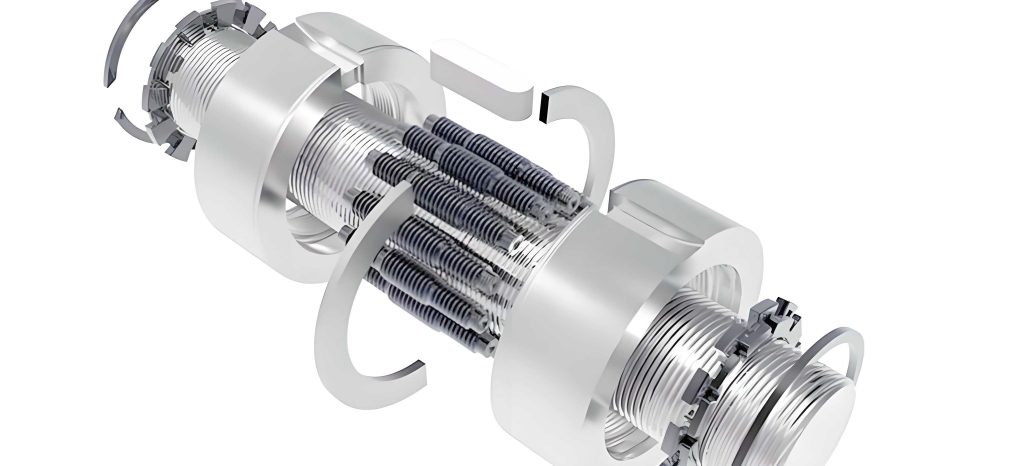
The planetary roller screw transmission device is the heart of this system. A planetary roller screw consists of a threaded screw, a nut, threaded rollers, retaining rings, and flat keys. In this configuration, multiple threaded rollers are arranged planetarily around the threaded screw. The screw is connected to the motor shaft, while the nut is linked to the plunger of the oil pump. As the motor rotates the screw, the rollers are driven passively, causing the nut to move in a reciprocating linear motion. To ensure optimal performance in submersible applications, several critical mechanisms are integrated into the transmission device: a sealing mechanism to isolate well fluid, an anti-rotation mechanism to prevent nut twisting, and a thrust mechanism to counteract reactive forces on the screw. The planetary roller screw design offers numerous benefits, including high transmission efficiency, minimal friction loss, precise positioning, smooth motion without crawling, low noise, high reliability, easy maintenance, low energy consumption, and long service life.
The structural composition of the planetary roller screw transmission device can be summarized in the following table:
| Component | Description | Function |
|---|---|---|
| Sealing Mechanism | Includes lock nuts, adjustment rings, oil seals, sealing joints, and push rods. Features 2-3 axial oil seals with lubrication grooves. | Prevents well fluid ingress, reduces friction heat, and extends seal life. |
| Anti-rotation Mechanism | Comprises anti-rotation rods, pressure plates, hard alloy liners, and guide joints with polygonal interfaces. | Restricts nut rotation, allowing only linear motion. |
| Planetary Roller Screw Mechanism | Consists of the planetary roller screw, anti-collision rings, annular springs, and spring seats. Includes a sliding sleeve for screw alignment. | Converts rotary to linear motion, with damping to absorb reversal impacts. |
| Thrust Mechanism | Includes connecting shafts, needle roller bearings, thrust cylindrical roller bearings, bearing housings, protector joints, and spline sleeves. | Absorbs axial forces from the screw, using paired bearings for bidirectional thrust. |
In the planetary roller screw system, the screw rotates while the nut is constrained to linear motion. This necessitates a robust anti-rotation design. We implemented a polygonal anti-rotation rod connection, where the rod links the nut to the plunger. The rod has a triangular prism shape, transferring radial forces to the support via wear-resistant plates. Stress analysis is crucial for ensuring the durability of the anti-rotation rod and wear plates. The stress on the anti-rotation rod can be evaluated using the following formula for shear stress due to torsional loads:
$$ \tau = \frac{T \cdot r}{J} $$
where $\tau$ is the shear stress, $T$ is the torque applied, $r$ is the radius of the rod, and $J$ is the polar moment of inertia. For a solid circular cross-section, $J = \frac{\pi d^4}{32}$, with $d$ as the diameter. However, for our polygonal design, we modify this based on the geometry. Additionally, the contact stress on the wear plates can be approximated using Hertzian contact theory for curved surfaces:
$$ \sigma_c = \sqrt[3]{\frac{6F E^2}{\pi^3 R^2 (1-\nu^2)^2}} $$
where $\sigma_c$ is the maximum contact stress, $F$ is the normal force, $E$ is the modulus of elasticity, $R$ is the effective radius of curvature, and $\nu$ is Poisson’s ratio. These calculations ensure that the planetary roller screw assembly operates within safe stress limits, enhancing reliability.
The plunger oil pump in our system adopts an inverted configuration, with the fixed valve at the top and the pump barrel and plunger below. This design facilitates upward oil displacement. During the plunger’s upstroke, the ball valve in the upper closed valve opens while the lower one closes, allowing well fluid to flow into the tubing. During the downstroke, the upper valve closes and the lower opens, filling the pump barrel with fluid. This operation is synchronized with the linear motion generated by the planetary roller screw, ensuring efficient pumping.
The protector unit is divided into upper and lower sections. The upper protector connects to the transmission device cavity, using a breathing capsule to compensate for lubricant volume changes. The lower protector links to the motor cavity, balancing internal and external pressures, compensating for thermal expansion of motor oil, and preventing well fluid ingress to avoid motor burnout. This dual-protector design is essential for maintaining the integrity of both the planetary roller screw system and the motor in harsh downhole environments.
The rotary motor is a low-speed permanent magnet synchronous motor tailored for submersible applications. Its power can be scaled by connecting multiple identical motor sections in series to meet varying output demands. The motor’s torque and speed characteristics are optimized to work seamlessly with the planetary roller screw transmission. The relationship between motor torque $T_m$, screw thrust $F_s$, and planetary roller screw parameters is given by:
$$ F_s = \frac{2 \pi \eta T_m}{P} $$
where $\eta$ is the transmission efficiency of the planetary roller screw (typically above 90%), and $P$ is the lead of the screw. This equation highlights how the planetary roller screw amplifies motor torque into substantial linear force, crucial for deep well applications.
We conducted extensive testing to validate the performance of the planetary roller screw-based pump. Initial factory tests included no-load and load trials to assess mechanical behavior (impact, vibration, shaking) and control systems (stroke control, cycle control, error accumulation control). Load tests were performed at pressures of 2, 4, 6, 8, 12, 16, and 18 MPa, with measurements of flow rate, voltage, current, and power. The results confirmed that the design met all specifications. Following this, field industrial trials were carried out in an oil well with a depth of 1600 m, 86% water cut, and 5.5-inch casing. The technical parameters for the pump are summarized below:
| Parameter | Value |
|---|---|
| Plunger Pump Diameter | 57 mm |
| Planetary Roller Screw Lead | 24 mm |
| Maximum Thrust of Planetary Roller Screw | 6 t (58.8 kN) |
| Maximum Stroke | 650 mm |
| Protector Maximum Breathing Volume | 4.4 L |
| Motor Power | 9 kW |
| Motor Rated Speed | 300–500 r/min |
| Motor Torque | 230–440 N·m |
During field operation, key running parameters were set: maximum speed of 500 r/min, screw stroke of 550 mm, compensation distance of 0 mm, top and bottom dwell times of 1.0 s, current limits of 20 A (upstroke) and 12 A (downstroke), acceleration and deceleration times of 3.6–4.0 s, and a total cycle time of 18.4 s. The system achieved a flow rate of 6.5 m³/day at 1600 m depth with an outlet pressure of 0.5 MPa, meeting user requirements. The planetary roller screw’s adaptability allows for designing different leads and strokes to match various flow and lift needs, demonstrating its versatility.
The efficiency of the planetary roller screw transmission can be further analyzed using power balance equations. The input power $P_{in}$ from the motor is partially converted to useful output power $P_{out}$ for fluid lifting, with losses due to friction and heat. The overall system efficiency $\eta_{sys}$ is:
$$ \eta_{sys} = \frac{P_{out}}{P_{in}} = \eta_{motor} \cdot \eta_{planetary\ roller\ screw} \cdot \eta_{pump} $$
where $\eta_{motor}$ is motor efficiency, $\eta_{planetary\ roller\ screw}$ is the transmission efficiency (often exceeding 0.9 for planetary roller screws), and $\eta_{pump}$ is the hydraulic efficiency of the plunger pump. Comparative studies show that systems using planetary roller screws achieve higher $\eta_{sys}$ than those with linear motors, due to reduced electrical and mechanical losses.
To illustrate the performance gains, consider the following table comparing key metrics between conventional rod pumping systems and our planetary roller screw-based pump:
| Metric | Conventional Rod Pump | Planetary Roller Screw Pump |
|---|---|---|
| Adaptability to Deviated Wells | Poor (rod wear issues) | Excellent (rodless design) |
| Energy Consumption | High (mechanical losses in rods) | Low (direct drive with high efficiency) |
| Control Precision | Limited | High (electronic stroke control) |
| Maintenance Frequency | Frequent (rod failures) | Reduced (robust planetary roller screw) |
| Noise Level | Moderate to High | Low (smooth motion of planetary roller screw) |
The success of the field trials confirms that the submersible electric cylinder plunger pump, centered on the planetary roller screw, operates stably and reliably. It offers comprehensive and accurate control data, along with green energy efficiency. Compared to conventional pumping units, it exhibits clear advantages: it adapts well to low-flow, highly deviated, and wear-prone wells; reduces energy consumption by eliminating rod drag; enables remote monitoring and parameter adjustment; and has a comparable comprehensive cost when factoring in product, labor, energy, and maintenance expenses. The planetary roller screw’s high efficiency and low failure rate make it suitable for horizontal wells, slanted wells, and other complex wellbores, extending pump inspection cycles, saving investment, shortening operation times, lowering costs, improving lifting efficiency, reducing energy use, and broadening applicability.
Looking ahead, the potential for planetary roller screw technology in submersible pumps is vast. Future developments could involve optimizing the planetary roller screw geometry for even higher thrust capacities or integrating smart sensors for predictive maintenance. The mathematical modeling of planetary roller screw dynamics, including vibration analysis, can be refined using differential equations. For instance, the motion equation for the nut in a planetary roller screw system under dynamic loads might be expressed as:
$$ m \ddot{x} + c \dot{x} + k x = F(t) – F_{fluid} $$
where $m$ is the mass of moving parts, $c$ is the damping coefficient (influenced by lubrication in the planetary roller screw), $k$ is the stiffness of the assembly, $x$ is displacement, $F(t)$ is the force from the planetary roller screw, and $F_{fluid}$ is the hydraulic resistance from the pump. Solving such equations helps in designing more resilient systems.
In conclusion, the integration of planetary roller screw mechanisms into submersible electric pumps represents a significant advancement in artificial lift technology. By leveraging the planetary roller screw’s ability to efficiently convert rotary motion to linear thrust, we have created a system that addresses the shortcomings of existing methods. The planetary roller screw’s robustness, precision, and efficiency make it an ideal choice for demanding oilfield conditions. As the industry continues to evolve, the planetary roller screw will undoubtedly play a pivotal role in enhancing production efficiency and sustainability. We are confident that ongoing innovations in planetary roller screw design and application will further solidify its position as a cornerstone of modern pumping solutions.