
As an engineer deeply involved in the field of advanced actuation systems, I have witnessed a significant paradigm shift from traditional hydraulic and pneumatic systems towards electromechanical solutions. Among these, the planetary roller screw electric cylinder stands out as a transformative technology. This article synthesizes my perspective and analysis on its principles, comparative advantages, current application landscape, and future trajectory. The core motivation is to elucidate why this technology is becoming the preferred choice for high-performance, high-reliability applications across demanding industries.
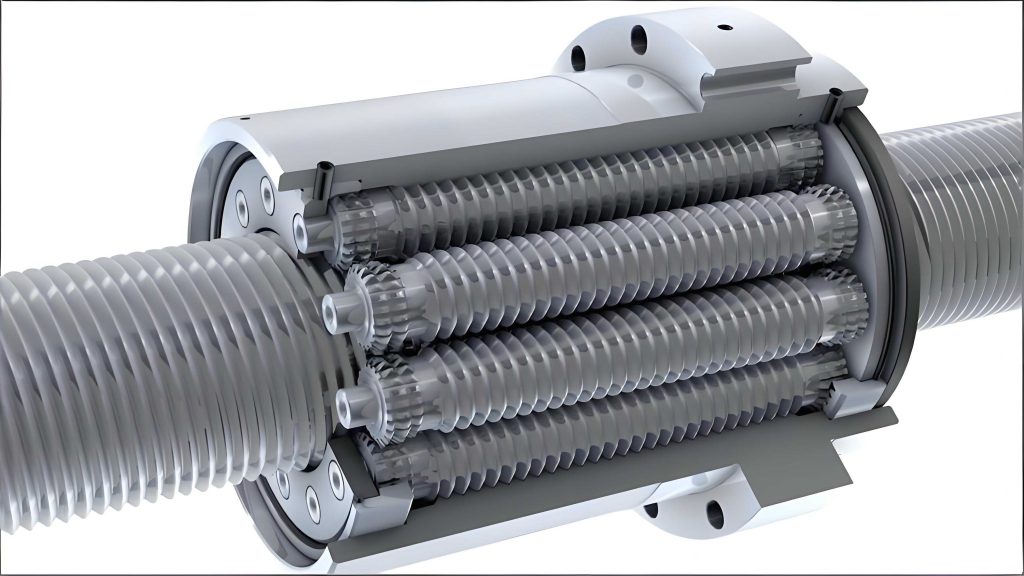
The fundamental principle of the planetary roller screw mechanism is elegantly derived from planetary gear systems combined with the efficiency of screw-nut translation. At its heart are three primary components: a central threaded screw (acting as the sun gear), multiple threaded rollers (the planet gears), and an internally threaded nut (the ring gear). When the screw rotates, it drives the rollers, which in turn engage with the threads on the nut. Due to the differential threading, the rollers perform a planetary motion—they rotate on their own axes while revolving around the screw—causing the nut to translate linearly. The kinematic relationship can be described by the fundamental translation formula for screw mechanisms:
$$ L = P \cdot n $$
where \( L \) is the linear displacement of the nut, \( P \) is the lead of the screw (distance advanced per revolution), and \( n \) is the number of screw revolutions. For a planetary roller screw, the effective lead is determined by the thread differential between the screw, rollers, and nut. The transmission ratio and force multiplication are significantly enhanced by distributing the load across multiple contact lines on the several rollers.
To fully appreciate the superiority of the planetary roller screw, it is crucial to compare it with other common linear actuation screw technologies. The following table provides a quantitative and qualitative comparison.
| Feature / Parameter | Trapezoidal (Acme) Screw | Ball Screw | Planetary Roller Screw |
|---|---|---|---|
| Contact Mechanics | Sliding Friction | Point Contact (Rolling) | Line Contact (Rolling) |
| Typical Efficiency (η) | 20% – 50% | 85% – 95% | 85% – 92% |
| Load Distribution | On screw thread flanks | On multiple ball points | On multiple roller lines |
| Static Load Capacity | Low-Medium | 1x (Reference) | > 3x (Reference to Ball Screw) |
| Dynamic Load Capacity | Very Low | 1x (Reference) | > 2x (Reference to Ball Screw) |
| Impact Resistance | Poor | Moderate | Excellent |
| Maximum Speed | Very Low (< 100 rpm) | High (3,000 – 6,000 rpm) | Very High (Up to 10,000 rpm) |
| Service Life (L10) | Short | 1x (Reference) | 5x – 15x (Reference to Ball Screw) |
| Noise Generation | Low (if lubricated) | Medium-High (ball circulation) | Low (gear meshing frequency) |
| Backlash | Adjustable (high) | Adjustable (low) | Adjustable (very low) |
The integration of this superior planetary roller screw mechanism with a high-performance servomotor creates the electric cylinder. This system translates the rotary motion of the motor into precise linear motion, governed by the control equation:
$$ F_a = \frac{2 \pi \cdot \eta \cdot T}{P} $$
where \( F_a \) is the output axial force, \( \eta \) is the mechanical efficiency of the planetary roller screw assembly, \( T \) is the input torque from the motor, and \( P \) is the lead. The advantages of this integrated system are multifaceted:
- High Power Density and Compactness: The line contact in a planetary roller screw allows a much smaller diameter for the same load compared to a ball screw, reducing the overall envelope. The direct integration of the motor (especially in in-line or rotary-to-linear designs) eliminates bulky couplings and reducers.
- Exceptional Dynamic Response: The low inertia of the rotating components (screw and rollers) combined with high-stiffness contact lines enables very high acceleration and deceleration, often exceeding 3-5 g. The maximum linear speed can surpass 2 m/s.
- Superior Reliability and Durability: The absence of recirculating elements (like balls in a ball screw) that undergo repeated impact loading eliminates a primary failure mode. The load is spread over a vast number of contact points, drastically reducing stress and wear.
- Environmental Robustness: The sealed design of an electric cylinder, particularly those with integrated motors, inherently protects the planetary roller screw mechanism from contaminants like dust, moisture, and chemical splash. They operate effectively in a wide temperature range and require minimal lubrication.
- Precision and Controllability: When paired with a servo motor and encoder, the system offers exceptional positioning accuracy (micron-level repeatability) and precise force control, making it ideal for sensitive automation and testing tasks.
The global application landscape for planetary roller screw electric cylinders reveals their penetration into mission-critical sectors. While domestic development is progressing, international leaders have established a strong foothold. The table below categorizes the primary application domains and specific use cases.
| Industry Sector | Percentage of Market (Est.) | Typical Applications | Key Drivers for Adoption |
|---|---|---|---|
| Aerospace & Defense | ~25% | Flight control surfaces, landing gear actuation, missile launcher positioning, helicopter rotor controls, submarine steering. | High reliability, power density, resistance to extreme temperatures, maintenance-free operation, elimination of hydraulic fluid hazards. |
| Industrial Automation | ~30% | Robotic end-effectors, precision press fitting, welding gun positioning, material handling, packaging machinery. | High speed, precision, programmability, cleanliness (no oil leaks), and energy efficiency compared to pneumatics. |
| Test & Simulation | ~20% | Vibration and fatigue test stands, flight simulators, crash test sleds, structural load testing. | High force capability, dynamic response, precise load control, and ability to simulate complex load profiles. |
| Energy & Process Control | ~15% | Valve actuation in oil/gas/power plants, solar tracker positioning, dam gate control. | High thrust in compact spaces, environmental sealing, and remote operability. |
| Other (Medical, Entertainment, etc.) | ~10% | Patient positioning systems, surgical robots, motion platforms for rides and simulators. | Smooth motion, high acceleration, low noise, and safety/reliability. |
From my analysis, the technological evolution of the planetary roller screw electric cylinder is directed by several convergent trends, often expressed as multi-objective optimization challenges. The performance envelope is constantly being pushed, governed by interrelated physical limits. For instance, the relationship between speed, load, and life can be modeled by a modified Lundberg-Palmgren theory for rolling contacts, applied to the roller-screw interface:
$$ L_{10} = \left( \frac{C}{P_{eq}} \right)^3 \cdot \frac{10^6}{60 \cdot n} $$
Here, \( L_{10} \) is the rated life in hours, \( C \) is the dynamic load rating of the planetary roller screw, \( P_{eq} \) is the equivalent dynamic load, and \( n \) is the rotational speed in rpm. The trends focus on maximizing \( C \) and \( n \) while minimizing \( P_{eq} \) and system size. Key vectors include:
- Increased Load Capacity and Stiffness: Research focuses on advanced materials (e.g., high-grade bearing steels, ceramics), innovative heat treatment processes, and optimized thread profiles to increase the dynamic load rating \( C \). The goal is to achieve higher static and dynamic load capacities without increasing the footprint.
- Higher Speeds and Accelerations: This requires balancing centrifugal forces on the rollers, optimizing lubrication for high-speed shear, and minimizing inertial losses. The limiting factor often becomes the planetary gear meshing at the roller ends or the first critical bending speed of the screw shaft.
- Extended Stroke Lengths: Developing longer, precision-ground screws while managing deflection and whip is a significant manufacturing challenge. The critical speed for a simply supported screw is given by:
$$ n_{cr} = \frac{4.73^2}{2\pi L^2} \sqrt{\frac{EI}{m}} $$
where \( L \) is the length between supports, \( E \) is Young’s modulus, \( I \) is the area moment of inertia, and \( m \) is mass per unit length. Pushing this limit requires novel support strategies or composite/metal hybrid screw designs. - Deep Integration and Miniaturization: The trend is towards fully mechatronic packages where the motor rotor is the screw or nut itself (rotary-linear motors), or where the motor is housed within the cylinder body. This minimizes parts count, connection losses, and overall size.
- Intelligence and Condition Monitoring: Embedding sensors for temperature, vibration, and load directly into the planetary roller screw assembly enables predictive maintenance, real-time health monitoring, and adaptive control, further enhancing system reliability.
For domestic enterprises aiming to close the gap with international leaders, a strategic and focused development approach is paramount. Based on the current landscape, I would prioritize the following recommendations:
- Foundational Research on Tribology and Dynamics: Invest in fundamental R&D to model the complex multi-contact elastohydrodynamic lubrication (EHL) in the planetary roller screw interface. Understanding the precise conditions for wear, skidding, and optimal film formation is key to predicting life and performance under extreme conditions.
- Mastery of Advanced Manufacturing and Metrology: The heart of a high-performance planetary roller screw lies in ultra-precise thread grinding, heat treatment for dimensional stability, and assembly. Developing domestic capability for manufacturing and, crucially, for measuring thread profiles, lead accuracy, and surface finish at the micron/sub-micron level is non-negotiable.
- System Integration and Validation Expertise: Moving from component supplier to system solution provider requires deep expertise in servo motor matching, thermal management, control algorithm development, and comprehensive lifecycle testing (e.g., accelerated life testing, environmental stress screening).
- Targeted Application Development: Instead of a broad approach, focus on dominating niche, high-value applications where the unique benefits of the planetary roller screw are indispensable (e.g., specific defense or aerospace subsystems, high-cycle industrial automation). Success in these areas builds reputation and drives iterative product improvement.
- Collaboration and Standardization: Foster collaboration between academia, research institutes, and industry to share knowledge. Participate in or drive the development of industry standards for performance testing and rating of planetary roller screw assemblies to ensure quality and interoperability.
In conclusion, the planetary roller screw electric cylinder represents a pinnacle of electromechanical actuation design, offering an unmatched combination of force, speed, precision, and robustness. Its adoption is accelerating, driven by the global demand for cleaner, smarter, and more reliable automation. While the technological bar is high, a concerted effort focused on core research, precision manufacturing, and strategic application can position domestic innovation at the forefront of this critical technology’s next evolutionary phase. The transition from hydraulic to electric motion, with the planetary roller screw at its core, is not merely a trend but a fundamental shift in engineering philosophy for high-performance systems.