
The transmission of motion and force between rotary and linear domains is a fundamental requirement in countless mechanical systems. Among the various solutions available, the planetary roller screw (PRS) mechanism stands out for its exceptional load capacity, high stiffness, and reliability. As a key component in applications ranging from aerospace actuators and precision machine tools to heavy-duty industrial machinery, understanding its detailed contact mechanics is paramount for optimal design and longevity. This article delves into a critical, yet often underexplored, geometric parameter: the thread profile angle (or vertex angle). Through a detailed theoretical and numerical investigation, we will establish how variations in this angle fundamentally alter the contact stress distribution between the screw and the rollers, directly influencing the mechanism’s performance and lifespan.
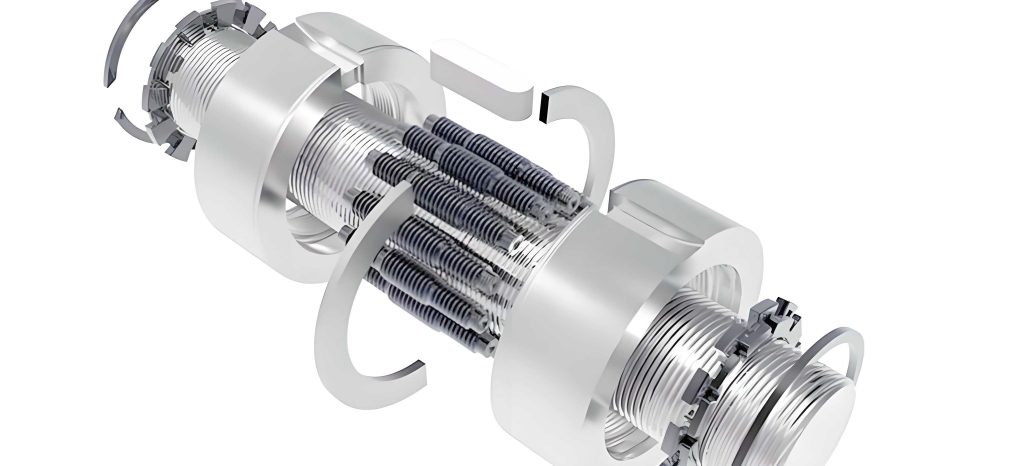
The core of a planetary roller screw assembly consists of three primary components: a central screw with a multi-start thread, a nut with a corresponding multi-start thread, and several threaded rollers (typically 5 to 10) positioned circumferentially between them. The rollers feature single-start threads and are constrained by integral gears at their ends to maintain proper phasing and prevent axial migration relative to the nut. When the screw rotates, the rollers both revolve around the screw axis (planetary motion) and rotate about their own axes, causing the nut to translate axially. The significant advantage of the planetary roller screw over its ball-screw counterpart lies in the vastly increased number of load-bearing contact points. Instead of discrete balls, the full flanks of the roller threads engage with the screw and nut threads, leading to a much larger contact area and, consequently, superior load capacity and rigidity.
The contact at each thread interface is typically a modified line contact, often approximated by a Hertzian point contact when the roller thread is crowned with a spherical profile. This design choice reduces edge stresses and accommodates minor misalignments. The geometry of this contact, defined by parameters such as the helix angle, the contact angle, and crucially, the thread profile angle, dictates the magnitude and distribution of contact pressure. Excessive or uneven contact stress is a primary driver of failure modes like pitting, spalling, and wear in planetary roller screw systems. Therefore, a thorough analysis of the contact characteristics is not merely an academic exercise but a necessity for robust engineering design.
Theoretical Foundation and Modeling
To isolate and study the effect of the thread profile angle, we first establish a simplified yet representative model. We consider a single roller in mesh with the screw, extracting a segment containing a finite number of engaged thread turns. This approach reduces computational complexity while capturing the essential physics of load sharing and stress concentration. The analysis focuses on the screw-roller interface, as it typically experiences more severe loading conditions than the roller-nut interface due to the smaller relative curvature.
1. Geometric Relationships
The thread profile angle, denoted by $$ \alpha $$, is the included angle between the two flanks of a symmetric thread. In a standard planetary roller screw design, both the screw and nut have trapezoidal thread profiles, while the rollers are crowned. The crown is usually generated from a sphere with its center located on the roller’s axis. The radius of this equivalent sphere, $$ R_{eq} $$, is intrinsically linked to the nominal roller pitch diameter $$ d_r $$ and the desired contact condition with the screw flank. For a given roller mid-diameter and a specified profile angle, the equivalent spherical radius required to maintain tangential contact at the pitch line can be derived as:
$$ R_{eq} = \frac{d_r}{2 \sin(\alpha/2)} $$
This relationship is pivotal. It shows that for a constant roller diameter, changing the profile angle $$ \alpha $$ necessitates a change in the crowning radius $$ R_{eq} $$. A smaller angle requires a larger crown radius, and vice-versa. For our study, we maintain a constant theoretical tooth thickness at the pitch diameter of the roller while varying $$ \alpha $$. This ensures a consistent load-carrying width while altering the flank inclination and the contact conformity.
The contact angle $$ \beta $$, defined as the angle between the common normal at the contact point and the radial direction, is another critical parameter influenced by the profile angle. For a screw with a straight-sided flank (trapezoidal profile) and a roller with a spherical crown, the instantaneous contact angle depends on the axial position of the contact point. However, at the designed pitch point of contact, a direct geometric relationship exists. The contact angle is approximately equal to the complement of half the profile angle for contacts occurring on the load-bearing flank. This can be expressed as:
$$ \beta \approx 90^\circ – \frac{\alpha}{2} $$
This approximation highlights a fundamental trade-off: a larger thread profile angle $$ \alpha $$ results in a smaller contact angle $$ \beta $$. Research indicates that a smaller contact angle can lead to higher contact pressures but may be beneficial for reducing spin-sliding losses, a significant source of friction in planetary roller screw mechanisms.
2. Contact Mechanics Model
The contact between the spherical roller flank and the inclined planar (or slightly concave) screw flank is modeled using Hertzian theory for elastic point contact. Although the actual contact is elliptical, the high conformity in one direction allows for a simplified analysis to understand trends. The maximum contact pressure $$ p_0 $$ at the center of the contact ellipse is given by:
$$ p_0 = \frac{3Q}{2\pi a b} $$
where $$ Q $$ is the normal load at the contact point, and $$ a $$ and $$ b $$ are the semi-major and semi-minor axes of the contact ellipse, respectively. These dimensions are calculated from the principal relative curvatures of the contacting bodies and the material properties (Young’s modulus $$ E $$ and Poisson’s ratio $$ \nu $$).
The relative curvature sum $$ \sum \rho $$ for this contact is:
$$ \sum \rho = \rho_{1I} + \rho_{1II} + \rho_{2I} + \rho_{2II} $$
For the screw (body 1) with a straight flank, the principal curvatures in the plane perpendicular to the thread helix are: $$ \rho_{1I} = 0 $$ (along the thread length, assumed flat) and $$ \rho_{1II} = 1/\infty = 0 $$ (across the thread, depending on flank concavity, often taken as zero for a plane). For the roller (body 2) with a spherical crown of radius $$ R_{eq} $$, the principal curvatures are both equal to $$ 1/R_{eq} $$, but one is aligned with the roller axis and the other is perpendicular. The effective curvature in the direction across the screw flank is modified by the contact angle $$ \beta $$. A more complete analysis requires the curvature tensor transformation, but qualitatively, increasing $$ \alpha $$ (which decreases $$ \beta $$ and $$ R_{eq} $$) increases the effective relative curvature $$ \sum \rho $$. According to Hertz theory, the contact ellipse dimension $$ b $$ (the smaller semi-axis, typically across the thread) is inversely proportional to $$ (\sum \rho)^{1/3} $$. Therefore, a larger $$ \sum \rho $$ leads to a smaller contact area and, for a constant load $$ Q $$, a higher maximum contact pressure $$ p_0 $$. This provides the initial theoretical expectation: increasing the thread profile angle tends to increase contact stress.
3. Load Distribution Model
A critical aspect of planetary roller screw performance is that the applied axial load is not shared equally among all engaged threads. Due to elastic deformations, the first few load-bearing threads closest to the load application carry a disproportionately high share of the total load. This load distribution can be modeled by a system of springs in series, where the compliance of each thread contact is governed by its Hertzian contact stiffness and the local bending/shear stiffness of the tooth.
The normal load on the i-th thread, $$ Q_i $$, can be expressed relative to the total axial load $$ F_a $$ converted to normal load via the helix angle $$ \lambda $$ and contact angle $$ \beta $$:
$$ Q_i = \frac{F_a \cdot \gamma_i}{n \cdot \sin \lambda \cdot \cos \beta} $$
where $$ n $$ is the number of rollers, and $$ \gamma_i $$ is the load distribution factor for the i-th thread, with $$ \sum_{i=1}^{N} \gamma_i = 1 $$ and $$ \gamma_1 > \gamma_2 > \gamma_3 > … $$. The value of $$ \gamma_1 $$ is highest, often accounting for 25-40% of the total load on that roller flank, depending on the number of engaged threads and the system stiffness. The finite element analysis conducted in this study directly computes these $$ \gamma_i $$ factors by evaluating the relative reaction forces at each thread contact.
Finite Element Analysis and Parameter Study
To accurately capture the complex three-dimensional stress state and the nonlinear contact behavior, a finite element model was developed. The model simplifies the full planetary roller screw assembly to a single screw-roller pair, as previously described. A segment containing four fully engaged thread turns on the roller and screw is analyzed. The screw is fixed in all degrees of freedom at its ends. A concentrated axial force is applied to the roller, simulating its share of the total nut load. The materials for both components are defined as bearing steel (GCr15) with elastic properties: $$ E = 212 \text{ GPa} $$ and $$ \nu = 0.3 $$.
The thread profile angle $$ \alpha $$ is varied systematically while keeping the nominal tooth thickness constant. The five angles investigated are: $$ 60^\circ $$, $$ 80^\circ $$, $$ 85^\circ $$, $$ 90^\circ $$, and $$ 95^\circ $$. For each angle, the equivalent spherical radius $$ R_{eq} $$ for the roller thread is calculated using Equation (1). The screw thread profile is adjusted accordingly to maintain proper meshing without interference. A high-density hexahedral mesh is used, with significant refinement in the contact regions to resolve stress gradients accurately.
The primary output of each simulation is the von Mises stress field and, more specifically, the maximum contact pressure (approximated by the peak subsurface von Mises stress) on each individual thread flank of both the roller and the screw. The “maximum relative error” in load distribution is calculated as a measure of uniformity. It is defined based on the deviation of the load on each thread from the ideal average load, focusing on the most unevenly loaded pair:
$$ \text{Max Relative Error} = \max \left( \frac{|Q_i – Q_{avg}|}{Q_{avg}} \right) \times 100\% $$
where $$ Q_i $$ is the load (inferred from contact pressure/force) on the i-th thread, and $$ Q_{avg} $$ is the average load per thread if the distribution were perfectly even. A smaller maximum relative error indicates a more uniform load distribution, which is highly desirable for smooth operation and long life.
Results and Discussion: The Impact of Profile Angle
The finite element analysis confirms several key theoretical predictions and reveals nuanced behaviors related to the thread profile angle in a planetary roller screw.
1. Location of Maximum Stress
Consistently across all profile angles, the maximum contact stress occurs on the first engaged thread (Thread #1) for both the roller and the screw. This is a direct consequence of the serial elastic deformation of the threads, where Thread #1 deflects the most, taking the largest share of the load. This finding is universal in threaded connections and gear meshes and underscores the importance of surface treatments and precise manufacturing of the first few load-bearing flanks in a planetary roller screw.
2. Magnitude of Maximum Contact Stress
The following tables summarize the maximum von Mises contact stress (in MPa) calculated for each thread on the roller and the screw, for the different profile angles. The applied axial load per roller segment is held constant.
| Profile Angle α | Thread #1 | Thread #2 | Thread #3 | Thread #4 | Max Relative Error |
|---|---|---|---|---|---|
| 60° | 1322 | 1287 | 1236 | 1208 | 8.62% |
| 80° | 1624 | 1551 | 1491 | 1487 | 8.43% |
| 85° | 1754 | 1624 | 1534 | 1555 | 12.54% |
| 90° | 1731 | 1663 | 1615 | 1625 | 6.70% |
| 95° | 1775 | 1771 | 1653 | 1659 | 6.87% |
| Profile Angle α | Thread #1 | Thread #2 | Thread #3 | Thread #4 | Max Relative Error |
|---|---|---|---|---|---|
| 60° | 1360 | 1326 | 1268 | 1214 | 10.73% |
| 80° | 1624 | 1564 | 1495 | 1457 | 10.28% |
| 85° | 1697 | 1626 | 1624 | 1514 | 10.78% |
| 90° | 1773 | 1677 | 1663 | 1573 | 11.28% |
| 95° | 1812 | 1726 | 1735 | 1644 | 9.27% |
The data clearly shows a strong correlation between the thread profile angle and the peak contact stress. As $$ \alpha $$ increases from 60° to 95°, the maximum stress on both components shows an overall increasing trend. For instance, the stress on Screw Thread #1 rises from 1360 MPa at $$ \alpha = 60^\circ $$ to 1812 MPa at $$ \alpha = 95^\circ $$, an increase of over 33%. This aligns perfectly with the Hertzian theory prediction: a larger $$ \alpha $$ decreases the equivalent crown radius $$ R_{eq} $$ and the contact angle $$ \beta $$, leading to higher relative curvatures, a smaller nominal contact area, and thus higher pressure for the same load.
3. Uniformity of Load Distribution
A more subtle but equally important effect is observed in the load distribution uniformity, quantified by the “Maximum Relative Error” in the tables. For the roller threads, this metric shows a distinct minimum at $$ \alpha = 90^\circ $$ (6.70%). At angles smaller (80°, 85°) or larger (95°) than 90°, the distribution is less uniform. The case of $$ \alpha = 85^\circ $$ shows particularly poor uniformity (12.54%). This suggests that a 90° profile angle promotes a more balanced sharing of the load among the engaged threads on the roller.
For the screw threads, the variation in load distribution uniformity with angle is less pronounced, with errors ranging between 9.27% and 11.28%. The distribution does not show a clear optimum within this range from the screw’s perspective alone.
4. Critical Failure Location
An interesting observation arises from comparing the absolute stress values on the roller versus the screw. For profile angles of 80° and 85°, the global maximum stress of the entire contact pair occurs on the roller threads (1624 MPa and 1754 MPa, respectively). However, for angles of 60°, 90°, and 95°, the global maximum stress occurs on the screw threads (1360 MPa, 1773 MPa, and 1812 MPa, respectively). In a well-designed planetary roller screw, it is generally preferable for the screw, which is typically a larger, more robust component, to be the slightly more stressed member rather than the smaller, more numerous rollers. This provides a margin of safety for the system.
Design Implications and Conclusion
The comprehensive analysis of thread profile angle effects on a planetary roller screw leads to several concrete conclusions and design guidelines:
1. Stress Magnitude Trade-off: The thread profile angle is a direct driver of contact stress. A smaller angle (e.g., 60°) yields significantly lower peak Hertzian pressure, which is beneficial for contact fatigue life. However, extremely small angles may lead to practical manufacturing challenges, reduced tooth strength at the root, and potentially different tribological (friction) behavior.
2. Load Distribution Optimality: From the perspective of load-sharing uniformity among the threads on a single roller—a key factor for smooth operation, reduced vibration, and consistent wear—a profile angle of 90° appears optimal. It achieves the most uniform distribution in this study, ensuring that no single thread on the roller is excessively overloaded relative to its neighbors.
3. System-Level Considerations: Combining the two factors—stress magnitude and distribution uniformity—along with the observation on the critical failure location, a strong case can be made for the 90° profile angle. While it does not offer the absolute lowest stress (that belongs to the 60° design), it provides a good compromise. It produces relatively uniform roller loading and, at this angle, the highest stress is borne by the screw rather than the roller, which is a favorable failure mode from a system reliability standpoint. This likely explains why 90° has become a prevalent standard in commercial and high-performance planetary roller screw designs.
4. Holistic Design Approach: It is crucial to remember that the profile angle does not act in isolation. Its selection must be coordinated with other parameters such as the helix angle, the number of thread starts, the amount of crown ($$ R_{eq} $$), and the material properties. For example, the beneficial effect of a 90° angle on load distribution might be enhanced or diminished by changes in the overall system stiffness or the number of engaged threads.
In summary, this investigation underscores that the thread profile angle is a fundamental geometric parameter with a profound influence on the internal mechanics of the planetary roller screw. The trend of increasing contact stress with angle is clear and predictable via contact mechanics theory. The more nuanced finding of an optimum (around 90°) for load distribution uniformity on the rollers provides valuable empirical guidance for designers aiming to maximize the performance and durability of these powerful and precise mechanical actuators. Future work could extend this analysis to dynamic loading conditions, the synergistic effect of the roller-nut interface, and the impact on frictional torque and efficiency.