
As a mechanical engineer specializing in precision transmission systems, I have extensively studied the performance of rotary vector reducers, which are critical components in industrial robotics due to their high precision, high reduction ratios, and compact two-stage planetary structure. This analysis aims to delve into the transmission characteristics through transient dynamics and modal studies, providing insights for design optimization. The rotary vector reducer, often abbreviated as RV reducer, is a closed-type combined planetary transmission mechanism that integrates a planetary gear stage and a cycloidal pinwheel stage. Its complexity necessitates detailed finite element analysis to ensure reliability and efficiency in high-demand applications like robotic joints.
The rotary vector reducer operates on a principle where an input sun gear drives multiple planetary gears, which in turn actuate crankshafts connected to cycloidal gears. These cycloidal gears mesh with a stationary pin gear ring, resulting in reduced output speed. The overall reduction ratio is a product of the first-stage planetary gear ratio and the second-stage cycloidal gear ratio, expressed as:
$$ i_{total} = \left(1 + \frac{z_2}{z_1}\right) \times z_p $$
where \( z_1 \) is the number of teeth on the sun gear, \( z_2 \) is the number of teeth on each planetary gear, and \( z_p \) is the number of pin teeth. This configuration allows rotary vector reducers to achieve significant speed reduction in a compact form, making them ideal for space-constrained industrial settings. The kinematic diagram illustrates the interaction between components, but for clarity, I will focus on numerical and analytical aspects. In my work, I utilized UG software to create a precise 3D assembly model of the rotary vector reducer, which served as the foundation for subsequent simulations. Special attention was paid to the cycloidal gear due to its non-standard tooth profile; I employed parametric modeling via UG’s expression tools to define the tooth flank equation, ensuring accuracy in geometry. The steps involved defining parameters like eccentricity, tooth height, and pitch in the expression editor, generating curves using law-based functions, and extruding them into solids. This approach facilitated rapid modifications for optimization studies. Other components, such as the sun gear, planetary gears, crankshafts, and housing, were modeled using conventional CAD techniques, resulting in a fully assembled digital prototype of the rotary vector reducer.
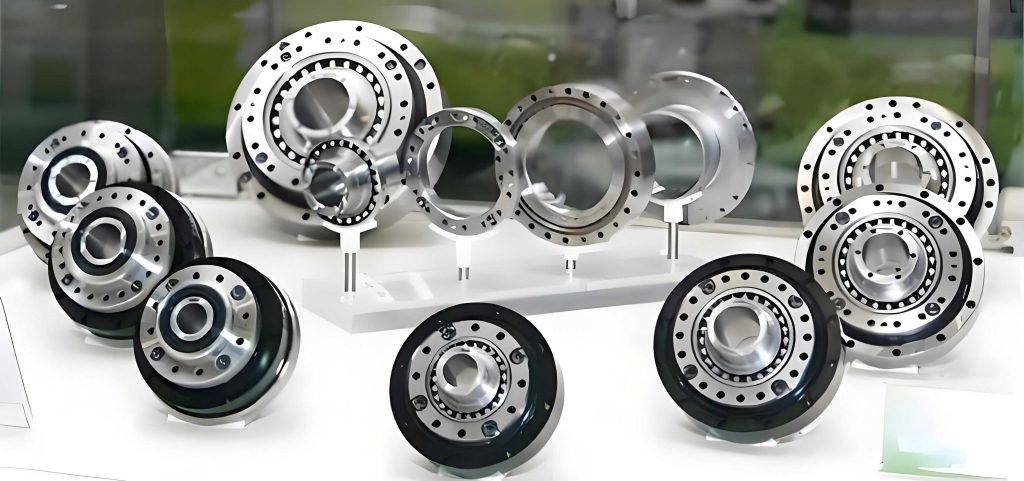
To evaluate the mechanical behavior under operational conditions, I conducted transient dynamic analyses on key contact pairs: the sun gear-planetary gear mesh and the cycloidal gear-pin tooth mesh. These analyses were performed using ANSYS Workbench, importing the UG models in .x_t format. For the sun gear and planetary gears, material properties were assigned from standard alloy steels to reflect real-world applications. The table below summarizes the material attributes used in the simulation for the first-stage gears:
| Component | Material | Density (kg/m³) | Elastic Modulus (GPa) | Poisson’s Ratio |
|---|---|---|---|---|
| Sun Gear | 20CrMnTi | 7.86 × 10³ | 212 | 0.289 |
| Planetary Gear | 40Cr | 7.87 × 10³ | 206 | 0.277 |
Mesh generation was critical for accuracy; I refined the tooth contact surfaces by dividing the sun gear teeth into 12 segments and planetary gear teeth into 9 segments, resulting in 162,491 nodes and 35,391 elements with an average element quality of 0.91957. Contact pairs were defined with the sun gear as the contact body and planetary gears as target bodies, applying a friction coefficient of 0.15. Revolute joints constrained the gears to rotate about their axes, with an input angular velocity of 140.25 rad/s applied to the sun gear and a torque of 4.8775 N·m on the planetary gears to simulate loading. The solution revealed that the maximum contact stress of 91.53 MPa occurred at the meshing point, while lower stresses were observed at the tooth roots, indicating minimal deformation within safe limits. This confirms the integrity of the first-stage transmission in rotary vector reducers under typical operating conditions.
For the second-stage analysis, I focused on the cycloidal gear and pin tooth interaction, which is pivotal for the high reduction ratio of rotary vector reducers. Material properties were assigned as follows:
| Component | Material | Density (kg/m³) | Elastic Modulus (GPa) | Poisson’s Ratio |
|---|---|---|---|---|
| Cycloidal Gear | G20CrMo | 7.80 × 10³ | 208 | 0.292 |
| Pin Tooth | GCr15 | 7.80 × 10³ | 219 | 0.300 |
The pin gear housing was treated as a rigid body due to its negligible deformation. Mesh sizes were controlled at 0.006 mm for the cycloidal gear and 0.004 mm for the pin teeth, yielding 448,801 nodes and 117,218 elements with an average quality of 0.75251. Contact settings included the cycloidal gear tooth flanks as contact surfaces and pin tooth cylindrical surfaces as targets, with a friction coefficient of 0.13. The housing was fully constrained, and a torque of 774 N·m was applied to the cycloidal gear’s central hole via a revolute joint. Results showed a maximum contact stress of 420.44 MPa at the planet carrier hole edge on the meshing side, with stress concentrations also near bearing holes. This highlights a potential weak point in rotary vector reducers, suggesting that reinforcement in these areas could enhance durability without compromising the compact design.
Beyond transient dynamics, modal analysis is essential to avoid resonance in rotary vector reducers. I performed constrained modal analyses on both the entire assembly and the cycloidal gear separately. For the full rotary vector reducer, materials were consistent with prior simulations, as detailed below:
| Component | Material | Density (kg/m³) | Elastic Modulus (GPa) | Poisson’s Ratio |
|---|---|---|---|---|
| Cycloidal Gear | G20CrMo | 7.80 × 10³ | 208 | 0.292 |
| Pin Tooth | GCr15 | 7.80 × 10³ | 219 | 0.300 |
| Sun Gear | 20CrMnTi | 7.86 × 10³ | 212 | 0.289 |
| Planetary Gear | 40Cr | 7.87 × 10³ | 206 | 0.277 |
| Housing | GCr15 | 7.80 × 10³ | 219 | 0.300 |
| Output Disk | 45 Steel | 7.89 × 10³ | 209 | 0.269 |
The assembly was meshed with controlled sizes of 0.005 mm for covers and housing, resulting in 809,296 nodes and 236,991 elements. Fixed supports constrained the housing base, and cylindrical supports limited the sun gear to rotational freedom only. I defined 163 bonded contact pairs to simulate connections like gear meshes and bearing fits. Solving for 16 mode shapes yielded natural frequencies, with the first six listed here:
| Mode | 1 | 2 | 3 | 4 | 5 | 6 |
|---|---|---|---|---|---|---|
| Frequency (Hz) | 2291 | 2372 | 2381.9 | 2912.9 | 2919.5 | 2989.7 |
Mode shapes involved complex deformations: the first mode showed front-back movement in the XZ plane, the second and third involved lateral and longitudinal swings, and higher modes included torsional motions. These frequencies are significantly higher than typical operational excitations, reducing resonance risk in rotary vector reducers. For the cycloidal gear alone, I applied a cylindrical support to its central hole and computed 16 modes. The natural frequencies are tabulated below:
| Mode | 1 | 2 | 3 | 4 | 5 | 6 | 7 | 8 |
|---|---|---|---|---|---|---|---|---|
| Frequency (Hz) | 2.4785×10⁻⁴ | 1553.7 | 1553.7 | 1717.8 | 2202.0 | 2202.1 | 4419.0 | 4552.7 |
| Mode | 9 | 10 | 11 | 12 | 13 | 14 | 15 | 16 |
|---|---|---|---|---|---|---|---|---|
| Frequency (Hz) | 5390.8 | 5391.3 | 7681.2 | 7865 | 7866.7 | 7930.2 | 7930.4 | 10874.0 |
To assess resonance potential, I calculated the meshing frequency due to gear engagement using the formula:
$$ f_{mesh} = \frac{n \cdot z}{60} $$
where \( n \) is the rotational speed in rpm. For a rotary vector reducer with an input speed of 1815 rpm, the cycloidal gear rotates at 15 rpm given the reduction ratio. With \( z_p = 40 \) (typical for pin teeth), the meshing frequency is:
$$ f_{mesh} = \frac{15 \times 40}{60} = 10 \, \text{Hz} $$
This value is far below the lowest natural frequencies of both the cycloidal gear and the full assembly, indicating that rotary vector reducers are unlikely to experience resonance from gear meshing. However, designers should still avoid external excitations near the identified natural frequency ranges to ensure stable operation.
In summary, my analysis of rotary vector reducers through transient dynamics and modal methods has yielded critical insights. The sun gear-planetary gear mesh exhibits a maximum contact stress of 91.53 MPa at the engagement point, well within allowable limits for the materials used. The cycloidal gear-pin tooth mesh shows a higher stress concentration of 420.44 MPa at the planet carrier hole, suggesting that this area merits reinforcement in future designs of rotary vector reducers. Modal analyses confirm that the natural frequencies of the system and its components are sufficiently distant from operational meshing frequencies, mitigating resonance risks. These findings provide a foundation for optimizing rotary vector reducers, particularly in enhancing strength at stress-prone locations while maintaining their compact, high-ratio advantages. Future work could explore material alternatives, lubrication effects, or dynamic load variations to further improve the performance and longevity of rotary vector reducers in robotic applications.
The versatility of rotary vector reducers makes them indispensable in precision engineering, and continuous analysis is key to advancing their design. By leveraging finite element tools, engineers can iterate rapidly, ensuring that rotary vector reducers meet the evolving demands of automation and robotics. In my experience, the integration of simulation-driven design not only reduces prototyping costs but also enhances reliability, making rotary vector reducers more robust for industrial use. As technology progresses, I anticipate further refinements in the geometry and material science of rotary vector reducers, potentially leading to even higher efficiency and smaller footprints. This study underscores the importance of comprehensive mechanical analysis in the development of advanced transmission systems like rotary vector reducers.