
The precise and efficient control of a multi-fingered dexterous robotic hand fundamentally depends on solving its inverse kinematics. This process involves determining the set of joint angles required to position the fingertip at a desired location and orientation. Traditional methods, such as the Denavit-Hartenberg (D-H) convention, require establishing a local coordinate frame for each joint, which is not only tedious and prone to singularities but also lacks clear geometric intuition. Furthermore, for complex mechanisms like a dexterous robotic hand, the inverse kinematics often lacks a closed-form solution, necessitating computationally expensive numerical methods. This paper presents a novel, efficient algorithm for solving the inverse kinematics of a three-fingered dexterous robotic hand based on the exponential product formula of screw theory and a combination of Paden-Kahan subproblems and algebraic solutions. This approach offers geometric clarity, eliminates cumulative error, and significantly improves computational efficiency.
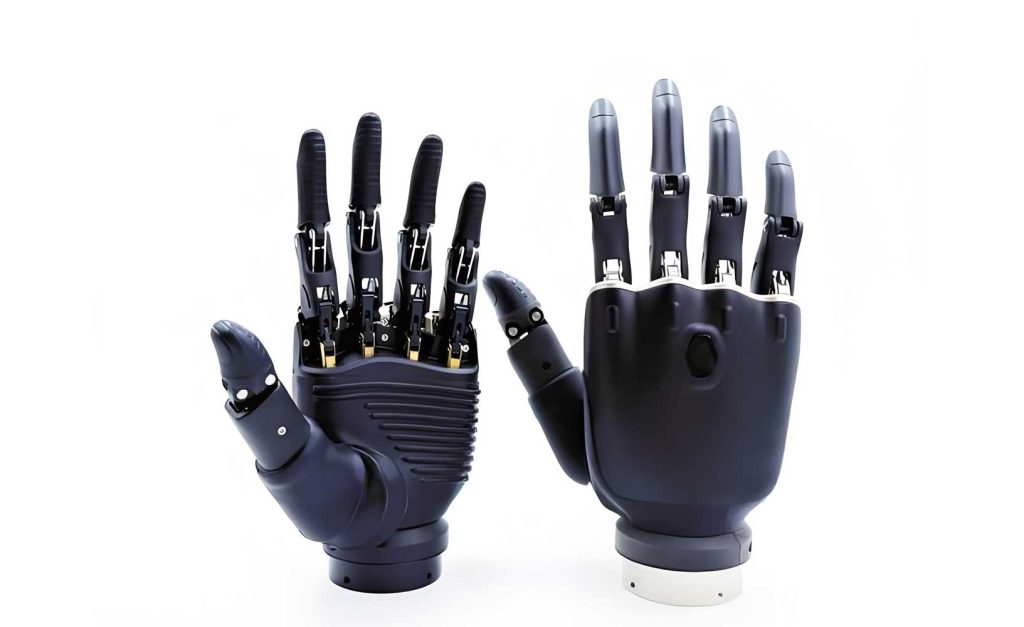
The dexterous robotic hand’s ability to perform complex manipulation tasks is a cornerstone of advanced robotics. The inverse kinematics problem for such a hand is more intricate than for a standard serial manipulator due to its multiple, often kinematically distinct, fingers. Efficiently solving this problem is critical for real-time control and grasp planning. Screw theory provides a powerful framework for this purpose. It describes rigid body motions as twists, represented by screws, and uses the matrix exponential to map joint motions to end-effector displacements. The overall forward kinematics of an n-degree-of-freedom (DOF) serial chain, such as a finger of a dexterous robotic hand, can be compactly expressed as an exponential product:
$$
g_{st}(\boldsymbol{\theta}) = \prod_{i=1}^{n} e^{\hat{\xi}_i \theta_i} g_{st}(0)
$$
where $g_{st}(\boldsymbol{\theta}) \in SE(3)$ is the homogeneous transformation matrix of the fingertip (tool frame $t$) relative to the base frame $s$, $\hat{\xi}_i \in se(3)$ is the screw coordinate of the $i$-th joint in its zero configuration, $\theta_i$ is the joint variable, and $g_{st}(0)$ is the initial configuration. The screw coordinate $\xi_i = (\mathbf{v}_i, \boldsymbol{\omega}_i)$ consists of the translational component $\mathbf{v}_i$ and the rotational axis $\boldsymbol{\omega}_i$. For a revolute joint, $\boldsymbol{\omega}_i$ is a unit vector along the axis, and $\mathbf{v}_i = -\boldsymbol{\omega}_i \times \mathbf{q}_i$, where $\mathbf{q}_i$ is any point on the axis. The matrix exponential for a revolute joint is given by:
$$
e^{\hat{\xi}_i \theta_i} = \begin{bmatrix}
e^{\hat{\boldsymbol{\omega}}_i \theta_i} & (\mathbf{I} – e^{\hat{\boldsymbol{\omega}}_i \theta_i})(\boldsymbol{\omega}_i \times \mathbf{v}_i) + \boldsymbol{\omega}_i \boldsymbol{\omega}_i^T \mathbf{v}_i \theta_i \\
\mathbf{0}^T & 1
\end{bmatrix}
$$
where $e^{\hat{\boldsymbol{\omega}}_i \theta_i} = \mathbf{I} + \hat{\boldsymbol{\omega}}_i \sin\theta_i + \hat{\boldsymbol{\omega}}_i^2 (1-\cos\theta_i)$ (Rodrigues’ formula). This formulation requires only the definition of a base and a tool frame, simplifying the modeling process for a dexterous robotic hand.
Paden-Kahan Subproblems: The Geometric Core
The key to solving inverse kinematics elegantly with screw theory lies in decomposing the problem into a sequence of canonical geometric problems known as the Paden-Kahan subproblems. These subproblems have closed-form solutions based on simple geometric constructions involving points, lines, and distances. The three fundamental subproblems are:
Subproblem 1: Rotation about a single axis. Given a screw axis $\xi$ with direction $\boldsymbol{\omega}$ and point $\mathbf{q}$, and two points $\mathbf{p}$ and $\mathbf{r}$, find $\theta$ such that:
$$
e^{\hat{\xi}\theta} \mathbf{p} = \mathbf{r}
$$
Let $\mathbf{u} = \mathbf{p} – \mathbf{q}$ and $\mathbf{v} = \mathbf{r} – \mathbf{q}$. Let $\mathbf{u}^\perp$ and $\mathbf{v}^\perp$ be the projections of $\mathbf{u}$ and $\mathbf{v}$ onto a plane perpendicular to $\boldsymbol{\omega}$. The solution is:
$$
\theta = \atan2\left( \boldsymbol{\omega} \cdot (\mathbf{u}^\perp \times \mathbf{v}^\perp), \mathbf{u}^\perp \cdot \mathbf{v}^\perp \right)
$$
Subproblem 2: Rotation about two subsequent intersecting axes. Given two intersecting screw axes $\xi_1$ and $\xi_2$ intersecting at point $\mathbf{c}$, and points $\mathbf{p}$ and $\mathbf{r}$, find $\theta_1$ and $\theta_2$ such that:
$$
e^{\hat{\xi}_1\theta_1} e^{\hat{\xi}_2\theta_2} \mathbf{p} = \mathbf{r}
$$
The intersection point $\mathbf{c}$ is invariant under both rotations. This problem can be solved by finding an intermediate point $\mathbf{x} = e^{\hat{\xi}_2\theta_2} \mathbf{p}$, which must satisfy $||\mathbf{x} – \mathbf{c}|| = ||\mathbf{p} – \mathbf{c}||$ and $||e^{-\hat{\xi}_1\theta_1} \mathbf{r} – \mathbf{c}|| = ||\mathbf{x} – \mathbf{c}||$. Solving these two constraints (often using Subproblem 3) yields $\theta_2$, and subsequently $\theta_1$ via Subproblem 1.
Subproblem 3: Rotation to a given distance. Given a screw axis $\xi$, two points $\mathbf{p}$ and $\mathbf{r}$, and a distance $\delta > 0$, find $\theta$ such that:
$$
|| \mathbf{r} – e^{\hat{\xi}\theta} \mathbf{p} || = \delta
$$
Let $\mathbf{q}$ be a point on the axis, $\mathbf{u}=\mathbf{p}-\mathbf{q}$, $\mathbf{v}=\mathbf{r}-\mathbf{q}$, and $\mathbf{u}^\perp$, $\mathbf{v}^\perp$ their perpendicular projections. The angle $\theta_0$ between $\mathbf{u}^\perp$ and $\mathbf{v}^\perp$ is found from their dot and cross products. The solutions are:
$$
\theta = \theta_0 \pm \arccos\left( \frac{||\mathbf{u}^\perp||^2 + ||\mathbf{v}^\perp||^2 – \delta^2}{2 ||\mathbf{u}^\perp|| \, ||\mathbf{v}^\perp||} \right)
$$
The existence of solutions depends on the triangle inequality for $||\mathbf{u}^\perp||$, $||\mathbf{v}^\perp||$, and $\delta$.
Kinematic Modeling of a Three-Fingered Dexterous Robotic Hand
We consider a model inspired by a three-fingered dexterous robotic hand with an opposable thumb, index, and middle finger (the ring finger kinematics are identical to the index). Each finger is modeled as an open kinematic chain.
Index/Middle Finger: This finger has 4 DOF: abduction/adduction ($\theta_1$) and flexion ($\theta_2$) at the metacarpophalangeal (MCP) joint, and flexion at the proximal interphalangeal (PIP, $\theta_3$) and distal interphalangeal (DIP, $\theta_4$) joints. A common simplification in robotic hands is to couple the PIP and DIP joints, typically with a 1:1 ratio, i.e., $\theta_4 = \theta_3$. The kinematic parameters are shown in the table below.
| Parameter | Description | Value |
|---|---|---|
| $a_1$ | Base offset (MCP to first flexion axis) | 0 mm |
| $a_2$ | Proximal phalanx length | 45 mm |
| $a_3$ | Middle phalanx length | 25 mm |
| $a_4$ | Distal phalanx length | 26 mm |
| $\theta_1$ | Abduction/Adduction | $[-20^\circ, 20^\circ]$ |
| $\theta_2, \theta_3, \theta_4$ | Flexion joints | $[0^\circ, 90^\circ]$ |
The forward kinematics for the index finger of the dexterous robotic hand, using the shorthand $c_{ij} = \cos(\theta_i+\theta_j)$, $s_{ij}=\sin(\theta_i+\theta_j)$, is:
$$
g_{st}^{index}(\boldsymbol{\theta}) = \begin{bmatrix}
c_1 c_{234} & -c_1 s_{234} & -s_1 & c_1(a_1 + a_2 c_2 + a_3 c_{23} + a_4 c_{234}) \\
s_1 c_{234} & -s_1 s_{234} & c_1 & s_1(a_1 + a_2 c_2 + a_3 c_{23} + a_4 c_{234}) \\
-s_{234} & -c_{234} & 0 & -a_2 s_2 – a_3 s_{23} – a_4 s_{234} \\
0 & 0 & 0 & 1
\end{bmatrix}
$$
Thumb: The thumb is modeled with 5 DOF to provide greater mobility: abduction/adduction ($\theta_1$) and flexion ($\theta_2$) at the carpometacarpal (CMC) joint, abduction/adduction ($\theta_3$) and flexion ($\theta_4$) at the MCP joint, and flexion ($\theta_5$) at the interphalangeal (IP) joint. The axes of joints 1, 4, and 5 are parallel, while the axes of joints 1 & 2 intersect, and joints 3 & 4 intersect. This structure prevents a direct decomposition into standard Paden-Kahan subproblems alone.
| Parameter | Description | Value |
|---|---|---|
| $a_1$ | Base offset (CMC to first flexion axis) | 0 mm |
| $a_2$ | Metacarpal length | 38 mm |
| $a_3$ | Proximal phalanx length | 32 mm |
| $a_4$ | Distal phalanx length | 27.5 mm |
| $\theta_1$ | CMC Abduction/Adduction | $[-55^\circ, 55^\circ]$ |
| $\theta_2$ | CMC Flexion | $[0^\circ, 70^\circ]$ |
| $\theta_3$ | MCP Abduction/Adduction | $[-12^\circ, 12^\circ]$ |
| $\theta_4$ | MCP Flexion | $[-40^\circ, 40^\circ]$ |
| $\theta_5$ | IP Flexion | $[0^\circ, 90^\circ]$ |
Proposed Inverse Kinematics Algorithm for the Dexterous Robotic Hand
The inverse kinematics problem is: given a desired fingertip pose $g_d \in SE(3)$ for a specific finger of the dexterous robotic hand, find all joint angle vectors $\boldsymbol{\theta}$ that satisfy $g_{st}(\boldsymbol{\theta}) = g_d$.
Algorithm for the Index/Middle Finger
Given the structural coupling ($\theta_4 = \theta_3$) and the kinematic structure, the inverse kinematics for this finger can be solved analytically using a mix of algebraic manipulation and Paden-Kahan subproblems.
Step 1: Solve for $\theta_1$ (Abduction/Adduction).
From the forward kinematics matrix, the $x$ and $y$ components of the fingertip position $(p_x, p_y)$ are $p_x = c_1 \cdot D$ and $p_y = s_1 \cdot D$, where $D = a_1 + a_2 c_2 + a_3 c_{23} + a_4 c_{234}$. Therefore, $\theta_1$ can be directly computed as:
$$
\theta_1 = \atan2(p_y, p_x)
$$
Note that this yields a unique solution within a $2\pi$ range, which is then constrained to the joint limits $[-20^\circ, 20^\circ]$.
Step 2: Solve for $\theta_3$ (PIP Flexion).
We start from the equation $g_{st}^{index}(\boldsymbol{\theta}) = g_d$. Premultiplying both sides by $e^{-\hat{\xi}_1 \theta_1}$ isolates the motion of the last three joints:
$$
e^{\hat{\xi}_2 \theta_2} e^{\hat{\xi}_3 \theta_3} e^{\hat{\xi}_4 \theta_4} g_{st}(0) = e^{-\hat{\xi}_1 \theta_1} g_d = g_1
$$
Let $\mathbf{p}$ be the origin of the coordinate frame at the MCP flexion axis (a point on $\xi_2$), and let $\mathbf{q}$ be a point on the DIP joint axis $\xi_4$ in the home configuration, e.g., $\mathbf{q} = (a_1+a_2+a_3+a_4, 0, 0)$ in the local finger frame after compensating for $\theta_1$. Applying both sides of the equation to point $\mathbf{q}$ and noting that rotation about $\xi_2$ does not change the distance from $\mathbf{p}$ to the transformed $\mathbf{q}$, we get:
$$
|| e^{\hat{\xi}_3 \theta_3} e^{\hat{\xi}_4 \theta_4} \mathbf{q} – \mathbf{p} || = || g_1 \mathbf{q} – \mathbf{p} ||
$$
Using the coupling $\theta_4 = \theta_3$, the left side becomes $|| e^{\hat{\xi}_3 \theta_3} (e^{\hat{\xi}_3 \theta_3} \mathbf{q}_0) – \mathbf{p} || = || e^{\hat{\xi}_3 (2\theta_3)} \mathbf{q}_0 – \mathbf{p} ||$, where $\mathbf{q}_0$ is an appropriately defined point. This is a Subproblem 3 (rotation to a given distance) in terms of $2\theta_3$, yielding up to two solutions for $\theta_3$.
Step 3: Determine $\theta_4$.
Directly from the coupling:
$$
\theta_4 = \theta_3
$$
Step 4: Solve for $\theta_2$ (MCP Flexion).
With $\theta_1$, $\theta_3$, and $\theta_4$ known, we rearrange the kinematic equation to isolate $\theta_2$:
$$
e^{\hat{\xi}_2 \theta_2} = g_1 \left( e^{\hat{\xi}_4 \theta_4} e^{\hat{\xi}_3 \theta_3} \right)^{-1} = g_2
$$
Applying both sides to a point $\mathbf{r}$ not on the axis $\xi_2$, for example $\mathbf{r} = (a_1 + a_2, 0, 0)$, gives:
$$
e^{\hat{\xi}_2 \theta_2} \mathbf{r} = g_2 \mathbf{r}
$$
This is now a pure rotation about a single axis (Subproblem 1), which can be solved directly for $\theta_2$.
The algorithm is summarized in the following table.
| Step | Joint | Method | Equation / Subproblem |
|---|---|---|---|
| 1 | $\theta_1$ | Algebraic (atan2) | $\theta_1 = \atan2(p_y, p_x)$ |
| 2 | $\theta_3$ | P-K Subproblem 3 | $|| e^{\hat{\xi}_3 (2\theta_3)} \mathbf{q}_0 – \mathbf{p} || = \delta$ |
| 3 | $\theta_4$ | Coupling | $\theta_4 = \theta_3$ |
| 4 | $\theta_2$ | P-K Subproblem 1 | $e^{\hat{\xi}_2 \theta_2} \mathbf{r} = g_2 \mathbf{r}$ |
Algorithm for the Thumb
The thumb’s kinematics are more complex due to the lack of intersecting axes among all joints. Our strategy is to isolate the IP joint angle $\theta_5$ first using a numerical step, then solve for the remaining four angles geometrically.
Step 1: Solve for $\theta_5$ (IP Flexion) using a Numerical Method.
Let $\mathbf{p}_w$ be the intersection point of axes $\xi_3$ and $\xi_4$ (the MCP joint), and let $\mathbf{q}_c$ be the intersection point of axes $\xi_1$ and $\xi_2$ (the CMC joint). The point $\mathbf{p}_w$ is invariant under rotations $\theta_3$ and $\theta_4$: $e^{\hat{\xi}_3 \theta_3} e^{\hat{\xi}_4 \theta_4} \mathbf{p}_w = \mathbf{p}_w$. Similarly, $\mathbf{q}_c$ is invariant under rotations $\theta_1$ and $\theta_2$: $e^{\hat{\xi}_1 \theta_1} e^{\hat{\xi}_2 \theta_2} \mathbf{q}_c = \mathbf{q}_c$.
Starting from $g_{st}^{thumb}(\boldsymbol{\theta}) = g_d$, we can write:
$$
e^{\hat{\xi}_1 \theta_1} e^{\hat{\xi}_2 \theta_2} e^{\hat{\xi}_3 \theta_3} e^{\hat{\xi}_4 \theta_4} = g_d \, g_{st}(0)^{-1} e^{-\hat{\xi}_5 \theta_5} = M(\theta_5)
$$
Applying both sides to point $\mathbf{p}_w$ and using the invariance properties:
$$
e^{\hat{\xi}_1 \theta_1} e^{\hat{\xi}_2 \theta_2} \mathbf{p}_w = M(\theta_5) \mathbf{p}_w
$$
The left-hand side represents a rotation of $\mathbf{p}_w$ around the intersecting axes $\xi_1$ and $\xi_2$. Crucially, the distance between the rotated point and the invariant center $\mathbf{q}_c$ remains constant and equal to the original distance $||\mathbf{p}_w – \mathbf{q}_c||$:
$$
|| e^{\hat{\xi}_1 \theta_1} e^{\hat{\xi}_2 \theta_2} \mathbf{p}_w – \mathbf{q}_c || = ||\mathbf{p}_w – \mathbf{q}_c||
$$
Therefore, we have the following equation in the single unknown $\theta_5$:
$$
|| M(\theta_5) \mathbf{p}_w – \mathbf{q}_c || = ||\mathbf{p}_w – \mathbf{q}_c||
$$
This is a scalar equation $f(\theta_5)=0$. Since $\theta_5$ is typically limited to $[0^\circ, 90^\circ]$, a fast numerical root-finding method like the bisection method or Brent’s method can be used to find $\theta_5$. This is the only numerical step required for the entire dexterous robotic hand.
Step 2: Solve for $\theta_1$ and $\theta_2$ (CMC Joint).
With $\theta_5$ known, the matrix $M(\theta_5)$ is fully defined. The equation from Step 1 becomes:
$$
e^{\hat{\xi}_1 \theta_1} e^{\hat{\xi}_2 \theta_2} \mathbf{p}_w = M(\theta_5) \mathbf{p}_w = \mathbf{p}_d
$$
This is now a standard Paden-Kahan Subproblem 2: rotate point $\mathbf{p}_w$ about two intersecting axes ($\xi_1$ and $\xi_2$, intersecting at $\mathbf{q}_c$) to reach the known target point $\mathbf{p}_d$. This yields up to two sets of solutions for ($\theta_1$, $\theta_2$).
Step 3: Solve for $\theta_3$ and $\theta_4$ (MCP Joint).
With $\theta_1$, $\theta_2$, and $\theta_5$ known, we can isolate the MCP joint motions. From the original equation, bring the known CMC rotations to the right-hand side:
$$
e^{\hat{\xi}_3 \theta_3} e^{\hat{\xi}_4 \theta_4} = \left(e^{\hat{\xi}_1 \theta_1} e^{\hat{\xi}_2 \theta_2}\right)^{-1} g_d \, g_{st}(0)^{-1} e^{-\hat{\xi}_5 \theta_5} = N
$$
Now, apply both sides to a point $\mathbf{r}_t$ that is not on the intersecting axes $\xi_3$ and $\xi_4$, for instance, the tip of the thumb in a configuration with only $\theta_5$ bent: $\mathbf{r}_t = e^{\hat{\xi}_5 \theta_5} \mathbf{r}_{t0}$.
$$
e^{\hat{\xi}_3 \theta_3} e^{\hat{\xi}_4 \theta_4} \mathbf{r}_t = N \mathbf{r}_t = \mathbf{r}_d
$$
This is again a Paden-Kahan Subproblem 2, where we rotate point $\mathbf{r}_t$ about the two intersecting axes $\xi_3$ and $\xi_4$ (intersecting at $\mathbf{p}_w$) to reach the target $\mathbf{r}_d$. This solves for $\theta_3$ and $\theta_4$.
| Step | Joint(s) | Method | Key Equation |
|---|---|---|---|
| 1 | $\theta_5$ | Numerical (Bisection) | $|| M(\theta_5) \mathbf{p}_w – \mathbf{q}_c || = ||\mathbf{p}_w – \mathbf{q}_c||$ |
| 2 | $\theta_1, \theta_2$ | P-K Subproblem 2 | $e^{\hat{\xi}_1 \theta_1} e^{\hat{\xi}_2 \theta_2} \mathbf{p}_w = \mathbf{p}_d$ |
| 3 | $\theta_3, \theta_4$ | P-K Subproblem 2 | $e^{\hat{\xi}_3 \theta_3} e^{\hat{\xi}_4 \theta_4} \mathbf{r}_t = \mathbf{r}_d$ |
Validation and Performance Analysis
To validate the proposed algorithm for the dexterous robotic hand, we follow a standard procedure. First, a set of valid joint angles $\boldsymbol{\theta}_{test}$ is randomly selected within the physical limits of each finger. The forward kinematics equations are then used to compute the corresponding precise fingertip pose $g_d$. This $g_d$ is fed into the inverse kinematics algorithms described above. The solved joint angles $\boldsymbol{\theta}_{sol}$ are compared to the original $\boldsymbol{\theta}_{test}$. A successful validation requires $|\theta_{test,i} – \theta_{sol,i}| < \epsilon$ for all $i$, where $\epsilon$ is a small tolerance (e.g., $10^{-6}$ radians), and that $g_{st}(\boldsymbol{\theta}_{sol})$ matches $g_d$ within numerical precision.
The following table shows the result of one such test case, demonstrating the accuracy of the method.
| Finger | Test Angles (Degrees) | Solved Angles (Degrees) | Max Error (Degrees) |
|---|---|---|---|
| Index | $\theta_1 = 20.0000$ | $20.0000$ | $0.0444$ |
| $\theta_2 = 30.0000$ | $29.9798$ | ||
| $\theta_3 = 35.0000$ | $34.9556$ | ||
| $\theta_4 = 35.0000$ | $34.9556$ | ||
| Thumb | $\theta_1 = 20.0000$ | $20.0004$ | $0.0099$ |
| $\theta_2 = 30.0000$ | $30.0043$ | ||
| $\theta_3 = 10.0000$ | $9.9986$ | ||
| $\theta_4 = 35.0000$ | $34.9901$ | ||
| $\theta_5 = 30.0000$ | $29.9943$ |
The extremely low error values confirm the algorithmic correctness. The index finger solution is purely analytic. For the thumb, only the first step ($\theta_5$) requires a numerical solver; the subsequent four angles are found via closed-form geometric subproblems. This hybrid approach stands in contrast to traditional D-H based methods, which often require a full iterative numerical solver (like Newton-Raphson) for all joints of such a complex dexterous robotic hand mechanism.
A critical performance metric is computational efficiency. The following table compares the average computation time for a single inverse kinematics query using the proposed Screw Theory method versus a conventional D-H parameterization solved with a numerical solver (e.g., using MATLAB’s `fsolve`). The simulation was run on a standard desktop computer.
| Method / Finger | Index Finger (ms) | Thumb (ms) | Notes |
|---|---|---|---|
| Screw Theory (Proposed) | ~2.60 ms | ~4.39 ms | Index: Analytic. Thumb: One numerical step. |
| D-H + Numerical Solver | ~4.43 ms | ~8.15 ms | Requires full iterative solution for all joints. |
The proposed method offers a speedup of approximately 1.7x for the index finger and 1.85x for the thumb. This efficiency gain is primarily due to the reduction of the problem to closed-form geometric operations (Paden-Kahan subproblems) and minimal numerical computation. This makes the algorithm highly suitable for the real-time control needs of a dexterous robotic hand, where multiple inverse kinematics solutions must be computed at high frequency for grasp planning and manipulation.
Discussion on Solution Multiplicity and Singularities
The geometric nature of the Paden-Kahan subproblems makes analyzing solution multiplicity straightforward. For the index finger:
- $\theta_1$: The $\atan2$ function gives one principal value. Joint limits typically restrict this to one viable solution.
- $\theta_3$: Subproblem 3 can yield 0, 1, or 2 solutions. The number depends on the desired distance $\delta$ relative to the geometry of the finger’s linkage. Physically, these correspond to the elbow-up and elbow-down configurations of the coupled PIP-DIP mechanism.
- $\theta_2$: Subproblem 1 generally yields one unique solution modulo $2\pi$, again constrained by joint limits.
For the thumb, the numerical step for $\theta_5$ may find multiple roots within the joint range. Each valid $\theta_5$ leads to its own set of solutions from the subsequent Subproblem 2 instances for ($\theta_1$, $\theta_2$) and ($\theta_3$, $\theta_4$). Each Subproblem 2 can also yield up to two solutions. Therefore, the thumb’s inverse kinematics can have several distinct solution branches, all of which are efficiently enumerated by this algorithm. This is a significant advantage for grasp planning with a dexterous robotic hand, as it allows the selection of the most optimal, collision-free, or torque-efficient configuration.
Singularities occur when the geometric constraints of a subproblem break down. For example, in Subproblem 1, if the point projections $\mathbf{u}^\perp$ or $\mathbf{v}^\perp$ are zero vectors, the rotation angle $\theta$ is undefined (the point lies on the axis). In Subproblem 3, if the triangle inequality is not satisfied, no solution exists, which in the context of the dexterous robotic hand corresponds to the desired fingertip position being unreachable. The algorithm naturally detects these conditions, providing robustness.
Conclusion
This paper has presented a highly efficient and geometrically intuitive algorithm for solving the inverse kinematics of a three-fingered dexterous robotic hand using screw theory. The method models each finger’s forward kinematics via the exponential product formula, eliminating the need for multiple intermediate coordinate frames and avoiding the singularities associated with the D-H convention. The core innovation lies in the tailored decomposition of the inverse problem for different finger structures of the dexterous robotic hand.
For the index/middle finger, the algorithm combines direct algebraic solution with Paden-Kahan subproblems, resulting in a fully analytic solution. For the more complex thumb kinematics, a hybrid strategy is employed where only one joint variable ($\theta_5$) is solved using a fast numerical method, while the remaining four are determined through closed-form geometric subproblems. This approach minimizes computational load while maintaining high accuracy. Validation tests confirm that the algorithm solves the inverse kinematics with negligible error. Comparative timing analysis demonstrates a significant performance improvement over traditional D-H based numerical methods, making it well-suited for the real-time operational demands of a dexterous robotic hand in dynamic grasping and manipulation tasks. The geometric foundation of the method also provides clear insight into solution multiplicity and workspace boundaries, which are essential for advanced motion planning of the dexterous robotic hand.