
The pursuit of creating machines capable of replicating the remarkable dexterity and adaptability of the human hand remains a central challenge in robotics. This quest is driven by the need for dexterous robotic hands to operate in environments hazardous or inaccessible to humans, such as nuclear facilities, deep-space missions, and underwater exploration. While significant strides have been made in mechanical design, the precision control of these complex multi-fingered systems, particularly their foundational joints, is paramount for executing delicate and reliable manipulation tasks.
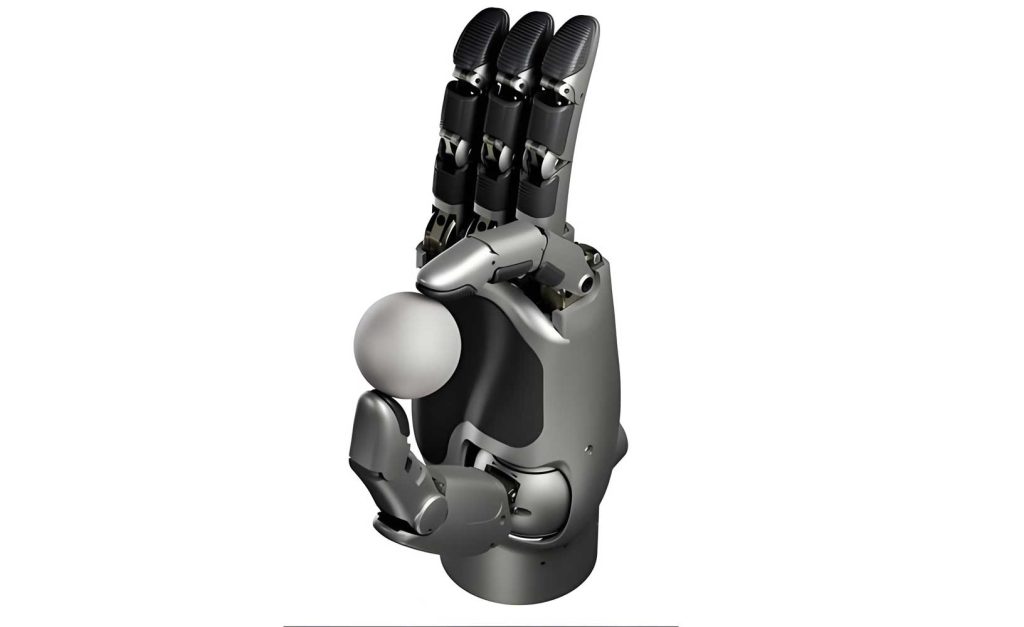
Many advanced dexterous robotic hands integrate their actuation systems within the fingers or palm to avoid the drawbacks of long tendon transmissions. A common design for the foundational, or base, joint involves a differential gear mechanism, where two motors work in tandem to achieve two degrees of freedom (DOF)—typically pitch and yaw. This compact configuration allows for shared load-bearing and enables the use of smaller, more integrated actuators. However, this very advantage introduces a critical control challenge: the motion accuracy of the base joint depends on the coordinated, synchronized effort of both motors. Traditional independent joint control methods, where each motor corrects its own tracking error without regard to the other, fail to exploit this interdependence, often leading to sub-optimal overall joint performance and reduced precision in the dexterous robotic hand.
This article addresses this fundamental control problem. We present a comprehensive framework, from dynamic modeling to controller design and experimental validation, aimed at significantly improving the trajectory tracking accuracy of the base joint in a dexterous robotic hand. The core of our contribution is a novel synchronized cross-coupled control strategy. This approach actively coordinates the two driving motors by incorporating feedback from both positional tracking errors and newly defined synchronization errors between them. Furthermore, we integrate a smooth, robust nonlinear element to compensate for friction, a dominant disturbance in geared systems. We rigorously establish the asymptotic stability of the proposed controller using Lyapunov theory. Finally, we demonstrate its superior performance through comparative experiments against conventional non-synchronized control methods on a physical dexterous robotic hand platform.
Mechanical Design and Dynamic Modeling of the Finger
The development of an effective control law must be grounded in a realistic dynamic model of the system. We consider a dexterous robotic hand finger with a specific, prevalent architecture. The finger possesses four joints resulting in three independent degrees of freedom. The distal joint (joint 4) is coupled to the middle joint (joint 3) via a tendon or linkage, often with a 1:1 ratio, producing a coupled bending motion at the fingertip. The critical base assembly (joints 1 and 2) provides two DOFs—yaw and pitch—through a differential gear system actuated by two motors.
The schematic of the finger kinematics is represented in the figure, where $l_i$ denotes link lengths, $d_i$ represents distances to the center of mass, and $\theta_{ji}$ are the joint angles ($i=1,2,3,4$, $j$ denotes joint space). The Lagrangian formulation, $L = K – P$, where $K$ is the total kinetic energy and $P$ is the total potential energy, is employed to derive the equations of motion. The kinetic energy for each link and the potential energy are computed considering the translational and rotational velocities of each center of mass. After deriving the Lagrangian and applying the Euler-Lagrange equation, and incorporating a friction torque vector, the standard rigid-body dynamics for the finger in joint space is obtained:
$$M(\theta_j)\ddot{\theta}_j + C(\theta_j, \dot{\theta}_j)\dot{\theta}_j + G(\theta_j) + F(\dot{\theta}_j) = \tau_j$$
Here, $\theta_j, \dot{\theta}_j, \ddot{\theta}_j \in \mathbb{R}^{4 \times 1}$ are the joint position, velocity, and acceleration vectors, respectively. $M(\theta_j) \in \mathbb{R}^{4 \times 4}$ is the symmetric, positive-definite inertia matrix. $C(\theta_j, \dot{\theta}_j)\dot{\theta}_j \in \mathbb{R}^{4 \times 1}$ is the Coriolis and centrifugal force vector. $G(\theta_j) \in \mathbb{R}^{4 \times 1}$ is the gravitational torque vector. $F(\dot{\theta}_j) \in \mathbb{R}^{4 \times 1}$ is the friction torque vector, and $\tau_j \in \mathbb{R}^{4 \times 1}$ is the applied joint torque vector.
The matrices possess two key properties essential for controller design and stability analysis:
- The inertia matrix $M(\theta_j)$ is symmetric and positive definite, and its elements are bounded.
- The matrix $\dot{M}(\theta_j) – 2C(\theta_j, \dot{\theta}_j)$ is skew-symmetric. That is, $x^T(\dot{M} – 2C)x = 0$ for any vector $x \in \mathbb{R}^{4 \times 1}$.
The elements of $M$, $C$, and $G$ are complex functions of the inertial parameters (masses $m_i$, moments of inertia $I_i$, link lengths $l_i$, center-of-mass distances $d_i$) and trigonometric functions of the joint angles. For conciseness, we define intermediate constant parameters $a_1$ through $a_{15}$ that aggregate these physical constants. For example, the inertia matrix and gravity vector have the following structural forms (showing key elements):
$$
M(\theta_j) =
\begin{bmatrix}
M_{11} & 0 & 0 & 0\\
0 & M_{22} & M_{23} & M_{24}\\
0 & M_{32} & M_{33} & M_{34}\\
0 & M_{42} & M_{43} & M_{44}
\end{bmatrix}, \quad
G(\theta_j) =
\begin{bmatrix}
-g(a_9 s_1 + a_{10} s_1 c_2 + a_{11} s_1 c_2 + a_{12} s_1 c_{23} + \ldots)\\
-g(a_{10} s_2 c_1 + a_{11} s_2 c_1 + a_{12} s_{23} c_1 + \ldots)\\
-g(a_{12} s_{23} c_1 + a_{14} s_{23} c_1 + a_{15} s_{234} c_1)\\
-g(a_{15} s_{234} c_1)
\end{bmatrix}
$$
where $s_i = \sin\theta_{ji}$, $c_i = \cos\theta_{ji}$, $s_{ij} = \sin(\theta_{ji}+\theta_{jj})$, etc., and the constants $a_k$ are defined as:
$$
\begin{aligned}
a_1 &= m_1 d_1^2 + m_2 d_2^2 + m_3 d_3^2 + m_4 d_4^2 + I_1 + I_2 + I_3 + I_4 + m_3 l_2^2 + m_4 l_2^2 + m_4 l_3^2 \\
a_2 &= m_3 l_2 d_3, \quad a_3 = m_4 l_2 l_3, \quad \ldots, \quad a_{15} = m_4 g d_4
\end{aligned}
$$
This detailed dynamic model forms the basis for model-based control design for the dexterous robotic hand finger.
The Synchronized Cross-Coupled Control Strategy
The core challenge in controlling the base joint of this dexterous robotic hand lies in the differential drive mechanism. The motion in joint space ($\theta_{j1}, \theta_{j2}$) is generated by the combined action of two motors in the drive space. The transformation from joint space to drive space (motor positions $\theta_{d1}, \theta_{d2}$) for the base joint is given by:
$$
\begin{bmatrix}
\theta_{d1} \\ \theta_{d2}
\end{bmatrix}
=
\begin{bmatrix}
-1 & 1 \\
1 & 1
\end{bmatrix}
\begin{bmatrix}
\theta_{j1} \\ \theta_{j2}
\end{bmatrix}
= {}^j_dL^{-1} \Theta_j
$$
For instance, a pure pitch motion ($\theta_{j2}$) requires both motors to turn in the same direction and speed ($\theta_{d1} = \theta_{d2}$), while a pure yaw motion ($\theta_{j1}$) requires them to turn in opposite directions ($\theta_{d1} = -\theta_{d2}$). Any discrepancy between the actual motions of the two motors from this ideal relationship directly degrades the accuracy of the resulting base joint motion.
To formalize the synchronization objective, we define a synchronization function. For a multi-axis system, axes are considered synchronized if a relation $f(\theta_1(t), \theta_2(t), \ldots, \theta_n(t)) = 0$ holds. For two adjacent motors in a differential pair, a natural synchronization condition is that their weighted position errors converge to the same value. Let $\Delta \theta_{di} = \theta_{di}^d – \theta_{di}$ be the position tracking error for drive $i$, where $\theta_{di}^d$ is the desired trajectory. The synchronization goal is:
$$
o_1 \Delta \theta_{d1}(t) = o_2 \Delta \theta_{d2}(t)
$$
where $o_i$ are positive coupling coefficients. This leads to the definition of the synchronization error $\varepsilon_i$:
$$
\begin{aligned}
\varepsilon_1 &= o_1 \Delta \theta_{d1} – o_2 \Delta \theta_{d2} \\
\varepsilon_2 &= o_2 \Delta \theta_{d2} – o_1 \Delta \theta_{d1} = -\varepsilon_1
\end{aligned}
$$
Clearly, if $\varepsilon_1 = 0$, the synchronization condition is satisfied. Therefore, the control objective expands: we must design control torques $\tau_i$ such that as $t \to \infty$, not only does the position error $\Delta \theta_{di} \to 0$, but the synchronization error $\varepsilon_i \to 0$ as well.
The proposed synchronized cross-coupled control architecture achieves this by feeding back both error types into each motor’s controller. The combined “coupled error” $p_i(t)$ for each drive is defined as a linear combination of its position error and its synchronization error:
$$
p_i(t) = \Delta \theta_{di}(t) + \alpha_i \varepsilon_i(t)
$$
where $\alpha_i > 0$ is a control gain that determines the influence of synchronization on the overall error signal. A new target signal $u_i(t)$ is then constructed based on this coupled error:
$$
u_i(t) = \theta_{di}^d(t) – \beta_i p_i(t)
$$
where $\beta_i > 0$ is another control gain. From this, we define a filtered tracking error $r_i(t)$, a common technique in robotics for stability analysis:
$$
r_i(t) = \dot{\theta}_{di}(t) – \dot{u}_i(t) + \lambda_i (\theta_{di}(t) – u_i(t)) = \dot{\Delta \theta}_{di}(t) + \lambda_i \Delta \theta_{di}(t) + \beta_i (\dot{p}_i(t) + \lambda_i p_i(t))
$$
for some $\lambda_i > 0$. The ultimate control goal is to drive $r_i(t)$ to zero, which implies the convergence of both $\Delta \theta_{di}$ and $p_i$ (and hence $\varepsilon_i$) to zero.
Controller Design and Stability Analysis
Leveraging the dynamic model derived earlier, we now design the control law for the dexterous robotic hand base joint drives. The controller is formulated in the drive space. Considering the dynamics for each drive axis (which includes the transformed inertia and coupling effects from the full finger model), the proposed synchronized control law is:
$$
\tau_i(t) = \hat{M}_i(\theta) \ddot{u}_i(t) + \hat{C}_i(\theta, \dot{\theta}) \dot{u}_i(t) + \hat{G}_i(\theta) + \hat{F}_i(\dot{\theta}) – K_{pi} r_i(t) – K_{di} \dot{r}_i(t)
$$
In practice, the friction model $\hat{F}_i(\dot{\theta})$ is often uncertain. To ensure robustness, we employ a Smooth Robust Nonlinear Feedback (SRNF) compensator instead of a precise model-based term. The SRNF compensator approximates the discontinuous Coulomb and static friction with a smooth, bounded function, effectively overcoming stiction and reducing steady-state error. The final implementable control law becomes:
$$
\tau_i(t) = \hat{M}_i(\theta) \ddot{u}_i(t) + \hat{C}_i(\theta, \dot{\theta}) \dot{u}_i(t) + \hat{G}_i(\theta) – K_{pi} r_i(t) – K_{di} \dot{r}_i(t) + U_{msi} \tanh(\gamma_i \Delta \theta_{di})
$$
where $U_{msi}$ is the estimated maximum static friction torque (with a small offset $\delta$ to ensure motion initiation), $\gamma_i$ is a positive shape factor determining the sharpness of the tanh function, and $\tanh(\cdot)$ is the hyperbolic tangent function. This term provides a smooth, continuous approximation of the signum function used in classic friction compensation.
Stability Proof
We now provide a Lyapunov-based stability analysis to prove that the proposed controller guarantees asymptotic convergence of both position and synchronization errors for the dexterous robotic hand joint. We assume the modeled dynamics $\hat{M}_i, \hat{C}_i, \hat{G}_i$ are accurate for the purpose of this proof (or that robust terms handle inaccuracies).
Theorem: For the finger dynamics and the proposed synchronized cross-coupled control law with SRNF compensation, if the desired trajectories $\theta_{di}^d, \dot{\theta}_{di}^d, \ddot{\theta}_{di}^d$ are continuous and bounded, then the closed-loop system is asymptotically stable. That is, all signals are bounded and the tracking errors converge to zero: $\lim_{t \to \infty} \Delta \theta_{di}(t) = 0$ and $\lim_{t \to \infty} \varepsilon_i(t) = 0$ for $i=1,2$.
Proof: Consider the following positive definite Lyapunov function candidate for the drive system:
$$
V(t) = \frac{1}{2} \sum_{i=1}^{2} \left( r_i^T \hat{M}_i r_i + \tilde{\theta}_i^T \Lambda K_{pi} \tilde{\theta}_i \right)
$$
where $\tilde{\theta}_i = \theta_{di} – u_i$ is related to the filtered error. Taking the time derivative and substituting the closed-loop error dynamics obtained by applying the control law to the system dynamics yields:
$$
\dot{V}(t) = \sum_{i=1}^{2} \left( r_i^T \hat{M}_i \dot{r}_i + \frac{1}{2} r_i^T \dot{\hat{M}}_i r_i + \dot{\tilde{\theta}}_i^T \Lambda K_{pi} \tilde{\theta}_i \right)
$$
Using the skew-symmetry property ($\dot{\hat{M}}_i – 2\hat{C}_i$ is skew-symmetric) and the definition of $r_i$, this simplifies to:
$$
\dot{V}(t) = -\sum_{i=1}^{2} r_i^T K_{di} r_i + \sum_{i=1}^{2} r_i^T ( \hat{F}_i – U_{msi} \tanh(\gamma_i \Delta \theta_{di}) )
$$
Since the SRNF term $U_{msi} \tanh(\gamma_i \Delta \theta_{di})$ is designed to dominate the actual friction $\hat{F}_i$ in magnitude (i.e., $U_{msi} > |\hat{F}_i|$), the sum of the second term is non-positive. Therefore,
$$
\dot{V}(t) \leq -\sum_{i=1}^{2} r_i^T K_{di} r_i \leq 0
$$
Since $V(t) > 0$ and $\dot{V}(t) \leq 0$, $V(t)$ is bounded, which implies $r_i$ and $\tilde{\theta}_i$ are bounded. From the system equations and the boundedness of desired trajectories, we can conclude that $\dot{r}_i$ is bounded. Hence, $\dot{V}$ is uniformly continuous. Applying Barbalat’s lemma, we have $\lim_{t \to \infty} \dot{V}(t) = 0$, which implies $\lim_{t \to \infty} r_i(t) = 0$.
Given the definition of $r_i$ and its convergence to zero, and noting that the mapping from $[r_i, p_i]$ to $[\Delta \theta_{di}, \varepsilon_i]$ is stable and linear, it follows that $\lim_{t \to \infty} \Delta \theta_{di}(t) = 0$ and $\lim_{t \to \infty} \varepsilon_i(t) = 0$. Thus, both position tracking and inter-motor synchronization are achieved asymptotically. $\blacksquare$
Experimental Validation and Results
The proposed control strategy was implemented and tested on the base joint of a modular dexterous robotic hand. The finger’s physical parameters, including mass, center of mass, and inertia for each link, were obtained from CAD models and are summarized below.
| Parameter | Description | Value | Unit |
|---|---|---|---|
| $m_2$ | Mass of Link 2 | 6.07e-2 | kg |
| $m_3$ | Mass of Link 3 | 1.45e-2 | kg |
| $m_4$ | Mass of Link 4 | 2.16e-2 | kg |
| $l_2$ | Length of Link 2 | 5.5e-2 | m |
| $l_3$ | Length of Link 3 | 2.5e-2 | m |
| $I_2$ | Inertia of Joint 2 | 1.91e-4 | kg·m² |
| $I_3$ | Inertia of Joint 3 | 1.91e-5 | kg·m² |
| $I_4$ | Inertia of Joint 4 | 1.64e-4 | kg·m² |
The desired trajectory for the base joint involved simultaneous motion in both yaw ($\theta_{j1}$) and pitch ($\theta_{j2}$). The joints moved from $(0^\circ, 0^\circ)$ to $(10^\circ, 50^\circ)$ at speeds of $(20^\circ/s, 100^\circ/s)$ and then back to the origin, following smooth 4th-order polynomial profiles. This trajectory was transformed into desired motor trajectories in the drive space via the differential transformation matrix ${}^j_dL^{-1}$.
To benchmark performance, we compared our Synchronized Cross-Coupled Control against two prevalent non-synchronized methods:
- PD with Friction Compensation (PDFC): A decentralized PD controller with a basic friction compensator for each independent motor.
- Independent Trajectory Tracking Control (TTC): A more advanced model-based computed-torque controller for each motor, but without synchronization error feedback.
Results in Drive Space
The primary metric in the drive space is the synchronization error $\varepsilon_1$ (since $\varepsilon_2 = -\varepsilon_1$). The results clearly demonstrate the advantage of explicit synchronization.
| Control Method | Max Abs Sync Error $\varepsilon_1$ [deg] | RMS Sync Error [deg] |
|---|---|---|
| PDFC | 0.524 | 0.312 |
| TTC | 0.215 | 0.128 |
| Proposed Sync Control | 0.028 | 0.011 |
The proposed method reduced the maximum synchronization error by an order of magnitude compared to the independent TTC method. This directly stems from the controller’s active effort to minimize $\varepsilon_i$ by coupling the feedback of both motors.
Results in Joint Space
The ultimate measure of success for the dexterous robotic hand is accuracy in the joint space, where the task is defined. The joint space errors $\Delta \theta_{j1}$ and $\Delta \theta_{j2}$ were calculated from the actual motor positions. The synchronized control provides a significant improvement here as well, because precise joint motion requires coordinated motor action.
| Control Method | Max Abs Error $\Delta \theta_{j1}$ [deg] | Max Abs Error $\Delta \theta_{j2}$ [deg] | RMS Error $\Delta \theta_{j1}$ [deg] | RMS Error $\Delta \theta_{j2}$ [deg] |
|---|---|---|---|---|
| PDFC | 0.262 | 0.251 | 0.152 | 0.143 |
| TTC | 0.108 | 0.058 | 0.065 | 0.037 |
| Proposed Sync Control | 0.014 | 0.029 | 0.006 | 0.015 |
The synchronized controller achieves the lowest joint space tracking error, confirming that minimizing drive synchronization error directly translates to superior overall joint performance in the dexterous robotic hand.
Influence of the Synchronization Gain $\alpha$
The parameter $\alpha_i$ in the coupled error definition $p_i = \Delta \theta_{di} + \alpha_i \varepsilon_i$ controls the weight given to synchronization relative to position tracking. Experimental analysis of its effect is crucial for tuning. The results show a clear trend:
| Sync Gain $\alpha$ | RMS Sync Error $\varepsilon_1$ [deg] | RMS Joint Error $\Delta \theta_{j2}$ [deg] |
|---|---|---|
| 0 (No Sync) | 0.128 | 0.037 |
| 0.4 | 0.045 | 0.028 |
| 0.7 | 0.011 | 0.015 |
| 1.2 | 0.008 | 0.018 (Oscillations observed) |
Increasing $\alpha$ from 0 to an optimal range (e.g., 0.7) monotonically improves both synchronization and joint tracking accuracy. However, excessively high values (e.g., 1.2) can lead to increased sensitivity and oscillatory behavior, highlighting a trade-off that must be managed for stable operation of the dexterous robotic hand.
Conclusion and Discussion
This work has presented a holistic approach to improving the precision of the foundational base joint in a dexterous robotic hand. We identified the inherent control challenge in differentially driven joints: the lack of explicit coordination between the driving motors. To address this, we developed a synchronized cross-coupled control strategy that is deeply rooted in the finger’s dynamic model.
The key innovation lies in the structured definition of a synchronization error and its integration into the feedback loop alongside traditional position error. The controller actively works to nullify discrepancies between the motors, ensuring they act as a cohesive unit. The incorporation of a smooth robust nonlinear feedback term provides practical robustness against friction uncertainties. The rigorous Lyapunov stability proof provides a solid theoretical foundation, guaranteeing the asymptotic convergence of all tracking and synchronization errors.
Experimental validation on a physical dexterous robotic hand platform unequivocally demonstrates the effectiveness of the proposed method. Compared to sophisticated but independent model-based control, our synchronized approach reduced synchronization errors by nearly 90% and joint space tracking errors by approximately 50-75%. This significant enhancement in precision is achieved without requiring faster or more powerful actuators, but rather through more intelligent coordination of existing hardware.
The implications for dexterous robotic hand manipulation are substantial. Improved base joint accuracy directly enhances the hand’s ability to position the entire finger chain precisely, which is a prerequisite for successful grasping and in-hand manipulation. Future work will involve extending this synchronization framework to coordinate multiple fingers of the hand during complex object manipulation tasks, further advancing the frontier of robotic dexterity. The principles established here—model-based design, explicit synchronization error feedback, and rigorous stability assurance—provide a robust template for controlling complex, coupled mechanisms not only in robotics hands but in a wide array of precision multi-actuator systems.