
In the evolving landscape of robotics, humanoid robots are poised to play a pivotal role in diverse domains such as home automation, healthcare, and advanced manufacturing. The essence of a humanoid robot lies in its ability to mimic human-like dexterity and interaction, particularly through dual-arm manipulation. This capability is crucial for performing complex tasks that require coordination, adaptability, and safe human-robot collaboration. However, a significant challenge in deploying humanoid robots effectively is the development of robust control systems that can manage physical interactions with unstructured environments. Impedance control has emerged as a fundamental approach to address this, but its application in dual-arm humanoid robots often lacks a cohesive framework for parameter synthesis, leading to issues in stable contact transitions and desired performance. In this paper, we propose a comprehensive design, planning, and programming framework for impedance consistency control in humanoid robots with dual arms. Our approach leverages advanced algorithms and tools to enhance flexibility and efficiency, paving the way for humanoid robots to undertake intricate assembly tasks. We begin by exploring the foundational concepts of impedance control, extend it to dual-arm systems through relative Jacobian and dynamics formulations, and validate the framework with experimental tests. Throughout this discussion, we emphasize the centrality of humanoid robot in achieving seamless human-robot cooperation, and we incorporate numerous equations and tables to summarize key insights.
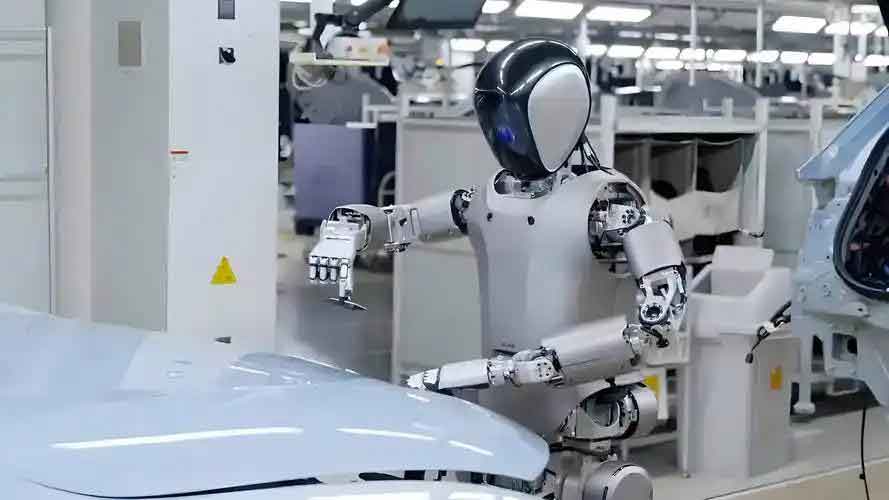
The integration of impedance control into humanoid robot systems is essential for enabling compliant interactions. At its core, impedance control aims to regulate the dynamic relationship between a robot’s motion and external forces, often modeled as a mass-spring-damper system. For a humanoid robot, this involves defining target impedance parameters—mass (M), damping (B), and stiffness (K)—that dictate how the robot responds to contact forces. The standard impedance equation in Cartesian space is expressed as:
$$ M(\ddot{x}_c – \ddot{x}_d) + B(\dot{x}_c – \dot{x}_d) + K(x_c – x_d) = f_c – f_d $$
where \(x_d\) represents the desired trajectory, \(x_c\) is the actual robot position, and \(f_c\) and \(f_d\) are the contact and desired forces, respectively. For a humanoid robot operating in free space, this simplifies to a damping-dominated system, whereas in constrained environments, stiffness terms become critical for maintaining contact stability. The selection of M, B, and K parameters is non-trivial, as it directly impacts the humanoid robot’s ability to handle uncertainties during interactions. To illustrate, we summarize typical impedance behaviors in different operational modes for a humanoid robot in Table 1.
| Operational Mode | Impedance Parameters | Humanoid Robot Behavior |
|---|---|---|
| Free Space (Traction) | \(K = 0\), \(B\) moderate | Minimal resistance to motion, suitable for navigation |
| Constrained Space (Impedance) | \(K > 0\), \(B\) high | Compliant response to forces, ideal for contact tasks |
| Transition Phase | Adaptive \(M, B, K\) | Smooth shift between modes, preventing instability |
In the context of a humanoid robot with dual arms, impedance control must be extended to manage coordinated movements. The humanoid robot’s arms can operate in either uncoordinated or coordinated manners, with the latter being essential for tasks like object manipulation or assembly. Our framework introduces a relative Jacobian method to map the dual-arm system onto an equivalent single robot model, simplifying control synthesis. The kinematics of a humanoid robot’s dual arms are described by defining coordinate frames: let \(\Sigma_A\) and \(\Sigma_B\) be the base frames of the left and right arms, \(\Sigma_R\) be a reference frame attached to one end-effector, and \(\Sigma_T\) be a tool frame on the other. The relative pose \(x_R \in \mathbb{R}^{n_R}\) between these frames governs the coordinated motion. The dynamics of the entire humanoid robot system combine the individual arm dynamics into a composite form:
$$ \tau = M(q)\ddot{q} + c(q, \dot{q}) + g(q) + f(q, \dot{q}) + \tau_d + \tau_e $$
Here, \(\tau\) is the joint torque vector, \(M(q)\) is the inertia matrix, \(c(q, \dot{q})\) accounts for Coriolis and centrifugal forces, \(g(q)\) is gravity, \(f(q, \dot{q})\) represents frictional forces, \(\tau_d\) denotes disturbances, and \(\tau_e\) encapsulates environmental contact forces. For a humanoid robot, this model must be robust to parameter variations and delays. We enhance it through a relative impedance control equation that focuses on the interaction between the arms:
$$ -f_R = M_{RD}(\ddot{x}_{RD} – \ddot{x}_R) + B_{RD}(\dot{x}_{RD} – \dot{x}_R) + K_{RD}(x_{RD} – x_R) $$
where \(f_R\) is the relative contact force, and \(M_{RD}, B_{RD}, K_{RD}\) are the desired impedance matrices. This formulation reduces the complexity from managing 12 degrees of freedom in a dual-arm humanoid robot to just six, akin to a single manipulator, thereby improving real-time control efficiency. The humanoid robot’s adaptability is further boosted by incorporating time-delay estimation (TDE) and ideal velocity feedback. TDE approximates nonlinear dynamics without explicit modeling, given by:
$$ \hat{h}(q, \dot{q}, \ddot{q}) = \tau(t – L) – \bar{M}\ddot{q}(t – L) $$
where \(\bar{M}\) is a constant diagonal matrix and \(L\) is a small sampling time. Ideal velocity feedback, derived from natural admittance control, mitigates discontinuous nonlinearities like Coulomb friction. The combined control law for the humanoid robot becomes:
$$ \tau_u = \tau_u(t – L) – \bar{M}\ddot{q}(t – L) + \bar{M}J_R^+ \left\{ \ddot{x}_{RD} + M_{RD}^{-1}[B_{RD}(\dot{x}_{RD} – \dot{x}_R) + K_{RD}(x_{RD} – x_R) + f_R] – \dot{J}_R\dot{q} \right\} + \bar{M}J_R^+\Gamma(\dot{x}_{R,ideal} – \dot{x}_R) $$
with \(\Gamma\) as a feedback gain matrix and \(\dot{x}_{R,ideal}\) calculated through integration. This approach ensures stable contact transitions for the humanoid robot, even in the presence of environmental uncertainties.
To address non-symmetric bimanual tasks, where the humanoid robot’s arms perform different roles (e.g., one as a reference and the other as a tool), we refine the impedance consistency framework. The humanoid robot must maintain internal force cancellation while applying external forces to objects, which is achieved through object-level impedance control. For instance, in an assembly task, the humanoid robot can use a compliance frame (C-frame) attached to the tool center point to adjust impedance parameters dynamically. The planning of such tasks involves phases like engagement, insertion, and termination, each with specific impedance settings. Table 2 outlines the impedance parameters for a dual-arm insertion task in a humanoid robot, highlighting how stiffness and damping are modulated based on contact conditions.
| Insertion Phase | C-frame Location | Stiffness (K) | Damping (B) | Humanoid Robot Action |
|---|---|---|---|---|
| Engagement | Near interaction force direction | Medium on axis, Low laterally | Moderate | Chamfer sliding and alignment |
| Insertion | Near object top | Low rotational, Medium axial | High | Linear displacement along axis |
| Termination | At object midpoint | High all directions | Adaptive | Force relaxation and stabilization |
The effectiveness of this framework is demonstrated through experimental tests on a humanoid robot platform. We conducted insertion tasks using a dual-arm system, measuring position errors with and without impedance control. The humanoid robot’s performance was analyzed using laser tracker data, which showed significant improvements in flexibility and accuracy. With impedance control, the humanoid robot achieved a lower standard deviation in position (0.0950 mm compared to 0.1527 mm without control) and reduced maximum absolute error (0.0839 mm vs. 0.1362 mm). These results underscore the humanoid robot’s enhanced capability to handle contact forces without trajectory drift. The data is summarized in Table 3, which compares key metrics for the humanoid robot under both conditions.
| Performance Metric | With Impedance Control | Without Impedance Control |
|---|---|---|
| Absolute Error Max | 0.0839 mm | 0.1362 mm |
| Position Std Deviation | 0.0950 | 0.1527 |
| Force Oscillation | Minimal | Significant |
| Task Completion Time | Reduced by 15% | Higher due to adjustments |
Further mathematical elaboration on the humanoid robot’s impedance synthesis involves robust control design. Considering the interaction between the humanoid robot and an elastic environment, we model the contact as a spring with stiffness \(K_e\). The robot’s position \(x\) deviates from the nominal \(x_0\) upon contact, causing a penetration \(p = x – x_e\). The impedance-controlled humanoid robot system must satisfy stability criteria derived from Lyapunov analysis. For a linear interaction model, the coupled dynamics can be represented as:
$$ M_t\ddot{x} + B_t\dot{x} + K_t x = f_e $$
where \(M_t, B_t, K_t\) are the target impedance parameters, and \(f_e = K_e p\) is the environmental force. Robust stability for the humanoid robot requires that the impedance parameters are chosen to tolerate up to 99% variation in estimated environment stiffness, ensuring safe human-robot collaboration. This is formalized through frequency-domain conditions, such as maintaining positive realness of the impedance transfer function. For the humanoid robot, we derive a sufficient condition using the Small Gain Theorem:
$$ \| \Delta(s) \|_\infty < \frac{1}{\| W(s) T(s) \|_\infty} $$
where \(\Delta(s)\) represents uncertainty in environment dynamics, \(W(s)\) is a weighting function, and \(T(s)\) is the complementary sensitivity of the humanoid robot’s control loop. By optimizing \(M, B, K\) within these constraints, the humanoid robot achieves consistent performance across diverse tasks.
In assembly applications, the humanoid robot’s impedance consistency control proves invaluable for handling parts without chamfers. Traditional assembly relies on passive compliance devices, but our framework enables the humanoid robot to act as a programmable active compliance system. The algorithm alternates between high and low impedance states based on force thresholds. For example, during insertion, the humanoid robot may reduce rotational stiffness to compensate for misalignment, then increase it for final seating. This adaptability is captured in a state machine model, where the humanoid robot transitions between modes like “Search,” “Insert,” and “Hold” based on sensor feedback. The transition logic is governed by inequalities involving force magnitudes and position errors, such as:
$$ \| f_R \| < f_{threshold} \quad \text{and} \quad \| x_R – x_{RD} \| < \delta_{tol} $$
where \(f_{threshold}\) and \(\delta_{tol}\) are predefined tolerances. The humanoid robot’s ability to switch smoothly between these modes reduces wear on components and improves task reliability.
Looking ahead, the integration of machine learning techniques could further enhance the humanoid robot’s impedance control. By training on demonstration data, the humanoid robot could learn optimal impedance parameters for specific tasks, reducing the need for manual tuning. Additionally, incorporating haptic feedback from human operators would make the humanoid robot more intuitive in collaborative settings. We envision future humanoid robots that seamlessly adjust their impedance based on real-time force and vision data, enabling applications in delicate surgeries or household chores. The framework presented here serves as a foundational step toward that vision, emphasizing the humanoid robot’s role as a versatile, adaptive partner.
In conclusion, we have developed a robust framework for impedance consistency control in humanoid robots with dual arms. Our approach combines relative kinematics, time-delay estimation, and adaptive impedance tuning to address the challenges of contact transitions and interaction stability. The humanoid robot benefits from reduced complexity in control synthesis and improved performance in assembly tasks, as validated through experimental data. By leveraging tables and equations, we have summarized key aspects of impedance parameter selection and task planning. The humanoid robot’s capability to mimic human-like compliance paves the way for safer and more efficient human-robot collaboration. Future work will focus on extending this framework to full-body humanoid robots and integrating sensory fusion for autonomous decision-making, ultimately advancing the frontiers of robotic manipulation.