
In the context of manufacturing transformation and upgrading, robots are increasingly deployed across various industries, necessitating diverse end-effectors for specific tasks. Traditional end-effectors, while simple and easy to control, often lack versatility and precision in grasping. To address this, I have focused on developing a multi-fingered dexterous robotic hand, designed to emulate the human hand’s adaptability and accuracy. This dexterous robotic hand aims to achieve high-precision, stable grasping and manipulation, enabling robots to perform complex operations in specialized environments. The study of such dexterous robotic hands has gained significant attention, particularly in areas like anthropomorphic design, kinematics, dynamics, and control. This article details the mechanical design, kinematic analysis, and grasping simulation of a three-fingered dexterous robotic hand, providing a foundation for advanced control and planning algorithms.
The mechanical architecture of the dexterous robotic hand is inspired by the structural features of the human hand. To ensure functionality for basic object manipulation, a minimum of three fingers and nine degrees of freedom (DOF) is required. The designed dexterous robotic hand consists of three identical fingers arranged symmetrically on a palm, each possessing three DOF. This modular finger design simplifies manufacturing and control. Each finger comprises a proximal phalanx, a medial phalanx, and a distal phalanx, connected by joints that enable flexion and abduction motions. The proximal phalanx is attached to the palm via a cross-axis joint, providing two DOF for abduction/adduction and flexion/extension. The medial phalanx has one DOF for flexion, while the distal phalanx is coupled to the medial phalanx through a wire rope transmission mechanism, allowing synchronized movement. All active joints are driven by DC servo motors housed within the finger structure, with power transmitted via bevel gears and wire ropes, ensuring a compact and integrated design. This configuration allows the dexterous robotic hand to perform both precision grasps and power grasps, mimicking human hand capabilities.
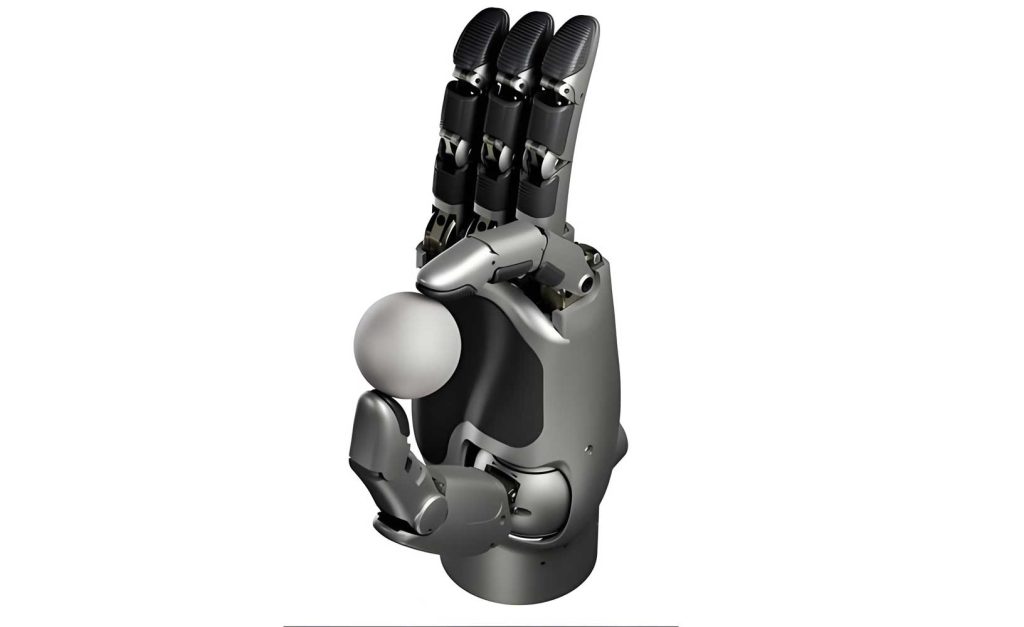
To control the dexterous robotic hand effectively, a comprehensive kinematic model is essential. Kinematics deals with the geometric description of motion, relating end-effector positions to joint displacements. For this dexterous robotic hand, I employ the Denavit-Hartenberg (D-H) method to establish coordinate frames and derive forward and inverse kinematic solutions. Each finger is modeled independently due to identical structure. A fixed reference frame {X0, Y0, Z0} is attached to the palm base, with moving frames assigned to each joint. The D-H parameters define the transformations between consecutive links, including joint angle θi, link twist αi, link length ai, and link offset di. For the dexterous robotic hand finger, the parameters are summarized in the table below.
| Link i | θ_i (Joint Angle) | α_i (Twist Angle) | a_i (Link Length) | d_i (Link Offset) |
|---|---|---|---|---|
| 1 | θ1 | 90° | a1 | 0 |
| 2 | θ2 | 0° | a2 | 0 |
| 3 | θ3 | 0° | a3 | 0 |
| 4 | θ4 | 0° | a4 | 0 |
Here, a1, a2, a3, and a4 represent the lengths of the palm attachment and phalanges, while θ1 to θ4 are the joint variables. Note that for this dexterous robotic hand, the distal joint is coupled, so θ4 = Kθ3, where K is a coupling constant from the wire mechanism. The homogeneous transformation matrix between link i-1 and link i is given by:
$$ A_i = \begin{bmatrix} \cos\theta_i & -\sin\theta_i \cos\alpha_i & \sin\theta_i \sin\alpha_i & a_i \cos\theta_i \\ \sin\theta_i & \cos\theta_i \cos\alpha_i & -\cos\theta_i \sin\alpha_i & a_i \sin\theta_i \\ 0 & \sin\alpha_i & \cos\alpha_i & d_i \\ 0 & 0 & 0 & 1 \end{bmatrix} $$
Substituting the D-H parameters yields the individual matrices A1, A2, A3, and A4. The overall transformation from the base frame to the fingertip frame {X4, Y4, Z4} is computed by consecutive multiplication:
$$ T^0_4 = A_1 A_2 A_3 A_4 = \begin{bmatrix} n_x & o_x & a_x & p_x \\ n_y & o_y & a_y & p_y \\ n_z & o_z & a_z & p_z \\ 0 & 0 & 0 & 1 \end{bmatrix} $$
After algebraic manipulation, the forward kinematics for the fingertip position P = (x, y, z) is derived as:
$$ x = (a_4 c_{234} + a_3 c_{23} + a_2 c_2) c_1 $$
$$ y = (a_4 c_{234} + a_3 c_{23} + a_2 c_2) s_1 $$
$$ z = a_4 s_{234} + a_3 s_{23} + a_2 s_2 $$
where shorthand notations are used: s_i = sin θ_i, c_i = cos θ_i, s_{ij} = sin(θ_i+θ_j), c_{ij} = cos(θ_i+θ_j), and similarly for triple sums. These equations define the workspace of the dexterous robotic hand finger. The inverse kinematics problem involves determining joint angles for a desired fingertip pose. From the forward equations, θ1 is solved directly:
$$ \theta_1 = \arctan\left(\frac{y}{x}\right) $$
Using the coupling relation θ4 = Kθ3 and trigonometric identities, θ3 can be obtained by solving:
$$ \frac{1}{a_2} \cos(K\theta_3) + \frac{1}{a_3} \cos((K+1)\theta_3) + \frac{1}{a_4} \cos\theta_3 = \frac{\left(\frac{x}{c_1}\right)^2 + z^2 – a_2^2 – a_3^2 – a_4^2}{2 a_2 a_3 a_4} $$
This equation may yield multiple solutions, requiring selection based on joint limits. Finally, θ2 is derived as:
$$ \theta_2 = \arctan\left(\frac{C}{\pm \sqrt{A^2 + B^2 – C^2}}\right) – \arctan\left(\frac{A}{B}\right) $$
where A = a4 sin(θ3+θ4) + a3 sin θ3, B = a4 cos(θ3+θ4) + a3 cos θ3 + a2, and C = z. These kinematic models are crucial for trajectory planning and control of the dexterous robotic hand.
To validate the design and kinematics, I performed a grasping simulation using ADAMS software. The process involved creating a 3D model in SolidWorks, exporting it to ADAMS, defining material properties, adding joints and drivers, and executing dynamic simulations. For this dexterous robotic hand, a spherical object was chosen as the target to assess precision grasping capability. The simulation parameters included joint drive functions and time settings to replicate a realistic grasp sequence. The dexterous robotic hand successfully approached, contacted, and secured the sphere within its workspace, demonstrating stable and accurate manipulation. Key metrics such as fingertip displacement and velocity were recorded to analyze performance.
The table below summarizes the simulation parameters and outcomes for the dexterous robotic hand grasping trial.
| Parameter | Value | Description |
|---|---|---|
| Object Type | Sphere | Diameter: 50 mm |
| Grasp Type | Precision Grasp | Three-fingered tripod grasp |
| Simulation Time | 1.5 s | Total duration |
| Joint Drivers | Time-based functions | Smooth step inputs |
| Fingertip Displacement Range | ±300 mm | In X, Y, Z directions |
| Peak Velocity | 35 mm/s | Observed during closure |
The displacement curves for the distal phalanx endpoint P in X, Y, and Z directions showed smooth trajectories without abrupt changes, indicating stable motion. Similarly, velocity curves exhibited consistent profiles, confirming that the dexterous robotic hand can achieve precise positioning without excessive oscillations. These results align with the kinematic predictions, verifying that the dexterous robotic hand operates effectively within its designed workspace. The simulation also highlighted the importance of coupling mechanisms in simplifying control while maintaining functionality. Overall, the ADAMS analysis substantiates the feasibility of this dexterous robotic hand for real-world applications requiring delicate object handling.
Beyond basic grasping, the dexterous robotic hand holds potential for advanced manipulations like rotation, re-grasping, and tool use. Future work will integrate sensor feedback for force control and adaptive grasping. Additionally, comparing this dexterous robotic hand with other multi-fingered designs could reveal improvements in compactness, weight, or speed. The kinematic framework established here serves as a foundation for implementing machine learning algorithms to optimize grasp strategies autonomously. As robotics evolves, such dexterous robotic hands will become pivotal in unstructured environments, from healthcare to space exploration.
In conclusion, I have presented the design, kinematics, and simulation of a three-fingered dexterous robotic hand. The modular finger structure with internal actuation enables compactness and versatility. Using D-H methodology, I derived forward and inverse kinematic solutions, essential for control systems. Simulation results demonstrate successful precision grasping of spherical objects, validating the design. This study contributes to the ongoing development of intelligent end-effectors, paving the way for more autonomous and capable robotic systems. The dexterous robotic hand represents a significant step toward human-like manipulation in machines, with broad implications for industrial and service robotics.