
The rapid development of industry and technology has led to an increased focus on strategic sectors like aerospace and nuclear energy in China. In these industrial environments, personnel often need to operate under extreme and hazardous conditions, posing significant risks to human health. Consequently, intelligent robots designed to replace technicians in such extreme scenarios for complex tasks have emerged. The choice of end-effector directly influences the robot’s operational efficiency. Dexterous hands, which incorporate novel bio-inspired end-effectors, offer high dexterity, strong adaptability, and the ability to perform a wide variety of complex manipulations, making them a prominent research focus in robotics in recent years.
Anthropomorphic dexterous hands can be classified into two categories: fully-actuated and underactuated. Regarding the development of underactuated hands, NASA developed one of the earliest and most classic underactuated dexterous hands for space robotics applications, the Robonaut Hand. This was later optimized in collaboration with General Motors to create the second generation. Catalano et al. developed the PISA/IIT SoftHand, which drives the entire 19-degree-of-freedom hand with a single motor, effectively leveraging the advantages of tendon-driven mechanisms and providing insights for tendon-driven dexterous hand design. Xu Yulin et al. developed the SHU-II, which uses lightweight tendon drive and embeds six DC motors within the palm. Five of these motors control the flexion of each finger, and the remaining one controls the abduction/adduction of the thumb, offering a large motion and grasping space. Building on this foundation, this paper presents the design of a tendon-driven anthropomorphic dexterous robotic hand. We first conduct a kinematic analysis, then derive its Jacobian matrix, and analyze the dynamic performance and motion workspace of the fingers, providing a control basis and theoretical foundation for the dexterous robotic hand.
The dexterous robotic hand designed in this work is modeled after the human hand as a bionic reference. The design is based on the skeletal structure of the human hand, retaining the degrees of freedom necessary for essential functions. Each finger is designed with only three revolute joint degrees of freedom. The hand utilizes a tendon-driven mechanism as the transmission system, responsible for delivering power from the actuators to the execution end. This approach mimics the way human tendons drive finger movement. The tendons are routed internally within the fingers. Pulleys with tendon grooves are constructed at the three joint locations with degrees of freedom on the index, middle, ring, and little fingers: the Distal Interphalangeal (DIP) joint, the Proximal Interphalangeal (PIP) joint, and the Metacarpophalangeal (MC) joint. Motor rotation pulls the tendons, causing the joints to rotate and thereby controlling finger motion.
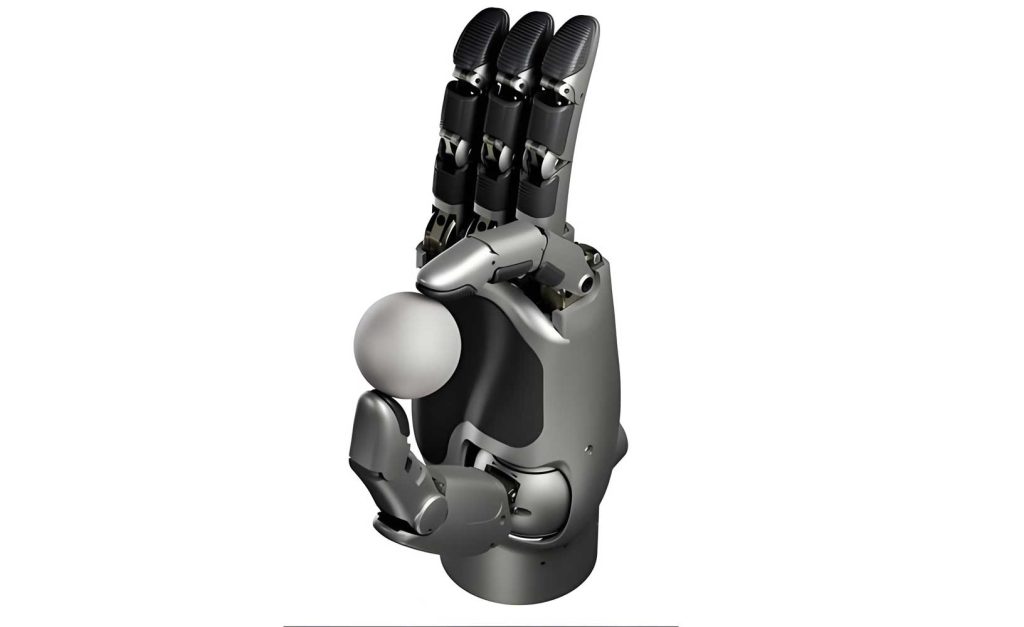
Each finger segment of the tendon-driven dexterous robotic hand is connected by joints. Each of the five fingers can be analogized to a serial-link robotic manipulator. Therefore, the forward and inverse kinematics theories from robotics can be applied to analyze the motion of the fingertip and its joints.
Forward Kinematics Analysis
Forward kinematics determines the fingertip position coordinates in the base coordinate system using the rotation angles of each joint to obtain the homogeneous transformation matrices. Coordinate transformations, such as rotation or translation, describe the relative relationship between the coordinate system of link n and its adjacent link. This can be decomposed into four steps. Multiplying all these transformation matrices yields the overall transformation matrix $${^{n-1}_nT}$$:
$$
\begin{aligned}
^{n-1}_nT &= Rot(z, \theta_n) \cdot Trans(0,0,d_n) \cdot Trans(a_n,0,0) \cdot Rot(x, \alpha_n) \\
&= \begin{bmatrix}
\cos\theta_n & -\sin\theta_n \cos\alpha_n & \sin\theta_n \sin\alpha_n & a_n \cos\theta_n \\
\sin\theta_n & \cos\theta_n \cos\alpha_n & -\cos\theta_n \sin\alpha_n & a_n \sin\theta_n \\
0 & \sin\alpha_n & \cos\alpha_n & d_n \\
0 & 0 & 0 & 1
\end{bmatrix}
\end{aligned}
$$
Each finger is considered a kinematic chain composed of a set of links. The Denavit-Hartenberg (D-H) parameter method is primarily used for the kinematic modeling of such structures. This paper takes the middle finger as an example and uses the D-H method to solve the forward kinematics of a single finger of the dexterous robotic hand. Based on robotics theory and the structure of the middle finger, the joint coordinate system for the dexterous robotic hand’s middle finger is established. ${^0_1T}$ represents the transformation from the base frame (on the palm) to the first joint. The D-H parameters for the middle finger are listed in the table below.
| Link i | $\alpha_{i-1}$ (deg) | $a_{i-1}$ (mm) | $d_i$ (mm) | $\theta_i$ (deg) |
|---|---|---|---|---|
| 1 | 90 | $L_1$ | 0 | $\theta_1$ |
| 2 | 0 | $L_2$ | 0 | $\theta_2$ |
| 3 | 0 | $L_3$ | 0 | $\theta_3$ |
| 4 | 0 | $L_4$ | 0 | $\theta_4$ |
Substituting the D-H parameters into the transformation matrix formula yields the transformation matrices between the joint coordinate frames of the middle finger: ${^0_1T}$, ${^1_2T}$, ${^2_3T}$, ${^3_4T}$, and ${^4_TT}$ (the tool frame at the fingertip). The position and orientation of the middle fingertip in the base coordinate system, ${^0_TT}$, is found by successive multiplication:
$$
^0_TT = ^0_1T \cdot ^1_2T \cdot ^2_3T \cdot ^3_4T \cdot ^4_TT = \begin{bmatrix}
c_1 c_{234} & -c_1 s_{234} & s_1 & c_1(L_1 + L_2 c_2 + L_3 c_{23} + L_4 c_{234}) \\
s_1 c_{234} & -s_1 s_{234} & -c_1 & s_1(L_1 + L_2 c_2 + L_3 c_{23} + L_4 c_{234}) \\
s_{234} & c_{234} & 0 & L_2 s_2 + L_3 s_{23} + L_4 s_{234} \\
0 & 0 & 0 & 1
\end{bmatrix}
$$
Where $c_i = \cos\theta_i$, $s_i = \sin\theta_i$, $c_{ij} = \cos(\theta_i+\theta_j)$, $s_{ij} = \sin(\theta_i+\theta_j)$, etc. The fingertip coordinates $(x, y, z)$ are extracted from the last column of ${^0_TT}$:
$$
\begin{aligned}
x &= c_1 (L_1 + L_2 c_2 + L_3 c_{23} + L_4 c_{234}) \\
y &= s_1 (L_1 + L_2 c_2 + L_3 c_{23} + L_4 c_{234}) \\
z &= L_2 s_2 + L_3 s_{23} + L_4 s_{234}
\end{aligned}
$$
Inverse Kinematics Analysis
Inverse kinematics solves for the joint angles given the desired fingertip position in the base coordinate system. Both analytical and numerical methods can be used. This work employs a numerical approach for the dexterous robotic hand. For the middle finger, basic geometric relations yield $\theta_1 = \arctan(y/x)$. From the coordinate expressions, we derive intermediate equations. By squaring and summing the coordinate equations, a relation involving coupled angles $\theta_3$ and $\theta_4$ is obtained: $\theta_4 = G(\theta_3)$. Solving the simplified equation yields $\theta_3$, and subsequently $\theta_4$. Using the expression for $z$ and the equation for $x$, $\theta_2$ can be solved.
Jacobian Matrix
In robotics, the Jacobian matrix defines the mapping between the velocity space of joint angles $(\dot{\theta}_1, \dot{\theta}_2, …)$ and the Cartesian velocity space of the end-effector $(v_x, v_y, v_z, \omega_x, \omega_y, \omega_z)$. It describes the relationship between the rotational speeds of the finger joints and the Cartesian linear and angular velocities of the fingertip. The Jacobian is essential for velocity analysis and static force analysis. This paper uses the analytical method, deriving differential motion relationships from mathematical expressions to solve for the Jacobian.
From the forward kinematics equations $x=f_x(\theta_1,\theta_2,\theta_3,\theta_4)$, etc., the differential change in fingertip position is:
$$
\begin{bmatrix} dx \\ dy \\ dz \end{bmatrix} = J \begin{bmatrix} d\theta_1 \\ d\theta_2 \\ d\theta_3 \\ d\theta_4 \end{bmatrix}, \quad \text{where} \quad J = \begin{bmatrix}
\frac{\partial x}{\partial \theta_1} & \frac{\partial x}{\partial \theta_2} & \frac{\partial x}{\partial \theta_3} & \frac{\partial x}{\partial \theta_4} \\
\frac{\partial y}{\partial \theta_1} & \frac{\partial y}{\partial \theta_2} & \frac{\partial y}{\partial \theta_3} & \frac{\partial y}{\partial \theta_4} \\
\frac{\partial z}{\partial \theta_1} & \frac{\partial z}{\partial \theta_2} & \frac{\partial z}{\partial \theta_3} & \frac{\partial z}{\partial \theta_4}
\end{bmatrix}
$$
Evaluating the partial derivatives, the Jacobian matrix for the middle finger of the dexterous robotic hand can be expressed as:
$$
J = \begin{bmatrix}
-L_1 s_1 – L_2 c_2 s_1 – L_3 c_{23} s_1 – L_4 c_{234} s_1 & -L_2 c_1 s_2 – L_3 c_1 s_{23} – L_4 c_1 s_{234} & -L_3 c_1 s_{23} – L_4 c_1 s_{234} & -L_4 c_1 s_{234} \\
L_1 c_1 + L_2 c_1 c_2 + L_3 c_1 c_{23} + L_4 c_1 c_{234} & -L_2 s_1 s_2 – L_3 s_1 s_{23} – L_4 s_1 s_{234} & -L_3 s_1 s_{23} – L_4 s_1 s_{234} & -L_4 s_1 s_{234} \\
0 & L_2 c_2 + L_3 c_{23} + L_4 c_{234} & L_3 c_{23} + L_4 c_{234} & L_4 c_{234}
\end{bmatrix}
$$
Dynamic Analysis of the Dexterous Robotic Hand Finger
Using the middle finger as an example, and based on the constructed three-joint finger structure, the Lagrange method is chosen to build the dynamic model for its computational efficiency. The three-joint middle finger structure is simplified into a more intuitive three-degree-of-freedom link model. Each link is assumed to be a uniform rod with its center of mass at the midpoint. The kinetic energy $T(\dot{\theta})$ and potential energy $V(\theta)$ of the system are formulated. The Lagrangian function is defined as $L(\theta, \dot{\theta}) = T(\dot{\theta}) – V(\theta)$. The Lagrange equation for the system is:
$$
\frac{d}{dt} \left( \frac{\partial L}{\partial \dot{\theta}_i} \right) – \frac{\partial L}{\partial \theta_i} = \tau_i, \quad i=1,2,3
$$
Substituting the expressions for kinetic and potential energy yields the dynamic equation for the three-joint finger of the dexterous robotic hand:
$$
\sum_{j=1}^{3} M_{ij}(\theta) \ddot{\theta}_j + \sum_{j=1}^{3} \sum_{k=1}^{3} D_{ijk}(\theta) \dot{\theta}_j \dot{\theta}_k + G_i(\theta) = \tau_i
$$
For convenience, this is often written in matrix form:
$$
M(\theta)\ddot{\theta} + V(\theta, \dot{\theta}) + C(\theta, \dot{\theta}) + G(\theta) = \tau
$$
Where $\theta$, $\dot{\theta}$, $\ddot{\theta}$ are the joint angle, velocity, and acceleration vectors, $M(\theta)$ is the mass matrix, $V(\theta, \dot{\theta})$ represents centripetal forces, $C(\theta, \dot{\theta})$ represents Coriolis forces, and $G(\theta)$ is the gravity vector. The elements of these matrices are derived from the link masses $m_i$, lengths $l_i$, and their trigonometric combinations.
Workspace Analysis of the Dexterous Robotic Hand Fingers
Mapping Between Global and Finger Base Frames
The palm center is taken as the origin of the global coordinate system. Base coordinate systems for the five fingers are established at the centers of their respective metacarpophalangeal (MCP) joints. The transformation from the global palm frame to each finger’s base frame involves specific rotations and translations. The homogeneous transformation matrices are:
- Thumb (T): $^P_OT = Rot(z, -180^\circ) \cdot Rot(x, 174.45^\circ) \cdot Trans(0, -13.93, 30.18)$
- Index (I): $^P_OI = Rot(x, 5.55^\circ) \cdot Trans(0, 38.24, 34.39)$
- Middle (M): $^P_OM = Trans(0, 41.8, 11.28)$
- Ring (R): $^P_OR = Rot(x, -2^\circ) \cdot Trans(0, 35.96, -13.33)$
- Little (L): $^P_OL = Rot(x, -4.56^\circ) \cdot Trans(0, 27.49, -31.17)$
Single-Finger and Full-Hand Workspace Analysis
The designed dexterous robotic hand lacks abduction/adduction degrees of freedom at the MCP joints for the four fingers (excluding the thumb). Therefore, the workspace of these four fingers is planar. Using the Monte Carlo method and the D-H parameters for the middle finger, its fingertip workspace is analyzed. The middle finger’s three joint axes are parallel, resulting in a planar workspace. Analysis shows the middle finger’s x-range is approximately -48 mm to 79 mm and its y-range is 46 mm to 121 mm. As the middle finger has the longest links, it possesses the largest planar workspace among the five fingers.
Similarly, based on the D-H parameters for all fingers and their respective transformations to the global frame, the individual workspaces of all five fingers are calculated and plotted in a unified 3D space using the Monte Carlo method. The thumb is shown in green, the index finger in red, the middle finger in blue, the ring finger in brown, and the little finger in purple. The workspaces of the four non-thumb fingers are crescent-shaped planar regions. The thumb, due to its abduction capability at the base joint, has a non-planar, volumetric workspace.
Observations from the composite workspace plot lead to the following conclusions regarding the capabilities of this tendon-driven dexterous robotic hand:
- The thumb has a relatively large 3D workspace, granting it superior mobility and range of motion compared to the other four fingers.
- The workspaces of the index and middle fingers exhibit substantial overlap with the thumb’s workspace, while the ring and little fingers show less overlap. This indicates that precise grasping operations will primarily rely on coordination between the thumb, index, and middle fingers, highlighting their importance in precision tasks.
- The little finger’s MCP joint is located closer to the palm center compared to the index, middle, and ring fingers. Therefore, in power or enveloping grasps, the little finger plays a crucial role in supporting the object and assisting with grasp stability.
Conclusion
This paper presents a dexterous robotic hand driven by tendons, featuring a bio-inspired structural design, resulting in a 3D model of the hand. Building on this, the Denavit-Hartenberg (D-H) parameter method was applied to derive and analyze the forward and inverse kinematics of the anthropomorphic dexterous robotic hand. The Jacobian matrix governing finger motion was studied, and a dynamic model was established using the Lagrangian formulation. The mapping relationships between the base frames of the five fingers and the global frame were solved. Combined with the results of the kinematic analysis, the single-finger and full-hand workspaces were determined. The results, showing the middle finger’s operational range, provide requirements for inter-finger motion coordination, validate the accuracy of the five-finger kinematic analysis, and offer a theoretical foundation and scientific basis for the future implementation of real-world control strategies for this type of dexterous robotic hand.