
As a crucial end-effector for robots, the dexterous robotic hand plays a vital role in fields such as service, medical care, and aerospace. Traditional grippers, often designed for specific tasks, struggle to meet the demands of versatility and intelligence. To better replace humans in hazardous operations or complex manipulations, multi-fingered dexterous robotic hands with autonomous tactile perception, multi-sensor fusion, and dexterous operation have garnered significant attention. While multi-fingered designs like the Shadow Hand offer high Degrees of Freedom (DOF), they often suffer from complex tendon-driven mechanisms, bulky actuators, and large overall size and mass. Three-fingered designs present a compelling alternative, balancing functionality with reduced mechanical and control complexity. However, existing three-fingered dexterous robotic hand models frequently exhibit limitations such as low integration, poor structural compactness, fixed finger bases limiting dexterity, and an inability to reliably grasp moving objects.
To address these challenges, I have designed a novel, integrated, motor-direct-drive dexterous robotic hand with three fingers and eight active degrees of freedom. The primary objectives were to achieve a low-cost, lightweight design with a large grasping envelope while enabling stable dynamic grasping. This was accomplished through an embedded, modular joint design using micro motors and gear reducers, coupled with a multi-sensor fusion algorithm for real-time perception and control. The following sections detail the mechanical design, kinematic analysis, dynamic grasping algorithm, and experimental validation of this compact dexterous robotic hand.
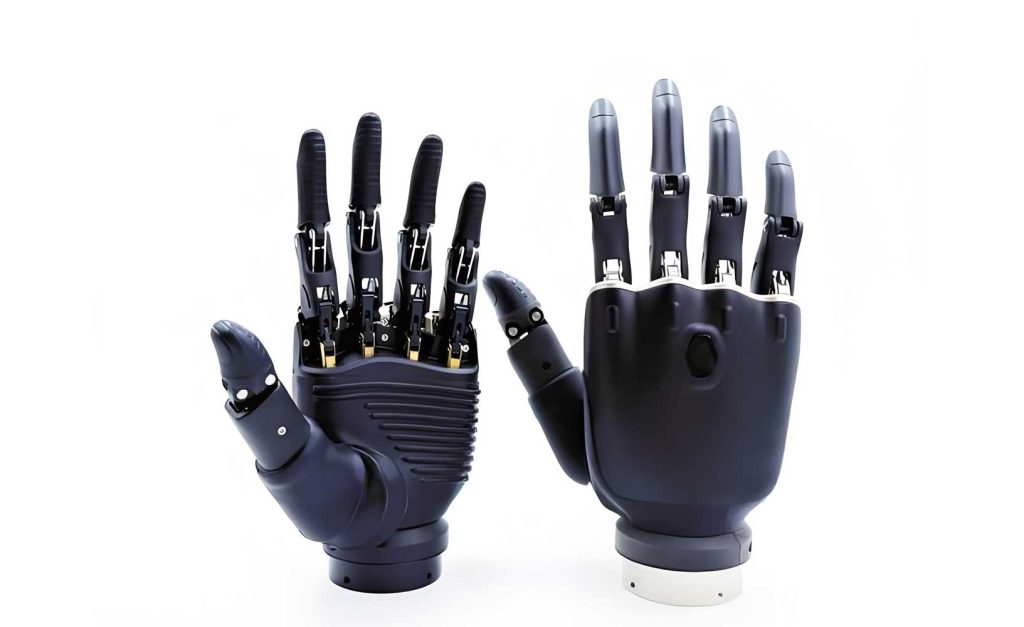
Mechanical Design of the Dexterous Robotic Hand
The overall architecture of the dexterous robotic hand consists of two rotatable fingers, one fixed finger, an integrated palm, and a base housing. The three fingers share similar mechanical structures. The flexion of the distal and medial joints for each finger is driven by micro motors embedded within the preceding phalange. The rotation of the two outer fingers’ proximal phalanges is achieved by motors housed within the base. This configuration allows the two outer fingers to swivel, working in concert with the central fixed finger to form adaptable grasping postures for enveloping or pinching various objects. An ultrasonic sensor is integrated into the palm base to detect the presence and distance of target objects above the hand, which is critical for dynamic grasping.
The dexterous robotic hand prototype possesses 8 active DOF: independent control of the distal and medial joints for all three fingers, plus independent rotation for the two outer proximal phalanges. All joints are driven directly by a combination of a micro DC motor and a multi-stage gear reducer (worm gear + spur gears), which is fully contained within the finger’s volume. This direct-drive joint design minimizes power transmission losses and improves driving force. Key dimensional and kinematic parameters for a single finger are summarized in the table below.
| Component | Length/Width/Thickness (mm) | Angular Range (°) | Angular Velocity (°/s) |
|---|---|---|---|
| Distal Phalanx | 47 / 18 / 18 | 0 ~ 90 | 480 |
| Medial Phalanx | 55 / 22 / 22 | 0 ~ 90 | 480 |
| Proximal Phalanx | 36 / 28 / 17 | 0 ~ 170 | 360 |
Finger Structure and Actuation
Each finger of the dexterous robotic hand comprises three phalanges: distal, medial, and proximal. The drive motor for a given joint is housed in the more proximal phalange. For instance, the motor driving the medial joint is located in the proximal phalange, and the motor driving the distal joint is in the medial phalange. The proximal phalanx rotation motor is situated in the base. This serial linkage is compact. A force-sensitive resistor (FSR) is mounted on the inner pad of the distal phalanx for contact detection and force control. Each joint is equipped with a potentiometer (SV01A) for real-time angular feedback. Internal channels within the phalanges allow neat routing of motor and sensor wires without impeding motion.
To compensate for the backlash inherent in the gear train and prevent positional drift, a torsional preload spring is installed at each flexion joint. These springs bias the finger towards a slightly flexed posture. When the finger experiences a sudden external impact or contacts a rigid object, these springs provide a compliant buffer, absorbing energy and contributing to stable grasp acquisition. This structural compliance is a key feature for the dynamic operation of this dexterous robotic hand.
Transmission System Design
The transmission system for each joint is a critical component enabling the compactness of the dexterous robotic hand. The motor output shaft drives a worm, which meshes with a worm wheel for a high-ratio primary reduction. A spur gear coaxial with the worm wheel then engages a secondary spur gear stage for further reduction. The final output is a D-shaped shaft that couples directly with the corresponding D-shaped bore in the driven phalange and the angle sensor. This integrated gearbox design provides high torque in a minimal volume with reduced losses compared to tendon-driven systems. The combination of worm gearing (which is self-locking to some degree) and spur gears offers a robust and efficient solution for direct joint actuation in this dexterous robotic hand.
Palm and Base Assembly
The base serves as the structural foundation and palm of the dexterous robotic hand. It consists of a circular fixed plate and a top palm plate. The proximal phalanges of the fingers are mounted between these plates. The design prioritizes both functionality for enveloping grasps and ease of assembly/maintenance. The three finger rotation axes are distributed 120° apart on the base plate. The space between the palm plate and the base plate is utilized to house the ultrasonic distance sensor, which points upward through an aperture. This integrated sensor placement allows the dexterous robotic hand to perceive the workspace directly above its palm.
Kinematic Analysis and Dynamic Grasping Algorithm
Forward Kinematics
To control the position of the fingertip and plan grasping trajectories, a kinematic model of the dexterous robotic hand finger is established. Using the Denavit-Hartenberg (D-H) convention, a coordinate frame is attached to each joint. The transformation from frame {i-1} to frame {i} is given by the homogeneous transformation matrix:
$$
T_{i-1}^{i} = \begin{bmatrix}
\cos\theta_i & -\sin\theta_i \cos\alpha_i & \sin\theta_i \sin\alpha_i & a_i \cos\theta_i \\
\sin\theta_i & \cos\theta_i \cos\alpha_i & -\cos\theta_i \sin\alpha_i & a_i \sin\theta_i \\
0 & \sin\alpha_i & \cos\alpha_i & d_i \\
0 & 0 & 0 & 1
\end{bmatrix}
$$
Where $\theta_i$ is the joint angle, $\alpha_i$ is the twist angle, $a_i$ is the link length, and $d_i$ is the link offset. For the finger design, $d_i$ and $\alpha_i$ are zero for the revolute joints, and $a_1$, $a_2$, $a_3$ correspond to the lengths of the proximal, medial, and distal links, respectively.
The position of the fingertip (frame {3}) relative to the palm base frame {0} is obtained by cascading transformations: $T_0^3 = T_0^1 T_1^2 T_2^3$. The Cartesian coordinates (x, y, z) of the fingertip in the palm coordinate system are:
$$
x = (a_3 \cos(\theta_2 + \theta_3) + a_2 \cos\theta_2 + a_1)\cos\theta_1
$$
$$
y = (a_3 \cos(\theta_2 + \theta_3) + a_2 \cos\theta_2 + a_1)\sin\theta_1
$$
$$
z = a_3 \sin(\theta_2 + \theta_3) + a_2 \sin\theta_2
$$
For brevity, let $s_i = \sin\theta_i$, $c_i = \cos\theta_i$, $s_{ij} = \sin(\theta_i+\theta_j)$, $c_{ij} = \cos(\theta_i+\theta_j)$. These equations allow the calculation of fingertip position given the joint angles from the sensors, which is fundamental for implementing the grasping algorithm of the dexterous robotic hand.
Dynamic Grasping Strategy
The core challenge addressed for this dexterous robotic hand is the stable grasping of moving targets. The strategy relies on multi-sensor fusion: an ultrasonic sensor for object distance/velocity, angle sensors for finger posture, and fingertip pressure sensors for contact detection. The control paradigm shifts from position-based pre-shaping to a force-based closure upon contact.
The process for a vertically falling object is analyzed. The origin of the base coordinate system is at the center of the palm/ultrasonic sensor. The object’s distance from the palm is $H_t$. The maximum detection distance is $H_{max}$, and the minimum stable grasping distance is $H_{min}$. The fingers start open at a width $W_{max}$ and close to a width $W_{min}$ upon grasping. The finger opening width is adjusted in real-time based on the object’s estimated height and velocity.
Ultrasonic Ranging and Velocity Estimation
The ultrasonic sensor (KS103) measures distance by timing the echo return. The speed of sound $V_s$ in air is temperature-dependent:
$$
V_s = 331.4 + 0.607T
$$
where $T$ is the ambient temperature in °C. Measured via a thermistor. The distance $H_t$ to the target is:
$$
H_t = \frac{t_g V_s}{2}
$$
where $t_g$ is the high-level pulse duration from the sensor. By sampling $H_t$ at a fixed rate $\Delta t$, the object’s approximate velocity $\dot{H}$ along the Z-axis is estimated as $\dot{H} \approx \Delta H / \Delta t$. This provides the critical state estimation for the moving target.
Fingertip Pressure and Joint Angle Feedback
The FSR sensor’s analog voltage $U$ is mapped to contact force $F$ through a calibration curve. A polynomial fit yields the relationship:
$$
F = 0.103U^3 – 0.41U^2 + 1.213U – 0.024
$$
The joint angle sensors provide real-time feedback $\theta_{i, actual}$, which is compared with the desired angle $\theta_{i, desired}$ for closed-loop position control during the reaching phase. The high consistency between commanded and sensed angles ensures accurate fingertip positioning for the dexterous robotic hand.
Virtual Damping Control Algorithm
To achieve a gentle, stable contact with a moving object and prevent bouncing or excessive impact force, a virtual damping force is incorporated into the control law during the final approach phase. This algorithm creates a simulated resistive force that slows the finger joints as they near the predicted contact point, providing algorithmic compliance. The virtual damping force $F_{damp}$ is modeled as:
$$
F_{\text{damp}} = k_1 \rho C \left( \frac{\Delta H}{\Delta t} \right)^2 + k_2 \frac{\Delta H}{\Delta t} + k_3 H_t
$$
where $\rho$ is air density, $C$ is a drag coefficient, $\Delta H$ is the change in measured object distance over one sample period, $H_t$ is the current distance, and $k_1$, $k_2$, $k_3$ are damping coefficients tuned empirically. This $F_{damp}$ is converted into a modifying signal for the joint motor controllers, effectively reducing the closing velocity. The transition to this virtual damping mode occurs when the predicted fingertip-to-object distance falls below a threshold $H_{yz}$, defined by the kinematic relation:
$$
H_{yz} \geq H_t – [a_3 \sin(\theta_2 + \theta_3) + a_2 \sin\theta_2]
$$
and the horizontal proximity condition: $R + L_x = a_3 \cos(\theta_2 + \theta_3) + a_2 \cos\theta_2 + a_1$, where $R$ is the object radius and $L_x$ is the desired horizontal offset for initiating damping. Once the fingertip pressure sensor detects contact ($F > F_{threshold}$), the control law switches to a force-control mode to secure the grasp. This multi-phase control strategy is essential for the dynamic capability of the dexterous robotic hand.
Experimental Validation and Results
A prototype of the dexterous robotic hand was fabricated using 3D printing (PLA material), resulting in a total mass of approximately 300 grams. The experimental platform comprised the hand prototype, an Arduino Mega 2560 microcontroller, motor drivers, a power supply, and an overhead camera for recording. The system integrated 8 joint angle sensors, 3 fingertip pressure sensors, and the ultrasonic sensor.
Static Grasping Performance
Initial tests evaluated the fundamental grasping strength and adaptability of the dexterous robotic hand. It successfully grasped a variety of common objects of different shapes (cylindrical, cubic, triangular) and weights. The maximum payload held in a power grasp was recorded to be 1.6 kg (e.g., a 1.6L water bottle), demonstrating the effective torque output of the direct-drive joint modules.
Dynamic Grasping Experiments
The dynamic grasping algorithm was tested using soft foam balls and silicone balls (diameters 40-100 mm) dropped from a fixed height of 0.5 m above the stationary hand. The ultrasonic sensor tracked the falling object, triggering finger closure. The virtual damping coefficients were tuned to $k_1=0.55$, $k_2=0.25$, $k_3=-1.2$ (with $\rho=1.293 \text{ kg/m}^3$, $C=0.4$).
Objects fell with different velocities due to air resistance; silicone balls fell faster than foam balls. The ultrasonic sensor successfully tracked the changing height $H_t$ and estimated velocity $\dot{H}$. The plot of $H_t$ vs. time showed a non-linear descent, while $\dot{H}$ vs. time indicated acceleration until terminal velocity was approached.
The key result was the measurement of contact force during grasping. Experiments comparing grasps with and without the virtual damping algorithm showed a significant reduction in the initial impact force spike when damping was active. This led to a more stable acquisition and less tendency for the object to bounce away from the fingers of the dexterous robotic hand.
The success rate of dynamic grasps was evaluated over multiple trials for different object sizes and materials. The results are summarized below:
| Material | Diameter (mm) | Drop Height (mm) | Number of Trials | Success Rate (%) |
|---|---|---|---|---|
| Silicone Ball | 100 | 500 | 50 | 94 |
| 80 | 93 | |||
| 60 | 90 | |||
| 40 | 88 | |||
| Foam Ball | 100 | 98 | ||
| 80 | 97 | |||
| 60 | 96 | |||
| 40 | 96 |
The higher success rates for lighter, more compliant foam balls are expected. The overall high success rates, particularly for larger objects, validate the effectiveness of the sensor fusion and virtual damping control algorithm in enabling the dexterous robotic hand to reliably intercept and secure moving targets.
Conclusion
This work presented the complete design and validation of a novel, compact three-fingered dexterous robotic hand. By employing an embedded, direct-drive joint architecture with micro motors and gear reducers, the design achieves high integration, low weight (300g), and satisfactory force output. The kinematic model provides the foundation for fingertip positioning. The primary contribution is the development and implementation of a dynamic grasping algorithm that fuses data from ultrasonic, angle, and pressure sensors. The algorithm features a virtual damping control phase that mitigates impact forces during the capture of moving objects.
Experimental results demonstrate that the dexterous robotic hand possesses strong static grasping capabilities and, more importantly, can successfully grasp dynamically falling objects with high reliability. The multi-sensor fusion approach allows the hand to perceive target motion and adapt its closure strategy accordingly, achieving accurate, safe, and stable dynamic grasps. Future work will focus on enhancing the perception system with vision, improving the object velocity estimation model, and exploring more advanced adaptive grip force control algorithms for an even wider range of dynamic manipulation tasks.