
In the field of robotics, the development of multi-fingered end-effectors capable of emulating human hand functionality has been a long-standing goal. This work focuses on the analysis of grasping capabilities, particularly power grasp, for a self-designed four-fingered dexterous robotic hand. The primary objective is to evaluate whether this dexterous robotic hand can achieve stable grasping of objects up to 3 kg, mirroring human hand proportions. The analysis encompasses structural design, kinematic and dynamic modeling, simulation of grasping tasks, and structural integrity verification via finite element methods. The insights gained provide a theoretical foundation for control system development and experimental validation of heavy-load grasping for such dexterous robotic hands.
The pursuit of a truly versatile dexterous robotic hand must balance two key aspects: dexterous manipulation (precision grasp) and robust, stable grasping under load (power grasp). While significant research has focused on the former, the latter is equally critical for practical applications where the dexterous robotic hand must interact with objects of substantial weight. This study aims to bridge that gap by systematically analyzing the power grasp performance of a specific anthropomorphic four-fingered dexterous robotic hand.
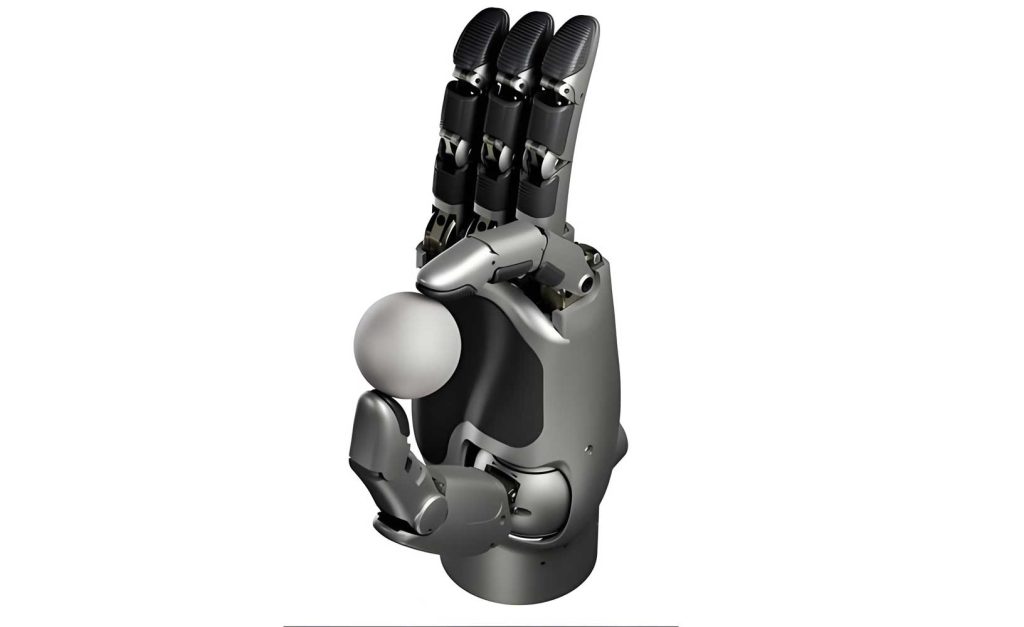
The mechanical architecture of the dexterous robotic hand is designed under the principle of “minimum weight and size for maximum load capacity.” This four-fingered dexterous robotic hand mimics the human thumb, index, middle, and ring fingers. Each finger in this dexterous robotic hand possesses three phalanges and three active degrees of freedom (DOFs). The thumb is the most complex, featuring two DOFs at its metacarpophalangeal (MCP) joint (adduction/abduction and flexion/extension) and one DOF at the proximal interphalangeal (PIP) joint. The distal interphalangeal (DIP) joint motion is coupled to the PIP joint via a novel “∞-shaped” steel wire coupling mechanism, ensuring a precise and constant 1:1 transmission ratio throughout the finger’s range of motion. This mechanism, characterized by its compact size, high reliability, and absence of slip, is a key feature of this dexterous robotic hand. The other three fingers have a similar structure but with only a flexion/extension DOF at their MCP joint. This configuration, with the thumb opposing the other three fingers, is essential for achieving stable enveloping grasps, a hallmark of a capable dexterous robotic hand.
The kinematic model is fundamental for planning the motions of this dexterous robotic hand. Using the Denavit-Hartenberg (D-H) convention, coordinate frames are attached to each link of the thumb. The parameters are summarized in the table below.
| Joint i | ai-1 (mm) | αi-1 (rad) | di (mm) | θi (variable) |
|---|---|---|---|---|
| 1 | 0 | π/2 | 0 | θ1 |
| 2 | L1 | 0 | 0 | θ2 |
| 3 | L2 | 0 | 0 | θ3 |
| 4 | L3 | 0 | 0 | θ4 |
Here, L1, L2, and L3 represent the lengths of the proximal, medial, and distal phalanges, respectively. The coupled motion between joints 3 and 4 implies θ4 = θ3. The homogeneous transformation matrix from the base to the fingertip is obtained by the consecutive multiplication of individual joint transformation matrices:
$$ {^0_4T} = {^0_1T}{^1_2T}{^2_3T}{^3_4T} = \begin{bmatrix}
{^0_4R} & {^0_4P} \\
0 & 1
\end{bmatrix} $$
Where the rotation matrix {^0_4R} and position vector {^0_4P} are given by:
$$ {^0_4R} = \begin{bmatrix}
c_1 c_{234} & -c_1 s_{234} & s_1 \\
s_1 c_{234} & -s_1 s_{234} & -c_1 \\
s_{234} & c_{234} & 0
\end{bmatrix} $$
$$ {^0_4P} = \begin{bmatrix}
L_3 c_1 c_{234} + L_2 c_1 c_{23} + L_1 c_1 c_2 \\
L_3 s_1 c_{234} + L_2 s_1 c_{23} + L_1 s_1 c_2 \\
L_3 s_{234} + L_2 s_{23} + L_1 s_2
\end{bmatrix} $$
In these equations, we use the shorthand notation: si = sin(θi), ci = cos(θi), sij = sin(θi+θj), cij = cos(θi+θj), and c234 = cos(θ2+θ3+θ4). This forward kinematic model is essential for determining the fingertip position and orientation for any given set of joint angles in the dexterous robotic hand.
Dynamic analysis is crucial for understanding the force and torque requirements during motion and interaction. The Lagrangian method is employed to derive the equations of motion for a single finger of the dexterous robotic hand. The general form of the dynamic equation is:
$$ \sum_{j=1}^{4} M_{ij} \ddot{\theta}_j + \sum_{j=1}^{4} \sum_{k=1}^{4} h_{ijk} \dot{\theta}_j \dot{\theta}_k + \sum_{j=1}^{n} m_j g^T J_{Lj}^{(i)} = Q_i $$
For i = 1, 2, 3, 4. Here, Mij are elements of the 4×4 inertia matrix, hijk are Coriolis and centrifugal coefficients given by hijk = ∂Mij/∂θk – (1/2)∂Mjk/∂θi, mj is the mass of link j, g is the gravity vector, JLj(i) is the linear Jacobian component for link j with respect to joint i, and Qi is the generalized force. The generalized force Qi includes the joint actuator torque τi and the contribution from external contact forces F acting on the fingertip: Qi = τi + JTF. The full expressions for Mij and hijk, though lengthy, are derived systematically from the kinematic model and link mass properties. This dynamic model forms the basis for simulating the response of the dexterous robotic hand under various loading conditions.
To validate the models and assess grasping performance, a comprehensive simulation study was conducted using the ADAMS multi-body dynamics software. Initial simulations focused on a single finger of the dexterous robotic hand to understand the relationship between joint motion, torque, velocity, and acceleration. Sinusoidal trajectories were prescribed for the first two joints: θ1(t) = 60 sin(t) and θ2(t) = 30 sin(t) (in degrees). The resulting joint torque profiles provided insights into the inertial and gravitational loading during free motion, establishing a baseline for the dexterous robotic hand’s actuator requirements.
The core grasping simulation aimed to replicate a power grasp, specifically a cylindrical grasp, which is ideal for holding heavy objects stably with the dexterous robotic hand. The object was modeled as a 3 kg aluminum cylinder. A critical aspect was defining the contact force model between the fingers of the dexterous robotic hand and the object. A penalty-based contact method with appropriate stiffness and damping coefficients was used to simulate realistic force interactions. To achieve a stable grasp without excessive initial impact forces, the joint torques were applied as STEP functions. For the thumb (finger 1), the torques were defined as:
$$ \tau_{1,1} = \text{STEP}(time, 0, -100, 2, -700) \, \text{N·mm} $$
$$ \tau_{1,2} = \text{STEP}(time, 0, -30, 3, -300) \, \text{N·mm} $$
For the other three fingers (fingers 2, 3, 4), identical torque profiles were applied to ensure synchronized motion for enveloping the object:
$$ \tau_{i,1} = \text{STEP}(time, 0, 30, 5, 200) \, \text{N·mm} \quad \text{for} \, i=2,3,4 $$
$$ \tau_{i,2} = \text{STEP}(time, 0, 20, 1, 70) \, \text{N·mm} \quad \text{for} \, i=2,3,4 $$
The simulation successfully demonstrated a stable power grasp. The contact forces at each phalanx reached steady-state values after minor initial oscillations inherent to rigid-body contact models. The steady-state contact force data is summarized below.
| Finger | Phalanx | Contact Force (N) |
|---|---|---|
| Thumb (1) | Proximal | 30.0 |
| Medial | 21.0 | |
| Index (2) | Proximal | 10.0 |
| Middle (3) | Proximal | 9.6 |
| Ring (4) | Proximal | 9.2 |
These forces, primarily normal to the contact surface, generate the frictional forces necessary to balance the object’s weight. The total normal force is sufficient to produce a static frictional force greater than 30 N (3 kg × 9.81 m/s² ≈ 29.4 N), confirming the dexterous robotic hand’s capability to securely hold the target weight in simulation. The STEP-function torque profile proved effective in achieving a smooth grasp initiation and stable force maintenance.
While the simulation confirms kinematic and dynamic feasibility, the structural integrity of the dexterous robotic hand under load must be verified. A static finite element analysis (FEA) was performed using ANSYS to examine stress concentrations, particularly in the finger phalanges and joint pin connections, which are critical load-bearing points in this dexterous robotic hand. The thumb, subjected to the highest loads, was analyzed. A simplified 3D model of the thumb’s phalange plates and joint pins was created, representing the worst-case loading scenario. The material was set as hard aluminum alloy (LY12) with an elastic modulus E = 71 GPa and Poisson’s ratio ν = 0.33.
A key challenge in FEA of the dexterous robotic hand is accurately modeling the pin-joint connection between phalange plates and the axle. Based on comparative studies of pin-joint modeling techniques, the method of coupling degrees of freedom was adopted. The radial degrees of freedom on one side of the pin-hole interface were coupled to simulate the bearing contact, while allowing rotation about the pin axis. This approach provides a good balance between model accuracy and computational efficiency for analyzing the dexterous robotic hand structure.
The boundary conditions constrained the proximal end of the finger structure, allowing only rotation at the joint locations. The contact forces from the simulation (30 N on the medial phalanx and 21 N on the proximal phalanx of the thumb) were applied as distributed pressures on the respective contact areas of the phalange plates. The mesh was refined, especially around pin holes and loaded regions, using SOLID185 elements. The resulting von Mises stress distribution was analyzed. The maximum stress in the phalange plates, excluding the localized high stress at force application points, was found to be within safe limits. The most critical region was the joint pin itself. The stress distribution on the pin showed a maximum von Mises stress of approximately 4.86 MPa.
The yield strength (σ0.2) of LY12 aluminum is 260 MPa. Applying a safety factor of 1.5, the allowable stress [σ] is 173.3 MPa. Since 4.86 MPa << 173.3 MPa, the structural components of the dexterous robotic hand possess a significant safety margin. This confirms that the mechanical design of the dexterous robotic hand is more than adequate to handle the stresses induced by grasping a 3 kg object, fulfilling the core design requirement for this dexterous robotic hand.
The integrated analysis presented here provides a comprehensive evaluation of the grasping ability of the four-fingered dexterous robotic hand. The kinematic model enables precise motion planning for the dexterous robotic hand, while the dynamic model lays the groundwork for future force and impedance control strategies. The ADAMS simulation successfully demonstrated that the dexterous robotic hand can achieve a stable power grasp on a 3 kg cylinder through appropriate actuation profiles, with contact forces quantitatively predicted. Most importantly, the finite element analysis verified the structural robustness of the dexterous robotic hand under these operational loads, ensuring that mechanical failure is not a limiting factor.
This work establishes a solid theoretical foundation for the experimental phase of this dexterous robotic hand project. The models and methods can be extended to analyze other grasp types and object geometries. Future work will involve implementing the derived control models on the physical prototype of the dexterous robotic hand, conducting real-world grasping experiments, and potentially optimizing the design for even higher payloads or improved dexterity. The continuous development of such capable dexterous robotic hands is pivotal for advancing robotics in manufacturing, logistics, healthcare, and service applications where human-like manipulation under load is essential.