
The transition towards intelligent manufacturing represents a pivotal shift in core industries such as forging, which is fundamental to sectors like aerospace, automotive, and heavy machinery. Traditional hammer forging processes, however, remain labor-intensive and hazardous, particularly during the critical stage of repositioning high-temperature forgings that have shifted or adhered within the die cavity. Manual intervention not only poses significant safety risks but also introduces variability in positioning accuracy, ultimately impacting product quality and production efficiency. The恶劣 operating environment, characterized by intense heat and repetitive strain, further underscores the urgent need for robotic automation to replace human operators.
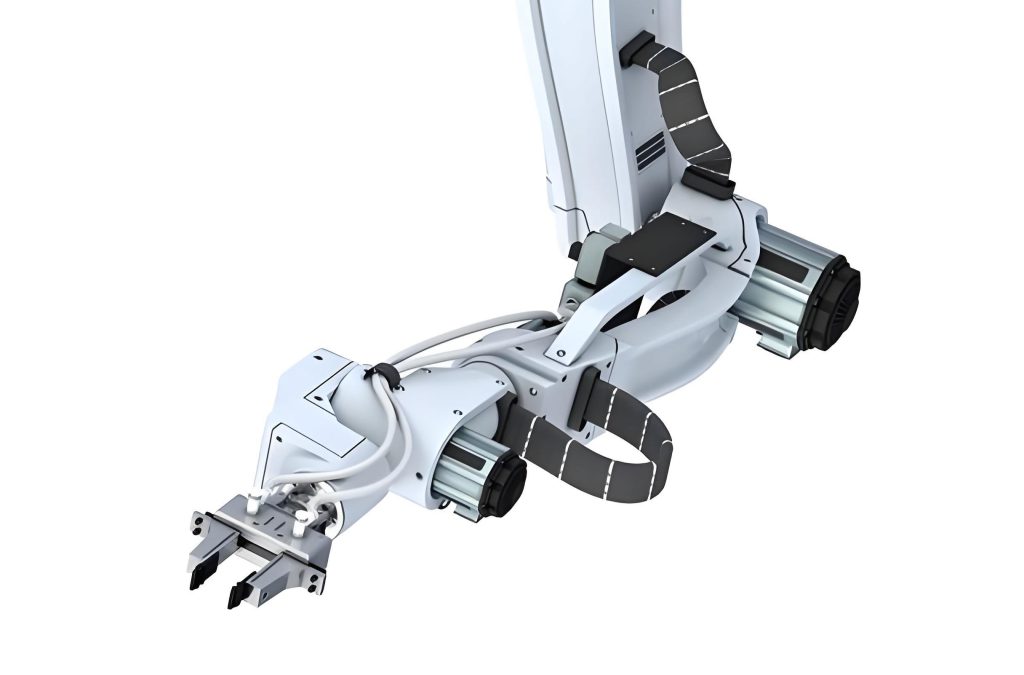
This paper addresses these challenges by presenting the comprehensive design, simulation, and experimental validation of a specialized pneumatic end effector developed for an industrial robot deployed in a hammer forging cell. The primary objective is to automate the retrieval and precise repositioning of displaced, high-temperature forgings, specifically focusing on a scraper beam component for mining equipment. The developed end effector employs a clamp-type, dual-cylinder pneumatic mechanism designed for robust, stable, and adaptive grasping under demanding conditions.
1. System Requirements and Conceptual Design
The target workpiece is a scraper beam forging with an integrated flash (excess material), as illustrated in the provided figure. Post-forging, this flash has a nominal thickness of 7 mm, and the total mass of the forging is 25 kg. The robotic system is integrated with a Lasco 125 kJ full-hydraulic die forging hammer. Key parameters of the forging hammer and the selected industrial robot, a Siasun SR165 model, are summarized below to establish the operational context and design constraints for the end effector.
| Parameter | Value |
|---|---|
| Nominal Striking Energy | 125 kJ |
| Max. Hammer Head Stroke | 1030 mm |
| Striking Frequency | 75 blows/min |
| Parameter | Value |
|---|---|
| Degrees of Freedom | 6 |
| Max. Payload | 165 kg |
| Max. Reach | 2586 mm |
| Repeatability | ±0.25 mm |
Given the high temperature of the forging (often exceeding 800°C), direct clamping on the finished body is prohibited to avoid surface damage and quality defects. Therefore, the grasping action must be performed exclusively on the cooler, sacrificial flash. This requirement dictates a grasping mechanism capable of securely holding a thin, protruding flange. A comparative analysis of common end effector types—suction, magnetic, flexible, and clamp-type—led to the selection of a dual-action clamp design. This design offers the necessary high gripping force, precise positioning capability, and adaptability to the workpiece geometry, outperforming alternatives in this high-load, precision-demanding scenario.
The conceptual design revolves around a two-stage clamping strategy: initial lateral support and final vertical securing. The core components of the designed end effector include:
1. Clamping Mechanism: Comprising a bottom clamping assembly (with extended plates forming a support tray) and a top pressing assembly.
2. Actuation Mechanism: Two pneumatic cylinders providing independent linear motion.
3. Supporting Structure: A rigid frame including L-shaped brackets, a base plate, and a connecting sleeve.
4. Flange Adapter: A custom interface for mounting the end effector to the robot’s wrist flange.
The total mass of the end effector is 32.5 kg, well within the robot’s payload capacity.
2. Detailed Mechanical Design of the End Effector
2.1 Bottom Clamping Assembly
This sub-assembly is responsible for the primary lateral gripping and vertical support of the forging’s flash. It consists of two clamping plates mounted on linear sliders that travel along precision guide rods. The guide rods are fixed to a pair of L-shaped brackets. A dedicated pneumatic cylinder (Cylinder 1) provides the actuating force. The key innovation here is the extended lower portion of the clamping plates, which forms a supporting tray. This tray cradles the flash from below, preventing damage to the main forging body and ensuring the forging’s weight is properly borne during lifting, not just pinched laterally.
2.2 Top Pressing Assembly
This sub-assembly provides a downward securing force, completing the two-stage grip and adapting to variations in flash thickness. It consists of two pressing plates, each connected via linkages to a central pivot. A second pneumatic cylinder (Cylinder 2) drives this linkage system, causing the pressing plates to rotate downward and apply a clamping force on the top surface of the flash. This action, combined with the bottom support, creates a highly stable, enveloping grasp that can correct minor misalignments.
2.3 Actuator Sizing and Selection
The pneumatic cylinders are the primary drivers. Their bore diameter \( D \) is determined based on the required force \( F \), the available supply pressure \( p \), and a load factor \( \eta \), using the standard formula:
$$ D = \sqrt{\frac{4F}{\pi \eta p}} $$
For Cylinder 1 (bottom clamp), the required force to overcome friction and provide sufficient clamping was calculated. With \( p = 0.6 \, \text{MPa} \) and \( \eta = 0.8 \), the calculated diameter was approximately 30.4 mm. A Festo DSNU-40-50-P-A cylinder (40 mm bore, 50 mm stroke) was selected to provide a safety margin. Similarly, for Cylinder 2 (top press), a larger force was anticipated for secure vertical holding, leading to the selection of a Festo DSNU-50-40-P-A cylinder (50 mm bore, 40 mm stroke).
2.4 Material Selection
Material choice is critical due to the proximity to high-temperature forgings and significant mechanical loads. Key stressed components like the clamping plates, pressing plates, guide rods, and linkage parts are fabricated from Inconel 625, a nickel-based superalloy known for its excellent high-temperature strength, corrosion resistance, and creep resistance. The supporting structure, base, and flange adapter, which experience lower thermal and mechanical stress, are made from 06Cr25Ni20 (AISI 310S) stainless steel, offering good oxidation resistance and structural integrity at elevated temperatures.
3. Kinematic, Dynamic, and Structural Simulation
3.1 Multi-Body Dynamics Simulation in ADAMS
A virtual prototype of the end effector and forging was built in ADAMS to simulate the complete operational sequence: clamping, vertical lift, and 180-degree in-air rotation. Appropriate constraints (fixed, revolute, translational joints) and material properties were applied. Two simulation models were run: a motion-driven model to verify kinematic travel and a force-driven model to validate actuator sizing.
In the motion-driven simulation, step functions defined the actuator strokes and robot motions. The results confirmed the required cylinder strokes: approximately 33.1 mm for Cylinder 1 (retracting) and 32.3 mm for Cylinder 2 (extending), both within the selected cylinders’ stroke limits. The trajectories of the clamping plates, pressing plates, and the forging itself were as intended.
The force-driven simulation applied the theoretical output forces of the selected cylinders (633 N for Cylinder 1, 1178 N for Cylinder 2) to the model. The resulting piston displacements matched those from the motion-driven simulation very closely, confirming that the chosen cylinders can reliably produce the necessary motion against the system’s inertia and load. The maximum forces required from the cylinders during the dynamic sequence were identified as 1178.1 N and 752.9 N, respectively.
| Component | Simulated Max. Stroke | Simulated Max. Force | Selected Cylinder |
|---|---|---|---|
| Bottom Clamp (Cyl 1) | 33.1 mm | 1178.1 N | Festo DSNU-40-50-P-A |
| Top Press (Cyl 2) | 32.3 mm | 752.9 N | Festo DSNU-50-40-P-A |
3.2 Finite Element Analysis in ANSYS
Static structural analyses were performed on critical components to verify their strength and stiffness under operational loads.
Bottom Support Structure: Fixed at the mounting points and subjected to a 250 N load (simulating the forging’s weight), the maximum deformation was 0.063 mm, the equivalent elastic strain was \( 4.37 \times 10^{-5} \), and the von Mises stress was 8.24 MPa. This stress is only 2.99% of the yield strength of 06Cr25Ni20 steel, indicating a high safety factor.
Clamping Plate: A 125 N side load was applied to one plate. The maximum deformation was 0.043 mm, with a maximum equivalent strain of \( 2.43 \times 10^{-5} \) and a stress of 4.85 MPa. This is far below the yield strength of Inconel 625 (414 MPa).
Top Pressing Assembly: Under a 250 N vertical load, the maximum deformation was 0.072 mm. The maximum equivalent strain was \( 2.35 \times 10^{-4} \), and the stress was 46.84 MPa, again well within the limits of the Inconel 625 material.
The FEA results, summarized below, conclusively demonstrate that all critical components possess sufficient rigidity and strength margin for the intended application, validating the end effector structural design.
| Component | Material | Max. Deformation (mm) | Max. Equivalent Stress (MPa) | Safety Factor (vs. Yield) |
|---|---|---|---|---|
| Bottom Support | 06Cr25Ni20 | 0.0626 | 8.24 | > 12 |
| Clamping Plate | Inconel 625 | 0.0435 | 4.85 | > 85 |
| Top Press Assembly | Inconel 625 / 06Cr25Ni20 | 0.0718 | 46.84 | > 8 |
4. Pneumatic Control System Design and Simulation
The actuation of the dual-cylinder end effector requires a reliable and sequenced pneumatic control system. The system architecture is centered on a Siemens S7-1200 PLC as the controller. The pneumatic circuit for each cylinder is based on a 5/3-way solenoid valve (4V230C-08) with a closed-center configuration. This “middle-closed” design locks the cylinder position when the valve is de-energized, essential for maintaining grip during power loss or emergency stop. Adjustable one-way flow control valves (speed controllers) are installed at the cylinder ports to regulate both extending and retracting speeds independently, allowing for smooth acceleration and deceleration.
The system was modeled and simulated using FluidSim software to verify the logic and dynamic behavior before physical implementation. The simulation confirmed the correct sequencing: energizing solenoid 1YA causes Cylinder 1 to retract (closing the bottom clamp), while energizing 2YA causes Cylinder 2 to extend (lowering the top press). The electrical control circuit, interlocked with the PLC outputs, ensures safe and sequential operation, preventing conflicting commands. The PLC program implements the two-stage gripping logic and integrates with the robot controller for coordinated motion.
5. Experimental Validation and Results
A full-scale prototype of the end effector was manufactured and integrated with the SR165 robot for laboratory testing. The experiments focused on validating the control system’s performance and the end effector’s practical grasping capability.
5.1 Effect of Speed Control Valve Opening
The opening of the one-way flow control valves directly impacts the actuator’s speed and, consequently, the system’s response time and impact force. Tests were conducted by measuring the opening and closing times of the gripper at different valve settings, with a constant supply pressure of 0.6 MPa. The results are tabulated below.
| Throttle Valve Opening (%) | Opening Time (s) | Closing Time (s) |
|---|---|---|
| 20 | 0.35 | 0.40 |
| 40 | 0.28 | 0.32 |
| 60 | 0.22 | 0.26 |
| 80 | 0.18 | 0.21 |
| 100 | 0.15 | 0.18 |
The data shows a clear inverse relationship between valve opening and action time. An opening of approximately 60% was identified as optimal, providing a responsive yet controlled speed that minimizes shock loading on the forging while maintaining cycle time efficiency. The slight asymmetry between opening and closing times is due to differing effective piston areas and circuit flow paths.
5.2 Grasping Stability Under Different Orientations
The end effector must handle forgings that may come to rest in various positions on the die. Two critical adaptability tests were performed:
1. Inclined Grasping: The robot, with the end effector holding a forging, was commanded to hold the forging at increasing inclination angles from horizontal (0°). The system successfully maintained a secure grip up to a maximum angle of 64°, demonstrating significant tolerance for off-angle retrieval scenarios.
2. 180-Degree In-Hand Rotation: To simulate the flipping operation required when a forging is upside-down, the robot’s wrist rotated the entire end effector and grasped forging through a full 180° arc. The end effector maintained a stable grip throughout the rotation, confirming the effectiveness of the dual-stage clamping strategy in resisting moments and changes in load direction caused by gravity.
6. Conclusion
This paper presented the complete development cycle of a specialized pneumatic end effector for automating forging repositioning in a hammer forging line. The钳夹式 dual-cylinder design, featuring independent bottom support and top pressing mechanisms, was proven through simulation and experiment to provide a secure, adaptive, and damage-free grip on high-temperature forgings via their flash.
Kinematic and dynamic simulations in ADAMS validated the actuator sizing and motion sequences, while FEA in ANSYS confirmed the structural integrity of all critical components under operational loads. The development of a PLC-controlled middle-closed pneumatic system ensured safe and reliable actuation. Experimental tests quantitatively identified optimal control parameters (e.g., 60% throttle valve opening) and qualitatively demonstrated the end effector’s robust performance across a range of forging orientations, including extreme inclinations and full in-hand rotation.
The successful design and validation of this end effector provide a concrete technical solution for a key bottleneck in hammer forging automation. It effectively addresses the safety, precision, and efficiency limitations of manual operation, contributing directly to the advancement of intelligent manufacturing in the heavy forging industry. The methodologies employed—integrating mechanical design, multi-physics simulation, and controlled experimentation—offer a replicable framework for developing task-specific end effectors for other challenging industrial applications.