
The automation of aircraft assembly processes has seen a significant evolution with the integration of industrial robotics. A critical operation within this domain is the automated drilling of numerous fastening holes on aircraft structural components. These components are often characterized by complex, large-curvature, and irregular geometries. A common challenge in robotic drilling systems is ensuring that the robotic end effector, the tool which holds the drill spindle, can approach each drilling point without colliding with the part itself or surrounding fixtures. While the drilling direction (normal vector) is typically defined by the part geometry, this constraint alone does not fully determine the orientation, or posture, of the end effector around that normal. A sub-optimal posture can force the robot arm into awkward, joint-limited, or interference-prone configurations. Therefore, developing a control algorithm to actively define and optimize the end effector‘s posture is essential for enhancing the flexibility, reliability, and collision-free operation of robotic drilling systems. This article presents a preliminary yet effective posture control algorithm for a robotic end effector, allowing for the specification of its rough orientation during drilling operations.
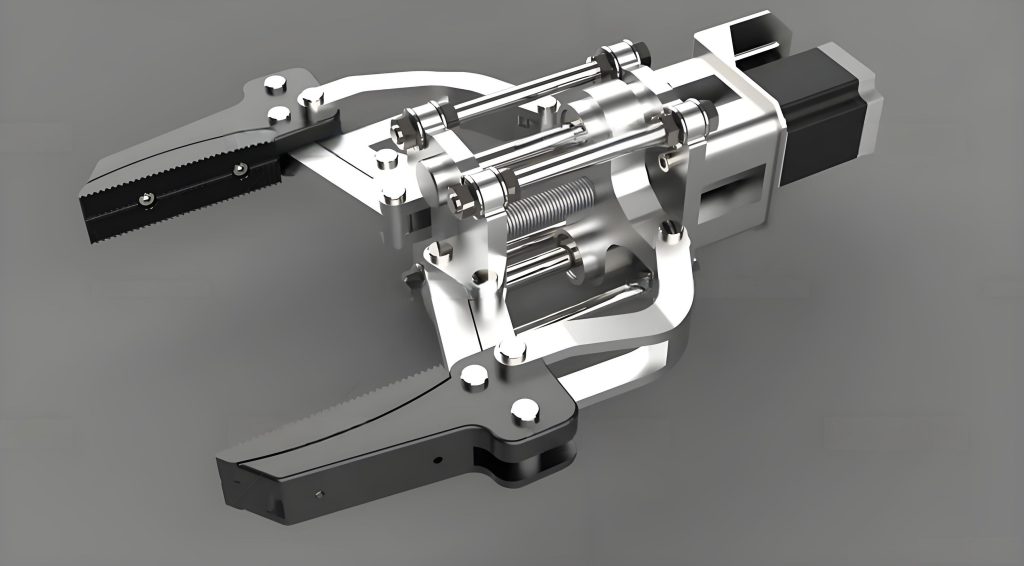
The foundation of this work is a specific aircraft component automated drilling system. The system primarily consists of an industrial robot, an Automated Guided Vehicle (AGV), a specialized drilling end effector, conformal tooling, and the aircraft part itself. To enhance the system’s flexibility for accessing complex contours, the drilling end effector is mounted on the robot’s flange such that its spindle feed axis is perpendicular to the robot’s flange axis. A virtual simulation platform for this robotic drilling system was constructed using DELMIA software to validate the proposed algorithm. In this platform, for a single drilling point with a given spatial coordinate and surface normal, the robot’s end effector can theoretically assume an infinite number of valid orientations, all aligning the spindle with the normal. These different postures directly dictate the overall configuration of the robot arm.
The core task is to define the Tool Center Point (TCP) pose for the end effector. The pose is represented by a position vector P = (x, y, z) and a rotation matrix R. For drilling, the TCP’s position coincides with the drilling point, and its z-axis must align perfectly with the surface normal vector a. However, the rotation around this z-axis (the spindle axis) remains free. This degree of freedom is what our algorithm aims to control. A common practical requirement is to orient a specific axis of the end effector, for example, its x-axis, to be approximately “horizontal” relative to the world or part coordinate system, minimizing the risk of collision with part features. The posture control algorithm provides a method to calculate the full rotation matrix R = [n, o, a], where n, o, a are the unit vectors of the TCP’s x, y, and z-axes expressed in the reference coordinate frame, given the normal vector a and a constraint on either n or o.
The step-by-step posture control algorithm is as follows:
Step 1: Define the Tool Z-Axis. The surface normal provided by the part definition directly gives the TCP’s z-axis unit vector:
$$
\mathbf{a} = [a_x, a_y, a_z]^T
$$
Step 2: Define the Primary Controlled Axis. Based on the operational requirement (e.g., “x-axis approximately horizontal”), we establish algebraic conditions for the primary axis unit vector, say n (the x-axis). “Approximately horizontal” can be interpreted as minimizing the absolute value of the z-component of n relative to its x and y components. A simple and effective heuristic is to set the z-component to zero and choose the x and y components to be orthogonal to a. The orthogonality condition is:
$$
\mathbf{a} \cdot \mathbf{n} = a_x n_x + a_y n_y + a_z n_z = 0
$$
If we enforce $n_z = 0$ for a near-horizontal x-axis, the condition simplifies to $a_x n_x + a_y n_y = 0$. One non-zero solution is:
$$
n_x = -a_y, \quad n_y = a_x, \quad n_z = 0
$$
This vector is then normalized to obtain the unit vector $\mathbf{\hat{n}}$:
$$
\mathbf{\hat{n}} = \frac{1}{\sqrt{a_x^2 + a_y^2}} [-a_y, a_x, 0]^T
$$
Step 3: Calculate the Remaining Axis. The third axis, the y-axis unit vector o, is determined by the right-handed orthonormal property of the rotation matrix: $\mathbf{o} = \mathbf{a} \times \mathbf{\hat{n}}$. This ensures $\mathbf{o}$ is orthogonal to both $\mathbf{a}$ and $\mathbf{\hat{n}}$. The cross-product yields:
$$
\mathbf{o} = \mathbf{a} \times \mathbf{\hat{n}} = \frac{1}{\sqrt{a_x^2 + a_y^2}} [a_x a_z, a_y a_z, -(a_x^2 + a_y^2)]^T
$$
This vector $\mathbf{o}$ is also automatically normalized because $\mathbf{a}$ and $\mathbf{\hat{n}}$ are orthogonal unit vectors.
Step 4: Compute Orientation Angles. The complete rotation matrix is now defined as $\mathbf{R} = [\mathbf{\hat{n}}, \mathbf{o}, \mathbf{a}]$. For robot programming, this matrix is often converted to Euler angles (e.g., ZYX or ZYZ conventions depending on the robot controller). Using a common ZYX convention where angles are $(\alpha, \beta, \gamma)$ representing rotations around the world Z, Y, and X axes respectively, the angles can be extracted from $\mathbf{R}$ when $cos(\beta) \ne 0$:
$$
\begin{aligned}
\beta &= \text{Atan2}( -r_{31}, \sqrt{r_{11}^2 + r_{21}^2} ) \\
\alpha &= \text{Atan2}( r_{21}/cos(\beta), r_{11}/cos(\beta) ) \\
\gamma &= \text{Atan2}( r_{32}/cos(\beta), r_{33}/cos(\beta) )
\end{aligned}
$$
where $r_{ij}$ are the elements of the rotation matrix $\mathbf{R}$.
To validate the algorithm, the DELMIA simulation platform was employed. Three distinct sets of drilling points were selected on a representative aircraft component, each with different high-level posture requirements for the end effector: the upper section required the end effector‘s x-axis to be horizontal; the middle-upper section required the end effector‘s y-axis to be horizontal; and the lower section required the end effector to avoid a specific fixture, which translated to another x-axis horizontal rule but with different world orientation. The algorithm was applied to each point, computing the full 6-DOF pose (position and Euler angles). The table below summarizes the input data (coordinates and normals) for a subset of points and the output Euler angles calculated by the algorithm.
| Point Group | Coordinates (x, y, z) mm | Normal Vector (ax, ay, az) | Computed Euler Angles (α, β, γ) deg |
|---|---|---|---|
| P1 (Upper) | (240, 2379, -542) | (-0.233, -0.012, 0.972) | (0.0, 13.469, -177.035) |
| P2 (Upper) | (240, 2336, -542) | (-0.236, -0.011, 0.972) | (0.0, 13.634, -177.222) |
| P4 (Mid-Upper) | (490, 1723, -407) | (-0.693, 0.035, 0.721) | (43.898, 0.0, -92.889) |
| P5 (Mid-Upper) | (524, 1728, -372) | (-0.754, 0.037, 0.655) | (49.047, 0.0, -92.826) |
| P7 (Lower) | (588, 1730, 340) | (-0.970, 0.110, -0.217) | (0.0, -102.533, -6.483) |
| P8 (Lower) | (571, 1730, 392) | (-0.922, 0.120, -0.369) | (0.0, -111.641, -7.416) |
The calculated poses were then programmed into the virtual robot within DELMIA. The simulation confirmed that for all point groups, the robotic end effector successfully achieved the commanded postures: its x-axis remained largely parallel to the global horizontal plane for the upper and lower groups, and its y-axis did so for the mid-upper group. This demonstrated that the algorithm effectively translated high-level orientation commands into precise, executable robot tool poses. The optimized postures naturally led to more favorable robot arm configurations, significantly reducing the likelihood of internal joint limits or external collisions during the simulated drilling path, which is the ultimate goal of end effector posture control.
In conclusion, this article has presented a practical and computationally efficient posture control algorithm for robotic drilling end effectors. The algorithm addresses a fundamental gap in automated robotic drilling by providing explicit control over the end effector‘s orientation around the drilling normal. By allowing engineers to specify a “rough heading” for the end effector (e.g., keeping a specific tool axis horizontal), the algorithm enables the generation of robot programs with inherently optimized, collision-averse arm configurations. The successful validation within a high-fidelity digital twin environment (DELMIA) confirms the algorithm’s feasibility and its value as a preliminary step in off-line programming and process simulation for complex aircraft assembly tasks. Future work may involve extending this heuristic algorithm to incorporate more sophisticated collision-avoidance checks and dynamic posture optimization across continuous drilling paths, further enhancing the autonomy and reliability of the robotic end effector.