
In the field of robotic-assisted healthcare, the development of specialized manipulators for traditional Chinese medical (TCM) massage represents a significant advancement. As a researcher focused on mechatronics and robotic systems, I explore the structural design and analysis of an end effector tailored for a TCM massage robot. This end effector is crucial for replicating complex manual techniques with precision and consistency. The primary challenge lies in designing a mechanism that can emulate the nuanced motions of human hands during massage therapies, such as pushing, pressing, kneading, and rolling. This paper delves into the kinematics, topology, and simulation of a parallel mechanism-based end effector, aiming to provide a robust foundation for practical applications in robotic massage.
The motivation stems from the limitations of manual TCM massage, which relies heavily on practitioner skill and endurance, leading to inconsistencies in treatment. Robotic solutions offer the potential for standardized, repeatable therapies. However, existing designs often struggle with balancing flexibility, stiffness, and control complexity. My approach centers on a hybrid serial-parallel configuration, where a parallel mechanism serves as the core of the end effector to achieve precise multi-degree-of-freedom (DOF) movements. Throughout this discussion, I emphasize the role of the end effector in enabling dexterous manipulations, and I incorporate multiple formulas and tables to summarize key insights. The analysis ensures that the end effector meets the dynamic requirements of various massage techniques while maintaining structural simplicity.
To begin, I analyze the characteristics of four fundamental TCM massage techniques: pushing, pressing, kneading, and rolling. Each technique involves specific force application patterns and motion trajectories, which dictate the necessary degrees of freedom for the end effector. Understanding these requirements is essential for designing an effective robotic system. Below is a table summarizing the motion characteristics and DOF needs for each technique, highlighting how the end effector must adapt to different therapeutic actions.
| Massage Technique | Description | Required Motions | DOF for End Effector |
|---|---|---|---|
| Pushing Method | Linear motion along a body surface with applied force. | Translation along X and Z axes for force; translation along Y for positioning. | 3 translations (X, Y, Z) |
| Pressing Method | Vertical pressure applied perpendicular to the body surface. | Translation along Z for force; translations along X and Y for positioning. | 3 translations (X, Y, Z) |
| Kneading Method | Circular or oscillatory motion with gentle force. | Small rotations around Z with translations in X, Y, Z for force application. | 3 translations (X, Y, Z) and 1 rotation (around Z) |
| Rolling Method | Rolling motion using the back of the hand or forearm. | Rotation around X or Y with translation along Z for force; translations along X or Y for positioning. | 3 translations and 1 rotation (around X or Y) |
From this analysis, I deduce that the end effector must possess at least three translational and one rotational DOF to replicate these techniques effectively. However, to optimize the design, I focus on a subset of motions that are most critical for the end effector’s performance. Specifically, the parallel mechanism portion of the end effector is designed to provide two translations and one rotation, while the overall hybrid system adds additional DOF for broader workspace coverage. This approach balances complexity and functionality, ensuring that the end effector can execute precise therapeutic movements without excessive mechanical overhead.
The overall mechanism design adopts a hybrid serial-parallel configuration. This choice leverages the advantages of both serial and parallel structures: serial chains offer a large workspace and flexibility, while parallel mechanisms provide high stiffness, accuracy, and load capacity—key attributes for an end effector in contact-intensive applications like massage. The system comprises a serial positioning stage with linear rails for gross movements along the X, Y, and Z directions, coupled with a parallel mechanism as the end effector for fine motions. The end effector is attached to a wrist joint that enables orientation adjustments, and it is driven by actuators integrated into the parallel structure. This setup ensures that the end effector can reach various body regions while maintaining precise control over force and motion during massage actions.
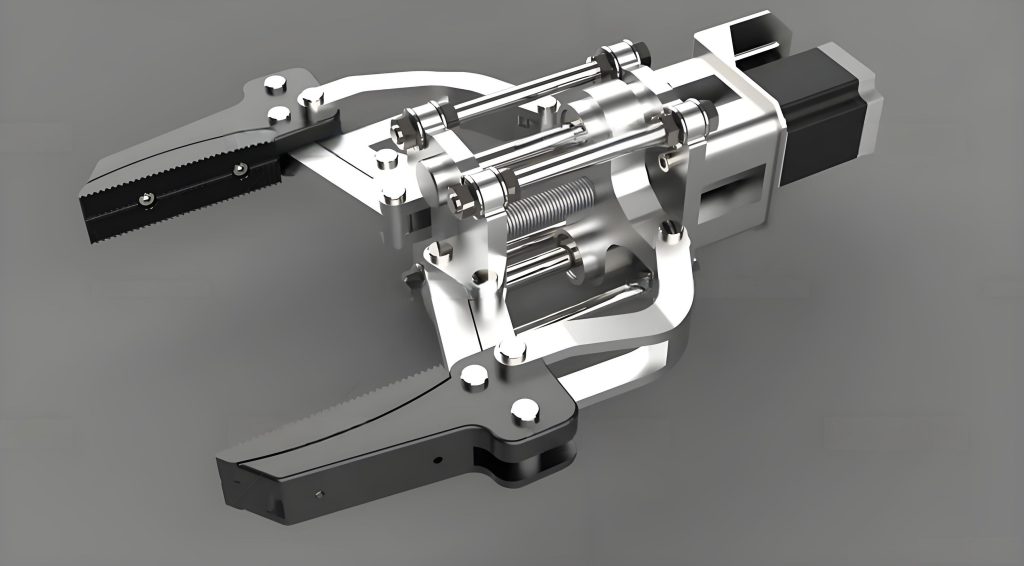
The core of the end effector is a 3-DOF parallel mechanism with a virtual triangular fixed platform and an equilateral triangular moving platform, connected by three kinematic chains. This design is selected for its simplicity and ease of control, which are vital for the end effector’s reliability in clinical settings. The moving platform of the end effector serves as the contact point for massage, and its motions are driven by actuators in the fixed platform. To analyze the DOF of this parallel mechanism, I apply topological structure theory and use formulas to compute the mobility. The general formula for DOF in a parallel mechanism is given by:
$$ F = \sum_{i=1}^{m} f_i – \sum_{j=1}^{v} \xi_{L_j} $$
where \( F \) is the total DOF, \( f_i \) is the freedom of the \( i \)-th joint, \( m \) is the number of joints, \( v \) is the number of independent loops, and \( \xi_{L_j} \) is the number of independent displacement equations for the \( j \)-th loop. For the end effector’s parallel mechanism, the kinematic chains are defined as follows: Chain 1 is R∥R∥R⊥R (equivalent to an RRU chain), Chain 2 is P∥R∥R∥R (a CRR chain), and Chain 3 is P∥R(⊥P)∥R (a CPR chain). Here, R denotes revolute joints, P denotes prismatic joints, and U denotes universal joints. The moving platform’s POC (Position and Orientation Characteristic) set is derived to determine its motion capabilities relative to the fixed platform.
Through detailed calculation, I find that the end effector’s moving platform has two translational DOF in the YOZ plane and one rotational DOF around the Y-axis. This configuration allows the end effector to perform essential massage motions, such as vertical pressing and rolling, while maintaining structural integrity. The DOF analysis confirms that the parallel mechanism is non-redundant and all joints are active, with the driving inputs selected as the prismatic joints in Chain 1 and Chain 2, and the prismatic joint in Chain 3. This selection ensures full control over the end effector’s position and orientation, which is critical for replicating the subtle force variations in TCM massage. Below is a table summarizing the joint types and their contributions to the end effector’s DOF.
| Kinematic Chain | Joint Sequence | DOF per Chain | Role in End Effector Motion |
|---|---|---|---|
| Chain 1 (RRU) | R∥R∥R⊥R | 4 | Provides translational flexibility in YOZ plane |
| Chain 2 (CRR) | P∥R∥R∥R | 4 | Enables rotation around Y-axis |
| Chain 3 (CPR) | P∥R(⊥P)∥R | 3 | Supports translational adjustment along Z |
To further elucidate the kinematics, I conduct a position analysis for the end effector’s parallel mechanism. This involves deriving both direct and inverse kinematic solutions, which are essential for trajectory planning and control of the end effector. The inverse kinematics problem involves determining the actuator inputs (joint variables) given the desired pose of the moving platform, while the direct kinematics solves for the platform pose from known inputs. For the end effector, I define coordinate systems: a fixed frame \( O-XYZ \) on the virtual platform and a moving frame \( O’-X’Y’Z’ \) on the equilateral triangular platform. The transformation matrix between these frames is represented as:
$$ \mathbf{T} = \begin{bmatrix} \mathbf{R} & \mathbf{P} \\ \mathbf{0} & 1 \end{bmatrix} = \begin{bmatrix} \cos\beta & 0 & \sin\beta & 0 \\ 0 & 1 & 0 & y_p \\ -\sin\beta & 0 & \cos\beta & z_p \\ 0 & 0 & 0 & 1 \end{bmatrix} $$
where \( \mathbf{R} \) is the rotation matrix, \( \mathbf{P} = [0, y_p, z_p]^T \) is the position vector, and \( \beta \) is the rotation angle around the Y-axis. The moving platform’s key points, such as the attachment points of the chains, are expressed in the moving frame and transformed to the fixed frame using \( \mathbf{T} \). For inverse kinematics, given \( y_p \), \( z_p \), and \( \beta \), I solve for the input variables: the displacement \( s_b \) of the prismatic joint in Chain 2, the length \( l_c \) of the prismatic joint in Chain 3, and the angle \( \theta \) of the revolute joint in Chain 1. The equations are derived from geometric constraints, such as the constant lengths of links and the distances between joint centers.
The inverse kinematic solutions are as follows:
$$ s_b = y_p $$
$$ \theta = \arcsin\left( \frac{k_1}{\sqrt{k_2^2 + k_3^2}} \right) + \arcsin\left( \frac{k_2}{\sqrt{k_2^2 + k_3^2}} \right) $$
where \( k_1 = L_1^2 + z_p^2 + (c + y_p – a)^2 – L_2^2 \), \( k_2 = 2L_1(c + y_p – a) \), and \( k_3 = 2L_1 z_p \), with \( L_1 \) and \( L_2 \) being link lengths, and \( a \), \( c \) as geometric parameters. For \( l_c \):
$$ l_c = -h_0 \pm \sqrt{(b \cos\beta – d)^2 + (z_p – b \sin\beta)^2} $$
where \( b \), \( d \), and \( h_0 \) are additional design parameters. These formulas allow precise calculation of actuator commands to achieve a desired end effector pose, ensuring accurate replication of massage techniques.
For direct kinematics, given the inputs \( s_b \), \( l_c \), and \( \theta \), I solve for \( y_p \), \( z_p \), and \( \beta \). The solutions are:
$$ y_p = s_b $$
$$ z_p = L_1 \sin\theta \pm \sqrt{L_2^2 – (s_b – a + c + L_1 \cos\theta)^2} $$
$$ \beta = \arcsin\left( \frac{m_1}{\sqrt{m_2^2 + m_3^2}} \right) + \arcsin\left( \frac{m_2}{\sqrt{m_2^2 + m_3^2}} \right) $$
where \( m_1 = b^2 + d^2 + z_p^2 – (l_c + h_0)^2 \), \( m_2 = -2bd \), and \( m_3 = 2b z_p \). These kinematic relations are fundamental for real-time control of the end effector, enabling feedback-based adjustments during massage operations. To illustrate the numerical range, I provide a table of example values for the end effector’s pose and corresponding inputs, demonstrating the consistency of the solutions.
| Pose Parameters | Value Range | Input Variables | Calculated Values |
|---|---|---|---|
| \( y_p \) (mm) | -50 to 50 | \( s_b \) (mm) | Equal to \( y_p \) |
| \( z_p \) (mm) | 0 to 100 | \( \theta \) (rad) | -0.5 to 0.5 |
| \( \beta \) (rad) | -0.3 to 0.3 | \( l_c \) (mm) | 50 to 150 |
With the kinematics established, I proceed to 3D modeling and motion simulation to validate the end effector’s design. Using CAD software, I create a detailed geometric model of the parallel mechanism, including all components such as links, joints, and platforms. This model is then imported into dynamics simulation software like Adams to perform kinematic and dynamic analyses. The simulation involves applying drive functions to the actuator joints and observing the motion of the end effector’s moving platform. Key performance metrics, such as velocity profiles and trajectory accuracy, are recorded to assess the end effector’s capability to emulate massage techniques.
The simulation results confirm that the end effector achieves the desired two translational and one rotational DOF. For instance, the linear velocity of the moving platform along the Z-axis shows smooth, continuous curves without discontinuities, indicating stable motion during force application. Similarly, the angular velocity around the Y-axis exhibits a quadratic profile, suitable for gentle rolling motions in massage. These outcomes verify that the end effector can perform complex movements with high precision, making it ideal for TCM applications. Below is a summary of simulation findings related to the end effector’s performance.
| Simulation Metric | Result | Implication for End Effector |
|---|---|---|
| Linear Velocity (Z-axis) | Continuous, no spikes | Smooth force application in pressing |
| Angular Velocity (Y-axis) | Quadratic profile | Controlled rolling for therapeutic effect |
| Workspace Volume | Sufficient for body regions | Flexibility in positioning the end effector |
| Actuator Torque | Within safe limits | Durability of the end effector under load |
In conclusion, the design and analysis of this end effector for a TCM massage robot demonstrate a viable solution for automating traditional therapies. The parallel mechanism-based end effector offers a balance of simplicity, accuracy, and controllability, addressing the challenges of replicating human-like massage techniques. Through kinematic modeling and simulation, I have shown that the end effector can achieve the necessary DOF for pushing, pressing, kneading, and rolling motions. The hybrid serial-parallel configuration further enhances the system’s workspace and stiffness, making it practical for clinical use. Future work may focus on optimizing the end effector’s materials for soft tissue interaction and integrating sensors for force feedback, ultimately improving the robot’s therapeutic efficacy. This research lays a theoretical foundation for advancing robotic end effectors in healthcare, emphasizing their role in bridging technology and traditional medicine.
The integration of this end effector into a full robotic system promises to revolutionize TCM massage by providing consistent, fatigue-free treatments. As I reflect on the design process, the emphasis on the end effector’s kinematics and dynamics has been paramount to its success. By leveraging parallel mechanisms, the end effector achieves high performance in a compact form factor, which is essential for patient-friendly devices. I anticipate that further iterations will enhance the end effector’s adaptability to different body contours and massage styles, solidifying its place in modern rehabilitative robotics. The ongoing development of such end effectors underscores the importance of interdisciplinary approaches in mechatronics, combining insights from robotics, mechanics, and traditional medicine to create impactful healthcare solutions.