
The advent of agricultural robotics presents a transformative solution to pressing challenges such as labor shortages and rising production costs, particularly in the selective harvesting of fruits. Within these robotic systems, the end-effector functions as the “hand” of the robot, and its performance is paramount for achieving efficient, reliable, and damage-free picking operations. Among the various end-effector types, including suction and vacuum-based systems, the gripping end-effector is often favored for spheroid fruits. However, ensuring a stable grasp in the unstructured agricultural environment—where fruit size and shape are inherently variable—remains a significant challenge. An unstable grasp can lead to fruit slippage, excessive mechanical stress, and detachment from the stem, ultimately compromising the success rate and economic viability of robotic harvesters.
This article details the design and optimization of a novel, linkage-driven three-finger, dual-knuckle end-effector specifically engineered to address the stable grasping of spheroid fruits. The design process begins with the conceptualization of the end-effector’s basic architecture and initial parameterization. This is followed by the establishment of a forward kinematics model. A core contribution is the formulation of a multi-objective optimization framework based on the principles of envelope stability during grasping. This framework is solved using the NSGA-II algorithm to identify optimal design parameters. The correctness of the derived motion laws is subsequently validated through dynamic simulation. Finally, physical prototype testing with tomatoes of varying sizes and orientations confirms the end-effector’s enhanced grasping stability and adaptability. The core objective is to provide a systematic methodology for end-effector design that prioritizes stable contact and minimizes fruit disturbance during the grasp, offering critical theoretical and technical support for the advancement of reliable picking robots.
1. End-Effector System Architecture
The proposed end-effector is intended for the harvesting of spheroidal fruits such as tomatoes. Its architecture is divided into two primary subsystems: the picking finger mechanism and the planar cam drive mechanism.
1.1 Overall Structural Concept
The picking mechanism comprises three identical fingers arranged symmetrically. Each finger consists of a distal phalange and a proximal phalange, both lined with soft silicone pads to prevent bruising. The synchronized opening and closing motion of all three fingers is achieved through a multi-linkage system. A single servo motor, housed in the end-effector’s base, drives two concentrically mounted planar cams. This cam pair actuates pushrods that transmit motion to the linkage systems of each finger, orchestrating the enveloping grasp.
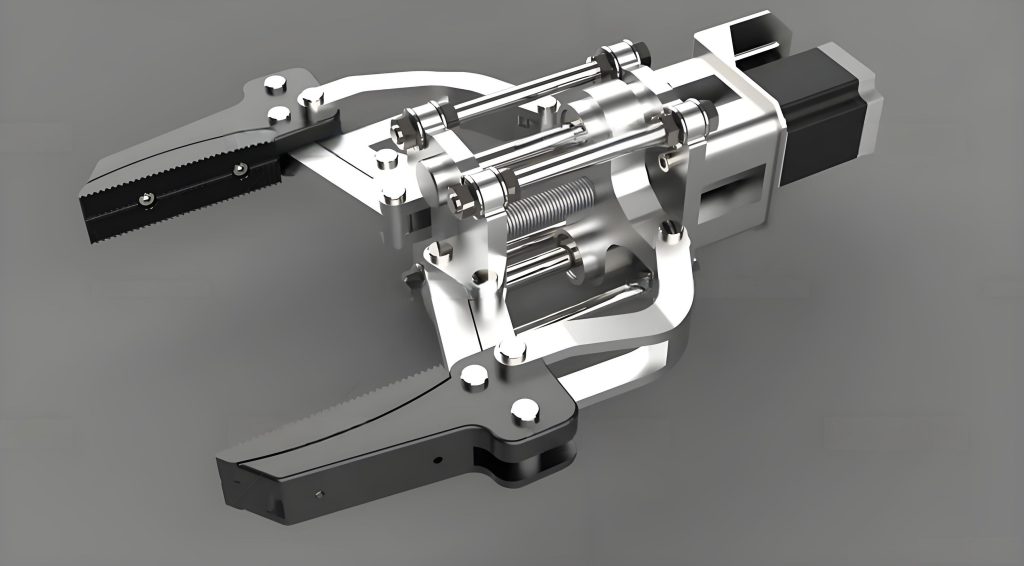
The grasping sequence is as follows: In the pre-harvest state, the inner cam is at its highest point and the outer cam at its lowest, positioning their respective pushrods accordingly. Upon initiation of the grasp, the servo rotates the cams, causing the inner cam to descend and the outer cam to ascend. This motion pushes the linked pushrods, which in turn drive the finger linkages to close in a coordinated, enveloping manner around the fruit. Critically, the cam profiles are designed to produce a specific velocity pattern: the distal phalange closes faster than the proximal one to swiftly secure the fruit and prevent initial slippage, while both phalanges follow a motion profile where velocity increases and then decreases. This design minimizes impact forces at the moment of contact, thereby reducing the risk of mechanical damage to the fruit.
1.2 Structural Parameter Design
The geometric characteristics of the target fruit serve as the fundamental basis for sizing the end-effector. This design is validated using the ‘Provence’ tomato variety. Statistical measurements from a sample population established a representative working diameter range. Based on this range and the design principles of stability and compactness, initial dimensional parameters for the linkage components were determined via CAD simulation. A subset of these fixed parameters is listed in Table 1. The lengths $l_1$, $l_3$, and the angle $\theta_2$ were identified as key variables significantly influencing grasping performance and were thus selected for subsequent formal optimization.
| Parameter | Value (mm or °) | Parameter | Value (mm or °) |
|---|---|---|---|
| $l_2$ | 20 | $l_{10}$ | 32 |
| $l_4$ | 20 | $l_{11}$ | 44 |
| $l_5$ | 40 | $l_{12}$ | 56 |
| $l_6$ | 100 | $l_{13}$ | 112 |
| $l_7$ | 30 | $c_{1max}$ | 8 |
| $l_8$ | 120 | $c_{2max}$ | 20 |
| $l_9$ | 93 | $\theta_5$ | 140 |
| – | – | $\theta_8$ | 90 |
1.3 Planar Cam Drive Mechanism Design
The drive mechanism employs two planar cams to provide precise control over the complex motion profile required for stable grasping. The required strokes for the pushrods were determined from kinematic analysis of the initial finger design to be 8 mm and 20 mm. For compactness and to ensure acceptable pressure angles, the base circle radius for both cams was set to 10 mm. The cam groove width was designed as 8 mm. The Simple Harmonic Motion (SHM) law was selected for the cam profiles due to its continuous and smooth characteristics, which help minimize vibrations and impact. The displacement equations for the two pushrods are given by:
$$h_1 = 4\left[1 – \cos\left(\frac{\delta}{2}\right)\right]$$
$$h_2 = 10\left[1 – \cos\left(\frac{\delta}{2}\right)\right]$$
where $h_1$ and $h_2$ are the displacements, and $\delta$ is the cam rotation angle. The resulting motion curves are smooth, with velocity profiles that increase from zero to a maximum and then decrease back to zero, fulfilling the requirement for a “soft” grasp finalization.
2. Multi-Objective Optimization for Stable Grasping
2.1 Forward Kinematics Model
To analyze and optimize the end-effector’s performance, a forward kinematics model for a single finger is established. A coordinate system $Oxy$ is defined at the cam rotation axis. The displacements of the front and rear pushrods are denoted as $c_1$ and $c_2$, respectively, with $c_2 = c_{2max} – (c_{2max}/c_{1max})c_1$. The coordinates of key linkage points (F, J, I, G, H, D, B, C) are derived sequentially through geometric and trigonometric relations based on the link lengths and pushrod positions. Finally, the coordinates of the fingertip (Point A) are determined as a function of the linkage state, given by two cases depending on the relative position of points B and C:
Case 1 ($y_C \ge y_B$):
$$x_A = x_B + l_1 \times \left( \frac{x_C – x_B}{l_6} \right) \times \cos\theta_2 – l_1 \times \sqrt{1 – \left( \frac{x_C – x_B}{l_6} \right)^2} \times \sin\theta_2$$
$$y_A = y_B + l_1 \times \left( \frac{x_C – x_B}{l_6} \right) \times \sin\theta_2 + l_1 \times \sqrt{1 – \left( \frac{x_C – x_B}{l_6} \right)^2} \times \cos\theta_2$$
Case 2 ($y_C < y_B$):
$$x_A = x_B + l_1 \times \left( \frac{x_C – x_B}{l_6} \right) \times \cos\theta_2 + l_1 \times \sqrt{1 – \left( \frac{x_C – x_B}{l_6} \right)^2} \times \sin\theta_2$$
$$y_A = y_B + l_1 \times \left( \frac{x_C – x_B}{l_6} \right) \times \sin\theta_2 – l_1 \times \sqrt{1 – \left( \frac{x_C – x_B}{l_6} \right)^2} \times \cos\theta_2$$
2.2 Fruit Envelope Stability Analysis
Grasping stability is quantitatively assessed using two metrics derived from the kinematics: the shift of the fruit’s center of mass (CoM) and the variation in contact point locations on the finger phalanges. During the enveloping motion, the fruit is modeled as an inscribed circle (incircle) tangent to the distal (AB) and proximal (BD) phalange lines. The incircle’s equation is $(x)^2 + (y – m)^2 = r^2$, where $m$ is the y-coordinate of the center (CoM proxy) and $r$ is the radius (fruit size proxy).
By enforcing tangency conditions between the circle and the two phalange lines, expressions for $r$ and $m$ are solved. Subsequently, the coordinates of the tangent points $Q$ (on distal phalange AB) and $T$ (on proximal phalange BD) are calculated. To measure contact point variation, one-dimensional coordinate systems are defined along each phalange, originating at pivot B. The positions $u$ and $v$ of points Q and T along these axes are calculated as:
$$u = \sqrt{(\alpha_1 – x_B)^2 + (\beta_1 – y_B)^2}$$
$$v = \sqrt{(\alpha_2 – x_B)^2 + (\beta_2 – y_B)^2}$$
where $(\alpha_1, \beta_1)$ and $(\alpha_2, \beta_2)$ are the coordinates of Q and T, respectively.
2.3 Multi-Objective Optimization Model
The optimization aims to maximize grasping stability by minimizing the fruit’s movement within the end-effector and ensuring consistent force application. The design variables are $X = [l_1, l_3, \theta_2]^T$. Three objective functions are defined:
1. Minimize CoM shift between grasping large and small fruits: $f_1(X) = (m_1 – m_2)^2$
2. Minimize distal phalange contact point variation: $f_2(X) = (u_1 – u_2)^2$
3. Minimize proximal phalange contact point variation: $f_3(X) = (v_1 – v_2)^2$
Here, subscripts 1 and 2 denote the states corresponding to the maximum and minimum inscribed circles (representing the largest and smallest target fruits), respectively.
The optimization is subject to geometric constraints ensuring proper linkage assembly, motion range, and avoidance of collisions, tailored to the physical dimensions of the target fruit and the end-effector structure. These constraints are formulated for different kinematic cases of the linkage assembly.
2.4 Optimization Algorithm
Given the competing nature of the multiple objectives, the optimal solution is a set of trade-offs known as the Pareto-optimal set. The Non-dominated Sorting Genetic Algorithm II (NSGA-II) is employed to solve this multi-objective optimization problem. The algorithm process involves initializing a population, applying genetic operators (selection, crossover, mutation), and using fast non-dominated sorting coupled with crowding distance computation to evolve the population toward the Pareto front over successive generations.
3. Optimization Results and Analysis
The NSGA-II algorithm was configured with the parameters listed in Table 2 and executed using the fruit size data and initial constraints.
| Parameter | Value | Parameter | Value |
|---|---|---|---|
| $\theta_{1min}$ | 40° | $r_{min}$ | 30 mm |
| $\theta_{1max}$ | 160° | $r_{max}$ | 50 mm |
| $\theta_{2min}$ | 40° | $l_{safe}$ | 10 mm |
| $\theta_{2max}$ | 160° | $l_{size}$ | 30 mm |
| $l_{1min}$ | 50 mm | Population Size | 100 |
| $l_{1max}$ | 60 mm | Max Generations | 500 |
| $l_{3min}$ | 50 mm | – | – |
| $l_{3max}$ | 70 mm | – | – |
The algorithm converged to a Pareto-optimal front. From the optimal set, a solution offering a balanced compromise between the objectives was selected. The optimized parameters and their corresponding objective function values are presented in Table 3.
| Parameter | Value | Objective | Value (mm) |
|---|---|---|---|
| $l_1$ | 56.7 mm | $f_1(X)$ | 44.7 |
| $l_3$ | 58.8 mm | $f_2(X)$ | 23.6 |
| $\theta_2$ | 81.1° | $f_3(X)$ | 23.6 |
Analysis of the end-effector’s motion with these parameters revealed the relationship between the incircle’s center (fruit CoM) and its radius during closure. To minimize the maximum CoM shift for fruits across the entire size range, the initial grasping position was set at an intermediate point of the closure path, rather than at the fully open or closed configuration. This strategic placement significantly enhances the end-effector’s adaptability to different fruit sizes.
The optimized design was modeled in ADAMS dynamics software for simulation. The simulated motion confirmed the desired velocity profiles: both phalanges moved with a speed that initially increased and then decreased, with the distal phalange moving faster than the proximal one. This behavior validates the cam profile design intent for fast, secure enclosure followed by a gentle final grasp. The objective function values obtained from the simulation matched the optimization results, verifying the kinematic model’s accuracy.
4. Stable Grasping Experiments
A physical prototype of the optimized end-effector was fabricated and integrated into a test platform. The platform consisted of the end-effector, a control system, a movable fruit fixture, a depth camera for position measurement, and a spring to simulate the fruit stem. Two key experiments were conducted to evaluate grasping stability.
4.1 Fruit Center of Mass Shift Experiment
This experiment measured the displacement of the tomato’s geometric center during the grasping cycle. Tomatoes were categorized as Large (80-90 mm), Medium (70-80 mm), and Small (65-70 mm). Each size group contained 5 samples, tested at three orientation angles (0°, 30°, 60°) relative to the end-effector’s axis to simulate different growth postures. The fruit’s center was marked, aligned with the optimal initial grasp position identified earlier, and its position $L_0$ was recorded via a depth camera. After the end-effector completed its grasp, the new position $L_1$ was recorded. The CoM shift was calculated as $|L_1 – L_0|$. The results, averaged across orientations, are summarized in Table 4.
| Fruit Size | Average CoM Shift (mm) |
|---|---|
| Large | 5.01 |
| Medium | 1.55 |
| Small | 6.33 |
| Overall Average | 4.30 |
4.2 Grasping Contact Point Variation Experiment
This experiment evaluated the consistency of contact locations between the finger phalanges and the fruit. Tomatoes were coated with dye and grasped by the end-effector. After grasping, the midpoint of the dye mark left on each phalange was measured as the contact point. The variation in these contact point locations across different fruit sizes and orientations was calculated. Instances where a phalange did not make contact were excluded from the average. The key results are presented in Table 5.
| Metric | Value (mm) |
|---|---|
| Average Position Change of Contact Points | 6.23 |
The experimental data confirm the stability of the optimized end-effector design. The overall average CoM shift of 4.30 mm and the average contact point variation of 6.23 mm are relatively small, indicating that the fruit experiences minimal sliding and rotation within the end-effector’s grasp. The slightly higher values for small fruits can be attributed to the greater relative clearance within the end-effector’s envelope range. The few cases of only three-point contact (instead of the ideal six) are due to the natural shape variance of real tomatoes, which are not perfect spheres. Nevertheless, the results strongly validate that the optimization successfully enhanced the end-effector’s adaptability and stable grasping performance for a range of fruit sizes and postures.
5. Conclusion
This work presents the comprehensive design and optimization of a novel linkage-driven three-finger end-effector for the stable harvesting of spheroid fruits. The primary contributions and findings are summarized as follows:
1. The proposed end-effector features a simplified, single-driver actuation system that synchronously controls three dual-knuckle fingers via a planar cam mechanism, effectively enabling envelope grasping for fruits of varying diameters.
2. The carefully designed cam profile produces a phalange motion characterized by an initial acceleration followed by deceleration. This profile ensures a swift enclosure to prevent fruit escape and a soft final contact to minimize damage, with the distal phalange moving faster to quickly secure the fruit.
3. A systematic multi-objective optimization methodology was developed, formalizing the grasp stability problem by minimizing fruit CoM shift and phalange contact point variation. Application of the NSGA-II algorithm yielded an optimal set of linkage parameters that best satisfy these competing stability criteria.
4. Prototype testing with tomatoes demonstrated the efficacy of the optimized design. The end-effector achieved an average fruit CoM shift of 4.30 mm and an average contact point variation of 6.23 mm across different sizes and orientations. These results confirm the end-effector’s improved adaptability and stable grasping capability.
In conclusion, this research provides a validated design and optimization framework for developing robust picking end-effectors. The focus on fundamental grasping stability metrics—fruit shift and contact consistency—directly addresses a key bottleneck in robotic harvesting reliability. The presented end-effector design and the associated methodology offer significant theoretical insight and practical guidance for advancing the performance of agricultural robotics in real-world unstructured environments.