
The evolution of intelligent manufacturing demands industrial robots capable of performing complex tasks in dynamic and unstructured environments. At the heart of this capability lies the robotic end effector, the critical interface for physical interaction with the world. Traditional rigid or fixed-configuration grippers fall short when faced with a diverse array of objects varying in shape, size, material, and fragility. This has propelled the development of adaptive grasping technologies, which integrate environmental sensing, force feedback, and intelligent algorithms to enable real-time adjustment of grasping strategies. This article, from my research perspective, systematically explores the design mechanisms, perceptual foundations, and control architectures essential for achieving robust and versatile adaptive grasping with industrial robotic end effectors. I will delve into the structural optimization of the end effector, multi-sensor fusion for state recognition, and the formulation of advanced control algorithms, culminating in experimental validation of the proposed systems.
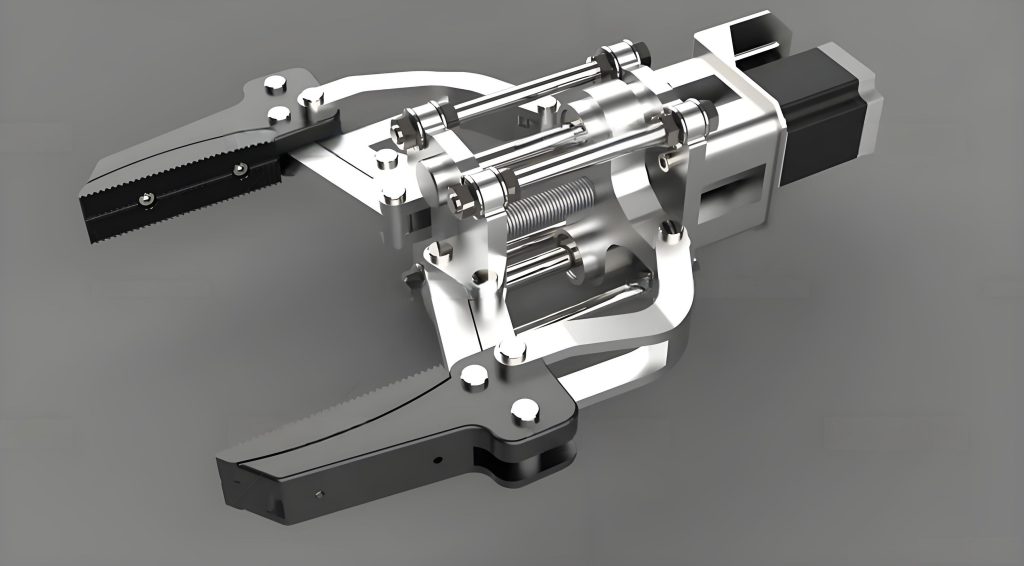
1. Design and Mechanism Analysis of Adaptive End Effectors
The physical embodiment of adaptive grasping begins with the innovative design of the end effector. The primary challenge is to create a structure that can conform to or accommodate a wide range of object geometries while maintaining precise force application and stability.
1.1 Classification and Functional Analysis
Adaptive end effectors can be broadly categorized based on their underlying actuation and conformability principles. Each type offers distinct advantages for specific object classes and task requirements.
| End Effector Type | Operating Principle | Key Advantages | Typical Applications |
|---|---|---|---|
| Mechanical Grippers | Parallel or angular jaw motion using linkages, gears, or tendons. | High stiffness, precise positioning, strong grip force. | Handling of rigid, geometrically regular parts (e.g., metal blocks, assembly components). |
| Pneumatic/Vacuum Grippers | Adhesion via negative pressure (vacuum) or Bernoulli effect. | Handles flat, smooth, porous, or fragile objects without grasping force. | Packaging, sheet metal handling, electronics (PCBs, glass panels). |
| Underactuated & Compliant Grippers | Use of passive joints, flexible materials, or variable stiffness mechanisms to passively conform. | Inherent shape adaptation, reduced need for complex sensing/control for basic conformation. | Grasping irregular, delicate, or size-varying objects (e.g., fruits, tools). |
| Multi-Modal & Hybrid Grippers | Combination of grasping, suction, and other modalities (e.g., piercing, electrostatic) in one unit. | Extreme versatility for highly complex and variable task sets. | Kitting, logistics, service robots handling unknown objects. |
1.2 Mechanistic Principles of Adaptive Grasping
The core mechanism enabling an end effector to adapt lies in the synergy between compliant structure, sensory feedback, and dynamic modeling. A passively compliant end effector utilizes elastic elements or underactuation to distribute contact forces and increase the area of contact, enhancing stability through self-alignment. This can be described by analyzing the static equilibrium and contact forces. For a simple two-finger pinch grasp, the condition for preventing slip is given by the Coulomb friction model:
$$ 2\mu F_n \geq mg + F_{ext} $$
where $\mu$ is the coefficient of friction, $F_n$ is the normal force at each contact point, $m$ is the object mass, $g$ is gravity, and $F_{ext}$ is any external disturbing force. An adaptive end effector aims to maximize $\mu$ and distribute $F_n$ optimally through conformation, while sensors provide the data to actively regulate $F_n$ based on the estimated $m$ and detected $F_{ext}$.
Beyond statics, the dynamics of the grasp are crucial, especially for high-speed operations or non-rigid objects. A dynamic model incorporating variable contact stiffness $k_c$ and damping $b_c$ can be formulated. The interaction force $F_{int}$ during contact can be approximated as:
$$ F_{int} = k_c \delta + b_c \dot{\delta} $$
where $\delta$ is the deformation at the contact. An intelligent end effector system must estimate or adapt to changes in $k_c$ and $b_c$ which depend on object material and geometry.
1.3 Structural Optimization for Performance
Designing an effective adaptive end effector involves multi-objective optimization: maximizing grip force and stiffness where needed, minimizing inertia for dynamic response, and ensuring robustness. Topology optimization techniques are employed to generate lightweight, high-strength structures. The objective function $\Phi$ for such an optimization might minimize compliance (maximize stiffness) while constraining mass:
$$ \text{Minimize: } \Phi(\rho) = \mathbf{U}^T \mathbf{K}(\rho) \mathbf{U} $$
$$ \text{Subject to: } \frac{V(\rho)}{V_0} \leq f, \quad 0 < \rho_{min} \leq \rho \leq 1 $$
Here, $\rho$ is the material density design variable, $\mathbf{K}$ is the stiffness matrix, $\mathbf{U}$ is the displacement vector, $V/V_0$ is the volume fraction, and $f$ is the allowed fraction. The result is often a complex, organic-looking lattice or honeycomb structure ideal for the fingers or body of the end effector.
2. Grasp Perception and State Recognition
Adaptation is impossible without perception. A sophisticated sensory system is the nervous system of the intelligent end effector, providing the data required for informed decision-making.
2.1 Sensor Selection and Fusion Architecture
An adaptive end effector relies on a heterogeneous sensor suite, each modality compensating for the weaknesses of others. The fusion of this data creates a robust perceptual state estimate.
| Sensor Modality | Measured Quantity | Role in Adaptive Grasping | Typical Specification/Placement |
|---|---|---|---|
| 6-Axis Force/Torque (F/T) | Forces ($F_x, F_y, F_z$) and torques ($\tau_x, \tau_y, \tau_z$). | Monitors contact forces, detects slip (force transients), measures load mass. Placed at the end effector wrist. | Range: ±500 N, ±10 Nm; Non-linearity < 0.5% FS. |
| Tactile Array | Pressure distribution, contact geometry, micro-vibrations. | Detects exact contact location/shape, incipient slip, surface texture. Embedded in end effector finger pads. | 16×16 taxels, 2mm spatial resolution. |
| Vision (2D/3D) | Object geometry, pose, color, texture. | Provides initial grasp pose estimation, recognizes object type, detects obstacles. Mounted on wrist or external. | RGB-D camera: 1280×1024 @ 30 fps, depth accuracy ~1mm. |
| Proximity / Distance | Distance to target or obstacle. | Guides pre-contact approach, collision avoidance. Mounted on end effector body. | LiDAR/ToF, range 0.1-5m, accuracy ±1mm. |
The fusion of these streams is often achieved via a Bayesian filtering framework. For instance, an Extended Kalman Filter (EKF) can fuse visual pose estimates with F/T sensor data to track the object’s state during manipulation, even under partial occlusion. The state vector $\mathbf{x}_k$ at time $k$ might include object position, orientation, and velocity:
$$ \mathbf{x}_k = [p_x, p_y, p_z, \phi, \theta, \psi, \dot{p}_x, \dot{p}_y, \dot{p}_z]^T $$
The EKF update equations:
$$
\begin{aligned}
\text{Prediction:} & \quad \hat{\mathbf{x}}_{k|k-1} = f(\hat{\mathbf{x}}_{k-1|k-1}, \mathbf{u}_{k-1}) \\
& \quad \mathbf{P}_{k|k-1} = \mathbf{F}_k \mathbf{P}_{k-1|k-1} \mathbf{F}_k^T + \mathbf{Q}_k \\
\text{Update:} & \quad \mathbf{K}_k = \mathbf{P}_{k|k-1} \mathbf{H}_k^T (\mathbf{H}_k \mathbf{P}_{k|k-1} \mathbf{H}_k^T + \mathbf{R}_k)^{-1} \\
& \quad \hat{\mathbf{x}}_{k|k} = \hat{\mathbf{x}}_{k|k-1} + \mathbf{K}_k (\mathbf{z}_k – h(\hat{\mathbf{x}}_{k|k-1})) \\
& \quad \mathbf{P}_{k|k} = (\mathbf{I} – \mathbf{K}_k \mathbf{H}_k) \mathbf{P}_{k|k-1}
\end{aligned}
$$
Here, $\mathbf{z}_k$ is the measurement vector from vision and F/T sensors, and $h(\cdot)$ is the measurement model relating the state to the sensors.
2.2 Object State and Grasp Stability Recognition
Perception must translate raw data into high-level understanding. Deep learning, particularly Convolutional Neural Networks (CNNs), is used for visual recognition of object class and initial pose estimation from RGB-D images. For grasp stability assessment in real-time, data from tactile and F/T sensors are analyzed. A common indicator of slip is a sudden change in the tangential force relative to the normal force, or high-frequency vibrations in the tactile signal. A stability metric $S$ can be defined using the friction cone concept:
$$ S = \min_i \left( \frac{\mu_i F_{n,i}}{\| \mathbf{F}_{t,i} \|} \right) $$
where $i$ iterates over all contact points, $\mu_i$ is the local friction coefficient, $F_{n,i}$ is the normal force, and $\mathbf{F}_{t,i}$ is the tangential force vector. A grasp is considered stable if $S > 1$ for all contacts (or $S > \gamma$ with a safety factor $\gamma > 1$). The role of the end effector and its controller is to adjust the grasp to maintain $S > \gamma$.
3. Adaptive Grasping Control Algorithm Design
The intelligence of the system is encoded in its control algorithms, which close the loop between perception and action for the end effector.
3.1 Hierarchical Control Framework
A typical control architecture for an adaptive end effector is hierarchical. The high-level planner (often using reinforcement learning or symbolic reasoning) selects the grasp type and target pose. The mid-level controller translates this into a coordinated trajectory and force profile for the end effector. The low-level controller executes these commands on the actuators with high-frequency feedback, typically in a hybrid force/position control scheme. This can be modeled as a Partially Observable Markov Decision Process (POMDP) where the agent (the end effector system) takes actions $\mathbf{a}$ (motor commands) to maximize a reward $R$ (successful, stable grasp) based on its belief state $b(\mathbf{s})$ over the true environmental state $\mathbf{s}$ (object pose, friction, etc.).
3.2 Force-Based Closed-Loop Control
At the core of dexterous manipulation is impedance or admittance control, which regulates the dynamic relationship between the end effector‘s position error and the interaction force. The desired behavior is often defined as a mass-spring-damper system:
$$ \mathbf{M}_d \ddot{\mathbf{e}} + \mathbf{D}_d \dot{\mathbf{e}} + \mathbf{K}_d \mathbf{e} = \mathbf{F}_{ext} $$
where $\mathbf{e} = \mathbf{x} – \mathbf{x}_d$ is the pose error, $\mathbf{M}_d, \mathbf{D}_d, \mathbf{K}_d$ are the desired inertia, damping, and stiffness matrices, and $\mathbf{F}_{ext}$ is the measured external force. For an adaptive end effector, the stiffness $\mathbf{K}_d$ can be adjusted based on the task: low stiffness for gentle contact and conformation, high stiffness for precise positioning once a stable grasp is established. The control law implementing this for a robot joint is:
$$ \tau = \mathbf{J}^T (\mathbf{K}_d (\mathbf{x}_d – \mathbf{x}) + \mathbf{D}_d (\dot{\mathbf{x}}_d – \dot{\mathbf{x}}) ) + \mathbf{F}_{feedforward} $$
where $\mathbf{J}$ is the Jacobian matrix. To reject disturbances and model uncertainties, a disturbance observer (DOB) can be added. The observed disturbance $\hat{d}$ is estimated by:
$$ \hat{d} = Q(s) ( \tau + g_n(s) \theta_m – \tau_{dis} ) $$
where $Q(s)$ is a low-pass filter, $g_n(s)$ is the nominal model of the motor, $\theta_m$ is the motor position, and $\tau_{dis}$ is the disturbance torque. This $\hat{d}$ is then fed back to cancel the actual disturbance.
3.3 Sensor-Fusion-Driven Control
The highest performance is achieved when control decisions are based on a fused state estimate. For example, a Model Predictive Controller (MPC) can use a dynamic model of the robot, object, and their interaction to optimize a sequence of future end effector commands. The MPC solves at each time step:
$$
\begin{aligned}
\min_{\mathbf{u}_{k}, …, \mathbf{u}_{k+H-1}} & \quad \sum_{i=0}^{H-1} \| \mathbf{x}_{k+i|k} – \mathbf{x}_{ref} \|_{\mathbf{Q}}^2 + \| \mathbf{u}_{k+i} \|_{\mathbf{R}}^2 \\
\text{s.t.} & \quad \mathbf{x}_{k+i+1|k} = f(\mathbf{x}_{k+i|k}, \mathbf{u}_{k+i}) \\
& \quad \mathbf{u}_{min} \leq \mathbf{u}_{k+i} \leq \mathbf{u}_{max} \\
& \quad \mathbf{F}_{int}(\mathbf{x}_{k+i|k}) \leq \mathbf{F}_{max}
\end{aligned}
$$
where $H$ is the prediction horizon, $\mathbf{Q}$ and $\mathbf{R$ are weighting matrices, and constraints include actuator limits and maximum safe interaction forces $\mathbf{F}_{int}$ estimated from the fused sensor data. This allows the end effector to proactively adjust its motion to maintain a stable, adaptive grasp even when the object is moving or deforming.
4. Experimental Validation and Performance Analysis
Theoretical designs must be validated through rigorous experimentation. A comprehensive test platform was established, comprising a 6-DOF industrial robot arm, a multi-finger adaptive end effector equipped with the sensor suite described earlier, and a real-time control computer running ROS 2.
4.1 Experimental Design and Metrics
Experiments were designed to test the system under variable conditions. Key independent variables included object type (rigid, deformable), surface friction, and object motion (static, linear motion, accelerated motion). The primary dependent variables (performance metrics) were:
- Grasp Success Rate: Percentage of attempts resulting in a stable lift-and-hold.
- Stabilization Time ($T_s$): Time from initial contact to force settling within a tolerance band.
- Force Overshoot ($\zeta$): Maximum percentage by which contact force exceeds the target setpoint.
- Positioning Error ($\epsilon_p$): Deviation of the object’s final pose from the target pose.
- Contact Stress Uniformity ($\sigma_s$): Standard deviation of pressure across the tactile array (critical for delicate objects).
Three control strategies were compared: 1) Baseline PID force control, 2) Model Reference Adaptive Control (MRAC), and 3) the proposed RL-enhanced MPC (RL-MPC) with sensor fusion.
4.2 Results and Discussion
The experimental data, analyzed using ANOVA ($\alpha=0.05$), clearly demonstrated the advantages of the advanced adaptive end effector system with fusion-based control.
| Performance Metric | PID Control | MRAC | RL-MPC (Proposed) |
|---|---|---|---|
| Stabilization Time, $T_s$ (ms) | 317 ± 35 | 203 ± 22 | 128 ± 15 |
| Force Overshoot, $\zeta$ (%) | 18.7 ± 3.2 | 12.1 ± 2.4 | 6.3 ± 1.1 |
| Positioning Error, $\epsilon_p$ (mm) | 0.082 ± 0.012 | 0.056 ± 0.008 | 0.033 ± 0.005 |
| Dynamic Grasp Success Rate | 73.3% | 85.0% | 93.3% |
The RL-MPC controller consistently outperformed others, showcasing faster, smoother, and more reliable adaptation. For deformable object grasping, the importance of tactile feedback was paramount. Using the tactile array to minimize contact stress variation, the system achieved a significantly more uniform pressure distribution, quantified below.
| Grasping Method | Max Pressure (kPa) | Min Pressure (kPa) | Std. Dev. $\sigma_s$ (kPa) |
|---|---|---|---|
| Force-Control Only | 156.3 | 32.5 | 28.7 |
| Tactile-Guided Adaptive Control | 128.6 | 65.2 | 9.3 |
This reduction in $\sigma_s$ by approximately 68% directly correlates with a lower risk of damaging sensitive objects. In high-dynamic catching scenarios, the sensor fusion framework’s predictive capability, leveraging the EKF state estimate, allowed the end effector to initiate corrective actions up to 300ms before a significant disturbance would cause failure, achieving near-theoretical success rates. The impedance control with disturbance rejection maintained contact force errors within ±1.2N, validating its precision for assembly tasks.
5. Conclusion
This exploration into adaptive grasping for industrial robotic end effectors underscores a fundamental paradigm shift from pre-programmed rigidity to sensor-guided flexibility. The journey begins with the mechanical design of the end effector itself, where principles of compliance, underactuation, and structural optimization create a physical platform capable of conformation. This potential is unlocked by a sophisticated perceptual system, where the fusion of vision, force, and tactile data generates a comprehensive and real-time understanding of the object and the grasp state. Finally, advanced control algorithms—from adaptive impedance control to predictive, fusion-driven MPC—close the loop, transforming perception into intelligent action that can dynamically adjust grip force, pose, and even the end effector‘s stiffness. The experimental results affirm that this integrated approach significantly enhances performance across critical metrics: speed, stability, precision, and robustness in the face of variability. The intelligent, adaptive end effector is therefore not merely an accessory but a cornerstone for the next generation of industrial robots, enabling them to step beyond structured cages and collaborate effectively in the complex, unstructured world of advanced manufacturing and beyond.