
In modern agriculture, the automation of fruit harvesting is increasingly critical to address labor shortages and improve efficiency. As a core component of fruit-picking robots, the end effector plays a pivotal role in determining picking success and fruit quality. However, traditional end effectors often have fixed structures and parameters, limiting their adaptability to diverse fruit sizes and shapes, such as spherical citrus fruits. To overcome this, we present the design and testing of an underactuated articulated end effector that mimics the human hand’s enveloping motion for picking citrus. This end effector features a simple drive system with fewer actuators than degrees of freedom, enhancing compliance and reducing damage to fruits. We further propose a parametric design method based on an improved genetic algorithm to optimize structural parameters, enabling rapid adaptation to different fruit diameters. Through dynamic simulations and physical prototype experiments, we demonstrate the effectiveness of this end effector in achieving high picking success rates with minimal fruit damage. This article details the design, optimization, and validation processes, emphasizing the integration of parametric tools and algorithmic optimization to advance robotic harvesting technology.
The underactuated articulated end effector is designed to replicate the natural picking action, where fingers envelop the fruit before twisting it off. The overall structure consists of three main parts: the picking finger mechanism, the enveloping drive mechanism, and the wrist rotation mechanism. The picking finger mechanism includes four fingers, each with three segments—base, middle, and end joints—covered with soft sponge tips to increase friction and protect the fruit surface. The drive mechanism uses a single motor connected via planetary and bevel gears to actuate linkage systems that bend the fingers. The wrist mechanism provides torque for twisting the fruit after enveloping. This configuration reduces complexity while maintaining flexibility, as the underactuated design allows the end effector to conform to various fruit shapes without requiring multiple sensors or feedback controls.
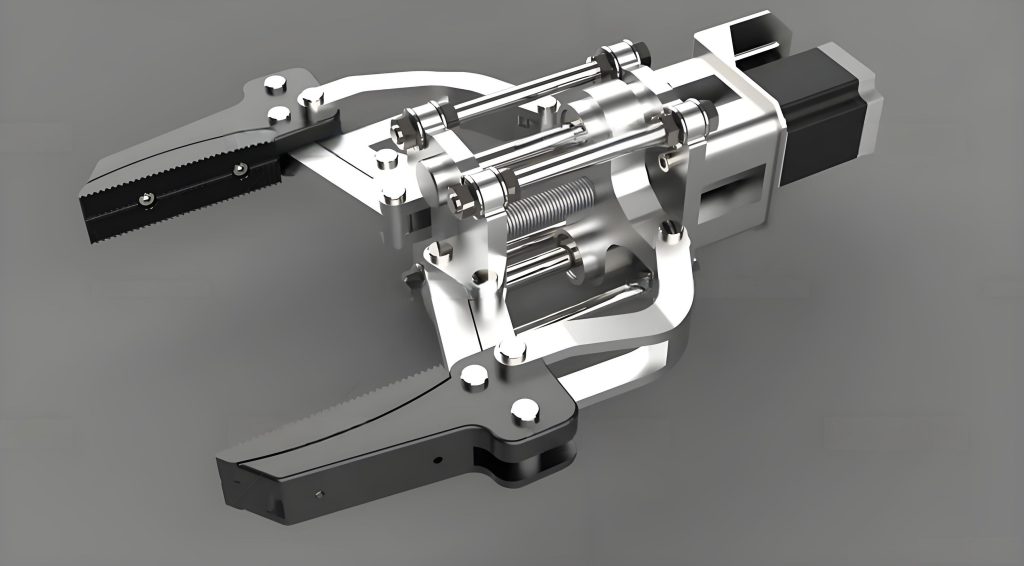
To understand the kinematics of this end effector, we define key parameters and derive motion equations. The linkage system for each finger is modeled as a series of rods connected by revolute joints. Let the lengths of the rods be denoted as \( l_i \) for \( i = 1, 2, \dots, 7 \), and the segments of the fingers as \( S_1 \), \( S_{21} \), \( S_{22} \), and \( S_3 \), representing the base, middle, and end sections. The fruit is modeled as a sphere with radius \( r \), and the distance from the base to the fruit axis is \( d \). Angles such as \( \alpha \), \( \beta \), \( \gamma \), and \( \phi \) describe the orientations of various components. The coordinates of key points, like the endpoints of linkages, are derived using geometric relationships. For example, the coordinates of point \( E \) on the driving link are given by:
$$ X_E = X_A + l_1 \cos(\alpha + \alpha_1) $$
$$ Y_E = Y_A + l_1 \sin(\alpha + \alpha_1) $$
where \( (X_A, Y_A) \) is the anchor point. Similar equations are used for other points, enabling the calculation of the end joint’s trajectory. This kinematic model forms the basis for optimizing the end effector’s performance.
We employ an improved genetic algorithm to optimize the structural parameters of the end effector, ensuring it can handle a wide range of fruit sizes. The design variables include the rod lengths and angles, represented as a vector \( \mathbf{X} = (l_1, l_2, \dots, l_7, \gamma, \phi, \alpha, \beta)^T \). The objective function aims to maximize the horizontal displacement of the end joint’s tip, targeting a value of \( 3r \) to accommodate fruits of different radii. Specifically, the function is:
$$ \max f(\mathbf{X}) = k_i – k_{ni} = 3r $$
where \( k_i \) is the horizontal coordinate of the end joint’s trajectory point. Constraints are imposed based on assembly conditions, link length limits, and motion ranges to ensure feasibility. For instance, the lengths must satisfy:
$$ l_{\text{AFmin}} \leq l_1 + l_2, \quad l_1 \leq l_{\text{AFmin}} + l_2, \quad l_2 \leq l_{\text{AFmin}} + l_1 $$
and angles are bounded like \( 10^\circ \leq \alpha \leq 60^\circ \). The improved genetic algorithm enhances convergence by adapting crossover and mutation probabilities based on fitness values. The crossover probability \( p_c \) and mutation probability \( p_m \) are adjusted as:
$$ p_c = \begin{cases}
p_{c1} \frac{c_{\text{max}} – c}{c_{\text{max}} – \bar{c}}, & \text{if } c \geq \bar{c} \\
p_{c2}, & \text{if } c < \bar{c}
\end{cases} $$
$$ p_m = \begin{cases}
p_{m1} \frac{c_{\text{max}} – c’}{c_{\text{max}} – \bar{c}}, & \text{if } c \geq \bar{c} \\
p_{m2}, & \text{if } c’ < \bar{c}
\end{cases} $$
where \( c_{\text{max}} \) is the maximum fitness, \( \bar{c} \) is the average fitness, and \( c \) and \( c’ \) are individual fitness values. This approach reduces the risk of local optima and accelerates the optimization process for the end effector.
To streamline the design process, we developed a parametric design system using NX Open API and Microsoft Visual Studio 2012. This system allows users to input initial parameters, such as fruit diameter, and automatically generates optimized end effector models. The workflow involves creating a custom menu in NX, building an MFC dialog for parameter input, and integrating the improved genetic algorithm to optimize parameters in real-time. The system outputs updated NX models and provides motion simulation results through Adams, enabling quick validation of the end effector’s performance. Key features of this parametric system are summarized in the table below:
| Component | Description |
|---|---|
| Menu Interface | Custom NX menu with options for model preview, parametric design, and dynamics analysis. |
| MFC Dialog | Interactive interface for inputting fruit radius, linkage parameters, and optimization settings. |
| Genetic Algorithm Integration | Python-based improved GA linked to NX expressions for automatic parameter adjustment. |
| Motion Simulation | Adams scripts to simulate end effector dynamics and output displacement, velocity, and acceleration curves. |
An application case focused on citrus with an average diameter of 80 mm demonstrates the system’s effectiveness. Initial parameters were set within defined bounds, and the improved genetic algorithm optimized them to enhance the end effector’s enveloping range. The optimization results are shown in the following table, comparing pre- and post-optimization values:
| Parameter | Before Optimization | After Optimization (Rounded) |
|---|---|---|
| \( l_1 \) (mm) | 20 | 16 |
| \( l_2 \) (mm) | 60 | 66 |
| \( l_3 \) (mm) | 15 | 18 |
| \( l_4 \) (mm) | 30 | 34 |
| \( l_5 \) (mm) | 30 | 29 |
| \( l_6 \) (mm) | 60 | 55 |
| \( l_7 \) (mm) | 45 | 40 |
| \( \alpha \) (°) | 35 | 26 |
| \( \beta \) (°) | 40 | 32 |
| \( \gamma \) (°) | 26 | 28 |
| \( \phi \) (°) | 30 | 42 |
| \( f(\mathbf{X}^*) \) (mm) | 105.36 | 121 |
The optimized end effector achieved a 29.1% increase in horizontal displacement, expanding the pickable fruit diameter range. Dynamics simulations in Adams confirmed these improvements, showing reduced angular velocity during fruit contact, which minimizes damage. The end joint’s displacement curve indicated a maximum offset of 62 mm, aligning with the target of 1.5 times the fruit radius. These simulations validate the parametric design system’s ability to enhance end effector performance efficiently.
We conducted validation experiments using a physical prototype of the optimized end effector. Indoor tests involved picking 20 citrus fruits with diameters ranging from 64 to 102 mm. The end effector successfully enveloped all fruits without drops, with an average enveloping time of 3.1 seconds per fruit. For orchard trials, the end effector was mounted on a custom robotic arm and tested on 84 citrus fruits with diameters between 68 and 106 mm. The results, summarized below, show high success rates and low damage:
| Fruit Diameter Range (mm) | Number of Fruits | Success Rate (%) | Damage Rate (%) | Average Picking Time per Fruit (s) |
|---|---|---|---|---|
| 68–70 | 8 | 87.5 | <0.1 | 7.3 |
| >70–80 | 25 | 96.0 | 4.0 | 7.3 |
| >80–90 | 36 | 97.2 | 2.8 | 7.3 |
| >90–106 | 15 | 80.0 | 6.7 | 7.3 |
The overall success rate was 92.9%, with an average damage rate of 5.9%. Failures were primarily due to branch interference during enveloping or minor skin damage at the stem during twisting. The end effector demonstrated robust performance across varied fruit sizes, confirming the effectiveness of the underactuated design and parametric optimization. This end effector can be adapted for other spherical fruits like apples and pears by adjusting parameters through the same system.
In conclusion, we have designed and tested an underactuated articulated end effector for citrus picking that combines mechanical simplicity with high adaptability. By integrating an improved genetic algorithm into a parametric design system, we optimized structural parameters to expand the pickable fruit range and reduce fruit damage. The end effector achieved a 92.9% success rate in orchard trials, with an average picking time of 7.3 seconds per fruit. This approach highlights the potential of algorithmic optimization in agricultural robotics, enabling rapid customization of end effectors for diverse harvesting tasks. Future work could focus on enhancing the end effector’s sensitivity to environmental obstacles and integrating real-time feedback controls for even greater precision and reliability in dynamic orchard settings.