
In modern large-scale poultry farming, the manual identification and removal of dead chickens pose significant challenges, including high labor intensity and low efficiency. As a researcher focused on agricultural robotics, I aimed to address this issue by developing an automated solution. Specifically, I designed an end effector for a dead chicken picking robot, targeting caged broilers aged 3–7 weeks. This end effector leverages underactuated principles to achieve a simple structure, large gripping range, and sufficient clamping force, making it suitable for the complex environment of chicken farms where broilers exhibit rapid growth and size variations. In this article, I will detail the design process, simulation analysis, and experimental validation of this end effector, emphasizing its optimization and performance. Throughout, I will use tables and formulas to summarize key data and principles, ensuring the term “end effector” is frequently highlighted to underscore its centrality to the study.
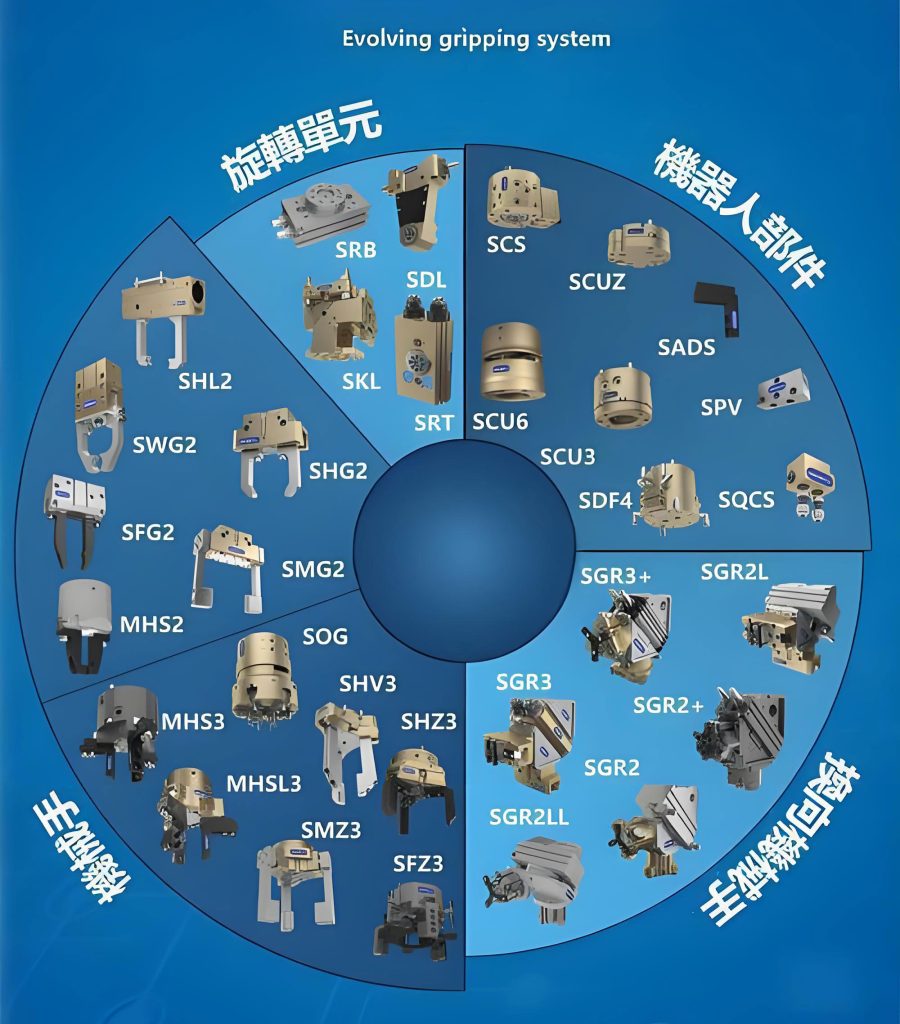
The core innovation lies in the underactuated mechanism, which allows a single actuator to control multiple degrees of freedom, enhancing adaptability and robustness. Traditional robotic hands often require complex control systems, but an underactuated end effector can conform to irregular shapes like dead broilers through passive joints and mechanical limits. My design incorporates three joints and four fingers, arranged symmetrically to balance weight distribution during grasping. The overall structure includes finger mechanisms, a transmission system, and a frame, all driven by a single stepper motor via a lead screw and linkage system. This configuration enables the end effector to perform grasping motions smoothly within confined cage spaces. To illustrate the concept, consider the following image of an end effector mechanism, which visually represents the underactuated design approach:
Before detailing the design, I conducted extensive measurements on broilers to inform the end effector’s specifications. Broilers aged 3–7 weeks were selected, as this period represents the post-separation phase where mortality rates are higher and economic losses are significant. I measured body dimensions and mechanical properties to create accurate models for simulation. The average values for weight, chest width, and body length are summarized in Table 1. These data were crucial for parameterizing the broiler model in ADAMS, a dynamic simulation software, ensuring the end effector could handle size variations.
| Week | Weight (g) | Chest Width (cm) | Body Length (cm) |
|---|---|---|---|
| 3 | 609.33 | 10.93 | 12.83 |
| 4 | 1054.00 | 12.78 | 16.17 |
| 5 | 1656.33 | 13.58 | 20.17 |
| 6 | 2290.33 | 15.97 | 28.67 |
| 7 | 2983.33 | 16.93 | 29.33 |
Additionally, I performed compression tests on broilers to determine the maximum force threshold the end effector could apply without causing damage. Using a universal testing machine, I applied loads up to 450 N and recorded displacement. The results, shown in Figure 1 (represented via a formula for clarity), indicated that broilers could withstand significant force, but deformation increased with age. Based on this, I set a gripping force limit of 80 N for the end effector to minimize deformation while ensuring stable grasping. The average load-displacement relationship can be approximated by:
$$ F(d) = k \cdot d + c $$
where \( F \) is the load in Newtons, \( d \) is displacement in millimeters, and \( k \) and \( c \) are constants derived from experimental data. For 7-week-old broilers, at \( F = 80 \, \text{N} \), \( d \approx 30 \, \text{mm} \), which informed the design constraints.
The mechanical finger of the end effector is the heart of the underactuated system. I developed a parametric point model in ADAMS using eight hinge points to define the finger’s geometry, as shown in Table 2. Each point corresponds to coordinates in a 3D space, and by parameterizing these points, I created design variables for optimization. This approach simplified the complex linkage lengths into manageable variables, allowing for efficient simulation and refinement of the end effector’s performance.
| Point | X Coordinate | Y Coordinate | Z Coordinate |
|---|---|---|---|
| POINT_1 | -10.0 | -64.0 | 0 |
| POINT_2 | -37.8 | -44.2 | 0 |
| POINT_3 | 20.0 | -13.0 | 0 |
| POINT_4 | 36.0 | -6.0 | 0 |
| POINT_5 | 0 | 0 | 0 |
| POINT_6 | 20.0 | 42.0 | 0 |
| POINT_7 | 35.0 | 42.0 | 0 |
| POINT_8 | 30.0 | 77.5 | 0 |
To optimize the end effector’s mechanical finger, I defined an objective function based on static equilibrium principles. When grasping a dead broiler, the finger applies contact forces at the distal and middle phalanges, denoted as \( F_2 \) and \( F_3 \), respectively. For stable grasping, the vertical forces must balance, and the horizontal components contribute to supporting the broiler’s weight. The equilibrium equations are:
$$ \sum F_y = 2F_{2y} + 2F_{3y} + F_s = 0 $$
$$ \sum F_x = 2(F_{2x} + F_{3x}) \mu + Mg = 0 $$
where \( F_{2y} \) and \( F_{3y} \) are the vertical components of contact forces, \( F_s \) is the palm contact force (negative in direction), \( F_{2x} \) and \( F_{3x} \) are the horizontal components, \( \mu \) is the friction coefficient between the finger and broiler, \( M \) is the broiler mass, and \( g \) is gravity. From the first equation, stability requires \( F_{2y} + F_{3y} \geq 0 \). The second equation shows that maximizing \( F_{2x} + F_{3x} \) enhances weight support. Thus, my objective function for optimization was:
$$ \text{max}(F_{2x} + F_{3x}) $$
This function aims to increase the gripping capability of the end effector, ensuring it can handle broilers across the target age range.
I selected design variables through sensitivity analysis. Among the 16 variables from the parameterized points, five showed high sensitivity: DV_2, DV_3, DV_5, DV_10, and DV_13, corresponding to Y-coordinates of POINT_1, POINT_2, POINT_3, and X-coordinates of POINT_5 and POINT_7. These variables significantly influenced the objective function, so I focused on them for optimization. Constraints included size limits to prevent structural failure, force conditions from equilibrium, and angle bounds to avoid self-locking or collisions. The size constraints were derived from simulation tests, ensuring the finger length combinations could stably grasp broilers with maximum chest width \( r_{\text{max}} \). The constraints are summarized as:
$$ a_3 = a_2 < a_1 $$
$$ a_1 + c_1 < b_1 + d_1 $$
$$ a_2 + c_2 < b_2 + d_2 $$
$$ \frac{1}{4}\pi r_{\text{max}} < a_1 + a_2 + a_3 \leq \frac{3}{8}\pi r_{\text{max}} $$
$$ F_{3y} + F_{2y} \geq 0 $$
$$ 105^\circ \leq \alpha_1 \leq 155^\circ $$
$$ 135^\circ \leq \alpha_2 \leq 175^\circ $$
where \( a_1, a_2, a_3 \) are link lengths, \( c_1, d_1, b_1, b_2, c_2, d_2 \) are related distances, and \( \alpha_1, \alpha_2 \) are joint angles. These constraints were implemented in ADAMS using measurement functions.
The optimization results, after seven iterative experiments, showed a significant improvement in the end effector’s performance. As detailed in Table 3, the objective function increased from 81.664 N to 105.055 N, a 28.6% enhancement. This demonstrates that the optimized mechanical finger can apply greater horizontal force, thereby supporting heavier broilers more effectively. The changes in design variables, such as adjustments in hinge positions, contributed to this gain, validating the importance of parametric optimization in end effector design.
| Experiment | DV_2 (mm) | DV_3 (mm) | DV_5 (mm) | DV_10 (mm) | DV_13 (mm) | Objective Function (N) |
|---|---|---|---|---|---|---|
| Initial | -64.021 | -37.801 | 20.000 | -2.500 | 35.000 | 81.664 |
| Optimized | -66.371 | -42.796 | 22.294 | -4.064 | 34.112 | 105.055 |
| Change (%) | +3.37 | +13.2 | +11.5 | +62.6 | -2.54 | +28.6 |
With the optimized design, I conducted motion simulation tests in ADAMS to evaluate the end effector’s grasping performance. I created broiler models for 3-week and 7-week ages, representing the size extremes. The simulation involved driving the end effector with a stepper motor at 1080 steps per second, mimicking real-world operation. For 3-week broilers (diameter 110 mm, weight 0.61 kg), the distal phalanx contacted first, followed by the middle phalanx, lifting the broiler smoothly. The contact forces and joint angles, plotted over time, showed stable dynamics with forces below the 80 N limit. Similarly, for 7-week broilers (diameter 170 mm, weight 2.98 kg), the middle phalanx contacted first, then the distal phalanx, achieving a enveloping grasp. The simulations confirmed that the end effector could adapt to different sizes without excessive force, thanks to the underactuated mechanism. The angle variations during grasping can be expressed as:
$$ \alpha_1(t) = \alpha_{1,0} – k_1 t $$
$$ \alpha_2(t) = \alpha_{2,0} – k_2 t $$
where \( \alpha_1 \) and \( \alpha_2 \) are joint angles, \( \alpha_{1,0} \) and \( \alpha_{2,0} \) are initial angles, \( k_1 \) and \( k_2 \) are constants dependent on motor speed and linkage geometry, and \( t \) is time. These equations highlight the controlled motion of the end effector’s fingers during operation.
To validate the end effector in practice, I fabricated a prototype using 3D printing and conducted grasping experiments on dead broilers. The tests considered two factors: posture (abdomen-down, side-lying, back-down) and time since death (within 30 minutes and beyond 30 minutes), as rigidity affects grasping. Each test involved 20 repetitions, with success defined as no drop within 10 seconds of gripping. The results, summarized in Tables 4 and 5, show high success rates, particularly for broilers dead beyond 30 minutes, where the body approximates a cylindrical shape ideal for the end effector’s design. The average grasping time was 32 seconds, indicating efficient performance suitable for farm use.
| Posture | Grasp Attempts | Drops | Average Time (s) | Success Rate (%) |
|---|---|---|---|---|
| Abdomen-Down | 20 | 1 | 32 | 95 |
| Side-Lying | 20 | 2 | 30 | 90 |
| Back-Down | 20 | 3 | 34 | 80 |
| Posture | Grasp Attempts | Drops | Average Time (s) | Success Rate (%) |
|---|---|---|---|---|
| Abdomen-Down | 20 | 0 | 32 | 100 |
| Side-Lying | 20 | 1 | 30 | 95 |
| Back-Down | 20 | 1 | 34 | 95 |
The overall average success rate was 88.3% for broilers dead within 30 minutes and 96.7% for those dead beyond 30 minutes. Lower success in back-down postures was attributed to the broiler’s wider abdomen compared to its back, reducing distal phalanx contact force. Nonetheless, the end effector demonstrated reliability, with the underactuated fingers conforming to shape variations. This performance underscores the efficacy of using an underactuated end effector for agricultural robotics tasks like dead chicken removal.
In conclusion, this study successfully designed and optimized an underactuated end effector for dead chicken picking. Through parametric modeling in ADAMS, I achieved a 28.6% increase in the objective function, enhancing gripping force. Simulations confirmed stable grasping across broiler sizes, and physical tests validated high success rates and efficiency. The end effector’s design, based on underactuated principles, offers a practical solution for automating labor-intensive tasks in poultry farming. Future work could integrate this end effector with vision systems for autonomous detection and positioning, further advancing robotic applications in agriculture. The repeated emphasis on the term “end effector” throughout this article highlights its role as a critical component in modern farming technology, enabling smarter and more efficient operations.
Reflecting on the process, I found that virtual prototyping with ADAMS significantly reduced development time and cost, allowing for precise optimization before physical fabrication. The use of formulas and tables, as shown here, facilitated clear communication of complex data. For instance, the equilibrium equations and optimization results are central to understanding the end effector’s mechanics. By sharing these insights, I hope to contribute to the growing field of agricultural robotics, where end effectors play a pivotal role in handling biological materials. As farming continues to evolve toward automation, designs like this underactuated end effector will become increasingly valuable for improving productivity and animal welfare.