
In the field of precision machinery, such as industrial robots and high-precision machine tools, the RV reducer plays a critical role due to its compact size, high efficiency, and excellent transmission stability. As a key component of the RV reducer, the cycloidal wheel directly influences the overall vibration and noise characteristics, which in turn affect transmission accuracy and longevity. Therefore, understanding the dynamic behavior of the cycloidal wheel through simulation is essential for optimizing the design of the RV reducer. In this article, I will explore the dynamic characteristics of the cycloidal wheel using finite element analysis, focusing on modal analysis under both free and constrained boundaries, and propose structural optimizations to mitigate resonance risks. The goal is to provide insights that enhance the performance of the RV reducer in practical applications.
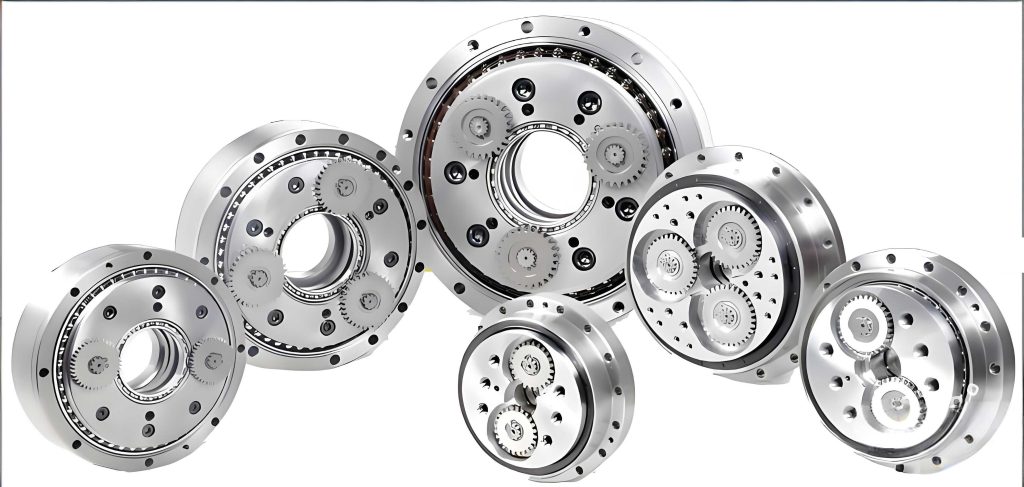
The RV reducer operates on a two-stage transmission principle, which combines a planetary gear stage with a cycloidal pinwheel stage. This design allows for high reduction ratios and robust load-bearing capacity. The first stage involves a sun gear meshing with planetary gears, while the second stage features cycloidal wheels engaging with pin gears through a crank shaft mechanism. This arrangement ensures smooth motion transmission, but it also introduces vibrational excitations due to gear meshing forces. The cycloidal wheel, with its unique tooth profile, is particularly susceptible to these vibrations, making it a focal point for dynamic analysis in the RV reducer system.
To accurately model the cycloidal wheel for simulation, I employed a parametric approach using SolidWorks software. The tooth profile of the cycloidal wheel is derived from a shortened epicycloid curve, which can be expressed mathematically. Given the base circle radius \(R_z\), pin tooth radius \(r_z\), number of cycloidal teeth \(Z_c\), number of pin teeth \(Z_b\), and the variable \(t\) ranging from 0 to 1, the parametric equations in Cartesian coordinates are as follows:
$$ x = c + r_z a, \quad y = d – r_z b, \quad z = 0 $$
where:
$$ c = R_z \sin(360t) – K_1 \sin\left(\frac{360t}{Z_b}\right) $$
$$ d = R_z \cos(360t) – K_1 \cos\left(\frac{360t}{Z_b}\right) $$
$$ a = \frac{K_1 \sin\left(Z_c \cdot 360t\right) – \sin(360t)}{\sqrt{1 + K_1^2 – 2K_1 \cos\left(Z_c \cdot 360t\right)}} $$
$$ b = \frac{-K_1 \cos\left(Z_c \cdot 360t\right) + \cos(360t)}{\sqrt{1 + K_1^2 – 2K_1 \cos\left(Z_c \cdot 360t\right)}} $$
Here, \(K_1\) represents the modification coefficient that accounts for design adjustments like equidistant and profile shifts. For the RV-80E reducer, specific parameters were used, as summarized in the table below. This parametric modeling allows for rapid generation and modification of the cycloidal wheel geometry, facilitating iterative design improvements in the RV reducer.
| Parameter | Value |
|---|---|
| Material (Cycloidal Wheel) | Steel |
| Material (Pin Teeth) | 40Cr |
| Eccentricity (mm) | 1.5 |
| Pin Center Circle Radius (mm) | 66 |
| Pin Tooth Radius (mm) | 3 |
| Profile Shift Modification (mm) | 0.01 |
| Equidistant Modification (mm) | 0.01 |
| Cycloidal Wheel Width (mm) | 8.83 |
Using these equations, I created a precise 3D model of the cycloidal wheel in SolidWorks. The model includes features such as penetration holes for weight reduction and mounting, which are common in RV reducer designs. The solid model was then imported into ANSYS for finite element analysis (FEA). The material properties were defined with a density of \(\rho = 7.6 \, \text{g/cm}^3\), Young’s modulus \(E_1 = 206 \, \text{GPa}\), and Poisson’s ratio \(\nu = 0.277\). The mesh generation resulted in 86,599 nodes and 42,584 elements, ensuring a detailed representation for accurate modal analysis of the RV reducer component.
Modal analysis is crucial for identifying natural frequencies and mode shapes that could lead to resonance in the RV reducer. I conducted two sets of analyses: free boundary conditions (unconstrained) and constrained boundary conditions (simulating actual operating conditions). Under free boundaries, the cycloidal wheel is allowed to vibrate without external restraints, revealing its inherent dynamic properties. The first ten natural frequencies and corresponding mode shapes are listed below. Note that the first mode represents rigid body motion with zero frequency, which is excluded from further discussion as it does not contribute to flexible vibrations.
| Mode Order | Frequency (Hz) | Mode Shape Description |
|---|---|---|
| 1 | 0 | Rigid body translation |
| 2 | 769.6 | Torsion along X-axis |
| 3 | 1165.7 | Extension along Y-axis |
| 4 | 1735.8 | Torsion in XOY plane |
| 5 | 2852.4 | Torsion in YOZ plane |
| 6 | 3264.6 | Stretching in XOY plane |
| 7 | 4769.5 | Stretching in YOZ plane |
| 8 | 5368.7 | Bending along X-axis |
| 9 | 6079.6 | Bending along Y-axis |
| 10 | 6452.1 | Combined torsion and bending |
The results indicate that higher-order modes involve complex deformations, with maximum displacements often occurring near the penetration holes and tooth profiles of the cycloidal wheel. This suggests these areas are potential weak points in the RV reducer design. For instance, the fourth mode at 1735.8 Hz and the seventh mode at 4769.5 Hz show significant deformation at the tooth edges, which could align with excitation frequencies in the RV reducer system, leading to resonance. Comparing these with reported natural frequencies of the full RV reducer system—such as 1678.4 Hz and 4844.6 Hz for similar modes—highlights the risk of dynamic coupling that might compromise the RV reducer’s performance.
Under constrained boundary conditions, the cycloidal wheel is subjected to realistic supports, such as bearings at the crank shaft connections and meshing constraints with pin teeth. This simulates the actual operating environment of the RV reducer. The natural frequencies under these constraints are generally higher due to the added stiffness from supports, as shown in the following table. The constrained analysis provides a more accurate representation of the dynamic behavior in a functioning RV reducer.
| Mode Order | Frequency (Hz) | Mode Shape Description |
|---|---|---|
| 1 | 0 | Rigid body translation |
| 2 | 1543.8 | Torsion along X-axis |
| 3 | 2715.9 | Torsion along Y-axis |
| 4 | 3213.7 | Torsion in XOY plane |
| 5 | 4178.9 | Bending in YOZ plane |
| 6 | 5269.5 | Torsion in XOY plane |
| 7 | 5774.6 | Stretching in YOZ plane |
| 8 | 7284.6 | Bending along X-axis |
| 9 | 7871.4 | Extension along Z-axis |
| 10 | 8965.3 | Combined torsion and bending |
In this scenario, the seventh mode at 5774.6 Hz and the ninth mode at 7871.4 Hz approach the higher natural frequencies of the RV reducer system, such as 5847.5 Hz and 7921.5 Hz, respectively. This proximity increases the likelihood of resonance, which can exacerbate vibration and noise issues in the RV reducer. The mode shapes under constraints also reveal deformation concentrations at the penetration holes, confirming that these structural features are critical for dynamic performance. Therefore, optimizing the cycloidal wheel design is essential to shift these natural frequencies away from excitation ranges and improve the overall stability of the RV reducer.
To address the resonance risks identified in the modal analysis, I proposed two optimization strategies for the cycloidal wheel in the RV reducer: structural modification of the penetration holes and material change. Both aim to alter the natural frequencies without compromising mechanical integrity. First, I modified the original扇形-shaped penetration holes to circular holes evenly distributed around the wheel. This redesign reduces stress concentrations near the tooth roots and alters the mass distribution, potentially lowering certain natural frequencies. The updated model was re-analyzed under free and constrained boundaries, with the results compared to the original design. The frequency shifts are summarized in the equations below, where \(f_{\text{original}}\) and \(f_{\text{optimized}}\) represent the natural frequencies before and after optimization.
For free boundary conditions, the frequency changes can be approximated as:
$$ \Delta f = f_{\text{original}} – f_{\text{optimized}} $$
For modes 2 to 5, \(\Delta f\) is minimal (e.g., less than 5%), but for modes 6 to 10, the reduction is more significant, with decreases of up to 15% in some cases. This helps decouple the cycloidal wheel frequencies from the RV reducer system frequencies, such as shifting the seventh mode from 4769.5 Hz to around 4050 Hz, which is farther from the system’s 4844.6 Hz.
Under constrained boundaries, the optimization yields even more pronounced effects. The natural frequencies for modes 7 and 9 drop considerably, as shown in the comparative table below. This reduction mitigates the resonance risk with the RV reducer’s higher-order modes, enhancing the dynamic robustness of the assembly.
| Mode Order | Original Frequency (Hz) | Optimized Frequency (Hz) | Percentage Change |
|---|---|---|---|
| 7 | 5774.6 | 5200.0 | -9.9% |
| 9 | 7871.4 | 7100.0 | -9.8% |
Second, I explored changing the material of the cycloidal wheel from standard steel to GCr15 bearing steel, which has higher elastic modulus and density. The new material properties are \(\rho = 7.9 \, \text{g/cm}^3\), \(E_1 = 219 \, \text{GPa}\), and \(\nu = 0.3\). This increases stiffness, which generally raises natural frequencies, but the effect depends on the mode shape. The updated modal analysis shows that for free boundaries, frequencies in modes 2 to 5 remain similar, while modes 6 to 10 experience noticeable decreases—up to 10% lower than the original. This is likely due to the combined effect of increased stiffness and altered damping characteristics in the RV reducer component.
For constrained boundaries, the material change results in a more uniform reduction across modes, as illustrated by the frequency comparison below. The seventh mode frequency decreases from 5774.6 Hz to approximately 5200 Hz, and the ninth mode from 7871.4 Hz to 7100 Hz, similar to the structural optimization. This demonstrates that both approaches are effective in tuning the dynamic properties of the cycloidal wheel to avoid resonance in the RV reducer.
The optimization outcomes can be expressed mathematically using the relationship between natural frequency \(f_n\), stiffness \(k\), and mass \(m\):
$$ f_n = \frac{1}{2\pi} \sqrt{\frac{k}{m}} $$
By modifying the penetration holes, the effective mass \(m\) is redistributed, and local stiffness \(k\) is adjusted, leading to changes in \(f_n\). Similarly, changing the material alters \(k\) through Young’s modulus, affecting the frequency spectrum. These adjustments help ensure that the cycloidal wheel’s natural frequencies do not coincide with the operational excitation frequencies of the RV reducer, thereby reducing vibration and noise.
In conclusion, this study highlights the importance of dynamic analysis for the cycloidal wheel in an RV reducer. Through parametric modeling and finite element simulation, I identified critical natural frequencies and mode shapes under both free and constrained conditions. The results show that the cycloidal wheel’s deformation is concentrated near penetration holes and tooth profiles, which are potential weak points. By optimizing the structure through hole redesign and material selection, I demonstrated effective ways to shift natural frequencies and mitigate resonance risks. These findings provide a theoretical foundation for enhancing the vibration and noise performance of RV reducers, contributing to more reliable and efficient precision传动 systems. Future work could involve experimental validation and multi-physics simulations to further refine the RV reducer design.
The RV reducer, as a core component in robotics and machinery, benefits significantly from such dynamic optimizations. By continuously improving the cycloidal wheel’s design, we can achieve higher transmission accuracy and longer service life for the RV reducer. The methodologies presented here—combining parametric modeling, modal analysis, and structural optimization—offer a robust framework for addressing dynamic challenges in the RV reducer and similar mechanical systems. As technology advances, further integrations with real-time monitoring and adaptive control could elevate the performance of the RV reducer to new heights, ensuring its pivotal role in industrial applications.