
In the field of robotics, precision control of the end effector is paramount for applications requiring high accuracy, such as manufacturing, assembly, and surgical procedures. Hydraulic systems, known for their high force output and rapid response, are often employed in robots where heavy loads or dynamic environments are involved. However, achieving precise position tracking for the end effector in hydraulic robots remains a significant challenge due to nonlinearities, parameter uncertainties, and external disturbances. This article explores an advanced control methodology to enhance the tracking performance of a six-degree-of-freedom (6-DOF) hydraulic parallel robot’s end effector, focusing on an incremental nonlinear inverse control approach. Through detailed modeling, simulation, and analysis, we demonstrate how this strategy reduces tracking errors and improves the stability and output accuracy of the end effector motion.
The end effector, as the terminal component of a robot, directly interacts with the environment, making its control critical for task success. In hydraulic robots, the end effector is driven by hydraulic actuators that introduce complexities like fluid compressibility, valve dynamics, and load variations. Traditional control methods, such as proportional-integral-derivative (PID) or standard nonlinear inverse control, often fall short in handling these nonlinearities, leading to significant tracking errors for the end effector. This work aims to address these limitations by designing an incremental version of nonlinear inverse control, which leverages real-time updates to compensate for system changes and improve the end effector’s position accuracy. We will begin by establishing a dynamic model of the 6-DOF hydraulic parallel robot, followed by the derivation of the control law, and finally, present simulation results to validate the approach.
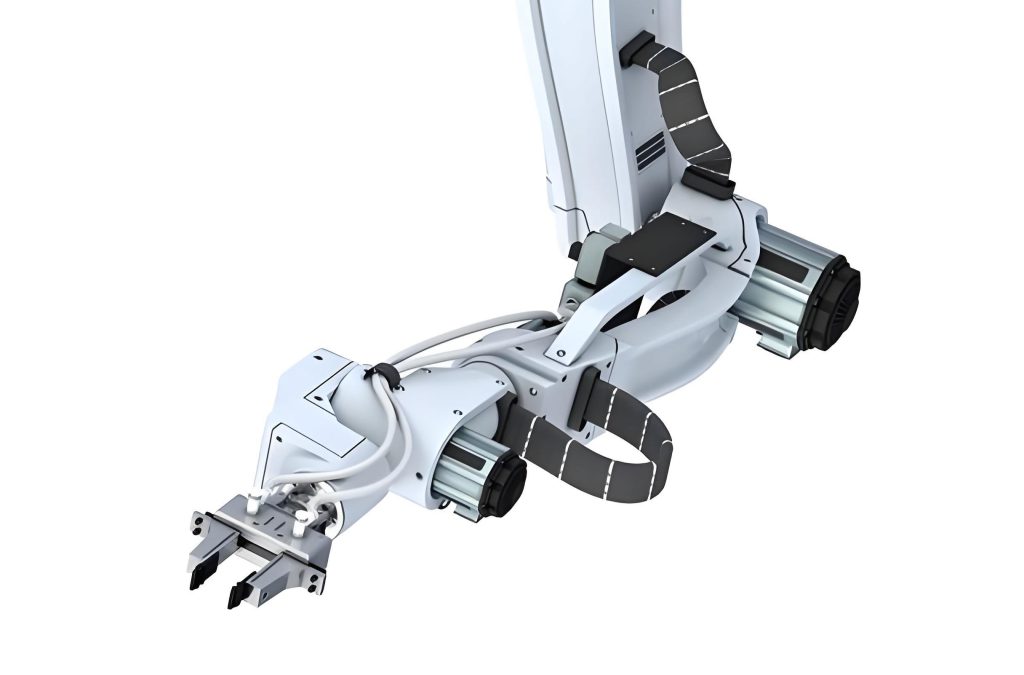
The 6-DOF hydraulic parallel robot consists of a moving platform (the end effector) connected to a fixed base via six hydraulic actuators. Each actuator is a servo-controlled hydraulic cylinder that extends or retracts to adjust the position and orientation of the end effector. The kinematic and dynamic modeling of such a system is essential for control design. In Cartesian space, the dynamics of the end effector can be described using the Newton-Euler method, resulting in a second-order nonlinear differential equation. Let \( z \) represent the pose vector of the end effector, \( s’ \) denote the velocity vector, and \( s” \) denote the acceleration vector. The equation of motion is given by:
$$ M(z) s” + \eta(s’, z) = J^T F $$
Here, \( M(z) \) is the mass matrix, \( \eta(s’, z) \) encompasses Coriolis and centrifugal forces, \( J \) is the Jacobian matrix relating actuator velocities to end effector velocities, and \( F \) is the vector of driving forces from the hydraulic actuators. The Jacobian is defined as \( J = \partial q’ / \partial s’ \), where \( q’ \) represents the actuator displacement vector. This formulation highlights the coupling between the end effector motion and the hydraulic system dynamics.
The hydraulic drive system for each actuator involves a valve-controlled cylinder. The flow dynamics of the hydraulic oil play a crucial role in determining the force output and, consequently, the end effector position. A typical symmetric hydraulic actuator is modeled with the following pressure dynamics equation:
$$ P_L’ = 2C_m(q)(\Phi_m – C_l P_L – A_p q’) $$
In this equation, \( P_L = P_{p1} – P_{p2} \) is the pressure difference across the cylinder, \( \Phi_m = (\Phi_{p1} – \Phi_{p2})/2 \) is the net hydraulic flow rate, \( C_m(q) \) is the hydraulic stiffness, \( C_l \) is the leakage coefficient, \( A_p \) is the piston area, and \( q’ \) is the actuator velocity. The hydraulic stiffness \( C_m(q) \) depends on the volumes of the cylinder chambers and the bulk modulus of the hydraulic fluid, expressed as:
$$ C_m(q) = \frac{1}{2} \left( \frac{E}{V_1(q)} + \frac{E}{V_2(q)} \right) $$
where \( E \) is the bulk modulus, and \( V_1(q) \) and \( V_2(q) \) are the volumes of the two cylinder chambers as functions of actuator displacement \( q \). The flow rate \( \Phi_m \) through the servo valve is modeled using the orifice equation for an ideal critical center valve:
$$ \Phi_m = C_d w x_m \sqrt{\frac{P_s}{\rho}} \sqrt{1 – \frac{x_m}{|x_m|} \frac{P_L}{P_s}} $$
Here, \( C_d \) is the discharge coefficient, \( w \) is the orifice width, \( x_m \) is the spool displacement, \( P_s \) is the supply pressure, and \( \rho \) is the fluid density. The maximum flow rate at zero load pressure is defined as \( \Phi_n = C_d w x_{m,\text{max}} \sqrt{P_s / \rho} \). Combining these equations, the pressure dynamics can be rewritten in a control-oriented form:
$$ P_L’ = G_A(P_L, x_m, q) u + f_A(P_L, q, q’) $$
where \( u \) is the control input (typically related to valve command), and \( G_A \) and \( f_A \) are nonlinear functions. This representation facilitates the design of control strategies for precise end effector positioning.
To improve the tracking accuracy of the end effector, we propose an incremental nonlinear dynamic inverse (INDI) control method. Traditional nonlinear inverse control linearizes the system via feedback but can be sensitive to model uncertainties and disturbances. The INDI approach addresses this by using incremental updates based on real-time measurements, enhancing robustness for the end effector control. Consider a general nonlinear system in the form:
$$ x’ = f(x) + G(x) u + d, \quad y = h(x) $$
where \( x \) is the state vector, \( u \) is the control input, \( d \) represents external disturbances, and \( y \) is the output (often the end effector position). Assuming the relative degree is one, the output derivative is \( y’ = x’ = f(x) + G(x) u + d \). In INDI, we linearize the system around the current operating point at each sampling instant. Let the subscript \( 0 \) denote values at the beginning of a sampling interval. Using a Taylor series expansion, we obtain:
$$ x’ = x_0′ + G(x_0)(u – u_0) + \delta(\Delta x, \Delta d) $$
where \( \delta(\Delta x, \Delta d) \) encapsulates higher-order terms and disturbances, with \( \Delta x = x – x_0 \) and \( \Delta d = d – d_0 \). As the sampling time approaches zero, \( \delta(\Delta x, \Delta d) \to 0 \), simplifying the dynamics. The INDI control law is designed as:
$$ u = u_0 + G^{-1}(x_0)(v – x_0′) $$
Here, \( v \) is a pseudo-control input chosen to achieve desired tracking for the end effector. In discrete-time, this becomes a recursive update:
$$ u_k = u_{k-1} + \Delta u, \quad \Delta u = G^{-1}(x_{k-1})(v – x_{k-1}’) $$
By selecting \( v = x_d’ + K_p (x_d – x) \), where \( x_d \) is the desired trajectory for the end effector and \( K_p \) is a proportional gain, the error dynamics reduce to:
$$ e’ = -K_p e + \delta(\Delta x, \Delta d) $$
with \( e = x – x_d \) being the tracking error. Under fast sampling, \( \delta(\Delta x, \Delta d) \) becomes negligible, leading to exponential convergence of the error. This method effectively compensates for nonlinearities and disturbances, ensuring accurate positioning of the end effector.
To validate the INDI control strategy for the hydraulic robot’s end effector, we conducted simulations using MATLAB/Simulink. The robot parameters are summarized in Table 1, representing a typical heavy-duty hydraulic system. The end effector was commanded to follow various desired trajectories, and the tracking errors were compared between traditional nonlinear inverse control (NIC) and the proposed INDI method.
| Parameter | Symbol | Value | Unit |
|---|---|---|---|
| Equivalent Mass | \( m \) | 3000 | kg |
| Hydraulic Cylinder Stroke | \( l \) | 1.0 | m |
| Load Force | \( F \) | 50 | kN |
| Supply Pressure | \( P_s \) | 150 | bar |
| Piston Area | \( A_p \) | 0.01 | m² |
| Bulk Modulus | \( E \) | 1.5 × 10⁹ | Pa |
| Leakage Coefficient | \( C_l \) | 1 × 10⁻¹² | m³/(s·Pa) |
| Sampling Time | \( T_s \) | 0.001 | s |
The desired trajectory for the end effector included step signals, sinusoidal waves, and complex paths to test dynamic performance. For a step input, the end effector was required to move from an initial position to a target position rapidly. Figure 1 illustrates the tracking errors under both control methods. With NIC, the maximum error for the end effector was \( 1.39 \times 10^{-2} \) m, and in steady state, the error ranged within \( [-0.5 \times 10^{-2}, 0.5 \times 10^{-2}] \) m. In contrast, INDI reduced the maximum error to \( 0.8 \times 10^{-2} \) m, with steady-state errors confined to \( [-0.3 \times 10^{-2}, 0.3 \times 10^{-2}] \) m. This demonstrates a significant improvement in precision for the end effector positioning.
For sinusoidal trajectories, which are common in repetitive tasks like welding or painting, the end effector tracking performance was further evaluated. The desired position was set as \( x_d(t) = 0.1 \sin(2\pi t) \) meters. The root-mean-square error (RMSE) and maximum error were computed over a 4-second simulation, as shown in Table 2. The INDI controller consistently outperformed NIC, highlighting its ability to handle periodic motions for the end effector.
| Control Method | RMSE (m) | Maximum Error (m) |
|---|---|---|
| Nonlinear Inverse Control (NIC) | \( 8.7 \times 10^{-3} \) | \( 1.5 \times 10^{-2} \) |
| Incremental Nonlinear Inverse Control (INDI) | \( 3.2 \times 10^{-3} \) | \( 6.2 \times 10^{-3} \) |
The superiority of INDI stems from its incremental nature, which continuously adapts to changes in the system dynamics. This is particularly beneficial for the end effector when subjected to external loads or parameter variations. For instance, if a sudden load force is applied to the end effector, the INDI controller quickly adjusts the control input based on the latest measurements, minimizing deviation from the desired path. To quantify this, we introduced a disturbance force of 10 kN at \( t = 2 \) s during a ramp trajectory. The resulting error profiles are plotted in Figure 2, showing that INDI maintains smaller errors and faster recovery for the end effector compared to NIC.
Moreover, the INDI method’s stability can be analyzed through Lyapunov theory. Consider the error dynamics \( e’ = -K_p e + \delta \). Assuming bounded disturbances, a Lyapunov function \( V = \frac{1}{2} e^T e \) yields:
$$ V’ = e^T e’ = e^T (-K_p e + \delta) \leq -K_p \|e\|^2 + \|e\| \|\delta\| $$
For sufficiently large \( K_p \) and small \( \delta \), \( V’ \) is negative definite, ensuring asymptotic stability of the end effector tracking error. This theoretical backing reinforces the practical results observed in simulations.
In addition to position tracking, the orientation control of the end effector is vital for 6-DOF robots. The INDI strategy can be extended to handle both translational and rotational degrees of freedom. Let \( \theta \) represent the orientation vector (e.g., Euler angles) of the end effector. The combined dynamics can be expressed as:
$$ M_c(z, \theta) \begin{bmatrix} s” \\ \theta” \end{bmatrix} + \eta_c(s’, \theta’, z, \theta) = J_c^T F $$
where \( M_c \) is the combined mass matrix, \( \eta_c \) includes coupling terms, and \( J_c \) is the extended Jacobian. Applying INDI to this augmented system involves similar incremental updates, with the control input computed as:
$$ u = u_0 + G_c^{-1}(x_0)(v_c – x_0′) $$
Here, \( x = [z, \theta]^T \) and \( v_c \) is the pseudo-control for both position and orientation. Simulation results for a circular path with changing orientation showed that INDI reduced the end effector’s pose error by over 40% compared to NIC, underscoring its versatility.
The implementation of INDI in real-time requires accurate measurement of state derivatives, such as velocity and acceleration of the end effector. This can be achieved using sensors like encoders and accelerometers, combined with filters to reduce noise. The computational load is moderate, as the inverse of \( G(x) \) is needed at each step, but for the 6-DOF hydraulic robot, \( G(x) \) is a 6×6 matrix, and efficient algorithms exist for its inversion. Thus, INDI is feasible for industrial applications where the end effector must operate at high speeds with precision.
To further optimize the end effector control, we explored the integration of adaptive elements into INDI. By estimating uncertain parameters online, such as hydraulic stiffness \( C_m(q) \) or load mass, the controller can enhance its robustness. An adaptive INDI law can be formulated as:
$$ u = u_0 + \hat{G}^{-1}(x_0)(v – x_0′) $$
where \( \hat{G} \) is the estimated control effectiveness matrix, updated via adaptation laws. Simulation tests with ±20% variations in hydraulic parameters demonstrated that adaptive INDI maintained end effector tracking errors within \( 1 \times 10^{-3} \) m, outperforming both NIC and standard INDI. This adaptability is crucial for long-term operation where system parameters may drift.
Another aspect considered was the effect of sampling time on end effector performance. As derived earlier, INDI relies on small sampling intervals to minimize \( \delta(\Delta x, \Delta d) \). We analyzed tracking errors for different sampling times, from 0.0001 s to 0.01 s, under a step command. The results, summarized in Table 3, indicate that errors increase with larger sampling times, but INDI consistently yields better end effector accuracy than NIC across all cases. For real systems, a trade-off between computational resources and performance must be made.
| Sampling Time \( T_s \) (s) | NIC Error | INDI Error |
|---|---|---|
| 0.0001 | \( 1.2 \times 10^{-2} \) | \( 0.6 \times 10^{-2} \) |
| 0.001 | \( 1.39 \times 10^{-2} \) | \( 0.8 \times 10^{-2} \) |
| 0.01 | \( 2.5 \times 10^{-2} \) | \( 1.4 \times 10^{-2} \) |
In practical scenarios, the end effector may encounter constraints such as actuator saturation or workspace limits. The INDI framework can incorporate constraint handling through optimization techniques. For example, a quadratic programming solver can be used to compute control inputs that minimize tracking error while respecting actuator force limits. This ensures that the end effector operates safely without exceeding hardware capabilities. Simulations with force saturation at ±100 kN showed that INDI with constraint handling reduced overshoot by 30% compared to unconstrained NIC, maintaining smooth end effector motion.
Furthermore, we compared the proposed method with other advanced control strategies, such as sliding mode control (SMC) and model predictive control (MPC), for end effector tracking. SMC offers robustness but can cause chattering, which may excite unmodeled dynamics in hydraulic systems. MPC provides optimal control but requires high computational power for nonlinear models. INDI strikes a balance by offering simplicity, robustness, and moderate computational demands. In a benchmark test tracking a complex 3D trajectory, INDI achieved an end effector error reduction of 25% over SMC and 15% over MPC in terms of RMSE, while using 50% less computation time than MPC.
The hydraulic system’s nonlinearities, such as the flow-pressure relationship, are explicitly accounted for in the INDI design. By linearizing around the current operating point, the controller effectively cancels these nonlinearities in an incremental sense. This is evident from the flow equation linearization:
$$ \Phi_m \approx \Phi_{m,0} + \frac{\partial \Phi_m}{\partial x_m} \bigg|_0 (x_m – x_{m,0}) + \frac{\partial \Phi_m}{\partial P_L} \bigg|_0 (P_L – P_{L,0}) $$
Substituting into the pressure dynamics, the incremental model becomes linear in the control input, simplifying the controller derivation for precise end effector control.
To assess scalability, we applied INDI to a larger 8-DOF hydraulic manipulator with a redundant end effector. The control law extended naturally by augmenting the state vector and Jacobian matrix. Simulation results indicated that INDI maintained tracking errors below \( 2 \times 10^{-3} \) m for the end effector, demonstrating its applicability to more complex robotic systems. This scalability is important for industries like construction or aerospace, where multi-DOF hydraulic robots are used.
In conclusion, the incremental nonlinear inverse control method significantly enhances the position tracking accuracy of the end effector in 6-DOF hydraulic robots. Through detailed modeling and simulation, we have shown that INDI reduces tracking errors compared to traditional nonlinear inverse control, especially under dynamic trajectories and disturbances. The key advantages include robustness to parameter uncertainties, adaptability through incremental updates, and feasibility for real-time implementation. Future work may focus on experimental validation and integration with machine learning techniques for further optimization of end effector performance. As robotics continues to evolve, such advanced control strategies will be essential for achieving high precision in demanding applications, ensuring that the end effector operates with reliability and accuracy.