
The integration of artificial intelligence into educational paradigms is undergoing a profound shift from purely algorithmic processing towards a more holistic, interactive model. This evolution is epitomized by the rise of embodied AI robot systems—intelligent agents that possess a physical or simulated physical form and learn through interaction with their environment. These systems challenge the traditional disembodied, cognitivist approaches to knowledge acquisition by emphasizing that intelligence is not merely a product of abstract computation but is deeply rooted in sensory-motor experiences and situated action. In the context of higher education, particularly within the domain of labor education, this paradigm offers transformative potential. Labor education, aimed at fostering correct values, practical skills, and an appreciation for work, has traditionally struggled with bridging the gap between theoretical knowledge and physical, experiential learning. The advent of the embodied AI robot presents a unique opportunity to reconfigure this educational space, creating dynamic, interactive, and immersive learning environments. However, this technological empowerment is not without significant challenges. This paper employs a first-person analytical perspective to systematically examine the transformative impacts, inherent dilemmas, and potential pathways for the effective integration of embodied AI robot technologies in higher education labor curricula, utilizing frameworks and formulas to structure the discourse.
Conceptual Foundation and Theoretical Framework
To understand the role of embodied AI robot systems, we must first ground our discussion in embodied cognition theory. Contrary to classic Cartesian dualism, embodied cognition posits that cognitive processes are deeply shaped by the body’s interactions with the world. Perception, reasoning, and learning are not confined to the brain but are distributed across the entire sensorimotor system. This can be formalized to an extent by considering cognition \(C\) as a function of bodily states \(B\), environmental context \(E\), and action \(A\):
$$C = f(B, E, A)$$
An embodied AI robot operationalizes this principle. Its “intelligence” is not pre-programmed in full but emerges from its capacity to sense (\(S\)), act (\(A\)), and learn from the consequences within an environment (\(E\)). The learning loop for such a system can be modeled as a continuous cycle:
$$S_{t} \rightarrow \text{Perception & Reasoning} \rightarrow A_{t} \rightarrow E_{t+1} \rightarrow S_{t+1} \rightarrow \text{Learning Update}$$
This framework directly challenges the “disembodied education” model prevalent in many theoretical aspects of labor education, where knowledge (\(K\)) is often treated as a transferable commodity independent of experience:
$$K_{\text{traditional}} = \text{Transfer}(Teacher \rightarrow Student)$$
In contrast, embodied learning (\(L_e\)) proposes that knowledge is constructed through situated, physical engagement:
$$L_e = \int (\text{Sensorimotor Engagement} \times \text{Environmental Feedback}) \, dt$$
The embodied AI robot serves as both a tool and a model for this form of learning. It can create virtual or physical environments where students are not passive recipients but active participants whose physical actions directly shape their understanding. The following table summarizes the core theoretical shift.
| Aspect | Disembodied (Traditional) Model | Embodied (AI-Robot Mediated) Model |
|---|---|---|
| Epistemology | Knowledge is abstract, symbolic, and transferable. | Knowledge is situated, experiential, and constructed through action. |
| Learning Process | Primarily cognitive; separation of mind (learning) and body (doing). | Holistic; integration of cognitive, sensory, and motor functions. Embodied AI robot facilitates this loop. |
| Role of Environment | Static backdrop for learning. | Dynamic and interactive partner in the learning process. The robot interacts with and changes the (virtual/physical) environment. |
| Educational Goal | Acquisition of declarative knowledge and procedural rules. | Development of tacit understanding, adaptive skills, and values through lived experience. |
Technological Empowerment and Transformative Potential
The infusion of embodied AI robot systems into labor education drives a multi-dimensional transformation. This transformation can be analyzed across three primary vectors: content, process, and environment.
1. Content: From Abstract Knowledge to Embodied Schemas
Traditional labor education often begins with manuals, lectures, and videos—abstract representations of labor. An embodied AI robot platform translates these abstractions into actionable, sensory-rich experiences. For instance, instead of reading about the torque required to fasten a bolt on an engine, a student in a VR simulation, guided by haptic feedback from an embodied AI robot interface, can feel the resistance and learn the precise motor skill. The knowledge becomes a “schema”—a mental structure linked to physical action. The effectiveness of this translation can be related to the depth of sensory modality integration (\(I_{sm}\)). A richer integration leads to stronger schema formation (\(SF\)):
$$SF \propto I_{sm} = \sum_{i}^{n} w_i \cdot M_i$$
where \(M_i\) represents different sensory modalities (visual, auditory, haptic, proprioceptive) and \(w_i\) their weighted importance for the specific task.
2. Process: From Unidirectional Instruction to Collaborative, Sense-Making Action
The educational process shifts from a teacher-centered transmission model to a student-centered exploration model mediated by technology. The embodied AI robot acts as a collaborative partner or a simulated environment with which the student must interact to achieve a goal. This fosters “sense-making,” where understanding emerges from the attempt to impose order on the environment through action. The process is cyclical: Plan → Act (via robot interface) → Perceive Consequence → Reflect → Re-plan. This mirrors the experiential learning cycle but is deeply enhanced by the immediate, variable, and risk-free feedback provided by the embodied AI robot system.
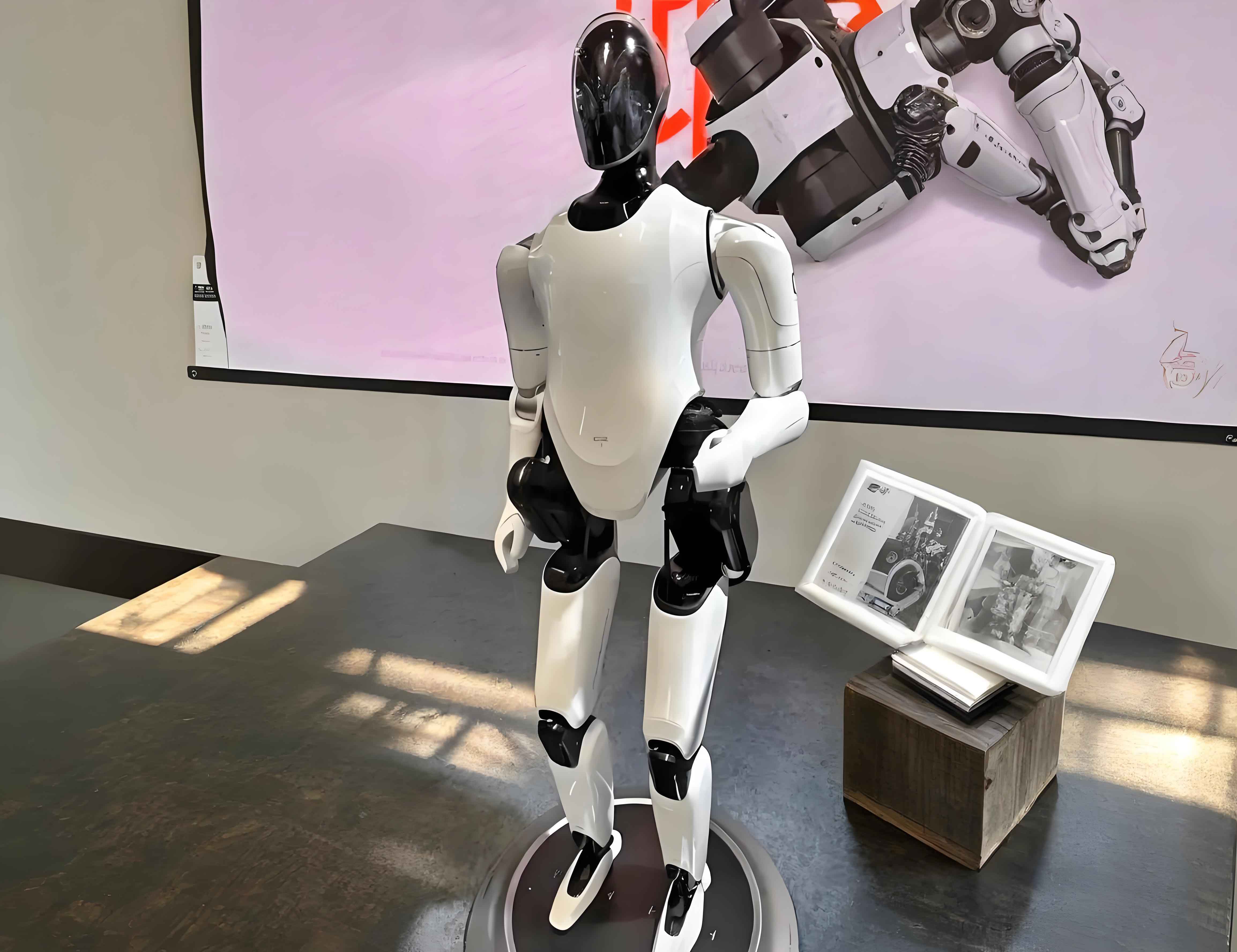
3. Environment: From Fixed, Scarcity-Bound Spaces to Scalable, Intelligent Ecosystems
Physical constraints—access to workshops, farms, or factories—have historically limited labor education. Embodied AI robot technologies demolish these barriers. Through mixed reality (MR), digital twins, and teleoperated robots, students can access, manipulate, and learn from environments that are otherwise inaccessible due to cost, safety, or geographical limits. The learning environment \(E_{learn}\) becomes a function of both physical (\(P\)) and virtual (\(V\)) components, seamlessly blended by the embodied AI robot platform:
$$E_{learn} = \alpha P + \beta V, \quad \text{where } \alpha + \beta = 1 \text{ and values vary by task.}$$
For a hazardous material handling task, \(\beta\) might approach 1 (fully virtual simulation). For a collaborative assembly task with a physical embodied AI robot, \(\alpha\) would have a higher value. This creates an intelligent, responsive, and infinitely scalable ecosystem for labor practice.
| Dimension | Traditional State | Embodied-AI Empowered State | Key Enabling Technology |
|---|---|---|---|
| Content Nature | Abstract, symbolic, declarative. | Experiential, sensorimotor, procedural-tacit. | Haptic VR/AR, force-feedback manipulators. |
| Pedagogical Process | Transmissive, teacher-led, passive. | Explorative, student-driven, collaborative (human-robot). | Interactive AI simulations, adaptive learning paths in robot tasks. |
| Spatio-Temporal Scope | Fixed location, scheduled time, limited repetition. | Anywhere (via VR/cloud), anytime, unlimited safe repetition. | Cloud-based robot simulators, digital twin platforms. |
| Feedback Mechanism | Delayed, summative, often qualitative. | Immediate, formative, rich and quantitative (e.g., precision metrics, efficiency scores). | Real-time data analytics from embodied AI robot sensors. |
Systemic Dilemmas and Realistic Challenges
Despite its promise, the integration of embodied AI robot systems into the humanistic endeavor of labor education introduces significant systemic dilemmas that threaten to undermine its core goals if not carefully managed.
Dilemma 1: The Seduction of Technicism and the Erosion of Telos
The primary telos (purpose) of labor education is the cultivation of character, values, resilience, and social responsibility through work. There is a severe risk that fascination with the embodied AI robot technology itself displaces this telos. Education may devolve into a series of impressive technical demonstrations or gamified interactions, where the focus is on operating the interface rather than internalizing the ethos of labor. The student’s role can subtly shift from an agent of labor to a supervisor of automated processes. This can be modeled as a misalignment between the designed activity (\(A_d\)) and the intended learning outcome (\(LO_i\)):
$$\text{Misalignment Risk} = \frac{|A_d – LO_i|}{LO_i}$$
When the activity is overly focused on technical proficiency with the embodied AI robot, this risk quotient rises, and the formative, value-laden aspects of labor recede.
Dilemma 2: The Attenuation of Authentic Embodiment and Affective Experience
This is a profound paradox: using an embodied AI robot to teach embodiment can lead to a diminished affective connection to real labor. Virtual environments, no matter how realistic, filter out essential phenomenological elements: the strain of prolonged physical effort, the discomfort of harsh conditions, the smell of grease or soil, the shared fatigue and triumph within a team of fellow humans. The embodied AI robot mediates and sanitizes the experience. The emotional valence (\(EV\)) and the sense of tangible achievement (\(TA\)) derived from a virtual task may be significantly lower than from its physical counterpart, potentially hindering the development of perseverance, grit, and deep respect for manual labor.
$$EV_{\text{virtual}}, TA_{\text{virtual}} \ll EV_{\text{physical}}, TA_{\text{physical}}$$
Furthermore, collaboration with AI agents or remote teammates lacks the nuanced, non-verbal communication and spontaneous problem-solving that builds robust interpersonal skills and cultural understanding in traditional apprenticeships.
Dilemma 3: The Reconfiguration of Teacher Agency and Pedagogical Authority
The instructor’s role is destabilized. When an embodied AI robot system can provide instant feedback, demonstrate procedures perfectly, and customize tasks, the teacher’s traditional role as the primary source of knowledge and skill validation is challenged. This can lead to two sub-problems: Teacher Obsolescence Anxiety and Pedagogical Deskilling. If teachers lack the technological fluency to orchestrate learning with these new tools, they may become passive facilitators, ceding curricular control to the software designers of the embodied AI robot platform. The essential human functions of mentorship, moral guidance, and contextualization of learning within a broader life framework—functions an AI cannot replicate—may be neglected. The teacher’s effectiveness (\(TE\)) in an embodied-AI environment thus becomes a complex function of their domain expertise (\(D\)), technological pedagogical knowledge (\(TPK\)), and ability to facilitate human-centric reflection (\(R\)):
$$TE_{\text{new}} = f(D, TPK, R)$$
An imbalance, particularly a deficiency in \(TPK\) or over-reliance on the embodied AI robot at the expense of \(R\), degrades overall effectiveness.
| Dilemma | Manifestation | Potential Consequence |
|---|---|---|
| Technicism vs. Telos | Focus shifts to operating the embodied AI robot rather than engaging in the meaning of labor. | Superficial skill acquisition; failure to instill work ethic, responsibility, and value formation. |
| Virtual vs. Affective Embodiment | Sanitized, risk-free simulations lack the physical duress and rich sensory-emotional texture of real work. | Weak development of resilience, grit, and authentic emotional connection to labor and its products. |
| Teacher Reconfiguration | AI system assumes roles of expert demonstrator and assessor, marginalizing the teacher. | Deskilling of educators; loss of mentorship, ethical guidance, and deep reflective dialogue in learning. |
| Dataism vs. Holism | Over-reliance on quantitative performance data from the embodied AI robot (speed, accuracy). | Neglect of qualitative, creative, collaborative, and ethical dimensions of labor performance. |
Pathways Towards a Synergistic Integration
Navigating these dilemmas requires a deliberate, human-centric design philosophy for integrating embodied AI robot systems. The goal is not replacement but augmentation—using technology to deepen, not dilute, the human experience of learning through work. The following pathways propose a systemic approach.
Pathway 1: Philosophically Grounded Design – The Human-Robot Symbiosis Model
The integration must be guided by a clear philosophy: the embodied AI robot is a tool for expanding human capability and experience, not a substitute for human labor or its associated struggles. Curriculum design should explicitly pair virtual simulations with physical counterparts. For example, a student might first learn the geometry of welding in a perfectly safe VR environment with an embodied AI robot tutor, but the culminating assessment must involve creating a physical weld, experiencing the heat, assessing the real bead, and understanding the material consequences. The robot prepares, but the human executes and reflects. The learning journey \(LJ\) should be a designed sequence:
$$LJ = [\text{AI-Simulated Practice}] \rightarrow [\text{Hybrid Guided Task}] \rightarrow [\text{Authentic Physical Labor}] \rightarrow [\text{Structured Reflection}]$$
Pathway 2: Constructing Phygital (Physical+Digital) Learning Ecologies
Move beyond a binary choice of virtual or real. Develop “phygital” spaces where embodied AI robot actions have consequences in the real world and vice-versa. A student could program a physical embodied AI robot arm to perform a task they first mastered in simulation. They could use AR glasses overlay instructions from a digital twin onto a real machine they are repairing. This seamless blend ensures that technological proficiency is always in service of tangible outcomes. The ecological model ensures that skill transfer \(T\) is maximized:
$$T = \gamma \cdot S_{\text{virtual}} + (1-\gamma) \cdot S_{\text{physical}}, \quad \text{where optimal } \gamma \text{ is task-dependent and } < 1.$$
Pathway 3: Implementing Multidimensional, Human-Centric Assessment
Assessment must rebel against the reductionism of pure analytics from the embodied AI robot. A holistic evaluation matrix \(H\) should include quantitative data (\(Q\)) from the system and qualitative judgments (\(Ql\)) from teachers and peers, focusing on the human aspects of labor.
$$H = \begin{bmatrix}
Q_{\text{robot}} & Ql_{\text{teacher}} & Ql_{\text{peer}} & Ql_{\text{self}} \\
\text{(e.g., efficiency, precision)} & \text{(e.g., problem-solving, creativity)} & \text{(e.g., collaboration, communication)} & \text{(e.g., reflection, growth mindset)}
\end{bmatrix}$$
Rubrics should evaluate not just if the task was completed via the embodied AI robot, but how—the student’s decision-making, adaptation to unforeseen errors, collaboration with others, and articulation of the work’s purpose and challenges.
Pathway 4: Cultivating the “Pedagogical Engineer” Educator
Faculty development is critical. Teachers must evolve into “pedagogical engineers” who can design learning experiences that intelligently weave embodied AI robot tools into value-driven outcomes. This requires sustained professional development in:
1. Technological Fluency: Understanding the capabilities and limitations of embodied AI robot platforms.
2. Scenario Design: Crafting narratives and problem spaces where technology use is necessary but not sufficient, forcing value-based decisions.
3. Facilitation of Metacognition: Leading discussions that connect the simulated experience with broader themes of ethics, society, sustainability, and personal growth derived from labor.
The teacher’s new role is to frame the challenge, curate the technological tools (including the embodied AI robot), and most importantly, guide the post-experience sense-making that transforms activity into learning.
| Strategic Pathway | Core Action | Mechanism for Mitigating Dilemmas |
|---|---|---|
| Philosophical Grounding | Adopt a Human-Robot Symbiosis design principle. | Prevents technicism; ensures technology serves human-centric learning goals (Telos). |
| Phygital Ecology | Build blended physical-digital learning environments. | Bridges the virtual-affective gap; provides authentic consequences and sensory engagement. |
| Holistic Assessment | Combine AI-generated data with human qualitative evaluation. | Counters dataism; values creativity, ethics, collaboration, and reflection. |
| Educator Transformation | Develop teachers as “Pedagogical Engineers.” | Restores teacher agency; empowers them to leverage the embodied AI robot for deep, reflective learning. |
Conclusion and Forward Perspective
The advent of the embodied AI robot in higher education labor contexts represents a formidable inflection point. Its capacity to create immersive, interactive, and scalable experiential learning environments aligns powerfully with the core tenets of embodied cognition, offering a potent remedy for the theory-practice divide. The transformations in content delivery, pedagogical process, and environmental access are undeniable. However, as this analysis has detailed, these advantages are coupled with deep systemic risks: the potential to hollow out the value-forming core of labor education, to replace gritty authentic experience with polished simulation, and to disempower the human teacher. Navigating this landscape successfully demands a rejection of a simplistic “technology as solution” narrative. Instead, it requires a principled, deliberate, and critical approach where the embodied AI robot is viewed as a sophisticated instrument in a broader pedagogical orchestra, conducted by a philosophically informed and technologically adept educator. The future of labor education lies not in choosing between the human and the robotic, but in carefully engineering their symbiosis. The ultimate metric of success will be whether graduates emerge not only as skilled operators of advanced systems but as thoughtful, resilient, and ethically grounded individuals who understand the profound human significance of work. This balanced integration, constantly scrutinized and refined, is the pathway to ensuring that embodied intelligence truly empowers, rather than undermines, the enduring human project of learning through labor.