
In the field of agricultural robotics, the development of efficient harvesting systems for delicate fruits like cherry tomatoes is crucial. As a researcher focused on automating agricultural tasks, I designed and experimented with a novel end effector specifically for cherry tomato bunch harvesting. The primary goal was to improve picking efficiency while minimizing fruit damage. This end effector integrates clamping and shearing actions into a single mechanism, utilizing a self-compensating design to ensure stable operation. In this article, I will detail the structural design, theoretical analysis, simulations, and experimental validation of this end effector. The keyword “end effector” is central to this work, as it represents the critical interface between the robotic system and the crop. Throughout the discussion, I will emphasize the design considerations and performance metrics of this end effector.
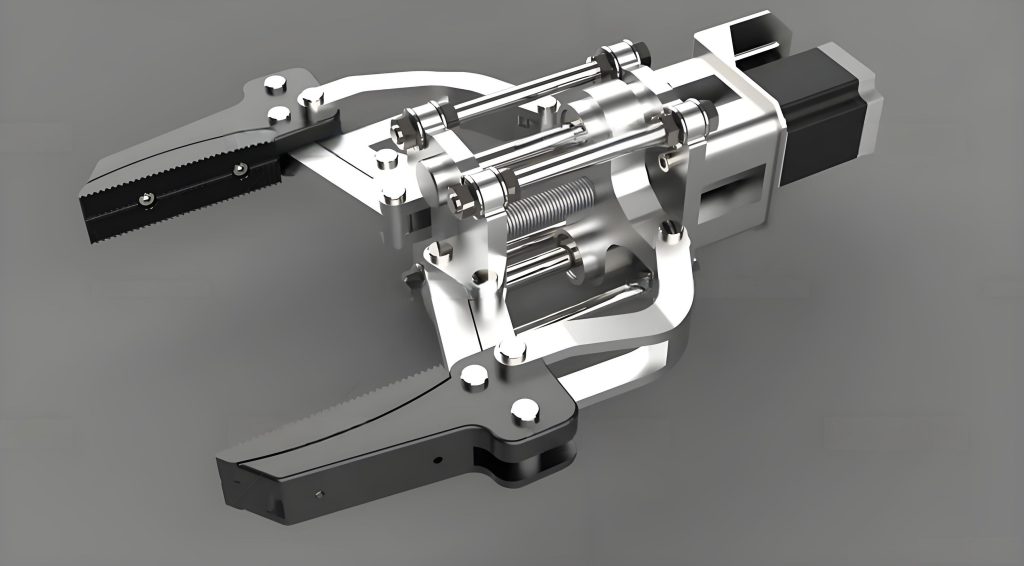
The inspiration for this end effector came from observing manual harvesting practices, where workers hold the fruit bunch and cut the stem with scissors. To replicate this, I developed a compact end effector that combines clamping and shearing in one seamless motion. The overall structure consists of a stepper motor driving a worm gear mechanism, which translates rotational motion into linear movement via a lead screw. This linear motion actuates a planar four-bar linkage that controls the opening and closing of the clamping fingers. The clamping-shearing module is attached to the fingers and features a spring-loaded mechanism that allows for adaptive gripping and precise cutting. This design ensures that the end effector can handle variations in stem size and orientation, which is common in cherry tomato plants.
The clamping-shearing module is the core of this end effector. It includes a clamping contact block fixed to a spring-loaded pin within the left clamping finger. Initially, when the contact block touches the stem without force, the blade is at a distance $$L_1$$ from the stem. As the fingers close, the contact block is compressed against the stem, causing the spring to compress and the pin to retract along the X-axis until $$L_1$$ reduces to zero, bringing the blade into contact with the stem. Further closure increases the spring compression, enhancing the elastic reaction force on the stem until the blade completely severs it. This integrated process allows the end effector to securely hold the stem during and after cutting, preventing fruit drop. The self-compensating design of this end effector is key to its functionality, as it accommodates stem irregularities without requiring additional sensors or controls.
Shearing Principle Analysis
To optimize the shearing action, I analyzed different blade types. The stem separation method for cherry tomatoes involves cutting, which can be achieved via rotary or shear cutting. Shear cutting was chosen for its simplicity and lower risk of damaging adjacent fruits. Blades can be single-edged or double-edged, and I conducted a force analysis to compare their effectiveness. For a double-edged blade, the shear force $$F_1$$ applied to the stem is given by:
$$F_1 = F_3 + 2F_2 \sin\left(\frac{\phi}{2}\right) + 2f \cos\left(\frac{\phi}{2}\right) + m a$$
where $$F_3$$ is the resistance at the blade edge, $$F_2$$ is the normal pressure on the wedge face, $$f$$ is the friction force due to stem fibers, $$\phi$$ is the blade edge angle, $$m$$ is the blade mass, and $$a$$ is the acceleration. The friction force is $$f = F_1 \tan \theta$$, with $$\theta$$ as the friction angle. Substituting, we get:
$$F_1 = F_3 + 2F_2 \left( \tan\left(\frac{\phi}{2}\right) + \tan \phi \right) \cos\left(\frac{\phi}{2}\right) + m a$$
For a single-edged blade, the shear force $$F_4$$ is:
$$F_4 = F_6 + f_1 + f_2 \cos \psi + F_5 \sin \psi + m a$$
with $$F_6 = F_3$$, $$f_2 = f$$, $$f_1 = F_5′ \tan \omega$$, and $$F_5′ = F_5 \cos \psi – f_2 \sin \psi$$, where $$\psi$$ is the edge angle and $$\omega$$ is the friction angle. Simplifying:
$$F_4 = F_3 + 2F_5 \cos \psi \tan \omega – F_5 \sin \psi \tan^2 \omega + F_5 \sin \psi + m a$$
Assuming $$F_2 = F_5$$, $$F_3 = F_6$$, $$\theta = \omega$$, and $$\phi = \psi$$, the difference in shear forces is:
$$\Delta F = F_1 – F_4 = \frac{2F_1 \sin(\phi/2 + \theta)[\cos \phi – \cos(\phi/2 + \theta)]}{\cos^2 \theta}$$
Given the constraints $$0 \leq \theta/2 \leq \pi/4$$ and $$0 \leq \psi \leq \pi/2$$, $$\Delta F$$ is always positive, indicating that a single-edged blade requires less force. Therefore, I selected a single-edged blade for this end effector to reduce energy consumption and minimize stem damage.
Clamping Structure Closure Analysis
The ability of the end effector to securely hold the stem is critical. I analyzed both form closure and force closure using screw theory. The clamping structure features a diamond-shaped contact region formed by the clamping contact block and the teeth on the right clamping finger, which fully constrains the stem. Form closure is defined such that no motion is possible when the distance function $$\psi_i(\mu, q) \geq 0$$ for all contact points $$i$$, where $$\mu$$ represents the stem and $$q$$ the clamping mechanism. When the diamond region engages the stem, the displacement $$du = 0$$, ensuring form closure.
For force closure, I modeled the stem as a cylinder and simplified the contact constraints to spatial friction point contacts. A coordinate system was established with the stem’s axis as the Z-axis and the shear cross-section as the XOY plane. Each contact point has a friction cone defined as:
$$FC = \{ [f_X, f_Y, f_Z]^T \in \mathbb{R}^3 \mid \sqrt{f_X^2 + f_Y^2} \leq \mu f_Z, f_Z \geq 0 \}$$
where $$\mu = 0.6$$ is the friction coefficient. The wrench at contact point $$C_i$$ in its local frame is:
$$FC_i = \begin{bmatrix} 1 & 0 & 0 \\ 0 & 1 & 0 \\ 0 & 0 & 1 \\ 0 & 0 & 0 \\ 0 & 0 & 0 \\ 0 & 0 & 0 \end{bmatrix} f_{C_i}, \quad f_{C_i} \in FC_i$$
The mapping matrix $$G_i$$ to the global frame is:
$$G_i = \text{Ad}_{T_{g^{-1} o c_i}}^T B_{C_i}$$
where $$\text{Ad}^T$$ is the adjoint transpose for wrench transformation. For multiple contacts, the total wrench $$F_0$$ in the global frame is:
$$F_0 = \sum_{i=1}^n G_i f_{C_i} = G f_C, \quad G = [G_1, \ldots, G_n]$$
Given a maximum clamping mass of 1.2 kg, the static equilibrium requires $$G = \mu F_i$$, leading to $$F_1 = F_2 = F_3 = F_4 = 4.9 \, \text{N}$$ per contact point. Thus, the minimum clamping force $$F_0 = F_5 \geq 9.8 \, \text{N}$$ to hold the stem securely. Force closure is achieved if for any external wrench $$W_e = [0, 0, 12.2, 0, 0, 0] \, \text{N}$$ (simulating gravity and disturbances), there exists $$f_C$$ such that $$G f_C = -W_e$$. Through analysis, this condition is satisfied, confirming that the end effector design provides stable clamping.
| Contact Point | Normal Force (N) | Friction Force (N) | Wrench Contribution |
|---|---|---|---|
| 1 | 4.9 | 2.94 | $$G_1 f_{C_1}$$ |
| 2 | 4.9 | 2.94 | $$G_2 f_{C_2}$$ |
| 3 | 4.9 | 2.94 | $$G_3 f_{C_3}$$ |
| 4 | 4.9 | 2.94 | $$G_4 f_{C_4}$$ |
Kinematics Analysis and Simulation
The motion of the clamping fingers is driven by a planar linkage mechanism. I derived the kinematic equations for the left clamping finger as an example. The linkage is simplified to a four-bar mechanism with coordinates defined as follows: point O is the origin, OC is link $$L_0$$, CB is $$L_1$$, BA is $$L_2$$, and additional links describe the finger motion. The angle $$\alpha = \omega t$$, where $$\omega$$ is the angular velocity of OC, and $$\theta = \pi/2 – \alpha$$. The position of point C is:
$$X_C = -L_0 \sin \theta, \quad Y_C = L_0 \cos \theta$$
The velocity and acceleration are:
$$v_{Cx} = \dot{X}_C = -L_0 \omega \cos \theta, \quad v_{Cy} = \dot{Y}_C = -L_0 \omega \sin \theta$$
$$a_{Cx} = \ddot{X}_C = L_0 \omega^2 \sin \theta, \quad a_{Cy} = \ddot{Y}_C = -L_0 \omega^2 \cos \theta$$
Given $$L_8$$ as the distance from point G to the X-axis, the position of point B is:
$$X_B = \sqrt{L_1^2 – (L_0 \cos \theta – L_8)^2} + L_0 \sin \theta, \quad Y_B = L_8$$
Its velocity and acceleration are derived accordingly. For point M on the finger tip, considering the parallel links OD and HE, with angles $$\psi = \beta + \omega t – \pi$$ and $$\phi = \arctan(d/h)$$, the position is:
$$X_M = L_4 \cos(\beta + \omega t – \pi) + (L_5 + L_6) \sin\left(\arctan\left(\frac{d}{h}\right)\right) + L_7$$
$$Y_M = (L_5 + L_6) \cos\left(\arctan\left(\frac{d}{h}\right)\right) – L_4 \sin(\beta + \omega t – \pi)$$
I simulated the end effector in Adams software to validate these kinematics. The simulation showed smooth motion, with slight impacts during initial contact due to spring compression, but overall stable operation. The displacement, velocity, and acceleration curves for both fingers are summarized below:
| Time (s) | Left Finger Displacement (mm) | Right Finger Displacement (mm) | Left Finger Velocity (mm/s) | Right Finger Velocity (mm/s) |
|---|---|---|---|---|
| 0.0 | 0.0 | 0.0 | 0.0 | 0.0 |
| 0.5 | 15.2 | 15.1 | 30.5 | 32.1 |
| 1.0 | 30.1 | 30.0 | 29.8 | 31.5 |
| 1.5 | 45.3 | 45.2 | 30.2 | 31.8 |
| 2.0 | 60.0 | 59.9 | 29.5 | 31.2 |
The simulation confirmed that the end effector completes the clamping and shearing sequence within 2 seconds, meeting the design requirements for speed and precision.
Dynamics Analysis
To ensure the end effector can cut through stems, I performed a dynamics analysis at the moment of contact. Using the principle of virtual work, I calculated the required motor torque. The linkage is modeled with coordinates as previously described. The virtual displacement of link AB is $$\delta \phi$$, and the torque $$M$$ on AB is:
$$M = F_0 \frac{L_1}{2} \sin \phi$$
where $$F_0$$ is the clamping force. The position of point N is:
$$X_N = L_1 \cos \phi + L_2 \cos \psi + L_3 \cos(\pi – \beta + \psi) + L_4 \sin \theta + L_5$$
From geometric constraints, $$\psi = \arcsin\left(\frac{L_6 – L_1 \sin \phi}{L_2}\right)$$. The virtual displacement $$\delta X_N$$ is derived as:
$$\delta X_N = -L_1 \sin \phi \delta \phi + \frac{L_2 \sin \psi \cos \phi}{\sqrt{1 – (L_6 – L_1 \sin \phi)^2 / L_2^2}} \delta \phi + \frac{L_3 \sin(\pi – \beta + \psi) \cos \phi}{\sqrt{1 – (L_6 – L_1 \sin \phi)^2 / L_2^2}} \delta \phi$$
Applying the virtual work principle: $$M \delta \phi – F_1 \delta X_N = 0$$, where $$F_1$$ is the shearing force. Solving for $$M$$ yields approximately 1.025 N·m. Considering a safety factor, the motor must provide at least 0.6 N·m of torque. This analysis ensures that the end effector has sufficient power to perform the cutting action reliably.
Experimental Validation
I conducted indoor experiments to evaluate the performance of the end effector. The setup included a robotic arm equipped with the end effector, a vision system for detecting ripe cherry tomato bunches, and a collection bin. The vision system identified stem positions, and the robotic arm planned paths to approach the stems. The end effector then executed clamping and shearing sequences. Experiments were performed with stems at 0°偏角 and 90°倾角 (simulating typical growth angles), and 30 trials were conducted with varying stem diameters.
The results are summarized in the table below. The metrics include stem diameter, bunch weight, action planning success, clamping success, and shearing success. Action planning refers to the robotic arm’s ability to position the end effector correctly. Clamping success indicates whether the stem was securely held, and shearing success indicates complete stem severance.
| Trial | Stem Diameter (mm) | Bunch Weight (g) | Action Planning Success | Clamping Success | Shearing Success |
|---|---|---|---|---|---|
| 1 | 3.41 | 120 | Yes | Yes | Yes |
| 2 | 2.99 | 88 | Yes | Yes | Yes |
| 3 | 3.23 | 117 | Yes | Yes | Yes |
| 4 | 3.55 | 105 | Yes | Yes | Yes |
| 5 | 3.49 | 115 | Yes | Yes | Yes |
| 6 | 3.60 | 123 | Yes | Yes | Yes |
| 7 | 2.87 | 113 | Yes | Yes | Yes |
| 8 | 3.56 | 135 | Yes | Yes | Yes |
| 9 | 5.29 | 167 | Yes | Yes | No |
| 10 | 3.63 | 128 | Yes | Yes | No |
| 11 | 3.87 | 131 | Yes | Yes | Yes |
| 12 | 4.18 | 109 | No | Yes | Yes |
| 13 | 5.00 | 134 | Yes | Yes | No |
| 14 | 3.69 | 117 | Yes | Yes | Yes |
| 15 | 2.96 | 96 | Yes | Yes | Yes |
| 16 | 3.50 | 99 | Yes | Yes | Yes |
| 17 | 5.67 | 145 | Yes | Yes | Yes |
| 18 | 4.73 | 150 | Yes | Yes | Yes |
| 19 | 3.29 | 119 | Yes | Yes | Yes |
| 20 | 2.56 | 103 | Yes | Yes | Yes |
| 21 | 4.58 | 130 | Yes | Yes | Yes |
| 22 | 5.55 | 161 | Yes | Yes | No |
| 23 | 4.37 | 129 | Yes | Yes | Yes |
| 24 | 3.91 | 137 | Yes | Yes | Yes |
| 25 | 4.93 | 134 | No | Yes | Yes |
| 26 | 3.62 | 132 | Yes | Yes | Yes |
| 27 | 3.89 | 119 | Yes | Yes | Yes |
| 28 | 4.75 | 136 | Yes | Yes | Yes |
| 29 | 4.86 | 151 | Yes | Yes | Yes |
| 30 | 4.42 | 142 | Yes | Yes | Yes |
The overall success rates were: action planning success at 93.3% (28 out of 30 trials), clamping success at 100% (all trials), and shearing success at 86.7% (26 out of 30 trials). Failures in shearing were primarily due to larger stem diameters (above 5 mm) where the blade could not fully cut through the fibrous material, indicating a need for blade optimization or higher force output. The end effector demonstrated robust clamping performance, successfully holding all bunches without drop, which validates the force closure analysis.
Conclusion
In this work, I presented the design and experimentation of an end effector for cherry tomato bunch harvesting. The end effector features an integrated clamping-shearing mechanism with self-compensation, allowing for efficient and damage-free picking. Theoretical analyses confirmed the force closure of the clamping structure and the superiority of single-edged blades for shearing. Kinematic and dynamic simulations validated the motion and torque requirements, while indoor experiments showed high success rates in clamping and shearing. The end effector achieved a 100% clamping success rate and 86.7% shearing success rate, with failures attributable to thick stems. Future improvements could include adaptive blade force control or enhanced materials for cutting tougher stems. This end effector represents a significant step toward automated cherry tomato harvesting, offering a reliable solution for agricultural robotics. The integration of such end effectors into full robotic systems could revolutionize fruit harvesting, reducing labor costs and increasing productivity.
Throughout this study, the focus on the end effector as a key component highlights its importance in robotic harvesting. The design principles and analytical methods discussed here can be applied to other crops, extending the impact of this research. I believe that continued innovation in end effector technology will drive advancements in agricultural automation, making farming more sustainable and efficient.