
In modern large-scale poultry farming, the manual identification and removal of dead chickens pose significant challenges, including high labor intensity and low efficiency. As a researcher focused on agricultural robotics, I aimed to address this issue by developing a specialized end effector for a robotic system capable of autonomously picking up dead broilers in cage-based environments. The end effector is designed based on underactuated principles, which allow for adaptive grasping with minimal actuators, making it suitable for handling broilers aged 3 to 7 weeks—a period when mortality rates can impact economic losses due to disease spread. This article details the design, simulation, optimization, and experimental validation of this end effector, emphasizing its mechanical structure, performance metrics, and practical applicability. Throughout this work, the term “end effector” is central, as it refers to the critical component that interacts directly with the chickens, and its design dictates the overall system efficacy.
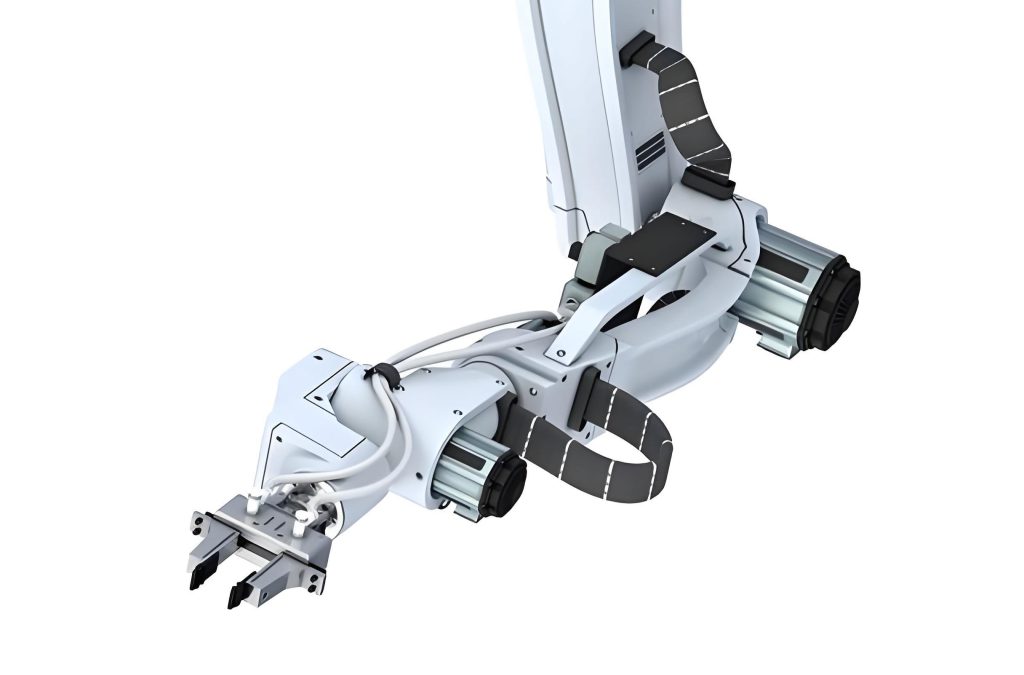
The core innovation lies in leveraging underactuation to create a 3-joint, 4-finger end effector that can accommodate the rapid growth and varying body sizes of broilers during their cultivation cycle. Underactuated mechanisms reduce the number of actuators needed by using passive elements like springs and mechanical limits, enabling complex grasping motions with simple control. For this end effector, a single stepper motor drives all four fingers via a screw mechanism, converting rotational motion into linear displacement to open and close the fingers. This design ensures a compact structure that can operate within the confined spaces of chicken cages while providing sufficient gripping force and range. The end effector’s fingers are symmetrically arranged on both sides of a palm-like structure to balance weight distribution during grasping, crucial for stable pick-up of chickens that may be in different postures after death.
To inform the design, I first conducted measurements on broilers to understand their physical characteristics. A group of Ross 308 broilers was studied, with data collected weekly from 3 to 7 weeks of age. Key parameters included body weight, chest width, and body length, which are essential for modeling the chickens as graspable objects. The average values are summarized in Table 1. These measurements revealed that broilers experience substantial growth, with chest width increasing from about 10.93 cm to 16.93 cm over five weeks. This variability necessitated an end effector with a wide grasping range, which the underactuated design inherently provides through its adaptive finger joints.
| Age (weeks) | Weight (g) | Chest Width (cm) | Body Length (cm) |
|---|---|---|---|
| 3 | 609.33 | 10.93 | 12.83 |
| 4 | 1054.00 | 12.78 | 16.17 |
| 5 | 1656.33 | 13.58 | 20.17 |
| 6 | 2290.33 | 15.97 | 28.67 |
| 7 | 2983.33 | 16.93 | 29.33 |
Additionally, I performed compression tests on broilers to determine the maximum allowable gripping force without causing damage, such as skin rupture or fluid leakage. Using a universal testing machine, I applied compressive loads to the side of broiler bodies at a rate of 60 mm/min, simulating the forces exerted by the end effector during grasping. The load-displacement curves indicated that broilers can withstand forces up to 450 N without severe damage, but to minimize deformation and ensure stable grasping, a threshold of 80 N was established for the gripping force. This threshold guided the structural optimization of the end effector to prevent over-compression, especially for larger broilers at 7 weeks, where deformation could affect grasping stability. The relationship between load and displacement can be approximated by a linear model for small deformations:
$$ F = k \cdot x $$
where \( F \) is the applied force, \( k \) is the effective stiffness of the broiler body, and \( x \) is the displacement. Based on experimental data, the stiffness varied with age, but for design purposes, the 80 N limit corresponded to a displacement of around 30 mm for 7-week broilers, ensuring safe operation.
Next, I developed a parametric model of the mechanical finger using ADAMS software, which enabled virtual prototyping and optimization. The finger consists of three phalanges: proximal, middle, and distal, connected by revolute joints with torsion springs and mechanical limits to achieve underactuation. The finger’s geometry was defined by eight key points, as shown in a simplified diagram, with coordinates parameterized as design variables. This parametric approach allowed for efficient optimization by treating the finger’s link lengths and angles as functions of these points. In ADAMS, I created 16 design variables from the coordinates, focusing on optimizing the finger’s performance for grasping broilers of different sizes. The primary goal was to maximize the gripping force while ensuring stable contact with the chicken body, which is critical for the end effector’s reliability.
The optimization process involved defining an objective function, design variables, and constraints. The objective function was derived from the static equilibrium conditions during grasping. When the end effector grips a broiler, the fingers exert contact forces on the chicken body, and stability requires that the vector sum of these forces balances the chicken’s weight. For a two-point contact scenario (e.g., middle and distal phalanges touching the broiler), the equilibrium equations in the vertical direction are:
$$ 2F_2 \sin \alpha + 2F_3 \sin \theta + F_s = 0 $$
$$ 2F_2 \cos \alpha \cdot \mu + 2F_3 \cos \theta \cdot \mu + Mg = 0 $$
where \( F_2 \) and \( F_3 \) are the contact forces at the middle and distal phalanges, respectively, \( \alpha \) and \( \theta \) are the angles of these forces relative to the horizontal, \( F_s \) is the palm contact force (if applicable), \( \mu \) is the friction coefficient between the finger and broiler skin, \( M \) is the mass of the broiler, and \( g \) is gravitational acceleration. For stable grasping without palm contact, the condition \( F_{2y} + F_{3y} \geq 0 \) must hold, where \( F_{2y} \) and \( F_{3y} \) are the vertical components of the contact forces. The horizontal components contribute to balancing weight through friction, so maximizing \( F_{2x} + F_{3x} \) enhances gripping capacity. Thus, the objective function was set as:
$$ \text{max}(F_{2x} + F_{3x}) $$
This function represents the total horizontal gripping force, which directly relates to the end effector’s ability to hold broilers of varying weights.
I then conducted a sensitivity analysis on the 16 design variables to identify the most influential ones for optimization. Using ADAMS, I evaluated how changes in each variable affected the objective function. The results, summarized in Table 2, showed that five variables had high sensitivity: DV_2, DV_3, DV_5, DV_10, and DV_13, corresponding to key hinge points in the finger mechanism. By focusing on these variables, I reduced computational complexity while ensuring effective optimization. The initial and optimized values of these variables are presented in Table 3, demonstrating significant adjustments to improve gripping performance.
| Design Variable | Sensitivity |
|---|---|
| DV_1 | 0.24416 |
| DV_2 | -0.47480 |
| DV_3 | -0.83678 |
| DV_4 | 0 |
| DV_5 | -1.3240 |
| DV_6 | 0.29084 |
| DV_7 | 0.11578 |
| DV_8 | -0.00926 |
| DV_9 | 0.14279 |
| DV_10 | -1.27830 |
| DV_11 | 0.20055 |
| DV_12 | -0.12236 |
| DV_13 | -0.54043 |
| DV_14 | 0.09564 |
| DV_15 | 0.21727 |
| DV_16 | -0.07259 |
| Design Variable | Initial Value (mm) | Optimized Value (mm) | Change (%) |
|---|---|---|---|
| DV_2 | -64.0214 | -66.37100 | 3.37 |
| DV_3 | -37.8005 | -42.79550 | 13.2 |
| DV_5 | 20.0000 | 22.29380 | 11.5 |
| DV_10 | -2.5000 | -4.06434 | 62.6 |
| DV_13 | 35.0000 | 34.11220 | -2.54 |
Constraints were applied to ensure the finger’s structural integrity and functionality. These included size constraints to prevent excessive deformation, force constraints based on the equilibrium condition \( F_{2y} + F_{3y} \geq 0 \), and angle constraints to avoid mechanical interference or self-locking. For example, the total finger length was limited to between \( \frac{1}{4}\pi r_{\text{max}} \) and \( \frac{3}{8}\pi r_{\text{max}} \), where \( r_{\text{max}} \) is the maximum chest width of broilers, ensuring the end effector can envelop chickens without being too bulky. The optimization in ADAMS involved iterative simulations, and the results showed a 28.6% increase in the objective function, from 81.664 N to 105.055 N, indicating a substantial improvement in gripping force capability. This enhancement is crucial for the end effector to handle heavier broilers at later growth stages.
With the optimized design, I performed motion simulations in ADAMS to evaluate the end effector’s grasping performance on virtual broiler models. Two extreme cases were tested: 3-week broilers (smallest) and 7-week broilers (largest), as successful grasping at these sizes would imply compatibility across all ages. The broiler models were created as cylindrical bodies with diameters and weights based on the measured data. The simulation tracked the contact forces and joint angles during grasping, providing insights into the finger’s adaptive behavior. For 3-week broilers, the distal phalanx made initial contact, followed by the middle phalanx, and the forces remained below the 80 N threshold, with stable lifting observed. The angle between phalanges decreased smoothly, indicating enveloping motion. For 7-week broilers, the middle phalanx contacted first, then the distal phalanx, and the force distribution shifted accordingly, but the total force stayed within limits. These simulations confirmed that the end effector could achieve stable grasps for both small and large broilers, validating the underactuated design’s adaptability.
The simulation data for contact forces and joint angles are summarized in Table 4. This table highlights the dynamic changes during grasping, showing how the underactuated mechanism distributes forces across phalanges to maintain equilibrium. The end effector’s ability to adjust its grip based on object size is a key advantage, reducing the need for complex sensing or control systems.
| Broiler Age | Initial Contact Phalanx | Max Force (N) | Final Grasp Stability |
|---|---|---|---|
| 3 weeks | Distal | ~50 | Stable |
| 7 weeks | Middle | ~70 | Stable |
To further validate the design, I fabricated a prototype of the end effector using 3D printing with resin materials. Although resin has lower mechanical strength than metal, it allowed for rapid prototyping and cost-effective testing. The prototype was integrated with a control system featuring an infrared sensor to trigger grasping when the end effector approached a target. I conducted picking experiments on dead broilers under various conditions, including different postures (abdomen down, side lying, back down) and times since death (within 30 minutes and after 30 minutes). Each test involved 20 repetitions, and success was defined as the end effector holding the broiler for 10 seconds without dropping. The results, shown in Table 5, demonstrate high success rates, particularly for broilers dead for over 30 minutes, where rigidity made them more cylindrical and easier to grasp. The average picking time was about 32 seconds, meeting practical requirements for farm use.
| Time Since Death | Posture | Success Rate (%) | Average Time (s) |
|---|---|---|---|
| Within 30 minutes | Abdomen down | 95 | 32 |
| Side lying | 90 | 30 | |
| Back down | 80 | 34 | |
| After 30 minutes | Abdomen down | 100 | 32 |
| Side lying | 95 | 30 | |
| Back down | 95 | 34 |
The experiments revealed that posture affected success rates, with back-down poses being more challenging due to the broiler’s shape, but the end effector still performed adequately. The underactuated design proved robust, as the fingers conformed to the broiler’s body without requiring precise positioning. This adaptability is essential for real-world applications where chickens may be in irregular positions after death. Moreover, the end effector’s simple actuation—using just one motor—reduces cost and maintenance, making it suitable for deployment in large-scale farms.
In discussing the broader implications, this end effector represents a step toward automating poultry farm management, potentially reducing labor costs and improving hygiene by quickly removing dead birds. The use of underactuation aligns with trends in agricultural robotics, where simplicity and reliability are prioritized. Future work could involve enhancing the end effector with sensors for better grip detection or using more durable materials for longer lifespan. Additionally, integrating the end effector with a mobile robot or overhead system could enable fully autonomous dead chicken removal, further increasing efficiency.
In conclusion, I have successfully designed, optimized, and tested an underactuated end effector for picking dead broilers in cage environments. The end effector’s 3-joint, 4-finger structure, driven by a single motor, provides adaptive grasping across a range of broiler sizes, as confirmed by simulations and physical experiments. The optimization process increased gripping force by 28.6%, and experimental success rates exceeded 88.3% for fresh dead broilers and 96.7% for rigid ones, with an average pick-up time of 32 seconds. This end effector demonstrates the potential of underactuated mechanisms in agricultural robotics, offering a practical solution to a persistent problem in poultry farming. By focusing on the end effector’s design, I have contributed to the development of smarter, more efficient farm tools that can enhance productivity and animal welfare.