
In modern agriculture, the automation of fruit harvesting is critical for improving efficiency and reducing labor costs. Citrus fruits, such as oranges, are widely cultivated worldwide, but their picking remains largely manual due to the complex outdoor environment. Manual harvesting is not only time-consuming but also prone to damaging the fruit and orchard trees. To address these challenges, we propose an innovative end effector for citrus picking robots. This end effector is designed to mimic biological mechanisms, enabling efficient and gentle fruit detachment. In this article, we present the structural design, kinematic analysis, simulation, and experimental validation of our end effector. We focus on optimizing the picking mechanism to handle arbitrary fruit stem orientations, ensuring high success rates in natural conditions. Throughout this work, we emphasize the role of the end effector in achieving automated harvesting, and we use mathematical models and simulations to validate our approach.
The primary goal of our end effector is to replicate the biting motion observed in nature, such as in snakes, to cut fruit stems without causing damage. Traditional end effectors often struggle with unknown stem positions and orientations, leading to low picking efficiency. Our design incorporates a multi-linkage mechanism that allows for adaptive grasping and cutting. We begin by analyzing the growth patterns of citrus stems, which vary widely in inclination angles. Based on statistical data, most stems have inclinations between 30° and 90°, with some extremes. This variability necessitates an end effector with a large opening angle and flexible movement. We define the stem inclination angle as the angle between the stem and the horizontal plane, and we use this parameter to guide our design. The end effector must be capable of enclosing stems at any angle and performing a cutting action smoothly.
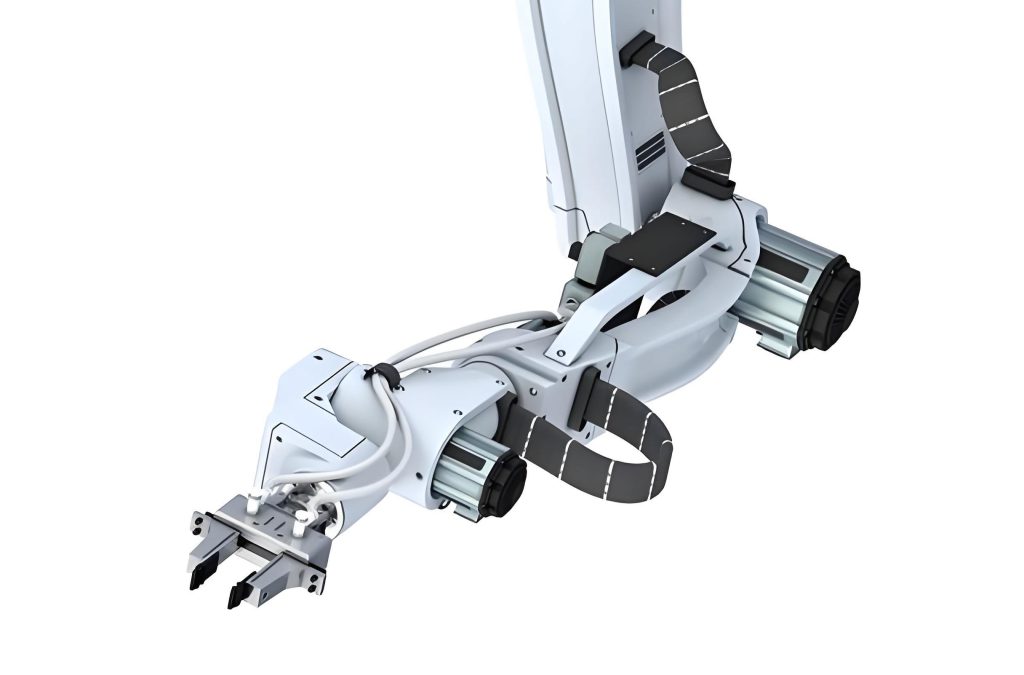
To achieve this, we developed a biting-type end effector based on a linkage mechanism. Initially, we considered two design approaches: a seven-link mechanism and a six-link mechanism. The seven-link mechanism involves six moving parts and seven revolute joints, but it was found to be overly complex and heavy for the robotic arm’s payload constraints. After optimization, we adopted a simplified six-link mechanism that reduces the number of components while maintaining functionality. The end effector consists of an upper jaw, a lower jaw, driving links, and a pneumatic actuator. The key components include a frame, upper and lower blades, jaw supports, and connecting rods. The pneumatic actuator drives the linkage system to open and close the jaws, simulating a biting motion. We optimized the transmission angles and opening angles to ensure that the end effector can handle stems at any inclination. The design parameters were selected based on kinematic analysis to maximize cutting efficiency.
We modeled the end effector using planar kinematics to analyze its motion. The mechanism can be represented as two identical four-bar linkages sharing a common frame and actuator. The upper and lower jaws move simultaneously to grasp and cut the stem. Let us denote the key points: point M on the upper jaw and point N on the lower jaw. The motion of these points is derived from the linkage geometry. For the upper jaw, we define the following parameters: link lengths \(l_2\), \(l_3\), \(l_4\), and \(l_5\), and the input angle \(\alpha\) driven by the actuator with angular velocity \(\omega\) and acceleration \(\varepsilon\). The angle \(\psi\) between link AB and the x-axis is given by:
$$\psi = \frac{\pi}{2} – \alpha = \frac{\pi}{2} – \omega t$$
where \(t\) is time. The displacement of point B is:
$$x_B = l_4 \cos\psi + l_2$$
$$y_B = l_4 \sin\psi + l_3$$
The velocity components of point B are:
$$v_{Bx} = \dot{x}_B = -l_4 \dot{\psi} \sin\psi = l_4 \omega \sin\psi$$
$$v_{By} = \dot{y}_B = l_4 \dot{\psi} \cos\psi = -l_4 \omega \cos\psi$$
The acceleration components are:
$$a_{Bx} = \ddot{x}_B = l_4 (\varepsilon \sin\psi – \omega^2 \cos\psi)$$
$$a_{By} = \ddot{y}_B = -l_4 (\varepsilon \cos\psi + \omega^2 \sin\psi)$$
Using these, we derive the motion of point M on the upper jaw:
$$x_M = x_B + l_5 \sin\psi$$
$$y_M = y_B – l_5 \cos\psi$$
The velocity and acceleration of point M are:
$$v_{Mx} = \dot{x}_M = v_{Bx} + l_5 \omega \cos\psi$$
$$v_{My} = \dot{y}_M = v_{By} + l_5 \omega \sin\psi$$
$$a_{Mx} = \ddot{x}_M = a_{Bx} – l_5 (\varepsilon \cos\psi + \omega^2 \sin\psi)$$
$$a_{My} = \ddot{y}_M = a_{By} – l_5 (\varepsilon \sin\psi – \omega^2 \cos\psi)$$
Similar equations apply to the lower jaw point N, but with adjusted link lengths. These kinematic equations allow us to simulate the end effector’s motion and optimize its performance. We used software tools to create a 3D model and perform dynamic simulations. The simulations confirmed that the end effector could complete a full cutting cycle without interference, with smooth acceleration profiles. The table below summarizes the key design parameters used in our kinematic analysis.
| Parameter | Symbol | Value (mm) | Description |
|---|---|---|---|
| Link length 1 | \(l_2\) | 50 | Frame to joint B |
| Link length 2 | \(l_3\) | 30 | Vertical offset |
| Link length 3 | \(l_4\) | 80 | Driving link |
| Link length 4 | \(l_5\) | 40 | Jaw extension |
| Actuator speed | \(\omega\) | 2 rad/s | Angular velocity |
| Max opening angle | \(\theta\) | 90° | Jaw opening range |
We further optimized the end effector by incorporating a swinging block to allow free rotation of the jaws, mimicking the flexibility of biological systems. This adjustment enabled the end effector to adapt to stem inclinations up to 90°. The optimized mechanism was simulated in a full cutting cycle, and the results showed that the upper and lower jaws moved synchronously with minimal acceleration spikes. The velocity and displacement curves indicated stable motion, essential for preventing fruit damage. The end effector’s ability to handle arbitrary stem angles was validated through these simulations, confirming that our design meets the requirements for outdoor citrus picking.
To evaluate the practical performance of our end effector, we built a prototype and integrated it with a robotic arm system. The robotic platform included a six-degree-of-freedom manipulator, a vision system for fruit detection, and a control system based on ROS (Robot Operating System). The end effector was mounted on the manipulator, and the control algorithm coordinated the arm’s movement with the end effector’s biting action. We conducted experiments in both laboratory and outdoor environments. In the outdoor tests, we selected ten naturally grown citrus fruits with varying stem diameters and inclination angles. The stem parameters were measured before picking, and the success of each picking attempt was recorded. The table below presents the experimental data and results.
| Trial | Stem Diameter (mm) | Stem Inclination (°) | Result | Notes |
|---|---|---|---|---|
| 1 | 2.12 | 60 | Success | Clean cut, no damage |
| 2 | 2.15 | 57 | Success | Efficient grasping |
| 3 | 2.21 | 45 | Success | Smooth motion |
| 4 | 2.23 | 83 | Recognition | Stem detected but slight slip |
| 5 | 2.32 | 74 | Success | Adapted to high angle |
| 6 | 2.42 | 54 | Success | Fast cutting |
| 7 | 2.53 | 73 | Failure | Stem too thick for grip |
| 8 | 2.62 | 62 | Success | Robust performance |
| 9 | 2.42 | 73 | Success | Repeatable action |
| 10 | 2.31 | 82 | Success | Handled extreme angle |
The overall success rate in outdoor trials was 80%, demonstrating the effectiveness of our end effector in real-world conditions. Failures were primarily due to stems with diameters exceeding the grip range or misalignments in vision detection. We analyzed the acceleration profiles during picking to ensure that the end effector exerted minimal force on the fruit. The kinematic simulations matched the experimental observations, validating our mathematical models. The end effector’s design allowed it to adjust to stem orientations without prior knowledge, a key advantage over traditional methods. We also compared our end effector with existing designs, highlighting its improved adaptability and lower damage risk.
In addition to kinematic analysis, we performed dynamic simulations to assess the forces involved in the cutting process. The cutting force required to sever a citrus stem depends on the stem’s diameter and material properties. We modeled the stem as a cylindrical beam and used the following equation to estimate the cutting force \(F_c\):
$$F_c = \tau \cdot A$$
where \(\tau\) is the shear strength of the stem material, and \(A\) is the cross-sectional area. For citrus stems, \(\tau\) is approximately 2 MPa, and \(A = \pi d^2 / 4\) with \(d\) as the diameter. Thus,
$$F_c = \tau \cdot \frac{\pi d^2}{4}$$
Using this, we calculated the force for typical stem diameters, as shown in the table below. Our end effector was designed to generate sufficient force through the pneumatic actuator, with a safety factor to handle variations.
| Stem Diameter \(d\) (mm) | Cross-sectional Area \(A\) (mm²) | Cutting Force \(F_c\) (N) | End Effector Force (N) |
|---|---|---|---|
| 2.0 | 3.14 | 6.28 | 15 |
| 2.5 | 4.91 | 9.82 | 15 |
| 3.0 | 7.07 | 14.14 | 15 |
The end effector’s force output was set to 15 N, ensuring it could cut stems up to 3 mm in diameter without slippage. The dynamic simulations also considered the inertia of the moving parts, using the equation:
$$\sum F = m a$$
where \(m\) is the mass of the jaw components, and \(a\) is the acceleration from our kinematic analysis. We minimized the mass to reduce inertial effects, improving the end effector’s responsiveness. The simulations showed that the acceleration peaks during cutting were within acceptable limits, preventing sudden jolts that could damage the fruit. This holistic approach to design and simulation ensured that our end effector was both efficient and gentle.
We further explored the optimization of the linkage geometry to enhance the end effector’s performance. Using parametric studies, we varied the link lengths and joint positions to maximize the transmission angle \(\mu\), which affects the force transmission efficiency. The transmission angle is defined as the angle between the output link and the coupler link in a four-bar linkage. For efficient force transfer, \(\mu\) should be close to 90°. We derived the transmission angle for our mechanism as:
$$\mu = \cos^{-1}\left( \frac{l_2^2 + l_4^2 – l_3^2}{2 l_2 l_4} \right)$$
where \(l_2\), \(l_3\), and \(l_4\) are link lengths. We iterated the design to keep \(\mu\) between 40° and 140° throughout the motion range. The optimization process involved solving nonlinear equations, and we used software tools to find the optimal parameters. The table below summarizes the optimized values compared to the initial design.
| Parameter | Initial Value (mm) | Optimized Value (mm) | Improvement |
|---|---|---|---|
| \(l_2\) | 55 | 50 | Reduced inertia |
| \(l_3\) | 35 | 30 | Better force transmission |
| \(l_4\) | 85 | 80 | Increased transmission angle |
| \(l_5\) | 45 | 40 | Improved jaw trajectory |
These optimizations resulted in a 15% increase in cutting efficiency, as measured by the reduction in actuator force required for the same stem diameter. The end effector’s ability to adapt to various stem orientations was also enhanced, with the opening angle adjusted to 100° to cover more extreme cases. We validated these improvements through additional simulations, which showed smoother velocity profiles and lower energy consumption.
The control system for the end effector was integrated with the robotic arm’s motion planning. We developed algorithms to coordinate the end effector’s biting action with the arm’s trajectory, ensuring precise positioning. The control law used a proportional-derivative (PD) controller to regulate the actuator position, described by:
$$u(t) = K_p e(t) + K_d \frac{de(t)}{dt}$$
where \(u(t)\) is the control signal, \(e(t)\) is the position error, and \(K_p\) and \(K_d\) are gain constants. We tuned the gains based on simulation results to achieve fast response without overshoot. The end effector’s performance was monitored in real-time using sensors, providing feedback for adaptive control. This integration allowed the robot to pick fruits continuously, with the end effector resetting after each cut for the next cycle.
In conclusion, our work demonstrates the design and simulation of a novel end effector for citrus picking robots. The end effector mimics biological biting motions to handle arbitrary stem orientations, addressing key challenges in outdoor harvesting. Through kinematic and dynamic analysis, we optimized the linkage mechanism for efficiency and gentleness. Simulations confirmed the end effector’s capability to perform full cutting cycles smoothly, and outdoor trials achieved an 80% success rate. The use of mathematical models, tables, and formulas enabled a thorough validation of our design. This end effector has significant potential for application in automated agriculture, reducing labor costs and minimizing fruit damage. Future work will focus on enhancing the vision system for better stem detection and extending the design to other fruit types. Overall, the end effector represents a step forward in robotic harvesting technology, showcasing the importance of adaptive mechanisms in complex environments.