
To address the inefficiencies, high safety risks, and resource wastage inherent in conventional methods for cleaning contact line insulators, this paper presents a comprehensive solution centered on the innovative design and sophisticated control optimization of a robotic end effector. The proposed framework integrates mechanical design, environmental perception, intelligent control strategy, and systematic validation into a cohesive technical pathway. The developed end effector features a modular architecture comprising a swing-arm system and a brush system, endowing it with significant adaptability to various insulator geometries. System perception, crucial for precise operation, is achieved through the fusion of LiDAR for environmental mapping and a depth camera for accurate 6D pose estimation of the target insulator. A CANopen communication protocol ensures robust and real-time data exchange within the control system. Recognizing the challenges of drastic load variations and stringent gripping accuracy requirements during the cleaning process, the control strategy introduces motor current feedback. This feedback is integrated with a fuzzy logic-based online tuning mechanism for PID parameters, forming an advanced closed-loop control system. Both simulation studies and physical experiments confirm the superior performance of the proposed end effector in terms of response speed, control precision, and cleaning efficacy, demonstrating strong engineering adaptability and promising prospects for widespread application.
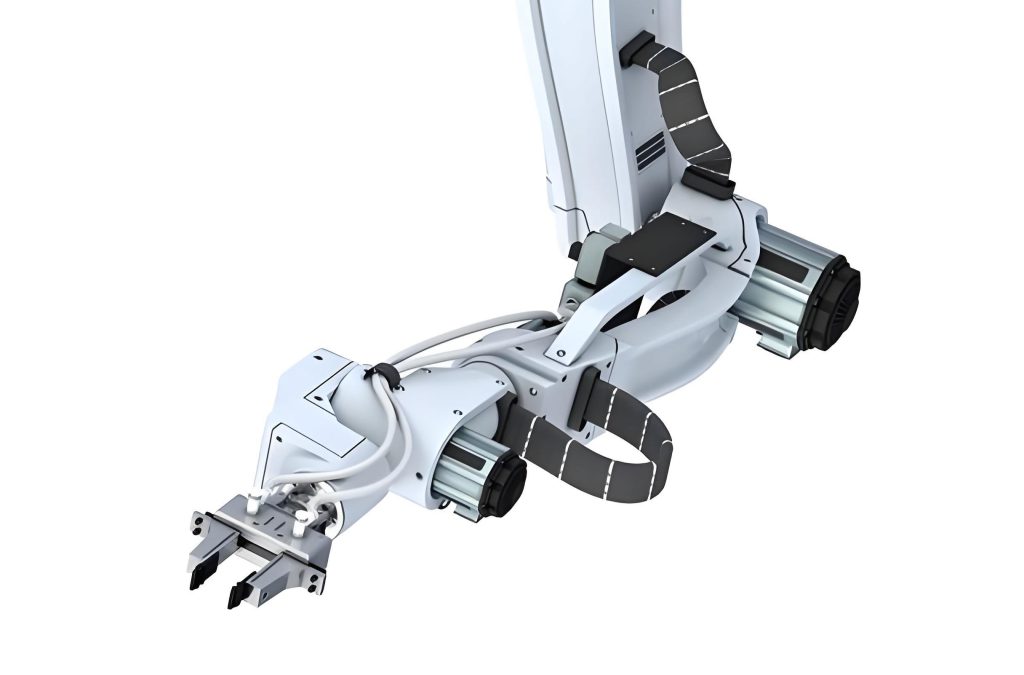
The reliable operation of electrified railway systems is critically dependent on the insulating performance of overhead contact line components. Insulators, serving as vital supports and electrical barriers, are prone to accumulating contaminants like dust and biological deposits when exposed to harsh outdoor environments. This contamination can severely degrade their insulating properties, potentially leading to flashovers and service disruptions. Traditional cleaning techniques, such as manual wiping or high-pressure water jets, are plagued by low efficiency, significant safety hazards for personnel, and substantial water consumption. Consequently, there is a pressing need for automated, efficient, and safe alternatives. This research focuses on the pivotal component of such an automation solution: the robotic end effector responsible for the physical cleaning action. The core contribution lies in establishing a complete development workflow—from modular structural design and multi-sensor fusion for perception to the implementation and validation of an adaptive control strategy—specifically tailored for the insulator cleaning task.
The operational principle of the complete system involves the end effector being mounted on an industrial robotic arm. The system initiates operation with the LiDAR scanning the environment to construct a model and locate the approximate position of target insulators. Subsequently, the robotic arm positions the end effector near the target, where the depth camera performs fine-grained 6D pose estimation. This information guides the final alignment and approach. The control architecture is distributed: a central industrial PC (IPC) handles high-level vision processing and task coordination, a PLC controls the robotic arm, and a dedicated microcontroller manages the end effector‘s motors. Communication across these subsystems is standardized using the CANopen protocol to ensure determinism and reliability. During the cleaning cycle, the IPC sends commands via CANopen to execute the cleaning sequence. The end effector‘s control system continuously monitors the brush motor’s current, using it as a proxy for the applied cleaning force, and dynamically adjusts the gripping action via a fuzzy-PID controller to prevent surface damage while ensuring effective cleaning.
Structural Design of the Robotic End Effector
Designing the end effector necessitates meeting stringent requirements: high cleaning efficiency, adaptability to diverse insulator shapes and installation angles, operational stability for prolonged use, and ease of maintenance. A modular design philosophy was adopted, decomposing the end effector into two primary subsystems: the Swing-Arm System and the Brush System. This modularity enhances serviceability and allows for potential future upgrades.
The Swing-Arm System is responsible for the enveloping and opening/closing motions that adapt the brush profile to the insulator. It consists of an upper arm assembly, a lower arm assembly, a lead screw, a nut, connecting links, and a dedicated opening/closing stepper motor. The stepper motor, selected for its high torque and precise positional control, drives the lead screw. The rotary motion of the screw is converted into linear motion of the nut, which in turn actuates the connecting links. These links drive the swing arms, causing them to pivot and thus open or close the brush assembly around the insulator. The mechanical advantage provided by the linkage ensures smooth motion and sufficient gripping force. The kinematic relationship for the arm opening angle $\theta$ based on the linear displacement $x$ of the nut can be derived from the geometry of the four-bar linkage mechanism. A simplified relation for a symmetric design is given by:
$$ \theta = 2 \cdot \arcsin\left(\frac{x}{2L}\right) $$
where $L$ is the effective length of the connecting link. The selection of an 86-series stepper motor ensures reliable actuation under varying load conditions encountered during the gripping of different-sized insulators.
The Brush System performs the actual scrubbing action. It incorporates brush wheels, a chain drive, transmission gears, a central sun gear, and a main rotary motor. The rotary motor drives the central sun gear, which transmits torque through a planetary gear arrangement and a chain to the individual brush wheels. A key design feature is the inclusion of one-way bearings within the gear train connected to the brush wheels. This allows the brush wheels to continue rotating by inertia after the motor stops, gradually decelerating due to friction rather than experiencing an abrupt halt that could cause mechanical shock. The brush wheels themselves are covered with high-density, soft, yet abrasive-resistant synthetic filaments to effectively remove contaminants without scratching the delicate glaze of ceramic insulators. The brush wheels are designed as quick-release modules for easy replacement. The power transmission efficiency $\eta$ of the chain and gear system can be estimated as:
$$ \eta = \eta_{gear}^n \cdot \eta_{chain} $$
where $\eta_{gear}$ is the efficiency of a single gear mesh, $n$ is the number of gear meshes, and $\eta_{chain}$ is the chain drive efficiency, typically above 95%. This ensures sufficient torque reaches the brush wheels.
Control Optimization Based on Fuzzy PID for the End Effector
The cleaning process imposes complex control challenges on the end effector. The interaction force between the brush and the insulator surface must be carefully regulated: too little force results in poor cleaning, while excessive force risks damaging the insulator. Furthermore, the load on the brush motor varies nonlinearly with surface contour and contamination level. Traditional fixed-gain PID controllers struggle with such nonlinearities and time-varying disturbances, often exhibiting slow response, significant overshoot, or steady-state error. To address this, a Fuzzy-PID control strategy is developed, leveraging real-time motor current feedback to form a closed-loop force control system. This strategy uniquely optimizes for the specific dynamics of the wiping process, where load fluctuations are frequent and precise force modulation is paramount.
Control Requirement Analysis and Variable Selection
The core insight for control is the strong correlation between the gripping/cleaning force and the load current of the brush motor. Experiments established that motor current $I$ increases monotonically with the applied normal force $F_n$ during wiping, as shown in Figure 4 (relationship plot). Therefore, the motor current serves as an effective, real-time measurable proxy for the cleaning force. The control objective is to maintain this current at a desired setpoint $I_{ref}$, which corresponds to an optimal cleaning force.
The Fuzzy-PID controller adjusts the parameters of a conventional PID controller ($K_P$, $K_I$, $K_D$) online based on the error $E$ and the change in error $EC$, defined as:
$$ E(k) = I_{ref} – I(k) $$
$$ EC(k) = E(k) – E(k-1) $$
where $k$ denotes the discrete time step. The output of the PID controller, which is the command signal (e.g., PWM duty cycle) to the gripping/brush motor, is:
$$ u(k) = K_P \cdot E(k) + K_I \cdot \sum_{j=0}^{k} E(j) + K_D \cdot EC(k) $$
The fuzzy inference system dynamically computes $K_P$, $K_I$, and $K_D$.
The input variables $E$ and $EC$ are normalized to the standard universe of discourse [-1, 1]. Seven linguistic terms are defined for each: Negative Big (NB), Negative Medium (NM), Negative Small (NS), Zero (ZO), Positive Small (PS), Positive Medium (PM), Positive Big (PB). Gaussian membership functions are chosen for the inputs for smooth transition:
$$ \mu_E(x) = e^{-\frac{(x-c)^2}{2\sigma^2}} $$
where $c$ is the center (mean) and $\sigma$ determines the width of the Gaussian curve. For the output variables ($K_P$, $K_I$, $K_D$), which are denormalized to their respective physical ranges (e.g., $K_P$ ∈ [-5, 5]), triangular membership functions are used for computational efficiency and clarity. The design of these membership functions is summarized in Table A.
| Variable | Type | Universe | Linguistic Terms | MF Type |
|---|---|---|---|---|
| Error (E) | Input | [-1, 1] | NB, NM, NS, ZO, PS, PM, PB | Gaussian |
| Error Change (EC) | Input | [-1, 1] | NB, NM, NS, ZO, PS, PM, PB | Gaussian |
| Proportional Gain (KP) | Output | [-5, 5] | NB, NM, NS, ZO, PS, PM, PB | Triangular |
| Integral Gain (KI) | Output | [-0.5, 0.5] | NB, NM, NS, ZO, PS, PM, PB | Triangular |
| Derivative Gain (KD) | Output | [-1.5, 1.5] | NB, NM, NS, ZO, PS, PM, PB | Triangular |
Fuzzy Rule Base Design
The fuzzy rule base encapsulates expert knowledge and empirical tuning data to map the state ($E$, $EC$) to appropriate adjustments in the PID gains. The rules are formulated in an IF-THEN format. For instance, a rule for $K_P$ might be: “IF $E$ is PB AND $EC$ is ZO, THEN $K_P$ is PB” (i.e., when error is large and not changing quickly, use a large proportional gain for a fast response). The complete rule base is structured as three separate 7×7 matrices for $K_P$, $K_I$, and $K_D$. The underlying logic is:
- When $|E|$ is large, increase $K_P$ to accelerate the system response.
- When $E$ persists (small $EC$ but non-zero $E$), increase $K_I$ to eliminate steady-state error.
- When $EC$ is large (error changing rapidly), increase $K_D$ to dampen oscillations and prevent overshoot.
The optimized rule tables derived from extensive simulation and testing are presented in Table 1.
| EC | E | ||||||
|---|---|---|---|---|---|---|---|
| NB | NM | NS | ZO | PS | PM | PB | |
| NB | PB/NB/PS | PB/NB/NS | PM/NM/NB | PM/NM/NB | PS/NS/NB | ZO/ZO/NM | ZO/ZO/PS |
| NM | PB/NB/PS | PB/NB/NS | PM/NM/NB | PS/NS/NM | PS/NS/NM | ZO/ZO/NS | NS/ZO/ZO |
| NS | PM/NB/ZO | PM/NM/NS | PM/NS/NM | PS/NS/NM | ZO/ZO/NS | NS/PS/NS | NS/PS/ZO |
| ZO | PM/NM/ZO | PM/NM/NS | PS/NS/NS | ZO/ZO/NS | NS/PS/NS | NM/PM/NS | NM/PM/ZO |
| PS | PS/NM/ZO | PS/NS/ZO | ZO/ZO/ZO | NS/PS/ZO | NS/PS/ZO | NM/PM/ZO | NM/PB/ZO |
| PM | PS/ZO/PB | ZO/ZO/NS | NS/PS/PS | NM/PS/PS | NM/PM/PS | NM/PB/PS | NB/PB/PB |
| PB | ZO/ZO/PB | ZO/ZO/PM | NM/PS/PM | NM/PM/PM | NM/PM/PS | NB/PB/PS | NB/PB/PB |
Each cell contains three terms corresponding to the recommended linguistic value for $K_P$, $K_I$, and $K_D$, respectively (e.g., PB/NB/PS means $K_P$=PB, $K_I$=NB, $K_D$=PS).
Modeling and System Simulation
The proposed control system was modeled and simulated in MATLAB/Simulink environment. A dynamic model of the end effector‘s motor-drive system was established, incorporating load torque variations representative of the wiping process. The Fuzzy Logic Designer toolbox was used to implement the fuzzy inference system. The performance of the Fuzzy-PID controller was compared against a conventional fixed-gain PID controller and a standard fuzzy controller under identical disturbance conditions. A step disturbance was introduced at t=1s to simulate a sudden change in surface friction or contamination level. The simulation results, depicted in Figure 8, clearly demonstrate the advantages of the Fuzzy-PID approach. It exhibits a faster rise time, significantly reduced overshoot, and a shorter settling time compared to the conventional PID. It also shows better disturbance rejection and smoother recovery than the standard fuzzy controller. The performance metrics are quantified in Table B.
| Control Method | Rise Time (s) | Overshoot (%) | Settling Time (s) | ISE (Integral Squared Error) |
|---|---|---|---|---|
| Conventional PID | 0.25 | 22.5 | 1.10 | 0.89 |
| Standard Fuzzy | 0.18 | 8.7 | 0.65 | 0.45 |
| Fuzzy-PID (Proposed) | 0.15 | 3.2 | 0.40 | 0.28 |
The Integral Squared Error (ISE), calculated as $\sum E(k)^2$, is minimized by the proposed Fuzzy-PID controller, indicating superior tracking performance and robustness.
Experiments and Results Analysis
A functional prototype of the insulator cleaning robot’s end effector was constructed based on the aforementioned design. The control hardware centered on an STM32F407 microcontroller managing the end effector motors, communicating with the host IPC via CANopen. Laboratory tests were conducted on contaminated ceramic insulators. A measured amount of standardized dust (kaolin clay and salt mixture) was applied to the insulator surface to simulate real-world pollution. The robot system executed the complete operation: perception, approach, and cleaning using the fuzzy-PID controlled end effector. Visual inspection before and after cleaning (see Figure 10) confirmed the effective removal of surface contaminants.
To quantitatively assess cleaning performance, the Equivalent Salt Deposit Density (ESDD) was measured before and after the robotic cleaning process. ESDD is a standard metric (mg/cm²) for evaluating the severity of pollution on insulators. The test samples had an initial ESDD of 0.352 mg/cm², classified as “Extremely Heavy” pollution (Grade E). After cleaning with the robotic end effector, the ESDD was measured repeatedly over multiple trials. The results, presented in Table 2, show that the end effector consistently reduced the ESDD to levels corresponding to “Light” pollution (Grade A), with a cleaning efficiency exceeding 86% in every trial. Cleaning efficiency $\eta_c$ is calculated as:
$$ \eta_c = \left(1 – \frac{ESDD_{after}}{ESDD_{before}}\right) \times 100\% $$
| Cleaning Cycle | ESDD After (mg/cm²) | Cleaning Efficiency $\eta_c$ (%) | Final Pollution Grade |
|---|---|---|---|
| 1 | 0.0476 | 86.5 | A (Light) |
| 2 | 0.0448 | 87.3 | A (Light) |
| 3 | 0.0365 | 89.6 | A (Light) |
| 4 | 0.0407 | 88.4 | A (Light) |
| 5 | 0.0484 | 86.2 | A (Light) |
The high and consistent cleaning efficiency, coupled with the system’s adaptive force control, validates the practical effectiveness and reliability of the designed end effector and its control system.
Conclusion
This paper has presented a systematic development of a novel robotic end effector for automated contact line insulator cleaning. The solution emphasizes holistic engineering integration, addressing key limitations of prior research through a cohesive workflow spanning modular mechanical design, multi-sensor perception, intelligent control optimization, and experimental validation. The modular end effector design demonstrates excellent adaptability to various insulator geometries. The integration of LiDAR and depth vision enables precise target acquisition. Most importantly, the implementation of a Fuzzy-PID control strategy, utilizing real-time motor current feedback, provides the end effector with responsive, stable, and force-sensitive cleaning action, effectively balancing cleaning efficacy with surface protection. Simulation and physical testing confirm the system’s superior performance in response speed, precision, and cleaning outcomes. The proposed end effector system offers a robust, efficient, and safe alternative to traditional cleaning methods, showing significant potential for real-world deployment in railway and power grid maintenance. Future work may focus on further lightweighting the end effector structure, enhancing the intelligence of the perception system for more complex environments, and exploring fully autonomous operational workflows.