
As a researcher in mechanical engineering, I have always been fascinated by the precision and efficiency of gear transmission systems, particularly the rotary vector reducer. This device, often abbreviated as RV reducer, represents a significant advancement in power transmission technology, combining the principles of cycloidal pin gear and planetary gear mechanisms. In this article, I will delve into the structural analysis and three-dimensional modeling design of the rotary vector reducer, providing insights into its传动原理, key components, and digital fabrication processes. The rotary vector reducer is widely used in industrial robots, machine tools, and medical equipment due to its compact size, high torque capacity, and excellent shock resistance. Through this exploration, I aim to offer a comprehensive guide for engineers and designers working with rotary vector reducers, emphasizing the importance of accurate modeling for performance optimization.
The rotary vector reducer operates on a two-stage transmission principle, which I will explain in detail. The first stage involves a planetary gear system, while the second stage utilizes a cycloidal pin gear mechanism. This combination allows the rotary vector reducer to achieve high reduction ratios with minimal backlash. To understand the传动比, let’s consider the kinematic analysis. In the first stage, the input shaft drives a central sun gear, which engages with multiple planetary gears evenly distributed around it. Applying a reversal speed equal to the output carrier’s rotation, we can derive the transmission ratio for this stage. For a rotary vector reducer with a sun gear of $$z_1$$ teeth and planetary gears of $$z_2$$ teeth, the ratio is given by:
$$ i_{6}^{12} = \frac{n_1 – n_6}{n_2 – n_6} = -\frac{z_2}{z_1} $$
where $$n_1$$ is the sun gear speed, $$n_2$$ is the planetary gear speed, and $$n_6$$ is the output carrier speed. The negative sign indicates opposite rotation directions. In the second stage, the cycloidal gears interact with fixed pins on the housing, and the摆线轮’s motion involves both revolution and rotation. By applying a reversal speed equal to the planetary gear speed, we can analyze this as a fixed-axis transmission. For a rotary vector reducer with a cycloidal gear of $$z_4$$ teeth and a pin gear of $$z_7$$ teeth (where typically $$z_4 = z_7 – 1$$), the ratio is:
$$ i_{6}^{47} = \frac{n_4 – n_2}{n_7 – n_2} = -\frac{z_7}{z_4} $$
Given that the pin housing is stationary ($$n_7 = 0$$), and the cycloidal gear speed equals the output speed ($$n_4 = n_6$$), we can combine these equations to obtain the overall transmission ratio of the rotary vector reducer:
$$ i_{16} = \frac{n_1}{n_6} = 1 + \frac{z_2}{z_1} \cdot z_7 $$
This formula highlights the high reduction capability of the rotary vector reducer, often exceeding 100:1 in practical applications. To summarize the传动原理, I have included a table below that outlines key parameters and their effects on the rotary vector reducer’s performance.
| Parameter | Symbol | Typical Value | Impact on Transmission |
|---|---|---|---|
| Sun Gear Teeth | $$z_1$$ | 10-30 | Influences first-stage ratio and size |
| Planetary Gear Teeth | $$z_2$$ | 20-50 | Affects torque distribution |
| Pin Gear Teeth | $$z_7$$ | 40-100 | Determines overall reduction ratio |
| Cycloidal Gear Teeth | $$z_4$$ | $$z_7 – 1$$ | Ensures smooth engagement |
| Eccentricity | $$a$$ | 1-5 mm | Affects cycloidal profile and load capacity |
Moving on to the structural components, the rotary vector reducer consists of several critical parts that must be precisely designed and manufactured. The central sun gear and planetary gears are typically involute gears, which can be modeled as gear shafts or connected via splines. In the rotary vector reducer, two or three planetary gears are used to balance radial forces. The cycloidal gear, also known as the RV gear, is the heart of the device; its tooth profile accuracy directly impacts the contact conditions and efficiency. The parametric equations for the standard cycloidal gear profile in a rotary vector reducer are essential for modeling. Based on the reference, these equations are:
$$ X = \left( r_p – r_{rp} s^{-\frac{1}{2}} \right) \cos\left[ (1 – i^H) \varphi \right] – \frac{a}{r_p} \left( r_p – z_p r_{rp} s^{-\frac{1}{2}} \right) \cos(i^H \varphi) $$
$$ Y = \left( r_p – r_{rp} s^{-\frac{1}{2}} \right) \sin\left[ (1 – i^H) \varphi \right] – \frac{a}{r_p} \left( r_p – z_p r_{rp} s^{-\frac{1}{2}} \right) \sin(i^H \varphi) $$
$$ s = 1 + k^2 – 2k \cos \varphi $$
where $$r_p$$ is the pin center circle radius, $$r_{rp}$$ is the pin radius, $$i^H = \frac{z_p}{z_c}$$ is the relative transmission ratio between the cycloidal gear and pin gear, $$a$$ is the eccentricity, $$\varphi$$ is the meshing phase angle, and $$k = \frac{a z_p}{r_p}$$ is the shortening coefficient. These equations allow for the parametric modeling of the cycloidal gear in a rotary vector reducer. Another key component is the crankshaft, which connects the planetary gears to the cycloidal gears. It has eccentric sections that enable the cycloidal gears to undergo both revolution and rotation. The crankshaft’s design ensures load distribution and minimizes vibration in the rotary vector reducer.
To better visualize the assembly of a rotary vector reducer, I have inserted an image below that illustrates its internal structure. This diagram helps in understanding the spatial arrangement of components, which is crucial for three-dimensional modeling.
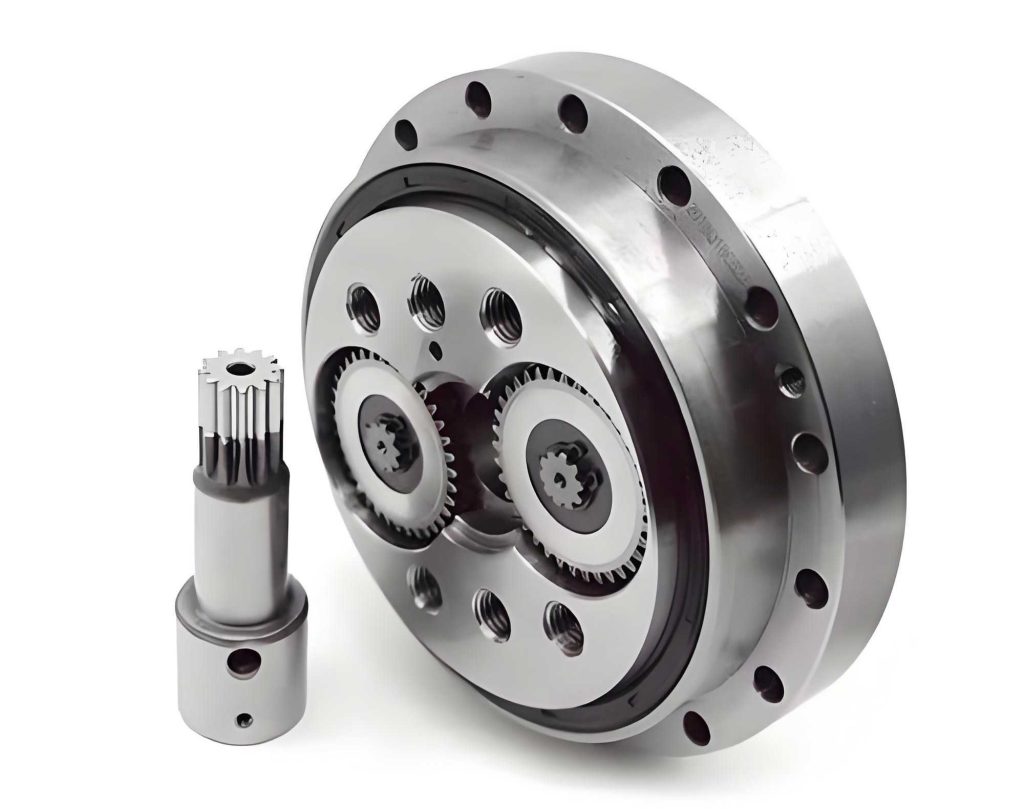
In three-dimensional modeling, I utilize CAD software such as SolidWorks to create digital prototypes of the rotary vector reducer. The process begins with parametric modeling of key parts. For gears, I define basic parameters like module, number of teeth, pressure angle, and width. Using the齿廓参数 equations, I generate tooth profiles programmatically. For instance, the involute gear profile can be derived from the following parametric equations:
$$ x = r_b (\cos \theta + \theta \sin \theta) $$
$$ y = r_b (\sin \theta – \theta \cos \theta) $$
where $$r_b$$ is the base radius and $$\theta$$ is the involute angle. For the cycloidal gear in the rotary vector reducer, I implement the equations mentioned earlier to create a precise profile. This involves generating points along the curve and using splines to form the齿廓. Once the profiles are ready, I extrude them to create solid models. The crankshaft is modeled using simple sketches and revolves, given its symmetrical design. To ensure accuracy, I often create a table of design parameters for the rotary vector reducer, as shown below.
| Component | Design Parameter | Value Range | Modeling Technique |
|---|---|---|---|
| Sun Gear | Module (m) | 1-3 mm | Parametric sketch with involute curve |
| Planetary Gear | Number of Teeth (z) | 20-40 | Array pattern after single tooth creation |
| Cycloidal Gear | Eccentricity (a) | 1-5 mm | Equation-driven curve based on cycloidal equations |
| Crankshaft | Eccentric Offset | Equal to a | Offset extrude and revolve features |
| Pin Housing | Pin Diameter | 2-10 mm | Circular pattern on a pitch circle |
The assembly of the rotary vector reducer is a step-by-step process that I approach using a bottom-up design methodology. First, I create sub-assemblies for major components. For example, the pin housing sub-assembly involves importing the housing model and then adding pin models with coaxial and coincident constraints. Similarly, the crankshaft sub-assembly includes bearings fitted onto the eccentric sections. I typically use three crankshafts in a rotary vector reducer, each with four bearings to support the cycloidal gears and output carrier. The input and output sub-assemblies consist of flanges, seals, and bearings, all constrained through concentric and face alignments. Finally, I combine all sub-assemblies into a main assembly, ensuring proper meshing between gears and pins. During this process, I frequently check for干涉 and collisions, making adjustments to the models as needed. This digital assembly allows for virtual testing of the rotary vector reducer’s kinematics and dynamics before physical prototyping.
To further elaborate on the modeling细节, I focus on the cycloidal gear’s齿廓 generation. Using the parametric equations, I define a set of variables in the CAD software and create a curve through equation-driven design. For a rotary vector reducer with $$z_p = 40$$ and $$z_c = 39$$, the摆线轮 profile can be plotted by varying $$\varphi$$ from 0 to $$2\pi$$. The resulting curve is then mirrored and patterned to form the complete tooth set. After extrusion, I add features like bolt holes and bearing seats based on standard dimensions. For the pin housing, I create a circular pattern of pins on a pitch circle of radius $$r_p$$, ensuring that the pin count matches $$z_p$$. This attention to detail is crucial for the rotary vector reducer’s performance, as even minor deviations can lead to increased transmission error.
In terms of传动误差 analysis, the three-dimensional model of the rotary vector reducer enables finite element simulations to assess contact stresses and deformations. I often run static and dynamic analyses to evaluate the load distribution among components. For instance, the contact between the cycloidal gear and pins in a rotary vector reducer can be modeled using nonlinear contact algorithms. The results help in optimizing tooth profiles and material selection. Additionally, I use the model to calculate the transmission error under different loading conditions, which is vital for precision applications like robotics. The transmission error $$\Delta \theta$$ for a rotary vector reducer can be expressed as:
$$ \Delta \theta = \theta_{input} – \frac{\theta_{output}}{i_{16}} $$
where $$\theta_{input}$$ and $$\theta_{output}$$ are the actual rotation angles. By minimizing this error through design iterations, I can enhance the rotary vector reducer’s accuracy.
The advantages of using three-dimensional modeling for the rotary vector reducer extend beyond design validation. It facilitates rapid prototyping through 3D printing, allowing for physical testing of assembly fits and function. I have employed fused deposition modeling (FDM) to create scaled models of rotary vector reducer components, which aids in educational and prototyping purposes. Moreover, the digital model serves as a basis for manufacturing drawings and CNC programming, streamlining the production process for rotary vector reducers.
In conclusion, the rotary vector reducer is a complex yet highly efficient transmission device that requires meticulous design and modeling. Through this article, I have shared my insights into its传动原理, structural components, and three-dimensional modeling techniques. The use of parametric equations and CAD software enables accurate digital representations, which are indispensable for performance analysis and manufacturing. As technology advances, the rotary vector reducer will continue to evolve, with improvements in materials, lubrication, and precision. I hope that this comprehensive discussion will aid engineers in developing more reliable and efficient rotary vector reducers for various industrial applications. Future work may involve integrating smart sensors into the rotary vector reducer for real-time monitoring, further pushing the boundaries of mechanical transmission systems.