
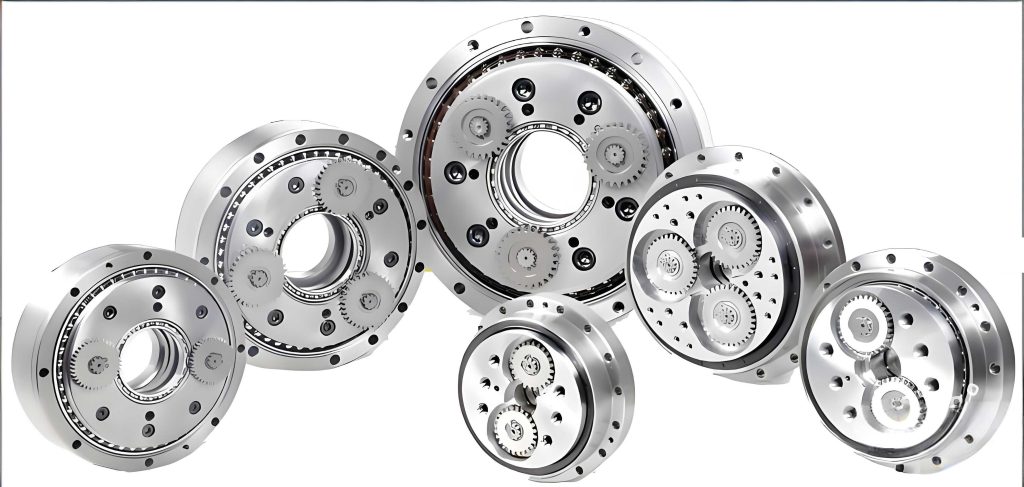
In modern industrial automation, particularly in robotic applications, the rotary vector reducer plays a critical role due to its high precision, compact structure, and excellent load-bearing capacity. As a core component, the main bearing within the rotary vector reducer operates under challenging conditions characterized by low-speed and heavy-load scenarios, often involving frequent start-stop cycles and variable loading. Understanding the dynamic behavior of these bearings under such typical service conditions is essential for enhancing performance, reliability, and lifespan. This article aims to explore the dynamic response characteristics of main bearings in rotary vector reducers through a combination of theoretical modeling, simulation analysis, and experimental validation. The focus is on how radial loads and rotational speeds influence radial and axial displacements, providing insights for optimizing bearing design and testing protocols. The term “rotary vector reducer” will be frequently referenced throughout to emphasize its central role in this analysis.
The service conditions for main bearings in rotary vector reducers are typically defined by segmented functions representing radial loads, axial loads, and rotational speeds over time. These conditions mimic real-world operational cycles, such as acceleration, steady-state operation, and deceleration phases. The radial load \( F_r \) can be expressed as:
$$ F_r(t) = \begin{cases}
k_1 t & 0 \leq t < t_0 \\
a_{10} & t_0 \leq t < t_3 \\
-k_1 t + a_{11} & t_3 \leq t < t_4 \\
0 & \text{otherwise}
\end{cases} $$
where \( k_1 \) is the rate of load change, \( a_{10} \) and \( a_{11} \) are constants related to stable radial loads, and \( t_0 \), \( t_3 \), \( t_4 \) represent specific time points. Similarly, the axial load \( F_a \) and inner ring angular speed \( \omega \) are defined with analogous piecewise functions. For instance, the angular speed is given by:
$$ \omega(t) = \begin{cases}
k_3 t – a_{30} & t_0 \leq t < t_1 \\
a_{31} & t_1 \leq t < t_2 \\
-k_3 t + a_{32} & t_2 \leq t < t_3
\end{cases} $$
Here, \( a_{31} \) denotes the steady-state rotational speed during stable operation. These functions capture the transient and steady-state phases typical of rotary vector reducer applications. A summary of key time points and parameters is provided in Table 1 to clarify the service profile.
| Parameter | Description | Typical Value/Range |
|---|---|---|
| \( t_0 \) | End of load increase phase | 0.3 s |
| \( t_1 \) | End of acceleration phase | 0.8 s |
| \( t_2 \) | Start of deceleration phase | 3.8 s |
| \( t_3 \) | End of load decrease phase | 4.3 s |
| \( t_4 \) | End of cycle | 4.6 s |
| \( a_{10} \) | Stable radial load | 30 kN (example) |
| \( a_{31} \) | Stable angular speed | 120 to 660 °/s |
To analyze the dynamic characteristics, a multi-body dynamics model of the main bearing for the rotary vector reducer is developed. The bearing typically features a thin-walled structure with multiple balls, made from bearing steel GCr15. Key material properties and structural parameters are listed in Table 2, which are essential for accurate modeling.
| Parameter | Value |
|---|---|
| Inner Diameter (mm) | 320 |
| Outer Diameter (mm) | 383 |
| Width (mm) | 30 |
| Number of Balls | 51 |
| Ball Diameter (mm) | 23 |
| Cage Inner Diameter (mm) | 354.5 |
| Cage Outer Diameter (mm) | 366 |
| Material Density (kg/m³) | 7800 |
| Elastic Modulus (GPa) | 208 |
| Poisson’s Ratio | 0.3 |
The dynamics model incorporates Hertzian contact theory to simulate interactions between balls and raceways. The normal contact force \( F_{\text{impact}} \) is calculated using a nonlinear spring-damper model with an impact function:
$$ F_{\text{impact}} = \begin{cases}
0 & q > q_0 \\
K (q_0 – q)^e – c \cdot \frac{dq}{dt} & q \leq q_0
\end{cases} $$
where \( K \) is the equivalent contact stiffness, \( q \) is the actual distance after contact, \( q_0 \) is the initial contact distance, \( e \) is the force exponent (set to 1.5 for point contact), and \( c \) is the damping coefficient. The friction between components is modeled using Coulomb friction, with a coefficient that transitions from static to dynamic states. The friction coefficient \( \mu \) is defined as:
$$ \mu = \begin{cases}
-\mu_d \cdot \text{sign}(v) & |v| > v_d \\
-\text{step}(|v|, v_d, \mu_d, v_s, \mu_s) \cdot \text{sign}(v) & v_s \leq |v| \leq v_d \\
-\text{step}(|v|, v_s, \mu_s, 0, \mu_s) & |v| < v_s
\end{cases} $$
with \( \mu_s = 0.1 \), \( v_s = 100 \, \text{mm/s} \), \( \mu_d = 0.02 \), and \( v_d = 1000 \, \text{mm/s} \). This model captures the transient friction effects during start-stop cycles, which are common in rotary vector reducer operations. In the simulation, the outer ring is fixed, while the inner ring is subjected to radial and axial loads along with rotational motion. The dynamic equations are solved to compute displacements and vibrations over time.
To validate the dynamics model, experimental tests were conducted on a dedicated test rig for rotary vector reducer main bearings. Radial and axial displacements of the inner ring were measured using laser displacement sensors under controlled loads and speeds, such as a radial load of 30 kN and an angular speed of 660 °/s. The comparison between simulation results and experimental data showed good agreement, confirming the model’s accuracy. For instance, the radial displacement during stable operation aligned within 5% error, while axial displacement trends matched closely. This validation ensures that the model can reliably predict dynamic behaviors under various service conditions for the rotary vector reducer.
The dynamic response characteristics are analyzed by varying radial loads and inner ring angular speeds. Key metrics include radial displacement \( \delta_r \) and axial displacement \( \delta_a \) of the inner ring. First, the effect of angular speed is examined with a constant radial load of 30 kN and axial load of 10 kN. The angular speed is varied from 120 °/s to 660 °/s. During start-up and deceleration phases, the radial displacement variation range \( \Delta \delta_r \) increases linearly with angular acceleration. This relationship can be fitted as:
$$ \Delta \delta_r = \alpha \cdot \omega + \beta $$
where \( \alpha \) and \( \beta \) are constants derived from simulation data. For example, during start-up, \( \Delta \delta_r \approx 2.5 \times 10^{-5} \omega + 0.032 \, \text{mm} \). Similarly, the axial displacement variation range \( \Delta \delta_a \) also increases linearly with angular acceleration, expressed as \( \Delta \delta_a \approx 1.85 \times 10^{-5} \omega + 0.048 \, \text{mm} \). During steady-state operation, the mean radial displacement decreases linearly with angular speed, while the mean axial displacement increases linearly. These trends are summarized in Table 3 using linear fit equations.
| Phase | Displacement Type | Linear Fit Equation (mm vs. °/s) | Remarks |
|---|---|---|---|
| Start-up | Radial Variation Range | \( \Delta \delta_r = 2.5 \times 10^{-5} \omega + 0.032 \) | Increases with acceleration |
| Deceleration | Radial Variation Range | \( \Delta \delta_r = 6.0 \times 10^{-5} \omega + 0.004 \) | Increases with deceleration |
| Steady-State | Mean Radial Displacement | \( \bar{\delta}_r = -5.0 \times 10^{-5} \omega + 0.056 \) | Decreases with speed |
| Start-up | Axial Variation Range | \( \Delta \delta_a = 1.85 \times 10^{-5} \omega + 0.048 \) | Increases with acceleration |
| Deceleration | Axial Variation Range | \( \Delta \delta_a = 1.9 \times 10^{-6} \omega + 0.026 \) | Increases with deceleration |
| Steady-State | Mean Axial Displacement | \( \bar{\delta}_a = 7.9 \times 10^{-6} \omega + 1.996 \) | Increases with speed |
Next, the effect of radial load is analyzed with a constant angular speed of 120 °/s. Radial loads range from 20 kN to 40 kN. During start-up and deceleration, the radial displacement variation range increases linearly with radial load, while the axial displacement variation range decreases linearly. This inverse relationship for axial displacement is due to increased contact deformations limiting axial vibrations. During steady-state operation, both mean radial and axial displacements increase linearly with radial load. The linear fit equations are presented in Table 4, highlighting how load magnitudes influence displacements in the rotary vector reducer main bearing.
| Phase | Displacement Type | Linear Fit Equation (mm vs. N) | Remarks |
|---|---|---|---|
| Start-up | Radial Variation Range | \( \Delta \delta_r = 8.0 \times 10^{-7} F_r + 0.03 \) | Increases with load |
| Deceleration | Radial Variation Range | \( \Delta \delta_r = 2.2 \times 10^{-7} F_r + 0.02 \) | Increases with load |
| Steady-State | Mean Radial Displacement | \( \bar{\delta}_r = 2.0 \times 10^{-6} F_r + 0.025 \) | Increases with load |
| Start-up | Axial Variation Range | \( \Delta \delta_a = -9.0 \times 10^{-7} F_r + 0.06 \) | Decreases with load |
| Deceleration | Axial Variation Range | \( \Delta \delta_a = -3.0 \times 10^{-7} F_r + 0.038 \) | Decreases with load |
| Steady-State | Mean Axial Displacement | \( \bar{\delta}_a = 1.0 \times 10^{-6} F_r + 1.98 \) | Increases with load |
The underlying mechanisms for these trends relate to centrifugal forces and contact dynamics. In a rotary vector reducer, higher angular speeds increase centrifugal effects, leading to greater ball-raceway contact loads and deformations. This reduces radial clearance during steady operation, hence the decrease in mean radial displacement. Conversely, axial displacements grow due to enhanced axial force components from skewed contact angles. During transient phases, acceleration amplifies inertial forces, causing larger displacement oscillations. Radial loads directly affect contact pressures; higher loads increase deformations, raising mean displacements but constraining axial vibrations due to geometric constraints. These interactions are critical for designing robust main bearings in rotary vector reducers, as they impact vibration, noise, and fatigue life.
To further quantify these effects, consider the general dynamic equations governing the bearing system. The equation of motion for the inner ring can be expressed as:
$$ m \ddot{\delta} + c \dot{\delta} + k \delta = F_{\text{ext}} $$
where \( m \) is the effective mass, \( c \) is damping, \( k \) is stiffness, \( \delta \) is displacement, and \( F_{\text{ext}} \) represents external loads from the rotary vector reducer operation. The stiffness \( k \) varies with load and speed due to nonlinear contact mechanics, approximated by Hertzian theory as \( k \propto \delta^{1/2} \) for point contacts. This nonlinearity explains why displacement responses are not purely linear but can be approximated linearly over limited ranges, as shown in the fits. Additionally, the centrifugal force \( F_c \) on a ball is given by:
$$ F_c = \frac{1}{2} m_b \omega^2 r $$
where \( m_b \) is the ball mass and \( r \) is the pitch radius. This force alters contact angles and loads, influencing displacements. For the rotary vector reducer, these dynamics are exacerbated under low-speed, heavy-load conditions, where lubrication films may be thin, increasing friction and wear risks.
In practical terms, the findings suggest that for main bearings in rotary vector reducers, operational strategies should consider minimizing sudden acceleration/deceleration to reduce displacement variations, which can mitigate vibration and prolong bearing life. For instance, implementing smoother speed profiles in robotic joints could enhance performance. Moreover, bearing design could optimize preload and clearance to balance radial and axial stiffness under expected loads. The linear relationships provide a simplified tool for predicting displacements during testing or simulation, aiding in the development of standardized load spectra for rotary vector reducer bearing evaluations.
In conclusion, the dynamic characteristics of main bearings in rotary vector reducers under typical low-speed, heavy-load service conditions are significantly influenced by radial loads and rotational speeds. Through detailed dynamics modeling and experimental validation, this analysis reveals that: (1) During start-up and deceleration phases, radial and axial displacement variation ranges increase linearly with angular acceleration, while axial variation decreases with radial load; angular acceleration has a more pronounced effect than radial load. (2) During steady-state operation, mean radial displacement decreases linearly with angular speed but increases with radial load, whereas mean axial displacement increases linearly with both speed and load, with speed being a more dominant factor. (3) Lower speeds can help avoid excessive vibrations during abrupt start-stop cycles in rotary vector reducers. These insights contribute to better understanding and optimization of rotary vector reducer systems, ensuring reliability and efficiency in demanding industrial applications. Future work could explore temperature effects, lubrication conditions, and more complex multi-axis loading scenarios to further refine the dynamics of rotary vector reducer bearings.