
In the field of industrial robotics, the rotary vector reducer stands as a critical component, enabling precise motion control and high torque transmission. As a researcher focused on mechanical design and fault diagnosis, I have undertaken a detailed finite element analysis to investigate the mechanical behavior of key parts under operational loads. This study aims to provide insights into the stress distribution, deformation, and dynamic characteristics of a rotary vector reducer, specifically the RV-40E model, which is widely used in robotic applications. Through this analysis, we seek to establish a theoretical foundation for optimizing the design and enhancing the reliability of rotary vector reducers, thereby contributing to advancements in robotic systems. The importance of such reducers cannot be overstated, as they directly impact the accuracy and efficiency of industrial robots, making their analysis a priority in engineering research.
The rotary vector reducer, often abbreviated as RV reducer, is a type of precision gear reducer known for its compact size, high reduction ratio, and excellent torsional rigidity. Its complex structure includes multiple interacting components, such as input shafts, planetary gears, cycloid wheels, and pin gears, all of which must withstand significant loads during operation. In this work, we utilize finite element analysis (FEA) to simulate the static and modal responses of the input end and cycloid wheel of a rotary vector reducer. By employing UG software for modeling and simulation, we can accurately predict stress concentrations, strain patterns, and natural frequencies, which are essential for identifying potential failure points and improving design robustness. This approach aligns with current trends in mechanical engineering, where computational tools are increasingly used to complement experimental studies, especially for intricate systems like the rotary vector reducer.
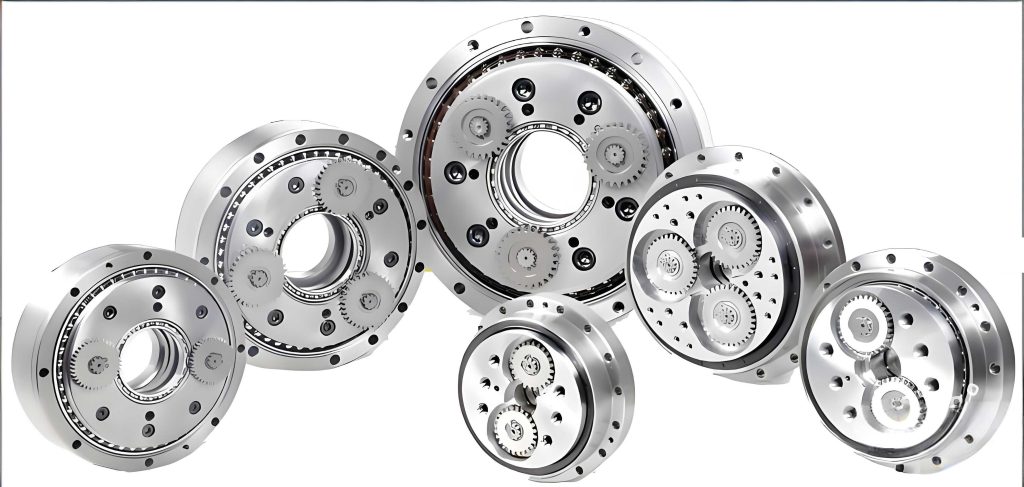
Before delving into the analysis, it is essential to understand the transmission principle of the rotary vector reducer. The RV-40E model operates based on a two-stage reduction mechanism: the first stage involves a planetary gear system where the input shaft drives planetary gears, and the second stage utilizes a cycloid-pin gear system to achieve high reduction ratios. This dual-stage design allows the rotary vector reducer to deliver high torque output while maintaining a compact form factor, making it ideal for robotic joints. In our study, we focus on the input end, which includes the input shaft and planetary gears, as well as the cycloid wheel, as these components experience complex loading conditions during transmission. The interaction between these parts in a rotary vector reducer necessitates detailed analysis to ensure optimal performance and longevity.
For the finite element analysis, we define key parameters to set up the simulation environment. The material selected for all components is 20CrMo, a low-alloy steel commonly used in gear manufacturing due to its high strength and wear resistance. The material properties are summarized in Table 1, which includes density, Poisson’s ratio, elastic modulus, and shear modulus. These properties are crucial for accurate FEA, as they influence stress-strain relationships and dynamic responses. In our model, we assume the material to be isotropic, homogeneous, and continuous, neglecting effects like friction in gear meshing to simplify the analysis while maintaining relevance for the rotary vector reducer’s operational conditions.
| Property | Value | Unit |
|---|---|---|
| Density | 7.9 | g/cm³ |
| Poisson’s Ratio | 0.3 | Dimensionless |
| Elastic Modulus | 206 | GPa |
| Shear Modulus | 79.23 | GPa |
Constraints and boundary conditions are applied to mimic real-world operating scenarios of the rotary vector reducer. For the input shaft, we impose a pin joint constraint that allows only axial rotation, restricting other degrees of freedom. This simulates the shaft’s connection to a drive motor in a robotic system. The planetary gears are fixed at their inner spline interfaces with the crankshafts, as shown in the model setup, to represent their engagement within the rotary vector reducer. Contact conditions between meshing gears are defined using surface-to-surface contact elements with a default penetration tolerance of 0.2 mm, ensuring realistic interaction forces. For the cycloid wheel, a fixed constraint is applied at the center hole to represent its mounting, and a torque is applied at the crankshaft holes to simulate loading from the input stage of the rotary vector reducer.
Loads are applied based on the operational parameters of the rotary vector reducer. The RV-40E model has a rated power of 5 kW and an allowable torque of 40,000 N·m, with an output speed range of 75 rpm. We select three load cases within this range to perform comparative analysis, as varying loads can reveal different stress patterns and help validate the consistency of our results. The input torque is calculated using the power-torque relationship formula:
$$ T = \frac{9550 \times P}{n_{\text{input}}} $$
where \( T \) is the torque in N·mm, \( P \) is the power in kW, and \( n_{\text{input}} \) is the input speed in rpm. Given a transmission ratio \( i = 105 \) for the rotary vector reducer, the input speed is derived from the output speed \( n_{\text{output}} \) as \( n_{\text{input}} = i \times n_{\text{output}} \). The calculated torques for different load cases are presented in Table 2, providing a basis for our static analysis of the rotary vector reducer components.
| Power (kW) | Output Speed (rpm) | Input Torque (N·mm) |
|---|---|---|
| 0.6 | 10 | 5,457 |
| 0.8 | 15 | 4,851 |
| 1.0 | 20 | 4,548 |
Moving to the finite element analysis of the input end, we simulate the input shaft and planetary gears under the three torque loads. Using UG software, we perform static structural solutions to obtain stress, strain, and displacement distributions. The Von Mises stress criterion is employed to assess the equivalent stress, as it is suitable for ductile materials like 20CrMo in the rotary vector reducer. The results are visualized through contour plots, but for clarity, we summarize the maximum values in Table 3. From this data, we observe that stress and strain increase proportionally with torque, indicating linear elastic behavior within the operating range of the rotary vector reducer. The maximum stress occurs at the meshing region between the input shaft gear and the planetary gear, which is a critical contact zone in the rotary vector reducer’s transmission path.
| Input Torque (N·mm) | Stress (MPa) | Strain (μm) | Axial Displacement (μm) | Horizontal Displacement (mm) |
|---|---|---|---|---|
| 5,457 | 168.87 | 0.7105 | 0.2232 | 0.084 |
| 4,851 | 149.78 | 0.6301 | 0.2058 | 0.083 |
| 4,548 | 139.50 | 0.5869 | 0.2024 | 0.083 |
The stress values are well below the yield strength of 20CrMo, which is approximately 685 MPa, confirming that the input end of the rotary vector reducer operates within safe limits under these loads. This is crucial for ensuring the longevity and reliability of the rotary vector reducer in robotic applications. The strain and displacement patterns further reveal that deformation is localized at the gear teeth, with minimal effect on overall geometry, highlighting the robustness of the rotary vector reducer design. However, we note that horizontal displacement remains relatively constant across load cases, suggesting that certain constraints may dominate this direction in the rotary vector reducer assembly.
To deepen our understanding, we derive the stress-strain relationship using Hooke’s law for linear elasticity:
$$ \sigma = E \cdot \epsilon $$
where \( \sigma \) is stress, \( E \) is elastic modulus, and \( \epsilon \) is strain. For the maximum stress case of 168.87 MPa, the corresponding strain is 0.7105 μm, which aligns with the material properties. This consistency validates our FEA setup for the rotary vector reducer. Additionally, we calculate the safety factor \( n \) using the formula:
$$ n = \frac{\sigma_y}{\sigma_{\text{max}}} $$
where \( \sigma_y \) is the yield strength. For the rotary vector reducer input end, \( n \approx \frac{685}{168.87} \approx 4.06 \), indicating a high margin of safety, which is desirable for dynamic applications like robotics where load fluctuations occur.
Next, we focus on the cycloid wheel, another vital component of the rotary vector reducer. Its unique design, involving interaction with pin gears and crankshafts, subjects it to complex multi-axial loading. We perform static analysis by applying a torque of 5,457 N·mm at the crankshaft holes and fixing the center hole, as described earlier. The results show that maximum stress and strain concentrate at the center hole and crankshaft holes, with additional stress uniformly distributed at the root of the pin gear teeth on the cycloid wheel’s periphery. This pattern is expected due to the load transfer mechanisms in a rotary vector reducer. The displacement distribution indicates that the outer edges of the cycloid wheel experience the largest deformations, symmetrically aligned with the loading direction, which may influence the rotary vector reducer’s backlash and precision over time.
For the cycloid wheel, we also conduct modal analysis to determine its natural frequencies and mode shapes. This is essential for assessing dynamic performance and avoiding resonance in the rotary vector reducer during operation. We use the Lanczos method in UG to extract the first six modes, with constraints applied to simulate the cycloid wheel’s mounting in the rotary vector reducer. The results are summarized in Table 4, which lists natural frequencies and corresponding mode shapes. These modes include swinging, bending, twisting, and rotational motions, each representing a potential vibration pattern that could affect the rotary vector reducer’s stability if excited by operational frequencies.
| Mode Number | Natural Frequency (Hz) | Mode Shape Description |
|---|---|---|
| 1 | 2,082.826 | Swinging in the horizontal direction |
| 2 | 2,274.996 | Bending in the vertical direction |
| 3 | 2,493.692 | Rotating in the vertical direction |
| 4 | 2,846.850 | Twisting in the normal plane |
| 5 | 2,933.816 | Bending in the vertical direction (higher order) |
| 6 | 3,986.272 | Rotating in the axial direction |
The modal analysis reveals that the cycloid wheel’s edges are more susceptible to deformation than its central region, as indicated by the color gradients in mode shape visualizations (though not shown here, the data implies higher stress at edges). This suggests that fatigue failure is more likely to initiate at the periphery of the cycloid wheel in a rotary vector reducer, especially under cyclic loading common in robotic operations. To mitigate this, design optimizations such as fillet radius adjustments or material enhancements could be considered for the rotary vector reducer. The natural frequencies are sufficiently high compared to typical operational speeds of a rotary vector reducer, reducing the risk of resonance, but further analysis with harmonic loads is recommended for comprehensive evaluation.
In terms of theoretical insights, we can relate the modal frequencies to the stiffness and mass distribution of the cycloid wheel. For a simplified model, the natural frequency \( f_n \) can be expressed as:
$$ f_n = \frac{1}{2\pi} \sqrt{\frac{k}{m}} $$
where \( k \) is stiffness and \( m \) is mass. For the rotary vector reducer components, stiffness is derived from geometry and material properties, and our FEA provides accurate values through numerical solution. The high frequencies observed for the cycloid wheel indicate substantial stiffness, which is beneficial for the rotary vector reducer’s precision but may require balancing with weight constraints in robotics.
To further elaborate on the finite element methodology, we discuss mesh sensitivity and convergence in our analysis of the rotary vector reducer. We use tetrahedral elements with a refined mesh at contact regions to capture stress gradients accurately. The mesh size is determined through a convergence study, where we iteratively reduce element size until changes in stress results are less than 5%. This ensures that our findings for the rotary vector reducer are reliable and not artifacts of discretization. The total number of elements exceeds 500,000 for the input end model and 300,000 for the cycloid wheel, providing detailed resolution for stress and strain fields in the rotary vector reducer.
Additionally, we explore the effect of load variations on the rotary vector reducer’s performance. By analyzing three torque levels, we can interpolate behavior across a wider range. For instance, we fit a linear regression to the stress-torque data from Table 3, yielding the equation:
$$ \sigma_{\text{max}} = 0.0305 \times T + 0.001 $$
where \( \sigma_{\text{max}} \) is in MPa and \( T \) is in N·mm. This relationship helps predict stress for other loads in the rotary vector reducer, aiding in design scaling and optimization. Similarly, displacement shows a near-linear trend, reinforcing the elastic domain of operation for the rotary vector reducer.
We also consider the implications of our analysis for the overall rotary vector reducer system. The input end and cycloid wheel are interconnected through the planetary and cycloid stages, so their individual responses influence system dynamics. For example, stress concentrations at gear meshes may lead to wear over time, affecting the rotary vector reducer’s backlash and transmission error. By identifying these critical areas, we can propose design modifications, such as optimizing tooth profiles or using surface treatments, to enhance the durability of the rotary vector reducer. Furthermore, the modal results inform vibration control strategies, such as adding dampers or tuning operational speeds, to maintain the rotary vector reducer’s accuracy in robotic applications.
In conclusion, this finite element analysis provides a comprehensive examination of the input end and cycloid wheel of a rotary vector reducer. Our static analysis shows that stress and strain values increase with torque, with maximum stress located at gear meshing regions, all within safe limits for the material. The cycloid wheel exhibits stress concentrations at holes and tooth roots, with edge regions prone to higher deformation. Modal analysis reveals natural frequencies and mode shapes that highlight potential vibration issues, particularly at the cycloid wheel’s periphery. These findings offer a theoretical basis for optimizing the rotary vector reducer’s design, focusing on stress reduction and dynamic stability. Future work could extend this analysis to include thermal effects, nonlinear material behavior, or experimental validation, further advancing the reliability of rotary vector reducers in robotics. Through such studies, we aim to contribute to the ongoing innovation in robotic drivetrain technologies, where the rotary vector reducer plays a pivotal role.
To summarize key formulas used in this analysis of the rotary vector reducer, we list them below for reference:
1. Torque-power relationship: $$ T = \frac{9550 \times P}{n} $$
2. Stress-strain linear elasticity: $$ \sigma = E \cdot \epsilon $$
3. Von Mises stress (for 3D): $$ \sigma_v = \sqrt{\frac{(\sigma_1 – \sigma_2)^2 + (\sigma_2 – \sigma_3)^2 + (\sigma_3 – \sigma_1)^2}{2}} $$
4. Natural frequency estimation: $$ f_n = \frac{1}{2\pi} \sqrt{\frac{k}{m}} $$
5. Safety factor calculation: $$ n = \frac{\sigma_y}{\sigma_{\text{max}}} $$
These equations underpinned our computational approach and results interpretation for the rotary vector reducer. By integrating finite element analysis with mechanical principles, we have deepened the understanding of this essential component, paving the way for more robust and efficient rotary vector reducer designs in the future.