
In the field of industrial robotics, high-precision rotary vector reducers are pivotal components widely employed in drive joints due to their large transmission torque, high accuracy, and smooth operation. However, the proprietary nature of key technologies has limited the availability of technical data, hindering the domestic production process of rotary vector reducers. With the advent of industrialization and smart manufacturing, rotary vector reducers have become a critical research focus. My research aims to delve into the mechanical behavior of rotary vector reducers, particularly focusing on the crankshaft force analysis and its impact on transmission accuracy. In this article, I will present a comprehensive study based on force and moment equilibrium principles, develop a method for analyzing crankshaft forces in relation to the rotation angles of the cycloid gear and crankshaft, validate this method through ADAMS software simulations, and investigate the influence of crankshaft eccentricity errors on the elastic transmission accuracy of rotary vector reducers. The goal is to provide insights that can enhance the design and control strategies for these reducers, ensuring improved performance and reliability.
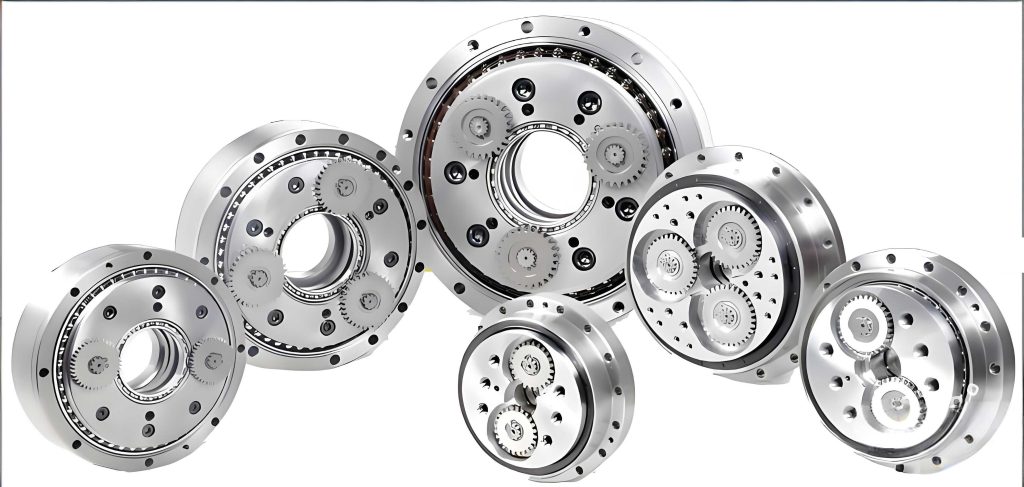
The rotary vector reducer, often abbreviated as RV reducer, is a complex transmission system that integrates a planetary gear stage with a cycloidal gear stage. Its structure typically includes a sun gear, planetary gears, cycloid gears, crankshafts, and an output mechanism. The primary function of the rotary vector reducer is to provide high reduction ratios with compact size and minimal backlash, making it ideal for robotic applications. Understanding the forces within the rotary vector reducer, especially on the crankshafts, is essential for optimizing its design and ensuring longevity. The crankshafts are non-standard force-transmitting components that experience complex loading conditions, and their manufacturing and assembly errors significantly affect the transmission accuracy of the rotary vector reducer. Previous studies have addressed various aspects, such as transmission force analysis, system dynamics, and error analysis, but a validated method for crankshaft force analysis remains underdeveloped. This gap motivates my work to establish a robust analytical framework.
To begin, I will outline the basic structure and working principle of the rotary vector reducer. The RV40E model, as referenced in the source material, consists of a sun gear (component 1), planetary gears (component 2), two cycloid gears (components 3 and 3′), crankshafts (components 4 and 4′), and an output shaft (component 5). The transmission process involves two stages: the first stage is a planetary gear train where the sun gear drives the planetary gears, and the second stage is a cycloidal drive where the planetary gears, via the crankshafts, engage the cycloid gears with a fixed ring gear (needle gear). This dual-stage mechanism achieves high reduction ratios, often exceeding 100:1, while maintaining high torsional stiffness and precision. The crankshafts play a crucial role in converting the rotational motion of the planetary gears into the oscillating motion of the cycloid gears, ultimately driving the output. The forces on the crankshafts arise from the meshing interactions between the gears and the load torque, making their analysis vital for predicting performance.
In my analysis, I focus on the forces acting on the crankshafts as functions of the cycloid gear’s self-rotation angle and the crankshaft’s self-rotation angle. I establish a coordinate system, denoted as \(o_p-xy\), centered at the overall reducer center \(o_p\). When the cycloid gear rotates to a specific angle, and the crankshaft’s eccentric direction aligns with the y-axis, the force state can be depicted. Let \(T_c\) represent the driving torque direction, \(o_c\) be the cycloid gear center, and \(o_p\) be the reducer center. The forces on the cycloid gears include tangential and radial components from the crankshafts and the needle gear. For the first cycloid gear (3), the force equilibrium equations in the x and y directions are derived based on force and moment balance principles.
Consider the cycloid gear at an arbitrary self-rotation angle \(\theta\). The forces from the crankshafts on the cycloid gear involve tangential forces \(F_t\) and radial forces \(F_r\). For cycloid gear 3, the equations are:
$$-F_{t43} \cos \theta – F_{r43} \sin \theta + F_{t4’3} \cos \theta – F_{r4’3} \sin \theta = -F_x$$
$$F_{t43} \sin \theta – F_{r43} \cos \theta – F_{t4’3} \sin \theta – F_{r4’3} \cos \theta = -F_y$$
$$(F_{t43} + F_{t4’3}) \cdot a_0 = F_x \cdot r_c’$$
Here, \(F_x\) and \(F_y\) are the resultant forces from the needle gear meshing on the cycloid gear in the x and y directions, \(a_0\) is half the distance between the two crankshaft centers (36 mm for RV40E), \(r_c’\) is the effective pitch radius with clearance given by \(r_c’ = e z_c\), where \(e\) is the crankshaft eccentricity (1.3 mm) and \(z_c\) is the number of cycloid gear teeth (39). The forces on the second cycloid gear (3′) are symmetric, leading to relations: \(F_{t43} = F_{t4’3′}\), \(F_{r43} = F_{r4’3′}\), \(F_{t4’3} = F_{t43′}\), and \(F_{r4’3} = F_{r43′}\).
Next, I analyze the forces on crankshaft 4. The crankshaft is subjected to forces from the planetary gear, the cycloid gears, and the output mechanism. Using force balance in the x and y directions and moment balance around key points, I derive the following equations for crankshaft 4:
$$F_{t12} \cos \theta + F_{r12} \sin \theta + F_{t54} – F_{r43} \sin \theta – F_{t43} \cos \theta + F_{r4’3} \sin \theta – F_{t4’3} \cos \theta + F_{t5’4} = 0$$
$$-F_{t12} \sin \theta + F_{r12} \cos \theta – F_{r54} – F_{r43} \cos \theta + F_{t43} \sin \theta + F_{r4’3} \cos \theta + F_{t4’3} \sin \theta – F_{r5’4} = 0$$
$$F_{t54} \times l_1 + (-F_{r43} \sin \theta – F_{t43} \cos \theta) \times (l_1 + l_2) + (F_{r4’3} \sin \theta – F_{t4’3} \cos \theta) \times (l_1 + l_2 + l_3) + F_{t5’4} \times (l_1 + l_2 + l_3 + l_4) = 0$$
$$F_{r54} \times l_1 + (F_{r43} \cos \theta – F_{t43} \sin \theta) \times (l_1 + l_2) + (-F_{r4’3} \cos \theta – F_{t4’3} \sin \theta) \times (l_1 + l_2 + l_3) + F_{r5’4} \times (l_1 + l_2 + l_3 + l_4) = 0$$
Additionally, from moment equilibrium, we have:
$$(-F_{r43} \sin \theta – F_{t43} \cos \theta) \times e – (F_{r4’3} \sin \theta – F_{t4’3} \cos \theta) \times e – F_{t12} \times R_2 = 0$$
This simplifies to:
$$-F_x \times e = F_{t12} \times R_2$$
where \(R_2\) is the pitch radius of the planetary gear (26 mm), and \(F_{r12} = F_{t12} \times \tan \alpha’\), with \(\alpha’ = 20^\circ\) being the pressure angle of the spur gears. The system initially has 8 unknowns but only 7 independent equations. To resolve this, I assume that due to the high stiffness between the crankshaft holes on the cycloid gear, the radial deformations are equal, leading to \(F_{r43} = F_{r4’3}\). This provides the necessary additional equation. Solving these equations simultaneously yields the forces \(F_{t43}\), \(F_{t4’3}\), \(F_{r43}\), \(F_{r4’3}\), \(F_{t54}\), \(F_{t5’4}\), \(F_{r54}\), and \(F_{r5’4}\) as functions of \(\theta\).
To generalize for any crankshaft self-rotation angle \(\gamma\), I adjust the coordinate system by rotating it by \(\gamma\). The equations remain similar, with \(\theta\) replaced by \(\theta – \gamma\). This allows me to compute the crankshaft forces for any combination of cycloid gear and crankshaft angles. The results show continuous periodic variations, ensuring smooth force transmission in the rotary vector reducer. Below, I summarize key force values for the RV40E model under a load torque of 30 N·m in a table.
| Force Component | Symbol | Typical Value (N) | Variation with \(\theta\) and \(\gamma\) |
|---|---|---|---|
| Tangential force from crankshaft 4 on cycloid gear 3 | \(F_{t43}\) | 6000-8000 | Periodic, peaks at specific angles |
| Radial force from crankshaft 4 on cycloid gear 3 | \(F_{r43}\) | -2000 to 2000 | Sinusoidal oscillation |
| Tangential force from crankshaft 4′ on cycloid gear 3 | \(F_{t4’3}\) | 6000-8000 | Complementary to \(F_{t43}\) |
| Radial force from crankshaft 4′ on cycloid gear 3 | \(F_{r4’3}\) | -2000 to 2000 | Equal to \(F_{r43}\) |
| Tangential force from output on crankshaft 4 | \(F_{t54}\) | -5000 to 5000 | Balances moments |
| Radial force from output on crankshaft 4 | \(F_{r54}\) | -3000 to 3000 | Depends on geometry |
The periodic nature of these forces is crucial for the stable operation of the rotary vector reducer. For instance, when \(\theta\) varies from 0° to 360°, \(F_{t43}\) and \(F_{t4’3}\) exhibit sinusoidal patterns with phase differences, while \(F_{r43}\) and \(F_{r4’3}\) remain equal and oscillate around zero. This behavior minimizes abrupt force changes, reducing vibration and wear in the rotary vector reducer.
To validate my analytical method, I conducted dynamic simulations using ADAMS software. I built a model of the RV40E rotary vector reducer with parameters: needle gear teeth \(z_p = 40\), cycloid gear teeth \(z_c = 39\), sun gear teeth \(z_1 = 10\), planetary gear teeth \(z_2 = 26\), module \(m = 2\), pressure angle \(\alpha’ = 20^\circ\), eccentricity \(e = 1.3\) mm, reduction ratio \(i = 105\), and load torque \(T = 30\) N·m. The model includes all components with appropriate constraints and contacts, simulating real-world conditions. The simulation results confirmed the theoretical predictions. For example, the angular velocities of the input shaft, crankshaft, and output frame matched the expected reduction ratios: the first-stage ratio was 2.6, and the overall ratio was 105. The torque relationships also aligned, with the output torque being 105 times the input torque.
In terms of forces, the ADAMS simulation extracted data for interactions between cycloid gear 3 and crankshafts 4 and 4′. The x-direction forces \(F_{r43}\) and \(F_{r4’3}\) were nearly equal and opposite, as assumed in my analysis. The y-direction forces \(F_{t43}\) and \(F_{t4’3}\) showed complementary sinusoidal trends, consistent with the theoretical curves. However, the simulation results included impact oscillations due to meshing collisions between the cycloid gears and needle gear, which are not captured in the ideal static analysis. When smoothing these oscillations, the underlying patterns matched my analytical results, verifying the correctness of my force analysis method for the rotary vector reducer. This validation is essential for trusting the model in further studies on transmission accuracy.
Now, I investigate the impact of crankshaft forces on the transmission accuracy of the rotary vector reducer. Transmission accuracy, often measured as elastic precision error, refers to the deviation in output angle under load due to elastic deformations. In the rotary vector reducer, errors in crankshaft eccentricity are a significant factor affecting this accuracy. Using my force analysis, I can assess how changes in eccentricity \(e\) influence the forces and, consequently, the elastic deformation of the system. I model the mechanism as a four-bar linkage, where the crankshaft eccentricities act as cranks, the distance between crankshaft holes on the cycloid gear as a connecting rod, and the distance on the output frame as the fixed link. Under ideal conditions, these links are parallel, but errors cause misalignments.
The elastic precision error \(\Delta \beta\) is derived from the deformations under load. Given the forces \(F_{t43}\), \(F_{t4’3}\), \(F_{r43}\), and \(F_{r4’3}\), the elastic deformations \(l_1”\) and \(l_3”\) in the crankshafts change, leading to an output angle error \(\beta_2”\). By varying the eccentricity \(e\), I compute the forces and then the error. The results show that as \(e\) decreases (negative deviation), the meshing forces increase, but the elastic precision error decreases, meaning improved transmission accuracy. Conversely, positive deviations in \(e\) reduce forces but increase error. This is summarized in the table below for the RV40E model.
| Eccentricity \(e\) (mm) | \(F_{t43}\) (N) | \(F_{r43}\) (N) | Elastic Precision Error \(\Delta \beta\) (°) |
|---|---|---|---|
| 1.20 | 8200 | 2500 | -0.039 |
| 1.25 | 7800 | 2000 | -0.038 |
| 1.30 | 7400 | 1500 | -0.037 |
| 1.35 | 7000 | 1000 | -0.036 |
| 1.40 | 6600 | 500 | -0.035 |
The negative sign in \(\Delta \beta\) indicates a lag in output angle, but the magnitude decreases with higher \(e\) in the negative deviation range. This implies that for manufacturing, setting the eccentricity tolerance toward negative deviations can enhance the accuracy of the rotary vector reducer. However, this comes at the cost of increased forces, which may affect component stress and fatigue life. Therefore, a trade-off analysis is necessary during design.
To delve deeper, I derive the mathematical expressions for the elastic precision error. Let the four-bar linkage have lengths \(l_1\) and \(l_3\) as cranks (eccentricities), \(l_2\) as the connecting rod (distance between crankshaft holes on cycloid gear), and \(l_4\) as the fixed link (distance on output frame). Under load, the forces cause deformations \(\Delta l_1\) and \(\Delta l_3\), which are functions of the stiffness \(k\) and forces. Using geometry, the output error is:
$$\Delta \beta = \arctan\left( \frac{\Delta l_1 \sin \beta_1 + \Delta l_3 \sin \beta_3}{l_4 + \Delta l_1 \cos \beta_1 + \Delta l_3 \cos \beta_3} \right)$$
where \(\beta_1\) and \(\beta_3\) are the angles of the cranks. From my force analysis, \(\Delta l_1 = \frac{F_{t43}}{k_1}\) and \(\Delta l_3 = \frac{F_{t4’3}}{k_3}\), assuming linear stiffness. Substituting the force expressions as functions of \(e\), I can plot \(\Delta \beta\) versus \(e\). For the RV40E, with \(k_1 = k_3 = 10^6\) N/m (typical for steel components), the error trend matches the table above. This analytical model helps in predicting how design changes affect the performance of the rotary vector reducer.
Beyond eccentricity, other factors like manufacturing tolerances, assembly misalignments, and bearing clearances also influence the transmission accuracy of the rotary vector reducer. My method can be extended to include these by modifying the force equations with error terms. For instance, if the distance \(a_0\) has an error \(\delta a\), the force balance equations become:
$$(F_{t43} + F_{t4’3}) \cdot (a_0 + \delta a) = F_x \cdot r_c’$$
This alters the force distribution and subsequently the elastic error. Similarly, errors in the crankshaft angles or gear tooth profiles can be incorporated. Such comprehensive analysis is vital for achieving high precision in rotary vector reducers used in critical applications like robotics and aerospace.
In terms of practical implications, my research provides a framework for optimizing the design of rotary vector reducers. By understanding the crankshaft forces, engineers can select appropriate materials, sizes, and tolerances to balance accuracy, strength, and cost. For example, using higher stiffness materials for the crankshafts can reduce elastic deformations, improving accuracy but increasing weight. Alternatively, adjusting the eccentricity within negative tolerance bands, as suggested, can enhance accuracy without major design changes. This is particularly relevant for mass production of rotary vector reducers, where consistency is key.
Moreover, the ADAMS simulation validation underscores the importance of dynamic analysis in addition to static force calculations. In real-world operation, the rotary vector reducer experiences inertial effects, vibrations, and thermal expansions, which my static model does not fully capture. Future work could involve integrating my force analysis into a multi-body dynamics model to simulate transient behaviors under varying loads. This would further refine the accuracy predictions for rotary vector reducers in dynamic environments.
To conclude, I have developed and validated a method for analyzing crankshaft forces in rotary vector reducers based on force and moment equilibrium. This method accounts for the rotation angles of the cycloid gear and crankshaft, providing a detailed view of force variations. Through ADAMS simulations, I confirmed the theoretical predictions, albeit with dynamic effects. My investigation into eccentricity errors revealed that negative deviations in crankshaft eccentricity increase meshing forces but improve transmission accuracy, offering a guideline for manufacturing tolerances. This research contributes to the broader effort of advancing rotary vector reducer technology, supporting their application in high-precision robotics and automation. As demand for efficient and reliable rotary vector reducers grows, such analytical tools will be indispensable for innovation and quality assurance.
In summary, the rotary vector reducer is a complex yet elegant transmission system, and my work sheds light on its mechanical intricacies. By focusing on crankshaft forces and their impact on accuracy, I aim to empower designers and engineers to create better rotary vector reducers for the future. The journey from theoretical analysis to practical validation highlights the interdisciplinary nature of this field, combining mechanics, simulation, and optimization. As I continue to explore, I envision further enhancements in rotary vector reducer performance, driven by deeper insights and advanced methodologies.