
Improving the transmission efficiency of the rotary vector reducer across its entire operational envelope is a critical objective in precision drive technology. This component is renowned for its high load capacity, excellent torsional stiffness, and compact design, making it indispensable in industrial robots, medical equipment, and high-precision machine tools. The overall efficiency is governed by the sum of its power losses, which are conventionally categorized into two main types: load-dependent losses and load-independent losses. A comprehensive understanding of how these losses interact under varying conditions of speed, torque, and temperature is essential for optimal design and application. This analysis presents a detailed experimental investigation into these phenomena, employing both single-factor tests and Response Surface Methodology (RSM) to dissect the influences and interactions of key operational parameters on the efficiency of a rotary vector reducer.
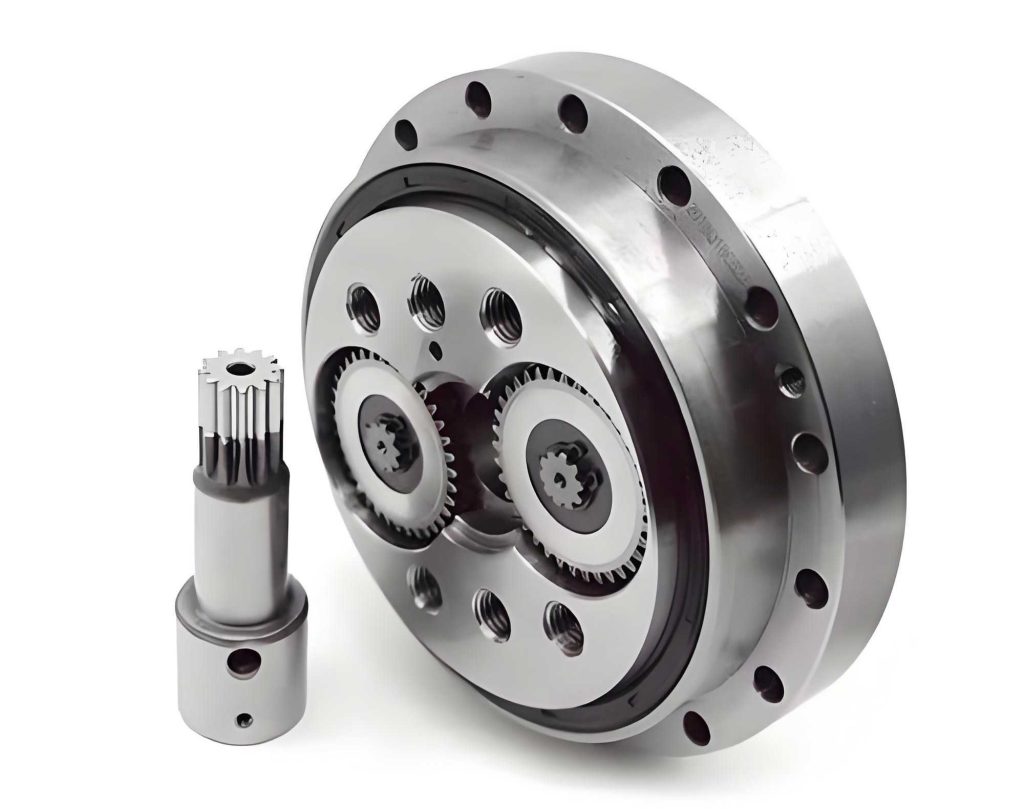
The mechanical architecture of the rotary vector reducer is a two-stage system combining a planetary gear train (first stage) and a cycloidal pin-wheel mechanism (second stage). This unique combination is the source of its high reduction ratio and robustness. Power loss within this system is an aggregate of losses from multiple sources. Load-dependent losses ($P_{dep}$) primarily originate from friction between contacting components under load. This includes sliding and rolling friction in all bearing elements (e.g., crankshaft bearings, cycloid disc bearings, output bearings) and the friction between the meshing teeth of the planetary gears and, more significantly, between the cycloid discs and the needle pins. These losses are intrinsically linked to the transmitted torque ($T$), the coefficient of friction ($\mu$), and the relative sliding velocities ($v_{sl}$) at the contacts, and can be conceptually expressed as a function:
$$ P_{dep} \propto f(T, \mu, v_{sl}) $$
Conversely, load-independent losses ($P_{ind}$), often called no-load or spin losses, are incurred even when the rotary vector reducer transmits zero torque. They are dominated by fluid-dynamic effects, specifically the churning and squeezing of the lubricating grease as gears and bearings rotate, and windage. These losses depend heavily on the kinematic viscosity ($\nu$) of the lubricant, the rotational speed ($n$), and the immersion depth of components, following a relationship such as:
$$ P_{ind} \propto g(\rho, \nu, n, d_{imm}) $$
where $\rho$ is lubricant density and $d_{imm}$ is immersion depth. The total power loss ($P_{loss}$) is simply the sum: $P_{loss} = P_{dep} + P_{ind}$. The transmission efficiency ($\eta$) is then calculated from the input power ($P_{in}$) and output power ($P_{out}$):
$$ \eta = \frac{P_{out}}{P_{in}} = \frac{T_{out} \cdot \omega_{out}}{T_{in} \cdot \omega_{in}} = 1 – \frac{P_{loss}}{P_{in}} $$
where $T$ and $\omega$ represent torque and angular velocity, respectively. The viscosity of the lubricating grease is a master variable, as it is highly sensitive to temperature ($\theta$), typically following an exponential decay (e.g., according to the Vogel-Fulcher-Tammann or similar models), which in turn influences both $P_{dep}$ and $P_{ind}$ in opposing ways.
Test Rig Configuration and Experimental Methodology
The experimental setup was designed to accurately measure the input and output parameters of the rotary vector reducer under controlled conditions. The test rig consisted of a high-precision servo motor as the prime mover on the input side and a programmable magnetic powder brake or servo motor acting as the load on the output side. Torque and speed sensors with high accuracy were installed on both the input and output shafts. The test specimen, a commercially available RV-40E type rotary vector reducer, was mounted on a rigid granite base to minimize alignment errors and structural deflections. To control and monitor the operating temperature, a heating band was wrapped around the reducer’s housing, regulated by a PID-controlled temperature controller. Three embedded temperature sensors provided real-time temperature feedback from different points on the housing to ensure uniform thermal conditions.
The experimental campaign was divided into two distinct phases: a comprehensive single-factor test matrix and a structured Response Surface Methodology design.
Phase 1: Single-Factor Experimental Design
This phase aimed to isolate the effect of individual parameters. Tests were conducted by varying one parameter while holding the others constant.
- Input Speed ($n_{in}$): Varied from 225 rpm to 1800 rpm in steps of 225 rpm.
- Output Load Torque ($T_{out}$): Varied from 0 N·m (no-load) to 412 N·m (rated torque) in steps of 51.5 N·m.
- Operating Temperature ($\theta$): Controlled at two primary levels: 30°C and 45°C.
At each stabilized operating point, data for input torque ($T_{in}$), input speed ($n_{in}$), output torque ($T_{out}$), output speed ($n_{out}$), and housing temperature were sampled at 5 Hz for 40 seconds. The load-dependent loss ($P_{dep}$) for a given load point was calculated by subtracting the no-load loss (at the same speed and temperature) from the total measured loss: $P_{dep}(n, T, \theta) = P_{loss}(n, T, \theta) – P_{loss}(n, 0, \theta)$. The load-independent loss ($P_{ind}$) is equivalent to the no-load loss: $P_{ind}(n, \theta) = P_{loss}(n, 0, \theta)$.
Phase 2: Response Surface Methodology Design
To analyze interactions between factors and identify optimal conditions, a three-factor, three-level Box-Behnken Design (BBD) was employed. The factors and their coded levels are defined in the table below.
| Factor | Symbol | Code | Level (-1) | Level (0) | Level (1) |
|---|---|---|---|---|---|
| Input Speed (rpm) | $x_1$ | Coded | 450 | 900 | 1350 |
| Load Torque (N·m) | $x_2$ | Coded | 103 | 309 | 412 |
| Temperature (°C) | $x_3$ | Coded | 30 | 37.5 | 45 |
The response variable was the transmission efficiency ($\eta$). A total of 17 experimental runs, including center points for estimating pure error, were performed according to the BBD matrix. A second-order polynomial model was fitted to the data to predict efficiency:
$$ \eta = \beta_0 + \sum_{i=1}^{3}\beta_i x_i + \sum_{i=1}^{3}\beta_{ii} x_i^2 + \sum_{i < j}\beta_{ij} x_i x_j + \epsilon $$
where $\beta_0$ is the constant coefficient, $\beta_i$ are linear coefficients, $\beta_{ii}$ are quadratic coefficients, $\beta_{ij}$ are interaction coefficients, and $\epsilon$ is the error.
Analysis of Single-Factor Experimental Results
The data from the single-factor tests reveal the distinct behavioral patterns of the two loss mechanisms in the rotary vector reducer.
Characterization of Load-Independent and Load-Dependent Losses
The load-independent loss ($P_{ind}$) shows a strong, non-linear increase with input speed, a trend that is characteristic of churning and windage losses. As speed doubles, the churning loss typically increases with a power law, often proportional to $n^{\alpha}$ where $\alpha$ ranges between 1.5 and 2.5. Crucially, $P_{ind}$ decreases significantly when the operating temperature rises from 30°C to 45°C. This is a direct consequence of the reduction in grease viscosity ($\nu$) with temperature, which lowers the resistance to motion within the fluid. The relationship can be approximated as $P_{ind} \propto \nu^{\beta} \cdot n^{\alpha}$, where $\beta$ is a positive exponent. Lowering $\nu$ reduces $P_{ind}$ substantially.
In contrast, the load-dependent loss ($P_{dep}$) increases approximately linearly with both load torque and input speed. Higher torque increases normal forces at all contact interfaces, directly increasing friction. Higher speed increases the sliding velocities in meshes and bearings, also raising frictional dissipation. Importantly, and opposite to the trend for $P_{ind}$, $P_{dep}$ increases with temperature. This is attributed to the reduction in lubricant film thickness ($h$) at the elastohydrodynamic (EHD) contacts due to lower viscosity. According to EHD theory, the central film thickness scales as $h_c \propto (\mu_0 u)^{0.67} \alpha^{0.53}$, where $\mu_0$ is the ambient viscosity, $u$ is the entrainment speed, and $\alpha$ is the pressure-viscosity coefficient. A drop in $\mu_0$ leads to a thinner film, increasing the boundary friction component and thus the total load-dependent friction. Therefore, temperature has a dual and opposing effect: it reduces $P_{ind}$ but increases $P_{dep}$.
| Loss Type | vs. Speed ($n$) | vs. Load Torque ($T$) | vs. Temperature ($\theta$) | Primary Physical Cause |
|---|---|---|---|---|
| Load-Independent ($P_{ind}$) | Strong increase (non-linear) | No effect (by definition) | Decrease | Churning, windage (Viscosity $\downarrow$) |
| Load-Dependent ($P_{dep}$) | Moderate increase (linear) | Strong increase (linear) | Increase | Friction in gears/bearings (Film thickness $\downarrow$) |
Dominant Loss Mechanism and Its Shift
The contribution of each loss type to the total loss ($P_{total}$) is not fixed; it shifts dramatically with operating conditions. At very low speeds and high torque, $P_{dep}$ is the dominant contributor because the frictional work is high while fluid churning is minimal. However, as speed increases, $P_{ind}$ grows rapidly due to its stronger speed dependence. Consequently, at high speeds, even under rated load, the load-independent loss can become the larger share of the total loss. This shift is visually summarized in the concept of a “Loss Regime Map”. Furthermore, increasing temperature amplifies this shift. Since higher temperature reduces $P_{ind}$ and increases $P_{dep}$, the proportion of total loss attributed to $P_{ind}$ decreases with temperature. For instance, at a high speed of 1800 rpm, the share of $P_{ind}$ might drop from ~78% at 30°C to ~69% at 45°C for the tested rotary vector reducer, with $P_{dep}$ making up the difference.
Impact on Overall Transmission Efficiency
The net effect on the transmission efficiency of the rotary vector reducer is a complex interplay of these loss components.
- Effect of Load Torque at Constant Speed: Efficiency increases monotonically with load torque before plateauing. The increase is very steep at low loads because the useful output power ($T_{out} \cdot \omega_{out}$) grows linearly while the total loss increases only marginally (as $P_{dep}$ starts from zero and $P_{ind}$ is constant). At higher loads, the rate of efficiency gain diminishes as $P_{dep}$ becomes a more significant portion of the input power.
- Effect of Input Speed at Constant Load: This effect depends on the load level. Under low-load conditions, efficiency consistently decreases with increasing speed because the input power rises linearly with speed ($P_{in} \propto n$), but $P_{ind}$ (a large portion of the loss) increases super-linearly, causing the loss fraction $P_{loss}/P_{in}$ to grow. Under high-load conditions, efficiency often exhibits a peak. At moderate speeds, the increase in input power outweighs the increase in total loss. However, beyond a certain speed, the rapid growth of $P_{ind}$ (and to a lesser extent $P_{dep}$) causes efficiency to decline and eventually stabilize.
- Effect of Temperature: The influence of temperature on the efficiency of a rotary vector reducer is non-monotonic and load-dependent. At low to moderate loads, the beneficial reduction in $P_{ind}$ outweighs the detrimental increase in $P_{dep}$, leading to a net increase in efficiency with temperature. At high loads, where $P_{dep}$ is the major loss component, the increase in $P_{dep}$ can offset or even surpass the reduction in $P_{ind}$, resulting in a slight decrease in efficiency with temperature. This highlights the critical role of lubricant selection—a grease with optimal viscosity-temperature characteristics for the expected duty cycle is paramount.
Response Surface Methodology Analysis and Model Development
The Box-Behnken experimental results were used to fit a second-order regression model for the transmission efficiency ($\eta$) of the rotary vector reducer. The final model in terms of coded factors is presented below. The high value of the regression coefficient confirms an excellent fit.
The analysis of variance (ANOVA) for the quadratic model is presented in the following table. The extremely low p-value for the Model confirms it is highly statistically significant. The non-significant “Lack of Fit” p-value indicates the model adequately fits the data.
| Source | Sum of Squares | df | Mean Square | F-value | p-value (Prob > F) | Significance |
|---|---|---|---|---|---|---|
| Model | 265.89 | 9 | 29.54 | 511.02 | < 0.0001 | Highly Significant |
| $x_1$: Speed | 0.10 | 1 | 0.10 | 1.75 | 0.2273 | Not Significant |
| $x_2$: Torque | 221.66 | 1 | 221.66 | 3833.99 | < 0.0001 | Highly Significant |
| $x_3$: Temperature | 2.52 | 1 | 2.52 | 43.59 | 0.0003 | Highly Significant |
| $x_1 x_2$ | 3.17 | 1 | 3.17 | 54.80 | 0.0001 | Highly Significant |
| $x_1 x_3$ | 5.81 | 1 | 5.81 | 100.46 | < 0.0001 | Highly Significant |
| $x_2 x_3$ | 0.30 | 1 | 0.30 | 5.14 | 0.0578 | Not Significant |
| $x_1^2$ | 18.94 | 1 | 18.94 | 327.56 | < 0.0001 | Highly Significant |
| $x_2^2$ | 9.02 | 1 | 9.02 | 155.94 | < 0.0001 | Highly Significant |
| $x_3^2$ | 1.69 | 1 | 1.69 | 29.20 | 0.0010 | Highly Significant |
| Residual | 0.40 | 7 | 0.058 | |||
| Lack of Fit | 0.25 | 3 | 0.084 | 2.23 | 0.2268 | Not Significant |
| Pure Error | 0.15 | 4 | 0.038 | |||
| Cor Total | 266.30 | 16 | ||||
| R² = 0.9985, Adjusted R² = 0.9965, Adequate Precision > 4 is desirable. | ||||||
The ANOVA table provides crucial insights into factor significance:
- Load Torque ($x_2$) has an overwhelmingly significant linear effect (largest F-value), confirming it is the most dominant factor governing the efficiency of the rotary vector reducer.
- Temperature ($x_3$) has a highly significant linear effect, underscoring the importance of thermal management and lubricant properties.
- Input Speed ($x_1$), within the tested range, does not show a statistically significant linear effect on its own. This is because its influence is complex and captured more strongly through its quadratic term ($x_1^2$) and its interactions (e.g., $x_1 x_2$, $x_1 x_3$), all of which are highly significant.
- The significant quadratic terms ($x_1^2$, $x_2^2$, $x_3^2$) confirm the presence of curvature in the response surface, meaning efficiency reaches a maximum or minimum within the design space.
- The significant interaction terms ($x_1 x_2$, $x_1 x_3$) mean the effect of speed on efficiency depends on the level of torque and temperature, and vice-versa, aligning with the observations from single-factor tests.
Using the model for optimization, the predicted conditions for maximum efficiency within the experimental domain were found at an input speed of approximately 898 rpm, the maximum load torque of 412 N·m, and a temperature near 32.5°C. The predicted maximum theoretical efficiency under these conditions was 79.2%. The response surface plots visually demonstrate these relationships: the surface shows a strong curvature with respect to torque (the most dominant ridge), a moderate curvature with respect to speed, and a tilt/curvature with respect to temperature.
Conclusions
This systematic experimental investigation into the transmission efficiency of a rotary vector reducer under varying operational conditions yields the following key conclusions:
- The power loss in a rotary vector reducer is decisively partitioned into load-independent and load-dependent components, each with distinct and often opposing sensitivities to operating conditions. Load-independent loss decreases with rising temperature but increases strongly with speed. Load-dependent loss increases with load, speed, and temperature.
- The dominant loss mechanism shifts with the operating point. At low-to-moderate speeds and high loads, load-dependent friction is predominant. At high speeds, load-independent churning loss becomes the major contributor to total loss in the rotary vector reducer. Increasing temperature reduces the proportional share of load-independent loss in the total dissipation.
- The overall transmission efficiency is a non-linear function of all three parameters. Efficiency always increases with load before plateauing. The effect of speed is conditional on load, leading to decreasing efficiency at low load and a peak-shaped curve at high load. The effect of temperature is conditional on load, generally improving efficiency at low load and potentially reducing it slightly at very high load due to increased friction from thinner lubricant films.
- Statistical analysis via Response Surface Methodology quantifies the significance of these factors. Load torque is the most significant factor affecting the efficiency of the rotary vector reducer, followed by operating temperature. Input speed, while important, manifests its influence primarily through quadratic and interaction effects rather than a simple linear trend. The interaction between speed and torque, and between speed and temperature, is highly significant.
- The optimal efficiency point within the tested domain for this specific rotary vector reducer lies near the maximum load, a mid-range speed, and a moderately low temperature. This highlights that for applications demanding peak efficiency, the rotary vector reducer should be operated close to its rated load, at a speed optimized to balance churning and friction losses, and with active cooling to maintain an optimal lubricant viscosity.
These findings underscore the complex thermo-tribological system within a rotary vector reducer. Future work should focus on developing first-principle based semi-empirical models for each loss component, investigating a wider range of lubricants with different additive packages, and extending the analysis to include dynamic loading cycles representative of real-world robotic applications.