
In the current era of intelligent technology, the digital transformation of education has entered a phase driven by advanced innovations, particularly embodied AI robots. These intelligent systems, which interact with physical and social environments through multimodal perception and real-time action, are reshaping how ideological and political education—often termed “curriculum ideology and politics”—is delivered. I believe that embodied AI robots serve as a pivotal force in deepening the integration of technology with educational processes, fostering a new ecosystem of human-machine collaboration in classrooms. This transformation aligns with national strategies for educational modernization, such as “China’s Education Modernization 2035,” which emphasizes the fusion of information technology with teaching to build smart, personalized, and ubiquitous learning environments. Through this essay, I will explore how embodied AI robots drive the digital transformation of ideological and political education, focusing on their role in reconstructing learning spaces, enhancing teaching processes, and empowering assessment and teacher development, all while providing a robust framework for cultivating values and competencies.
The core of this transformation lies in the unique capabilities of embodied AI robots. Unlike traditional digital tools, these robots embody intelligence through physical presence and interaction, enabling them to understand and adapt to complex educational contexts. In ideological and political education, which emphasizes value guidance and moral cultivation alongside knowledge acquisition, embodied AI robots offer a dynamic platform for immersive, participatory learning. I argue that by leveraging multimodal sensors, real-time data analysis, and adaptive feedback, embodied AI robots can create deeply engaging experiences that promote critical thinking, emotional engagement, and social responsibility. This approach not only supports the digitization of teaching but also ensures that ethical and ideological goals are seamlessly integrated into the curriculum.
To structure this discussion, I will delve into three key areas: the reconstruction of learning spaces through embodied AI robots, the transformation of teaching processes toward depth and responsiveness, and the empowerment of assessment and teacher growth. Throughout, I will incorporate tables and formulas to summarize concepts and models, emphasizing the practical applications of embodied AI robots. For instance, tables can illustrate the multimodal data captured by these robots, while formulas can model learning dynamics or evaluation metrics. Let’s begin by examining how embodied AI robots redefine the physical-digital learning environment.
Reconstructing Learning Spaces with Embodied AI Robots
Embodied AI robots are fundamentally altering the architecture of classrooms, merging physical and digital realms into a cohesive, intelligent space. I observe that this reconstruction is not merely about adding technology to existing settings but about creating an adaptive ecosystem where the environment itself becomes an active participant in learning. For ideological and political education, this means fostering a context-rich arena where values can be nurtured through experience and interaction.
First, embodied AI robots enable dynamic spatial layouts. Through wearable sensors, embedded environmental detectors, and spatial computing platforms, these robots integrate intelligence into physical elements like walls, desks, and floors. As a result, the learning space transitions from a static arrangement to a fluid, responsive entity. For example, an embodied AI robot might adjust lighting, display content, or rearrange furniture based on real-time analysis of student engagement, promoting an immersive atmosphere conducive to value-based discussions. This aligns with the goal of ideological and political education to provide浸润式 (immersive) and experiential learning.
Second, embodied AI robots deepen situational awareness. By employing multimodal sensing—such as visual, auditory, and tactile inputs—these robots capture nuanced aspects of student presence, including attention levels, emotional states, and collaborative behaviors. I propose that this capability allows for a more authentic understanding of learning dynamics, which is crucial for gauging value formation and moral reasoning. A formula can represent this perceptual depth:
$$ S(t) = \int_{0}^{t} \left( \alpha V(s) + \beta A(s) + \gamma T(s) \right) ds $$
Here, \( S(t) \) denotes the situational awareness score at time \( t \), with \( V(s) \), \( A(s) \), and \( T(s) \) representing visual, auditory, and tactile sensor inputs, weighted by coefficients \( \alpha \), \( \beta \), and \( \gamma \). This model highlights how embodied AI robots aggregate data to comprehend complex classroom contexts.
Third, embodied AI robots facilitate embodied behavior datafication. Every movement, gesture, and interaction in the space is recorded and analyzed, creating a holistic profile of student engagement. This data goes beyond traditional metrics to include social and emotional dimensions, providing insights into value-laden behaviors. For instance, an embodied AI robot might track how students collaborate on ethical dilemmas, offering objective evidence for ideological growth. The table below summarizes the key components of this reconstructed space:
| Component | Role of Embodied AI Robot | Impact on Ideological Education |
|---|---|---|
| Spatial Layout | Dynamic adjustment based on sensor data | Enhances immersive value experiences |
| Situational Awareness | Multimodal perception of student states | Provides real-time insights into moral engagement |
| Behavior Datafication | Comprehensive tracking of embodied actions | Supports evidence-based value assessment |
In this context, I assert that embodied AI robots transform the classroom into a smart, value-laden environment. As an educator, I see this as a foundation for fostering deeper ideological reflection, where technology seamlessly supports ethical learning. The integration of such spaces ensures that ideological and political education is not an add-on but an integral part of the digital ecosystem.
Driving Teaching Processes Toward Depth and Real-Time Feedback
Building on the reconfigured learning spaces, embodied AI robots propel teaching processes into a new paradigm of depth and adaptability. I contend that this shift is essential for ideological and political education, as it moves beyond passive knowledge transfer to active value internalization. Through multimodal perception and instant feedback, embodied AI robots create a dynamic loop that enhances cognitive and affective engagement.
First, embodied AI robots expand interaction depth through embodied perception. By using distributed sensor networks and wearable devices, these robots capture detailed data on eye movements, facial expressions, posture, and voice tones. This allows educators to monitor not just what students know, but how they feel and react to value-laden content. For example, an embodied AI robot might detect confusion during a discussion on social justice, prompting timely interventions. I model this perceptual process as:
$$ P_i = \sum_{j=1}^{n} w_j \cdot D_j $$
where \( P_i \) is the perception index for student \( i \), \( D_j \) are data streams from various sensors, and \( w_j \) are weights reflecting their importance in assessing ideological engagement. This enables a granular view of student development.
Second, embodied AI robots enable real-time feedback loops. By analyzing multimodal data, these robots can provide immediate adjustments to learning paths, such as offering explanatory hints or challenging tasks based on student performance. In ideological education, this feedback can guide value reflection—for instance, by suggesting alternative perspectives when biases are detected. The feedback mechanism can be represented as a control system:
$$ F(t) = K \cdot (E_d(t) – E_a(t)) $$
Here, \( F(t) \) is the feedback at time \( t \), \( K \) is a gain constant, \( E_d(t) \) is the desired educational outcome (e.g., value understanding), and \( E_a(t) \) is the actual outcome derived from sensor data. This ensures that teaching remains responsive to student needs.
Third, embodied AI robots act as intelligent mediators in knowledge construction. They facilitate group discussions by identifying conflicts, providing resources, and fostering consensus on ethical issues. I believe this promotes collective wisdom and value sharing, key goals in ideological education. The table below outlines how embodied AI robots transform teaching processes:
| Aspect | Contribution of Embodied AI Robot | Benefit for Ideological Education |
|---|---|---|
| Interaction Depth | Multimodal sensing of cognitive and affective states | Enables targeted value guidance |
| Real-Time Feedback | Adaptive responses based on continuous data | Supports dynamic moral reasoning |
| Knowledge Mediation | Facilitation of collaborative value discussions | Fosters shared ethical understanding |
As I reflect on this, embodied AI robots not only enhance learning efficiency but also embed ideological elements naturally into the flow of instruction. By creating an environment where feedback is immediate and personalized, these robots help students internalize values through experience, aligning with the holistic aims of curriculum ideology and politics.
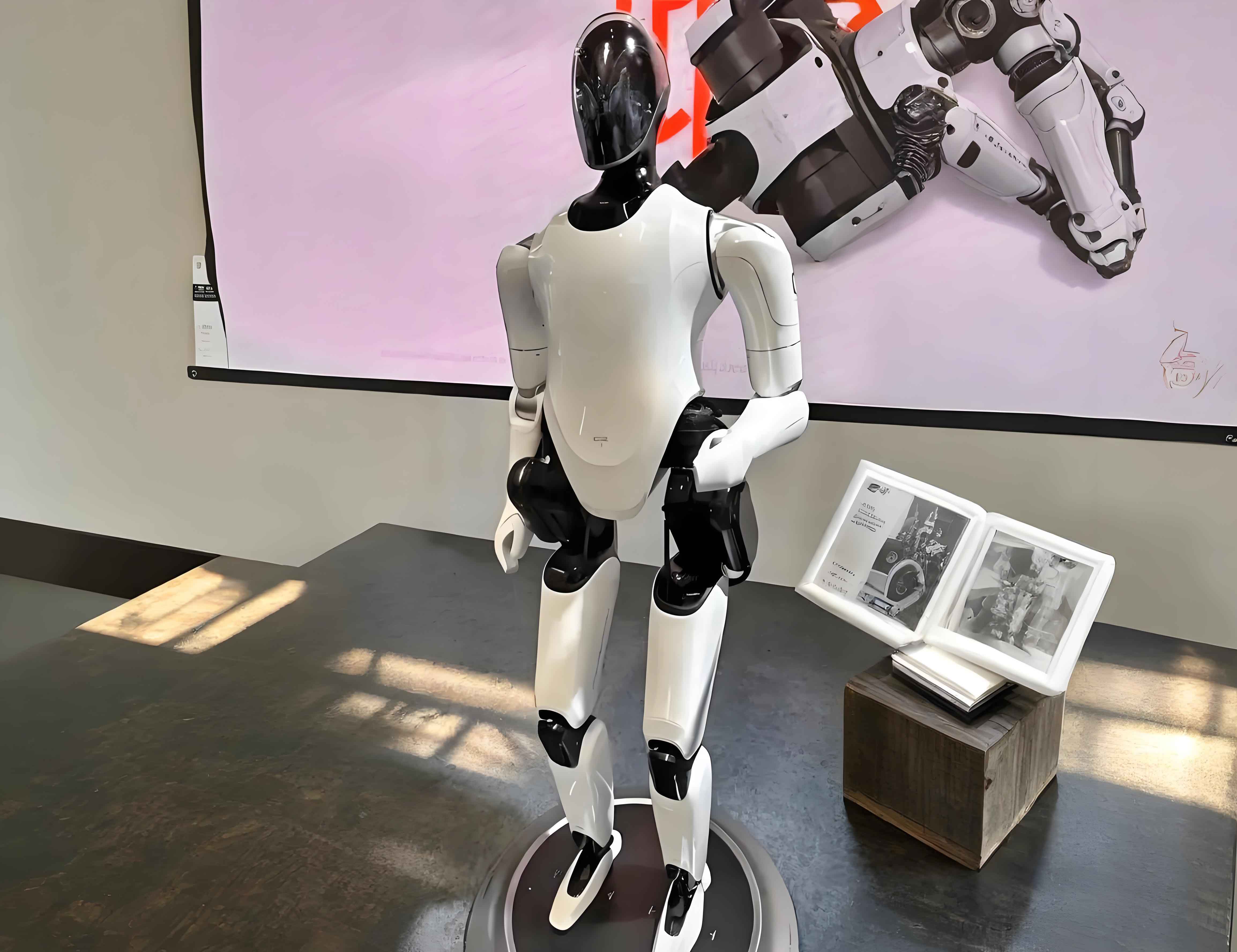
The image above illustrates the industrial application of embodied AI robots, akin to their educational use—where they integrate into complex environments to perform adaptive tasks. In classrooms, similarly, embodied AI robots become integral to the teaching ecosystem, driving数字化转型 (digital transformation) through physical presence and intelligence.
Empowering Assessment and Teacher Development with Embodied AI Robots
The influence of embodied AI robots extends to the realms of assessment and professional growth, crucial for sustaining ideological and political education. I argue that these robots provide a data-driven foundation for evaluating core competencies and supporting teacher evolution, thereby closing the loop on educational improvement.
First, embodied AI robots establish a multimodal assessment mechanism for core素养 (competencies). By capturing data on cognitive strategies, collaborative behaviors, emotional responses, and practical actions, these robots generate comprehensive profiles of student development. For ideological education, this includes assessing value identification, moral judgment, and social responsibility. I formulate an assessment score as:
$$ A_c = \int \left( \lambda_c C + \lambda_e E + \lambda_v V \right) dt $$
where \( A_c \) is the competency assessment, with \( C \), \( E \), and \( V \) representing cognitive, emotional, and value-based dimensions, weighted by \( \lambda \) coefficients. This holistic approach moves beyond traditional tests to capture real-world ethical performance.
Second, embodied AI robots foster human-machine synergy in teaching roles. They assist educators by handling routine tasks, monitoring classroom dynamics, and providing analytics, freeing teachers to focus on high-level value guidance. As an educator myself, I see this as a shift toward becoming a facilitator of ideological growth, supported by data from embodied AI robots. The table below summarizes this empowerment:
| Area | Role of Embodied AI Robot | Impact on Ideological Education |
|---|---|---|
| Multimodal Assessment | Data collection on embodied behaviors and values | Enables nuanced evaluation of moral development |
| Teacher Support | Automation of administrative tasks and real-time insights | Allows deeper engagement in value-based teaching |
| Professional Development | Platforms for reflection and collaborative improvement | Builds capacity for effective ideological instruction |
Third, embodied AI robots contribute to a sustainable educational ecosystem through iterative improvement loops. Assessment data informs personalized learning paths, while teacher profiles guide targeted professional development. I posit that this creates a virtuous cycle where technology and pedagogy co-evolve. For instance, embodied AI robots can analyze teaching sessions to identify best practices in value integration, sharing them across communities.
In this context, the ethical dimensions of embodied AI robots must be considered. Issues like data privacy, algorithmic transparency, and value alignment are paramount to ensure that these technologies serve educational goals without bias. I advocate for frameworks where embodied AI robots are designed with ethical guardrails, prioritizing human-centric outcomes in ideological education.
Conclusion and Future Directions
In summary, embodied AI robots are catalyzing a profound digital transformation in ideological and political education. By reconstructing learning spaces, deepening teaching processes, and empowering assessment and teacher development, these robots enable a seamless fusion of value guidance with technological innovation. I am convinced that embodied AI robots offer a pathway to more engaging, personalized, and effective education, where students not only acquire knowledge but also develop the moral compass needed for society.
Looking ahead, I recommend further research into the theoretical integration of embodied AI robots with pedagogical models, as well as empirical studies on their impact in diverse educational settings. Efforts should focus on optimizing human-robot collaboration, ensuring ethical standards, and building adaptive ecosystems that support lifelong value cultivation. As embodied AI robots continue to evolve, their role in education will likely expand, offering new opportunities for fostering integrity, empathy, and social responsibility. Ultimately, the journey toward数字化教学转型 (digital teaching transformation) is one where technology serves humanity, and embodied AI robots stand as powerful allies in this mission.
To encapsulate key concepts, here is a final table on the multifaceted contributions of embodied AI robots:
| Domain | Key Functions of Embodied AI Robot | Outcomes for Ideological Education |
|---|---|---|
| Learning Space | Dynamic adaptation, multimodal sensing, behavior tracking | Creates immersive value-based environments |
| Teaching Process | Real-time feedback, interaction depth, knowledge mediation | Enhances moral engagement and reflection |
| Assessment & Development | Competency evaluation, teacher support, ecosystem building | Drives continuous improvement in value education |
Through this exploration, I hope to have illuminated the transformative potential of embodied AI robots. As we embrace this technology, let us steer it toward enriching educational experiences that nurture both mind and character, paving the way for a more thoughtful and compassionate world.