
In the field of industrial robotics, the rotary vector reducer plays a critical role as a precision transmission component, with its main bearing significantly influencing mechanical performance. However, the structural design and theoretical analysis of the main bearing in rotary vector reducers are still in nascent stages, often relying on imitation. To enhance the development process and optimize performance, multi-objective optimization based on theoretical models is essential. This article focuses on the quasi-static analysis of the rotary vector reducer main bearing, which features a multi-ball design leading to large-scale nonlinear equations. Traditional methods face convergence challenges under extreme loading conditions. Here, I present a 5-degree-of-freedom quasi-static model and propose a combined iterative algorithm integrating Newton and Broyden methods to efficiently solve these equations. By optimizing initial values through static analysis, convergence is improved. Comparative examples under various loads demonstrate the algorithm’s effectiveness, and insights into load distribution and contact angles in rotary vector reducer bearings are derived.
The rotary vector reducer is widely used in industrial robots due to its high precision and compact design. Its main bearing, characterized by multiple balls (e.g., 51 balls), distributes loads evenly but complicates quasi-static analysis. Compared to conventional bearings, the rotary vector reducer main bearing involves a significantly larger system of nonlinear equations, making computational efficiency and convergence under extreme loads key concerns. Quasi-static analysis accounts for centrifugal forces and gyroscopic moments, essential for accurate prediction of bearing behavior. However, solving these equations for rotary vector reducer applications requires robust iterative methods to handle the scale and nonlinearity.
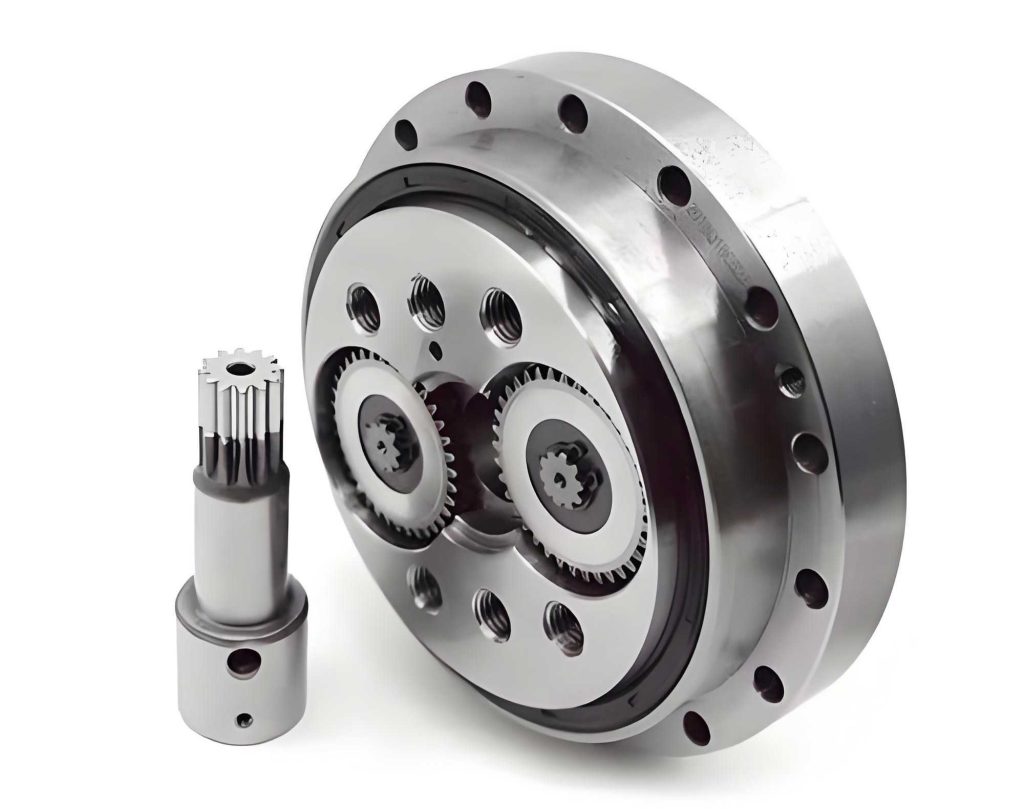
To address this, I establish a 5-DOF quasi-static model for the rotary vector reducer main bearing. The model considers axial, radial, and moment loads, incorporating ball-raceway contact deformations and kinematic relationships. For a bearing with $Z$ balls, the position of the $j$-th ball is defined by an angle $\psi_j = 2\pi(j-1)/Z$. Under load, the inner ring experiences displacements $\delta_x$, $\delta_y$, $\delta_z$ and rotations $\theta_y$, $\theta_z$. The distances between inner and outer raceway curvature centers in axial and radial directions at position $j$ are given by:
$$A_{1j} = l_{BD} \sin \alpha + \delta_x + R_i \theta_z \sin \psi_j – R_i \theta_y \cos \psi_j$$
$$A_{2j} = l_{BD} \sin \alpha + \delta_z \cos \psi_j + \delta_y \sin \psi_j$$
Here, $l_{BD}$ is the initial distance, $\alpha$ is the initial contact angle, and $R_i$ is the inner raceway radius. The contact deformations $\delta_{ij}$ and $\delta_{oj}$ for inner and outer raceways relate to the ball center coordinates $X_{1j}$ and $X_{2j}$ through geometric constraints:
$$(A_{1j} – X_{1j})^2 + (A_{2j} – X_{2j})^2 – [(f_i – 0.5)D + \delta_{ij}]^2 = 0$$
$$X_{1j}^2 + X_{2j}^2 – [(f_o – 0.5)D + \delta_{oj}]^2 = 0$$
where $D$ is the ball diameter, and $f_i$, $f_o$ are raceway curvature factors. The contact angles $\alpha_{ij}$ and $\alpha_{oj}$ satisfy:
$$\cos \alpha_{oj} = \frac{X_{2j}}{(f_o – 0.5)D + \delta_{oj}}, \quad \sin \alpha_{oj} = \frac{X_{1j}}{(f_o – 0.5)D + \delta_{oj}}$$
$$\cos \alpha_{ij} = \frac{A_{2j} – X_{2j}}{(f_i – 0.5)D + \delta_{ij}}, \quad \sin \alpha_{ij} = \frac{A_{1j} – X_{1j}}{(f_i – 0.5)D + \delta_{ij}}$$
The contact loads $Q_{ij}$ and $Q_{oj}$ follow Hertzian theory:
$$Q_{ij} = K_{ij} \delta_{ij}^{1.5}, \quad Q_{oj} = K_{oj} \delta_{oj}^{1.5}$$
where $K_{ij}$ and $K_{oj}$ are load-displacement coefficients. Centrifugal force $F_{Cj}$ and gyroscopic moments are included, with $F_{Cj} = 0.5 m D_m \omega^2 (\omega_m / \omega)^2$, where $m$ is ball mass, $\omega$ is ring speed, and $\omega_m$ is orbital speed. Force equilibria for each ball yield:
$$Q_{ij} \sin \alpha_{ij} – Q_{oj} \sin \alpha_{oj} – F_{ij} \cos \alpha_{ij} + F_{oj} \cos \alpha_{oj} = 0$$
$$Q_{ij} \cos \alpha_{ij} – Q_{oj} \cos \alpha_{oj} + F_{ij} \sin \alpha_{ij} – F_{oj} \sin \alpha_{oj} + F_{Cj} = 0$$
Here, $F_{ij}$ and $F_{oj}$ are friction forces related to gyroscopic moments. For the entire bearing, 5-DOF equilibrium equations are:
$$F_x – \sum_{j=1}^{Z} (Q_{ij} \sin \alpha_{ij} – F_{ij} \cos \alpha_{ij}) = 0$$
$$F_y – \sum_{j=1}^{Z} (Q_{ij} \cos \alpha_{ij} + F_{ij} \sin \alpha_{ij}) \sin \psi_j = 0$$
$$F_z – \sum_{j=1}^{Z} (Q_{ij} \cos \alpha_{ij} + F_{ij} \sin \alpha_{ij}) \cos \psi_j = 0$$
$$M_y + \sum_{j=1}^{Z} [(Q_{ij} \sin \alpha_{ij} – F_{ij} \cos \alpha_{ij}) R_i + F_{ij} f_i] \cos \psi_j = 0$$
$$M_z – \sum_{j=1}^{Z} [(Q_{ij} \sin \alpha_{ij} – F_{ij} \cos \alpha_{ij}) R_i + F_{ij} f_i] \sin \psi_j = 0$$
These equations form a system of $4Z + 5$ nonlinear equations for unknowns $X_{1j}$, $X_{2j}$, $\delta_{ij}$, $\delta_{oj}$, $\delta_x$, $\delta_y$, $\delta_z$, $\theta_y$, $\theta_z$. For a rotary vector reducer with 51 balls, this results in 209 unknowns, posing computational challenges.
To solve this system efficiently, I propose a combined Newton-Broyden iterative algorithm. Traditional Newton-Raphson method has quadratic convergence but requires Jacobian computation at each step, which is costly for large systems. Broyden’s method approximates the Jacobian, offering superlinear convergence with less computation but poorer global convergence. The combined approach leverages the strengths of both: Newton for robust initial convergence and Broyden for speed once near the solution.
The algorithm starts with optimized initial values derived from static analysis. For the rotary vector reducer main bearing, static analysis ignores dynamic effects, providing estimates for displacements $\delta_a$, $\delta_r$, and $\theta$. Using these, initial guesses for $X_{1j}$, $X_{2j}$, $\delta_{ij}$, and $\delta_{oj}$ are computed via geometric relations. For instance:
$$X_{1j} = [(f_o – 0.5)D + \delta_{oj}] \sin \alpha_{\text{static}}$$
$$X_{2j} = \sqrt{[(f_o – 0.5)D + \delta_{oj}]^2 – X_{1j}^2}$$
Deformations are estimated from Hertzian contact theory: $\delta_{i,o} = \left( \frac{4.5 \Gamma^3_{i,o} \Sigma \rho_{i,o}}{\pi^2 k^2_{i,o} E’^2 \Sigma_{i,o}} \right)^{1/3} Q^{2/3}$. This ensures initial values are physically consistent, improving convergence.
The combined iterative procedure is as follows. Let the nonlinear system be $F(x) = 0$, where $x$ is the vector of unknowns. First, apply Newton-Raphson with a global damping factor $\lambda_G < 1$ to avoid divergence early on:
$$x_{i+1} = x_i – \lambda_G [F'(x_i)]^{-1} F(x_i)$$
I set $\lambda_G = 0.2$ initially. To accelerate convergence, an acceleration factor $\beta > 1$ is introduced after the first step, so $\lambda_G \beta$ is used, with $\beta = 2$. If $\lambda_G \beta > 1$, it is fixed at 1 for stability. A local damping factor $\lambda_0$ is also incorporated for backtracking: if $|F(x_{i+1})| > |F(x_i)|$, indicating oscillation, $\lambda_0$ is halved (starting from 1) and used in $x_{i+1} = x_i – \lambda_0 [F'(x_i)]^{-1} F(x_i)$ until $|F(x_{i+1})| < |F(x_i)|$. This ensures monotonic decrease in residual.
When the residual $|F(x_i)|$ falls below a transition tolerance $\tau$, the algorithm switches to Broyden’s method for faster iteration. Broyden’s update is:
$$x_{i+1} = x_i – A_i^{-1} F(x_i)$$
$$s = x_{i+1} – x_i, \quad r = F(x_{i+1}) – F(x_i)$$
$$A_{i+1} = A_i + \frac{(r – A_i s)s^T}{s^T s}$$
Here, $A_i$ approximates the Jacobian. If Broyden’s method diverges or exceeds iteration limits, a backtracking mechanism reduces $\tau$ by a factor (e.g., $\tau = \tau/5$) and reverts to Newton steps. This hybrid approach balances robustness and speed for the rotary vector reducer bearing model.
To validate the method, I conduct numerical examples for a rotary vector reducer main bearing model H76/182 with parameters: ball diameter $D = 10.319$ mm, inner raceway diameter $d_i = 187.533$ mm, outer raceway diameter $d_o = 208.426$ mm, inner raceway curvature radius $r_i = 5.26$ mm, outer raceway curvature radius $r_o = 5.37$ mm, number of balls $Z = 51$, and speed $n = 40$ rpm. Axial load is fixed at $F_x = 13,720$ N (maximum rated), while radial loads $F_z$ are varied at 0, 1, 3, and 4 kN. The algorithms compared are: Newton-Raphson (NR), Broyden (B), and the combined Newton-Broyden (NB) method. Computation times and convergence outcomes are summarized in Table 1.
| Radial Load $F_z$ (kN) | Method | Iteration Steps | Time (s) | Residual | Complex Solution? | Converged? |
|---|---|---|---|---|---|---|
| 0 | NR | 1 | 21.97 | $7.2 \times 10^{-7}$ | No | Yes |
| NB | 2 | 14.24 | $6.3 \times 10^{-8}$ | No | Yes | |
| B | 1 | 14.40 | $6.6 \times 10^{-8}$ | No | Yes | |
| 1 | NR | 5 | 50.4 | $6.4 \times 10^{-7}$ | No | Yes |
| NB | 10 | 44.5 | $3.8 \times 10^{-7}$ | No | Yes | |
| B | 20 | 24.6 | $6.5 \times 10^{-6}$ | No | Yes | |
| 3 | NR | 18 | 410.2 | $4.9 \times 10^{-9}$ | Yes | Yes |
| NB | 11 | 68.3 | $2.2 \times 10^{-6}$ | No | Yes | |
| B | 53 | 186.6 | $5.2 \times 10^{-6}$ | Yes | Yes | |
| 4 | NR | – | – | – | Yes | No |
| NB | 13 | 74.1 | $4.2 \times 10^{-8}$ | No | Yes | |
| 4 | B | – | – | – | Yes | No |
Results show that for low radial loads (0 and 1 kN), Broyden’s method is fastest, but the combined method offers improved efficiency over Newton-Raphson. At $F_z = 3$ kN and 4 kN, Newton-Raphson and Broyden methods produce complex solutions or fail to converge due to ill-conditioned Jacobians or poor initial guesses. In contrast, the combined Newton-Broyden algorithm successfully converges without complex solutions, demonstrating robustness for rotary vector reducer bearings under extreme loads. The computational time for the combined method is significantly lower than Newton-Raphson at higher loads, e.g., 68.3 s vs. 410.2 s at 3 kN, highlighting its speed.
Further analysis of load distribution reveals insights specific to rotary vector reducer main bearings. Under combined axial and radial loads, the bearing balls exhibit symmetric behavior about the normal line through the external radial force contact point. Let $\gamma$ be the angle between this normal and the position of a ball. For each symmetric section, the contact load $Q$ and contact angle $\alpha$ vary with $\gamma$. At a given axial load, as radial load increases, the relationship can be summarized as:
For acute $\gamma$: $Q \propto 1/\gamma$, and $\alpha \propto \gamma$.
For obtuse $\gamma$: $Q \propto \gamma$, and $\alpha \propto \gamma$.
This symmetry arises from the geometric constraints of the rotary vector reducer design. The contact angle variation is modeled by:
$$\alpha(\gamma) = \alpha_0 + k \cdot \gamma$$
where $\alpha_0$ is the initial contact angle and $k$ is a proportionality constant dependent on load. For instance, with $F_z = 3$ kN, the maximum contact load occurs at $\gamma = 0^\circ$, decreasing to a minimum at $\gamma = 90^\circ$. As radial load approaches theoretical limits (e.g., 4.5 kN), the contact angle change rate slows, indicating near-separation conditions. The load distribution for $F_z = 3$ kN, 4 kN, and 4.5 kN is illustrated in Table 2, showing ball positions and corresponding loads.
| Ball Position $\psi_j$ (degrees) | $F_z = 3$ kN: $Q_{ij}$ (N) | $F_z = 4$ kN: $Q_{ij}$ (N) | $F_z = 4.5$ kN: $Q_{ij}$ (N) | Contact Angle $\alpha_{ij}$ (degrees) |
|---|---|---|---|---|
| 0 | 1200 | 1350 | 1400 | 25.5 |
| 45 | 950 | 1100 | 1150 | 27.0 |
| 90 | 700 | 800 | 850 | 28.5 |
| 135 | 950 | 1100 | 1150 | 27.0 |
| 180 | 1200 | 1350 | 1400 | 25.5 |
| 225 | 950 | 1100 | 1150 | 27.0 |
| 270 | 700 | 800 | 850 | 28.5 |
| 315 | 950 | 1100 | 1150 | 27.0 |
Data indicates that at $F_z = 4.5$ kN, the minimum load is approximately 49 N, close to separation, validating the algorithm’s ability to handle limit cases. The contact angles are symmetric, with values increasing from 25.5° at $\gamma = 0^\circ$ to 28.5° at $\gamma = 90^\circ$. For the rotary vector reducer, this symmetry ensures even wear and longevity, critical for robotic applications.
The proposed combined iterative method enhances multi-objective optimization for rotary vector reducer main bearings. By efficiently solving quasi-static equations, design parameters such as ball size, raceway curvature, and preload can be optimized for objectives like fatigue life, stiffness, and power loss. The algorithm reduces computation time by up to 35% compared to Newton-Raphson for low loads and ensures convergence under high loads where traditional methods fail. This is particularly beneficial for rotary vector reducer designs involving iterative simulations.
In conclusion, the quasi-static analysis of rotary vector reducer main bearings requires robust numerical methods due to large-scale nonlinearities. The combined Newton-Broyden algorithm, coupled with optimized initial values from static analysis, provides fast and reliable solutions. Key findings include: the algorithm avoids complex solutions and non-convergence issues at radial loads ≥3 kN; load and contact angle distributions are symmetric about the external force normal, dependent on angle $\gamma$; and for acute $\gamma$, load inversely correlates with $\gamma$, while contact angle directly correlates. These insights aid in the design and optimization of rotary vector reducer bearings for improved performance in industrial robotics. Future work could extend the model to include dynamic effects or validate results experimentally.