
The transition of humanoid robots from conceptual prototypes to tangible reality is accelerating dramatically. On February 11, Unitree Technology launched two humanoid robot models—Unitree H1 and G1—on its JD.com flagship store. By February 12, the first batch of G1 units, priced from ¥99,000, sold out completely.
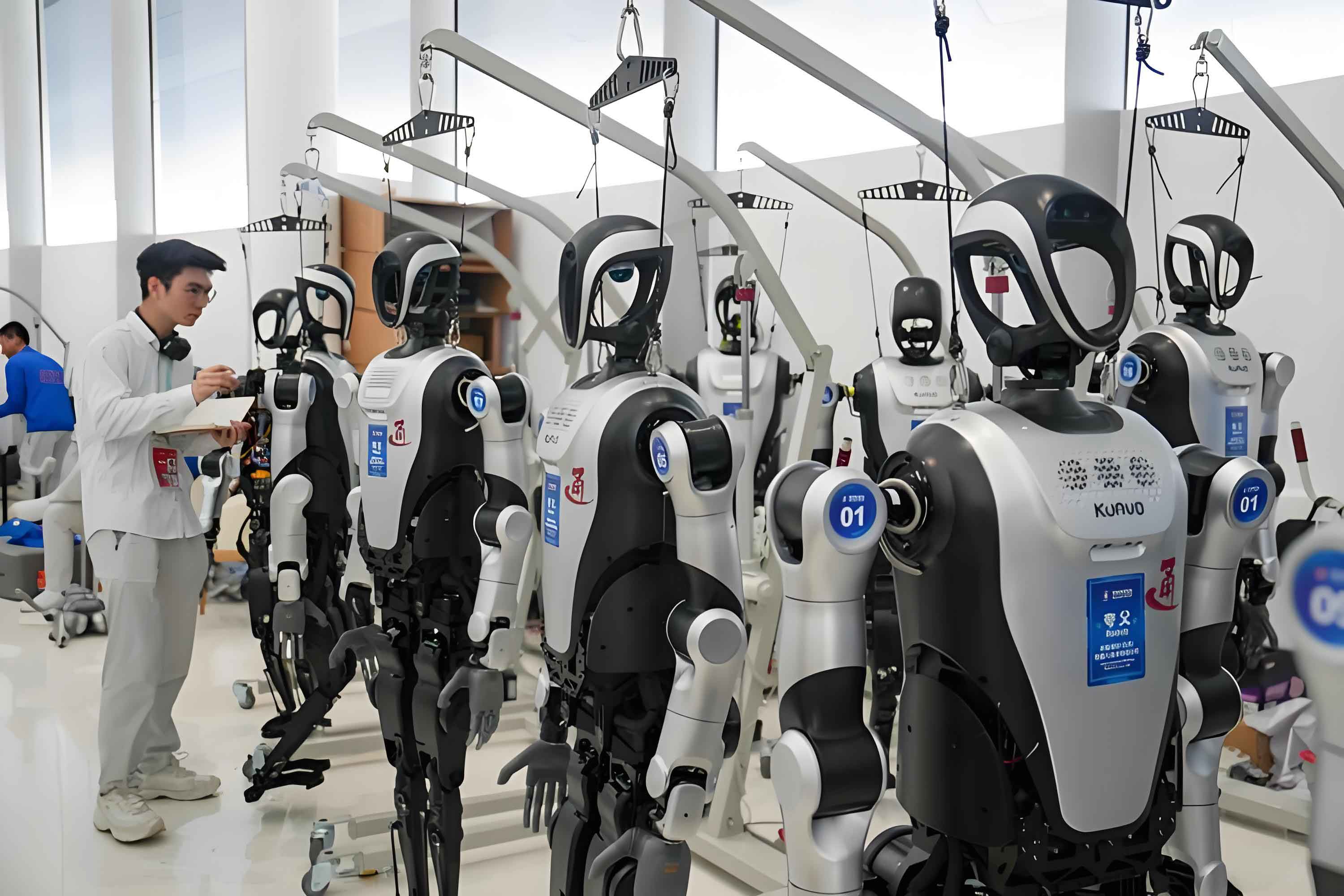
Industrial applications are demonstrating concrete progress. At BYD’s automotive factory, humanoid robot Walker S1 from Ubtech Robotics (09880.HK) achieved a 100% efficiency improvement and 30% stability increase during its first-phase training. Ubtech anticipates Walker S1 will achieve mass-delivery readiness by Q2 2025. Similarly, at Geely’s Zeekr plant in Ningbo, the humanoid robot completed phase-two trials and has advanced to phase three at Lynk & Co for charging-gun testing and material transport. At Foxconn, Walker S1 fulfilled initial logistics tasks, with expanded operational zones planned.
- Mass Production Initiatives
Humanoid robot manufacturing is scaling globally. Tesla updated job postings on February 6 for “Tesla Bot” roles at its Fremont factory, where its Optimus humanoid robot already handles battery sorting and welding. CEO Elon Musk targets production of 10,000 Optimus units in 2025, with external deliveries starting late 2026. “Optimus has the potential to generate over $10 trillion in revenue,” Musk stated during Tesla’s Q4 2024 earnings call, emphasizing unlimited demand even at high prices. Tesla’s current pilot line produces ≈1,000 units monthly, with subsequent lines targeting 10,000 and 100,000 units/month.
Chinese firms are matching this momentum:
- Leju Robotics delivered its 100th full-size humanoid robot to BAIC Group on January 17, 2025.
- Agibot produced its 1,000th general-purpose embodied robot on January 6, 2025, including 731 bipedal humanoid robots.
- Ubtech secured >500 intent orders for Walker S, targeting mass delivery in Q2 2025.
- Zhongqing Robotics’ SE01 humanoid robot, showcased in viral street-walking videos, plans multi-model deliveries in 2025. Co-founder Yao Qiyuan noted: “The industry has moved from 0→1 to 1→100—even 100→1,000.”
- Phased Production Scaling
Industry experts define two critical thresholds for humanoid robot mass production. At 100,000 units, the focus is on technical validation and replacing 10% of non-standardized manufacturing tasks, requiring hardware stability and task-specific software. At 1+ million units, hardware costs must fall below average annual human labor expenses ($20,000/unit as projected by Musk), while software achieves cross-scene adaptability for service/domestic applications.
Market projections reinforce this roadmap:
| Year | Global Humanoid Robot Sales | Market Size |
|---|---|---|
| 2024 | 11,900 units | $1.017B |
| 2030 | 605,700 units | $15.1B |
Source: GGII (2025)
East China Securities forecasts nearly 10,000 humanoid robot sales in China for 2025.
- Hardware and Software Hurdles
Scalability faces dual bottlenecks. Hardware limitations center on planetary roller screws—precision drives converting rotational to linear motion. Each humanoid robot requires 10–14 screws, constituting 5–8% of total costs. With 2023’s Chinese screw market (excluding humanoid robots) at ¥257M, million-unit production would demand tens of millions of screws. Domestic suppliers are responding:
- Xinjian Transmission launched a ¥2.6B project on January 3, 2025, targeting 1M screws/year.
- Zhenyu Technology (300953.SZ) operates semi-automated lines producing 50 screw sets/day, with full automation planned.
Software challenges involve the “cerebellum” (motion control) versus “cerebrum” (AI decision-making). While models like DeepSeek show promise for cognitive tasks, cerebellum development lags due to data scarcity. “Real-world motion data is multidimensional and hardware-dependent,” Yao explained. Key unsolved problems include terrain adaptability, low-power locomotion, and self-recovery systems.
- The Form-Factor Debate
Not all manufacturers endorse humanoid designs. A robotic-arm executive argued quadruped or wheeled robots offer 2–3× faster movement, 50% lower energy use, and 1/3–1/5 the cost of humanoid robots in structured environments like warehouses. Conversely, Yao Qiyuan emphasized humanoid robots’ environmental compatibility: “Human-centric infrastructure—stairs, tools, workspaces—demands humanoid forms for true generality.”
Hybrid solutions are emerging, such as modular robots switching between wheeled and bipedal configurations for factory/home transitions. Regardless of design philosophy, humanoid robots are nearing practical integration across society.