
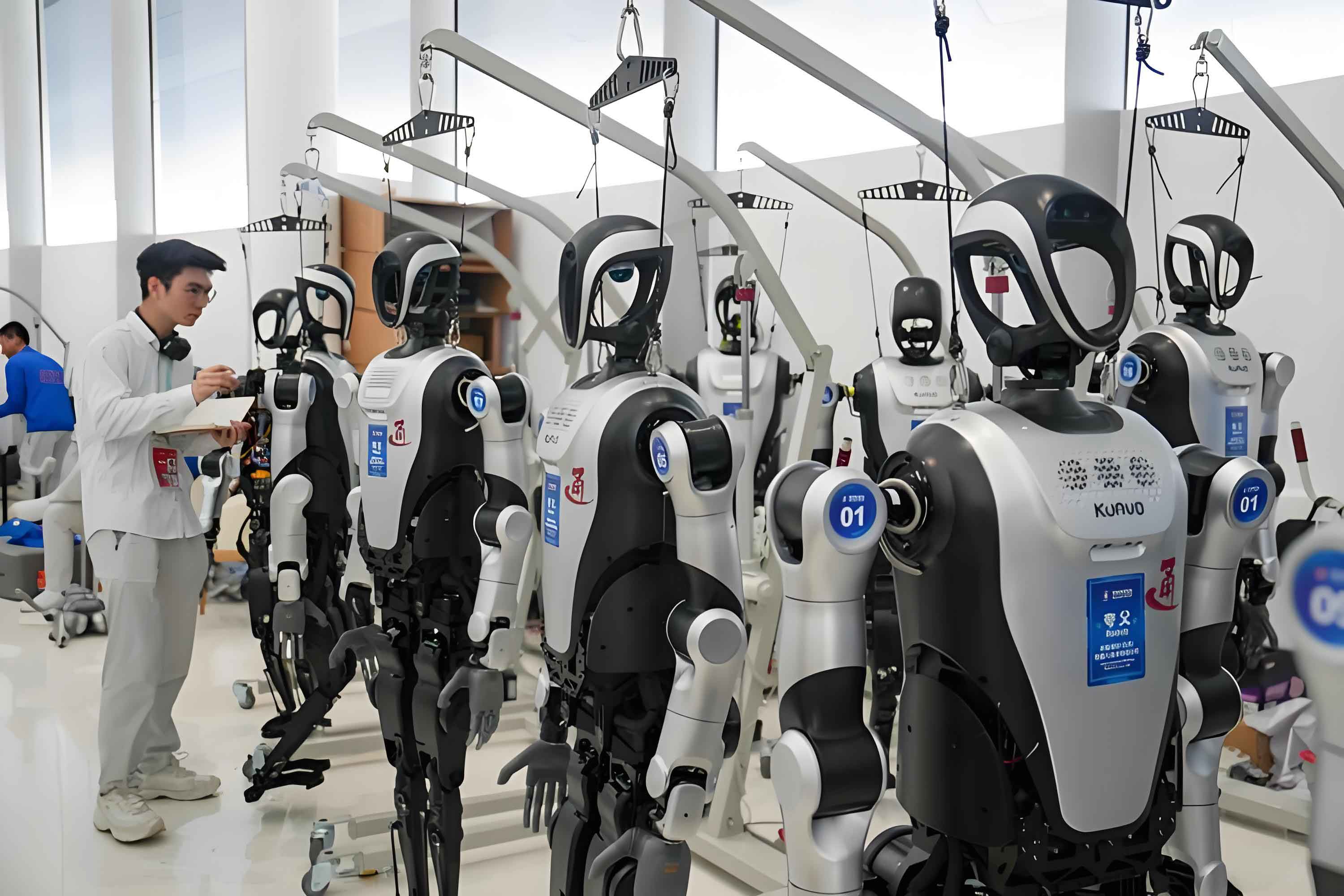
SHANGHAI – Scenarios once confined to science fiction – humanoid robots climbing mountains, tying scarves, or leading marathons – are rapidly materializing as revolutionary advancements reshape the robotics landscape. At the forefront of this transformation stands the National-Local Co-established Humanoid Robot Innovation Center Embodied Intelligence Training Ground (referred to as the National Center), poised for official operation in Shanghai’s Zhangjiang Moli Community this July. This facility marks China’s inaugural heterogeneous humanoid robot training ground and hosts the country’s most diverse collection of humanoid robot models.
1. Intensive Training: Mastering the Fundamentals
Inside the National Center, data collectors meticulously train humanoid robots through countless repetitions. A single action, such as grasping an object, often requires up to 50,000 practice iterations. This isn’t mere mechanical repetition; subtle variations in object size, shape, orientation, or placement generate unique data points for the humanoid robots. Movements effortless for humans present complex computational challenges for these machines. Daily routines involve relentless drilling of foundational skills: gripping, lifting, placing, cleaning apertures, and navigating obstacles. Even soccer-playing humanoid robots engage in repetitive drills – sprinting forward, retreating, lying prone, flipping upright, and celebrating goals with raised arms – all within simulated match scenarios.
2. Data: The Lifeblood of Humanoid Robot Advancement
The core mission of the 5,000-square-meter facility is generating, collecting, augmenting, and analyzing vast datasets. The “heterogeneous” nature of the training ground directly addresses a critical industry bottleneck: the lack of universal data standards. Humanoid robots from different manufacturers possess varying joint configurations, motor power specifications, and performance characteristics, rendering their data incompatible. By enabling shared access to large-scale, diverse datasets across multiple humanoid robot platforms, the center aims to propel the entire sector forward. Since its trial phase began on January 21, 2025, the facility has demonstrated significant potential. Currently producing 20,000-30,000 data entries daily during final adjustments, the National Center anticipates generating approximately 50,000 entries per day upon full operation in July, with an annual target of collecting over 10 million real-world humanoid robot data points. Future plans include establishing a data exchange platform, allowing manufacturers to trade datasets, minimize redundant investments, and accelerate development efficiency.
3. Diverse Real-World Applications for Humanoid Robots
Over 100 humanoid robots of various sizes train simultaneously across the facility, tackling tasks designed for ten major application scenarios:
- Industrial Operations: Handling hazardous material removal, large equipment maintenance in dangerous environments, warehouse shelf organization, and precise object retrieval/transportation.
- Domestic Assistance: Mastering garment folding, item fetching, and general household support tasks.
- Service and Hospitality: Engaging in customer interaction roles within tourism and service sectors.
This rigorous training cultivates generalization capabilities within each humanoid robot type. For instance, when encountering an unfamiliar object like a bag of cold medicine, a trained humanoid robot first searches its database for compatible grasping strategies. If existing methods prove inadequate, it experiments with alternative approaches. Successful grasps are immediately logged into the database, triggering exponential growth in the humanoid robot’s learning and self-updating capacities.
4. “Qinglong”: The Embodiment of Adaptive Intelligence
The spotlight recently shone on “Qinglong,” an upgraded humanoid robot that captivated audiences at the April 1, 2025, Shanghai Changjiang Half Marathon. This full-scale humanoid robot led the starting runners, waved at award ceremonies, and enthusiastically interacted with spectators. Qinglong first garnered global attention at the 2024 World Artificial Intelligence Conference as the world’s pioneering full-size general-purpose humanoid robot. Standing 185 cm tall and weighing 80 kg, its remarkably human-like appearance is matched by advanced capabilities. Featuring 43 active degrees of freedom in its biomimetic structure, Qinglong achieves walking speeds of 1 meter per second alongside high-mobility functions like impact resistance and disturbance rejection. Powered by the “Zhuque” embodied brain and “Xuanwu” cerebellum models, it executes complex locomotion: rapid walking, agile obstacle avoidance, stable ascent/descent on slopes, and robust stability against impacts – achieving a profound behavioral resemblance to humans.
5. The Rigors Behind Full-Scale Humanoid Robot Development
Despite its public achievements, Qinglong undergoes continuous, repetitive learning and data collection at the National Center. Developing full-scale humanoid robots presents immense challenges. Most contemporary humanoid robots rely on electronic control systems where motor power remains a critical bottleneck; larger stature and increased weight impose significantly higher demands on motor load capacity. Furthermore, transferring data and algorithms developed for smaller humanoid robots to full-scale platforms like Qinglong introduces complex technical hurdles. The primary motivation for creating such large humanoid robots is their potential to undertake strenuous labor and operate in perilous environments traditionally handled by humans. The core objective is engineering humanoid robots with human-like limbs and generalized skills, enabling them to intelligently adapt to their surroundings rather than requiring environments to be modified for the humanoid robot.
6. Open-Source Philosophy Driving Industry-Wide Progress
Qinglong represents a significant commitment to open-source principles. By making its design accessible, the National Center dramatically lowers entry barriers for research teams, accelerating the journey from initial concept exploration to proficient application development and algorithm refinement. Center leadership emphasizes Qinglong’s role as a foundational platform – a “national team” humanoid robot providing essential underlying technology and common technical support. The ultimate goal is fostering comprehensive growth across China’s entire humanoid robot industry ecosystem, enabling broader innovation and collaboration.
7. Adding “Flesh and Blood” to the Robotic Skeleton
While previous industry breakthroughs focused on animating the fundamental “skeletal framework” of humanoid robots, 2025 heralds potential leaps in adding sophisticated “flesh and blood” capabilities. Increased open-source initiatives and substantial involvement from upstream and downstream industries fuel this progress. A key development is the recent launch of “Gewu,” an embodied intelligence simulation platform co-developed by the National Center, Shanghai University, and Tsinghua University. Gewu provides a high-performance virtual environment for next-generation humanoid robot development, incorporating cutting-edge technologies:
- Model Auto-Adaptation
- Adaptive Curriculum Learning
- Feedforward-Guided Reinforcement Learning
- Seamless Virtual-Real Integration
- Online Learning Capabilities
This platform supports complex multi-modal movements like walking, running, and jumping, alongside rigorous stress testing. Crucially, Gewu integrates a pre-built “skill library” containing foundational capabilities (e.g., walking, running, jumping, grasping) honed through the National Center’s massive real-world training datasets. This allows new humanoid robot models to bypass starting from scratch. Developers can import these pre-trained skills into the simulation, drastically accelerating virtual “development” and enabling higher-level secondary development on established platforms. This approach yields significant cost savings and elevates the starting point for innovation.
8. 2025: The Dawn of Humanoid Robot Mass Production
The year 2025 is widely recognized as the inaugural year for humanoid robot mass production. The emergence of large language models like DeepSeek plays a pivotal role, substantially reducing the training and inference costs associated with developing the complex “brains” for humanoid robots. This cost reduction unlocks new possibilities and accelerates practical deployment timelines. The convergence of robust physical platforms (“living skeletons”), advanced AI cognition, and sophisticated skill libraries signifies unprecedented opportunities to enrich the framework of humanoid robots and imbue them with increasingly lifelike capabilities – their metaphorical “flesh and blood.”
9. Conclusion: A Future Forged by Humanoid Robots
The impending launch of the National-Local Co-established Humanoid Robot Innovation Center Embodied Intelligence Training Ground signifies a major strategic investment in China’s technological ambitions. By tackling the critical challenge of heterogeneous data generation and sharing, fostering open-source collaboration through platforms like Qinglong, and accelerating development via advanced simulation tools like Gewu, the center is positioned as a vital catalyst. As humanoid robots evolve beyond basic mobility to master complex, adaptive interactions within human environments, they stride decisively towards greater intelligence, versatility, and real-world utility. The trajectory points towards a future where humanoid robots are seamlessly integrated into diverse aspects of industry, domestic life, and society, fulfilling roles once unimaginable and reshaping the human experience. The potential applications for these increasingly capable humanoid robots appear boundless.