
As a core component in precision power transmission systems, the cycloid wheel within an RV reducer demands exceptionally high machining accuracy and consistency. In this paper, I address the challenges associated with finishing processes for cycloid wheels by optimizing production techniques and designing specialized tooling. The RV reducer, widely used in industrial robots, CNC machine tools, and satellite systems, relies on the precise interaction of its cycloid gears to achieve high reduction ratios and minimal backlash. The cycloid wheel, typically produced in paired sets (Type A and B), must not only meet individual part tolerances but also ensure perfect consistency between matched pairs to maintain the overall performance of the RV reducer. Traditional manufacturing methods often lead to low yield rates and inefficiencies due to thermal deformation, inadequate equipment precision, and suboptimal process sequencing. Therefore, this study focuses on enhancing the finishing process through innovative equipment design and process refinements, ultimately aiming to boost productivity and quality for RV reducer applications.
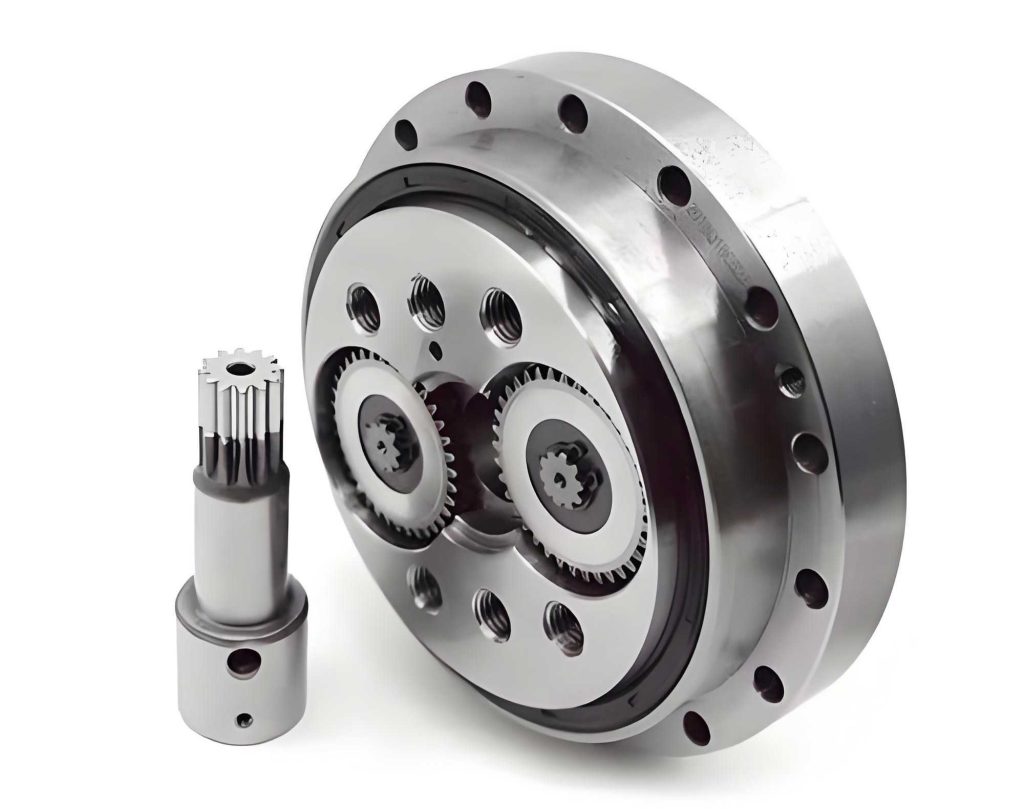
The RV reducer operates through a two-stage reduction mechanism: the first stage involves an involute planetary gear system, while the second stage employs a cycloid-pin gear planetary system. The cycloid wheel is critical in the second stage, where its unique tooth profile enables smooth torque transmission. However, achieving the required precision—such as parallelism within 0.01 mm and positional accuracy of bearing holes within micrometers—poses significant manufacturing hurdles. Common issues include distortion from heat treatment, inconsistent hardness, and limitations in conventional machining setups. To overcome these, I have revamped the finishing workflow by introducing double-face lapping, upgrading to high-precision imported machinery, and developing custom fixtures for each operation. These steps are essential for mass-producing cycloid wheels that meet the stringent demands of modern RV reducers.
Optimization of the Production Process for RV Reducer Cycloid Wheels
The finishing process for cycloid wheels begins after rough machining and heat treatment, which are outsourced. The initial in-house step involves surface grinding to establish flat reference planes. However, due to post-heat-treatment warping, traditional grinding often requires multiple alternating基准面, leading to inefficiencies. To address this, I have optimized the process flow by inserting a double-face lapping stage after surface grinding. This allows simultaneous machining of both faces, improving parallelism and enabling batch processing of multiple wheels. The revised sequence ensures that paired cycloid wheels are processed together, enhancing consistency for RV reducer assembly. Below is a summary of the optimized process steps:
| Step | Process | Key Objectives | Equipment Used |
|---|---|---|---|
| 1 | Surface Grinding | Establish flat reference planes with parallelism ≤ 0.01 mm | Precision Surface Grinder |
| 2 | Double-Face Lapping | Improve thickness uniformity and parallelism for paired wheels | Double-Face Lapping Machine |
| 3 | Boring and Honing | Machine three eccentric bearing holes with high positional accuracy | CNC Boring Machine with Honing Attachment |
| 4 | Tooth Grinding | Finish the cycloid tooth profile to specified tolerances | Precision Gear Grinder with C-axis |
Furthermore, I have upgraded the production environment to a temperature-controlled workshop maintained at 22°C ± 0.5°C. This stability is crucial for mitigating thermal expansion effects on both machinery and workpieces, thereby preserving the accuracy of the RV reducer components. Imported high-precision machines, such as cylindrical grinders and coordinate measuring machines (CMMs), are employed to meet the tight tolerances. The integration of these advancements lays a solid foundation for the subsequent tooling designs.
Design of Specialized Tooling for Each Finishing Step
To achieve the desired precision and consistency, custom fixtures are essential for each machining operation. These fixtures are designed to minimize distortion, ensure repeatable positioning, and facilitate batch processing. Below, I detail the design and application of tooling for surface grinding, double-face lapping, boring, and tooth grinding.
Surface Grinding Fixture
The surface grinding fixture is adapted from a standard three-jaw chuck with customized jaws. The design aims to clamp the cycloid wheel without inducing bending stresses, which is critical given the thin-walled nature of the part. Each jaw features an arcuate contact surface that engages with at least two cycloid teeth, distributing clamping forces evenly. An adjustable block is used to quickly level the workpiece before clamping, after which it is removed for grinding. The clamping torque is controlled at 5 N·m to prevent deformation. This setup allows for direct grinding of the second face using the first as a reference, eliminating the need for multiple alternating operations. The resulting parallelism is guaranteed to be within 0.01 mm, a key requirement for subsequent steps in RV reducer manufacturing.
The clamping force can be analyzed using the formula for bending stress. For a cycloid wheel of thickness $$t$$ and radius $$R$$, the maximum stress induced by clamping should not exceed the material’s yield strength. The relationship is given by:
$$ \sigma_{max} = \frac{M \cdot c}{I} $$
where $$M$$ is the bending moment, $$c$$ is the distance from the neutral axis, and $$I$$ is the moment of inertia. By keeping the torque low, we ensure that $$\sigma_{max}$$ remains negligible, preserving the wheel’s flatness.
Double-Face Lapping Setup
Double-face lapping is employed to enhance the thickness consistency and parallelism of paired cycloid wheels. The machine allows simultaneous grinding of both faces while the wheels undergo both planetary rotation and individual spinning. This motion ensures uniform material removal across the entire surface. The fixture holds multiple wheels in a carrier, and paired sets are lapped together to guarantee matched thickness. The process parameters, such as abrasive grit size and pressure, are optimized based on wheel hardness. For RV reducer applications, maintaining a thickness tolerance within ±0.005 mm is critical to ensure proper meshing in the assembly.
| Parameter | Value | Description |
|---|---|---|
| Abrasive Type | Diamond Compound | Used for high-precision finishing of hardened steel |
| Grit Size | W10 (2-4 μm) | Ensures fine surface finish and tight tolerances |
| Lapping Pressure | 0.1-0.3 MPa | Optimized to prevent overheating and distortion |
| Rotation Speed | 30-50 rpm | Balances material removal rate and consistency |
Boring and Honing Fixture
The boring and honing fixture is designed to machine the three eccentric bearing holes in paired cycloid wheels simultaneously. This is vital for ensuring the positional accuracy and consistency between Type A and B wheels in an RV reducer. The fixture incorporates movable positioning tongues that engage with the cycloid teeth, aligning the two wheels in their operational orientation (i.e., with teeth staggered). The Z-direction定位 is provided by the lapped flat surfaces. The machining sequence includes rough boring, finish boring, and honing, all performed on a CNC boring machine.
Prior to machining, the hardness of each wheel is measured using a Rockwell hardness tester. Wheels intended for pairing must have a hardness differential within 1 HRC to minimize variations in machining response. They are then marked with a laser for traceability. The honing process finalizes the hole dimensions, achieving a surface roughness better than Ra 0.4 μm and a diameter tolerance of ±0.003 mm. The positional accuracy of the holes, defined by their construction circle relative to the wheel center, is critical for the RV reducer’s performance. This can be expressed as:
$$ \Delta P = \sqrt{(\Delta x)^2 + (\Delta y)^2} \leq 0.003 \, \text{mm} $$
where $$\Delta x$$ and $$\Delta y$$ are deviations in the hole coordinates.
Tooth Grinding Fixture and Its Manufacture
Tooth grinding is the most critical operation, as it defines the cycloid profile that directly affects the efficiency and backlash of the RV reducer. The fixture uses the honed bearing holes for定位, employing hydraulic expansion mandrels to clamp multiple wheels of the same type (A or B) simultaneously. The fixture core shaft must be manufactured to ultra-high precision, with key dimensions as follows:
| Feature | Tolerance | Importance |
|---|---|---|
| Verticality of Mandrel Holes | ≤ φ0.001 mm | Ensures perpendicularity for accurate wheel mounting |
| Position of Three Holes | ≤ φ0.003 mm | Guarantees alignment with wheel’s eccentric holes |
| Concentricity with Center | ≤ φ0.003 mm | Maintains rotational balance during grinding |
The core shaft is made from low-carbon steel, case-hardened to 58-62 HRC on the surface while maintaining a core hardness of 30-45 HRC. During heat treatment, areas to be machined are masked to retain softer material for easier finishing. The final machining of the shaft is done in-house using a custom底座 that minimizes clamping distortion. The底座 features a narrow annular contact ring (4 mm wide) ground concave, ensuring line contact with the machine table to prevent bending under pressure.
The assembly of the grinding fixture is supported by an auxiliary tool that aids in loading onto the grinder’s C-axis. This tool provides coarse alignment and support before the machine centers engage, with a 0.5 mm clearance to avoid interference during operation. The grinding wheel is dressed using a CNC disk or form roller to generate the precise cycloid profile. The profile accuracy is verified via CMM scanning, comparing the measured curve to the theoretical modified cycloid. The deviation should fall within a specified envelope, often defined by:
$$ \delta_{profile} = \max|y_{actual} – y_{theoretical}| \leq 0.005 \, \text{mm} $$
where $$y$$ represents the tooth profile coordinates.
Mathematical Models for Machining Precision in RV Reducer Components
To further elucidate the importance of precision in cycloid wheel manufacturing, I have developed mathematical models that relate process parameters to final accuracies. These models help in optimizing the tooling designs and operational settings for RV reducer production.
The overall error in cycloid wheel machining can be decomposed into contributions from various sources, such as fixture alignment, thermal effects, and tool wear. A comprehensive error budget can be formulated as:
$$ E_{total}^2 = E_{fixture}^2 + E_{thermal}^2 + E_{tool}^2 + E_{measurement}^2 $$
where each term represents the variance from respective factors. For instance, the fixture error $$E_{fixture}$$ can be estimated based on the tolerances in Table 3, while thermal error $$E_{thermal}$$ is minimized by the恒温 workshop.
Another key aspect is the geometry of the cycloid tooth, which is defined by the parametric equations:
$$ x = (R + r) \cos(\theta) – e \cos\left(\frac{R + r}{r} \theta\right) $$
$$ y = (R + r) \sin(\theta) – e \sin\left(\frac{R + r}{r} \theta\right) $$
where $$R$$ is the pin circle radius, $$r$$ is the rolling circle radius, $$e$$ is the eccentricity, and $$\theta$$ is the rotation angle. Grinding must replicate this profile with minimal deviation, as even small errors can amplify backlash in the RV reducer. The required profile tolerance is typically within 0.005 mm, necessitating precise wheel dressing and stable fixturing.
Additionally, the consistency between paired wheels can be quantified using statistical measures. For example, the process capability index $$C_{pk}$$ for thickness variation should exceed 1.33 for mass production. This is calculated as:
$$ C_{pk} = \min\left(\frac{USL – \mu}{3\sigma}, \frac{\mu – LSL}{3\sigma}\right) $$
where $$USL$$ and $$LSL$$ are the upper and lower specification limits, $$\mu$$ is the mean, and $$\sigma$$ is the standard deviation. Implementing the optimized process and tooling has significantly improved $$C_{pk}$$ values, as shown in the application results.
Application Results and Performance Metrics
The implementation of the optimized process and custom tooling has yielded substantial improvements in the production of cycloid wheels for RV reducers. Key performance indicators include daily output, yield rate, and assembly efficiency. The table below summarizes the outcomes before and after the enhancements:
| Metric | Before Optimization | After Optimization | Improvement |
|---|---|---|---|
| Daily Output (sets) | 10 | 30 | 200% increase |
| Yield Rate | ~80% | >95% | 15+ percentage points |
| Assembly Time per Set | 30 minutes | 10 minutes | 67% reduction |
| Consistency (Cpk for thickness) | 0.8 | 1.5 | Near-doubling |
The increase in daily output to 30 sets demonstrates the efficiency gains from batch processing and reduced setup times. The yield rate exceeding 95% underscores the effectiveness of the tooling in maintaining precision. Moreover, because paired wheels are machined together and marked for hardness grouping, assemblers can directly match them without additional measurement, slashing assembly time. This streamlined workflow directly benefits the overall manufacturing cycle of RV reducers, reducing costs and enhancing reliability.
Furthermore, quality assessments using CMMs confirm that the cycloid teeth profiles adhere to the design specifications. The tooth-to-tooth error is consistently below 0.005 mm, and the cumulative pitch error is within 0.01 mm, meeting the stringent requirements for low-backlash RV reducers. These results validate the synergy between process optimization and equipment design.
Conclusion
In this paper, I have presented a comprehensive approach to refining the finishing process for cycloid wheels in RV reducers. By optimizing the production sequence—incorporating double-face lapping, upgrading to high-precision machinery, and designing specialized fixtures for each step—I have addressed the longstanding issues of low yield and inefficiency. The custom tooling, including the surface grinding chuck, boring fixture, and tooth grinding mandrel, ensures minimal distortion and high repeatability, crucial for maintaining the accuracy and consistency of paired wheels. Mathematical models and statistical controls further reinforce the precision goals. The application results show a dramatic boost in productivity and quality, with daily output tripling and yield rates surpassing 95%. This advancement not only lowers manufacturing costs but also enhances the performance and reliability of RV reducers in critical applications. Future work may explore adaptive control systems and advanced materials to push the boundaries of cycloid wheel manufacturing even further.
The success of this project highlights the importance of integrating process engineering with tailored equipment design. For the RV reducer industry, such innovations are key to achieving the high standards demanded by modern automation and robotics. As demand for precision drives continues to grow, the methodologies outlined here will serve as a valuable reference for scaling up production while ensuring uncompromising quality.