
As a researcher in the field of precision robotics, I have extensively studied the core components that drive robotic performance, with a particular focus on the RV reducer. The RV reducer is a critical transmission element in industrial robots, known for its high reduction ratio, compact design, low vibration, and superior accuracy. However, its complex structure, involving multiple gears and bearings, introduces various errors that affect transmission precision. In my work, I aimed to enhance the transmission accuracy of the RV reducer by developing an equivalent error model and optimizing key parameters using an improved genetic algorithm. This approach allows for a simplified yet accurate representation of error sources, facilitating better design and optimization. The following article details my methodology, experiments, and findings, emphasizing the importance of modeling and optimization in advancing RV reducer performance.
The transmission error in an RV reducer arises from factors such as manufacturing tolerances, assembly misalignments, gear mesh deviations, and bearing clearances. Traditionally, analyzing these errors requires complex multi-body dynamics simulations, which are computationally intensive. To address this, I adopted an equivalent error modeling technique, which simplifies the RV reducer into a system of rigid bodies connected by springs representing stiffness and error sources. This model transforms displacement variables into spring deformations, enabling efficient calculation of transmission error. The equivalent model includes components like the sun gear, planetary gears, cycloid gears, and the output carrier, each with associated stiffness parameters. By deriving dynamic equations for each component, I formulated a matrix equation to solve for the output angle error. The key stiffness parameters in this model include the gear mesh stiffness, bearing support stiffness, and contact stiffnesses, which significantly influence the overall transmission accuracy of the RV reducer.
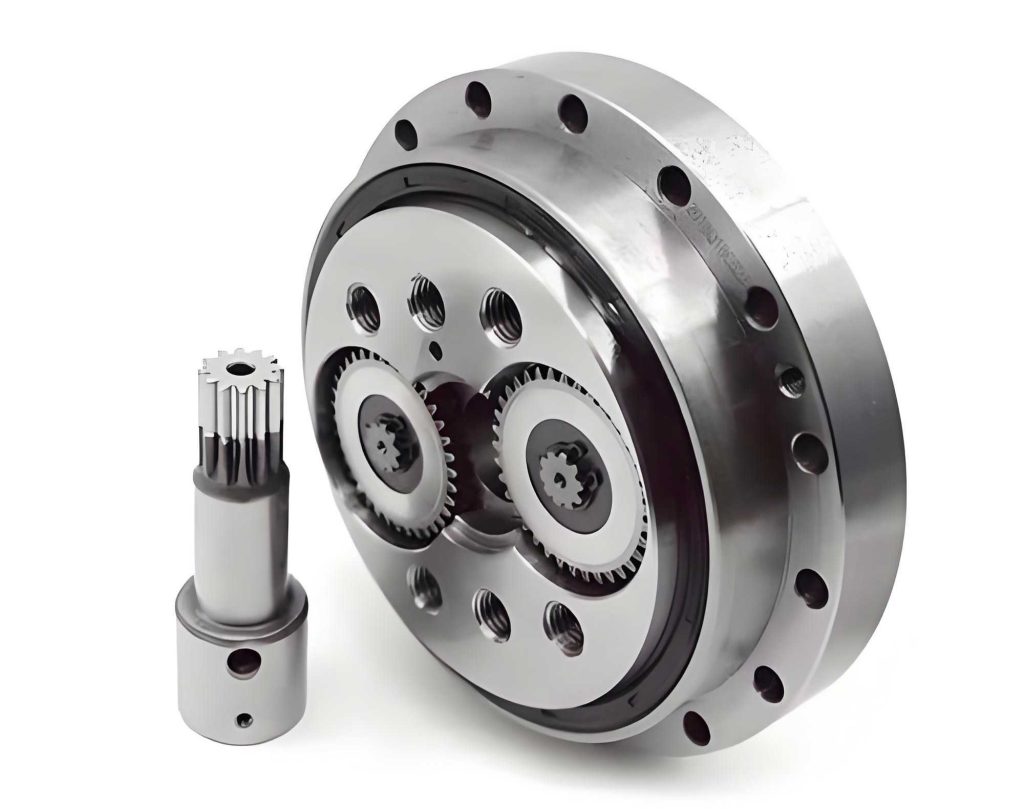
In my equivalent error model, the RV reducer is represented as a set of mass-spring systems. The model parameters include coordinates for gear centers, rotation angles, and stiffness values. For instance, the sun gear dynamics are governed by equations balancing mesh forces and support stiffness. The equation for the sun gear in the X-direction is given by:
$$\sum_{i=1}^{2} R_{spi} S_{spi} \cos(\gamma_i) + R_s (X_s – a_{SX}) = 0,$$
where \(R_{spi}\) is the mesh stiffness between the sun gear and the i-th planetary gear, \(S_{spi}\) is the equivalent displacement along the mesh line, \(\gamma_i\) is the angle of the mesh line, \(R_s\) is the support stiffness of the gear shaft, \(X_s\) is the displacement in the X-direction, and \(a_{SX}\) is the assembly error in the X-direction. Similarly, the Y-direction equation is:
$$\sum_{i=1}^{2} R_{spi} S_{spi} \sin(\gamma_i) + R_s (Y_s – a_{SY}) = 0.$$
For the planetary gears, the dynamics involve forces from gear meshing and bearing contacts. The equations for the i-th planetary gear are:
$$S_{spi} R_{spi} \cos \gamma_i – \sum_{j=1}^{2} R_{pd} S_{djix} – R_b S_{cix} = 0,$$
$$S_{spi} R_{spi} \sin \gamma_i – \sum_{j=1}^{2} R_{pd} S_{djiy} – R_b S_{ciy} = 0,$$
$$S_{spi} R_{spi} a_{sp} + e \sum_{j=1}^{2} (R_{pd} S_{djix} \sin B_j + R_{pd} S_{djiy} \cos B_j) = 0,$$
where \(R_{pd}\) is the cylindrical roller bearing stiffness, \(R_b\) is the tapered roller bearing stiffness, \(a_{sp}\) is the center distance, \(e\) is the eccentricity, and \(B_j\) is the theoretical rotation angle of the j-th cycloid gear. The cycloid gear dynamics are described by:
$$\sum_{i=1}^{2} (R_{pd} S_{djix} \sin B_j + R_{pd} S_{djiy} \cos B_j) + \sum_{k=1}^{m} R_{djk} S_{djk} \sin \alpha_{jk} = 0,$$
$$\sum_{i=1}^{2} (R_{pd} S_{djiy} \sin B_j – R_{pd} S_{djix} \cos B_j) + \sum_{k=1}^{m} R_{djk} S_{djk} \cos \alpha_{jk} = 0,$$
$$\sum_{i=1}^{2} a_{sp} (R_{pd} S_{djiy} \cos P_i – R_{pd} S_{djix} \sin P_i) + r_d \sum_{k=1}^{m} R_{djk} S_{djk} \sin \alpha_{jk} = 0,$$
where \(R_{djk}\) is the mesh stiffness between the j-th cycloid gear and the k-th pin gear, \(\alpha_{jk}\) is the mesh angle, \(P_i\) is the theoretical rotation angle of the i-th crank, and \(r_d\) is the pitch radius of the cycloid gear. The output carrier dynamics include:
$$\sum_{i=1}^{2} R_b S_{cix} – R_{ca} (X_{ca} – a_{cx}) = 0,$$
$$\sum_{i=1}^{2} R_b S_{ciy} – R_{ca} (Y_{ca} – a_{cy}) = 0,$$
$$a_{sp} \sum_{i=1}^{2} (R_b S_{cix} \sin P_i – R_b S_{ciy} \cos P_i) = T_{out},$$
with \(R_{ca}\) as the angular contact bearing stiffness, \(X_{ca}\) and \(Y_{ca}\) as carrier displacements, \(a_{cx}\) and \(a_{cy}\) as assembly errors, and \(T_{out}\) as the output torque. These equations are combined into a matrix form:
$$R Y = P,$$
where \(R\) is a 17×17 stiffness matrix, \(Y\) is a vector of displacement variables, and \(P\) is a force vector. The transmission error \(\Delta \theta\) is calculated as the difference between the simulated output angle \(\theta_{ca}^*\) and the theoretical output angle \(\theta_c\).
To optimize the RV reducer’s performance, I identified key stiffness parameters that dominate transmission error. Among the six stiffness types in the model, \(R_{ca}\), \(R_b\), and \(R_pd\) were selected for optimization because they significantly impact the second-stage reduction, where errors are amplified due to the high reduction ratio. The other stiffness parameters, such as gear mesh stiffnesses in the first stage, have negligible effects after reduction. Empirical formulas for these stiffnesses are used as initial estimates:
$$R_{ca} = \frac{E_g n_3 \sqrt{r_g}}{0.5^{3/2} (1 – \mu^2)},$$
$$R_b = \frac{\pi l_2 E n_2}{8 (1 – \mu^2) \sin(80\pi / 180)},$$
$$R_{pd} = \frac{\pi l_1 E n_1}{8 (1 – \mu^2)},$$
where \(\mu\) is Poisson’s ratio, \(E\) and \(E_g\) are elastic moduli, \(l_1\) and \(l_2\) are contact lengths, and \(n_1\), \(n_2\), \(n_3\) are numbers of rolling elements. However, due to manufacturing variations and material inconsistencies, these empirical values require refinement to improve accuracy.
I formulated an optimization problem using the least squares method to minimize the difference between actual transmission error peaks and model-predicted peaks. The objective function is:
$$\min \frac{1}{2} \sum_{i=1}^{N} (u_i^* – u_i)^2,$$
where \(u_i\) is the actual error peak and \(u_i^*\) is the simulated error peak from the equivalent model. The optimization variables are \(R_{ca}\), \(R_b\), and \(R_{pd}\), constrained within bounds derived from empirical formulas. To solve this, I developed an improved genetic algorithm that addresses issues like premature convergence and high computational cost in traditional genetic algorithms.
The improved genetic algorithm incorporates several enhancements. First, during initialization, I ensure population diversity by checking the number of unique individuals; if below a threshold, the population is reinitialized to avoid singular solutions. Second, I implement an elimination operator that removes the worst 20% of individuals each generation, based on fitness, to focus computational resources on promising solutions. Third, crossover and mutation probabilities are dynamically adjusted: if the population becomes too homogeneous, mutation probability is increased to introduce new genetic material. The fitness function is defined as the inverse of the variance between actual and simulated error peaks:
$$V = \frac{1}{N} \sum_{i=1}^{N} (\delta_i – \delta_i^*)^2,$$
$$V_{\text{fitness}} = \frac{1}{V},$$
where \(\delta_i\) and \(\delta_i^*\) are peak-to-peak values of actual and simulated errors, respectively. The algorithm uses binary encoding with a length of 45 bits, a population size of 100, and up to 100 generations. Crossover probability is set at 0.8, and initial mutation probability at 0.2, with adaptive adjustments.
For experimental validation, I built a test platform using an RV20E-type RV reducer. The platform includes a drive motor, input and output circular gratings for angle measurement, and a load motor. The RV reducer has a two-stage design: the first stage comprises a sun gear with 20 teeth and planetary gears with 26 teeth, module 1.5 mm, and pressure angle 20°; the second stage includes 40 pin gears and 39 cycloid gears, with a pin gear distribution radius of 52 mm and eccentricity of 0.9 mm. Transmission error is calculated by comparing the theoretical output angle (derived from input measurements) with the actual output angle from the grating.
I conducted multiple experiments to collect actual transmission error data. The improved genetic algorithm was then applied to optimize the stiffness parameters. To mitigate randomness in initialization, I performed multiple optimization runs and selected the best results. The table below summarizes the optimized stiffness parameters and the corresponding V-index from 10 runs:
| Run | \(R_{ca} \times 10^{10}\) | \(R_b \times 10^{10}\) | \(R_{pd} \times 10^{10}\) | V-index |
|---|---|---|---|---|
| 1 | 7.933 | 1.786 | 1.101 | 6.553 |
| 2 | 8.017 | 1.799 | 1.100 | 6.574 |
| 3 | 7.933 | 1.799 | 1.101 | 6.553 |
| 4 | 7.899 | 1.803 | 1.101 | 6.553 |
| 5 | 8.038 | 1.793 | 1.100 | 6.574 |
| 6 | 7.989 | 1.790 | 1.101 | 6.574 |
| 7 | 7.929 | 1.788 | 1.101 | 6.553 |
| 8 | 8.033 | 1.782 | 1.101 | 6.553 |
| 9 | 7.933 | 1.786 | 1.101 | 6.553 |
| 10 | 7.996 | 1.789 | 1.100 | 6.574 |
The average values of the optimized parameters are compared with pre-optimization empirical estimates in the following table:
| Parameter | Range (×10¹⁰) | Pre-optimization Average (×10¹⁰) | Post-optimization Average (×10¹⁰) | Improvement in V-index |
|---|---|---|---|---|
| \(R_{ca}\) | [7.4, 8.0] | 7.850 | 7.970 | 18.62% reduction |
| \(R_b\) | [1.4, 1.8] | 1.640 | 1.792 | |
| \(R_{pd}\) | [0.8, 1.3] | 1.090 | 1.101 |
The V-index decreased from 8.065 to 6.564 on average, indicating a significant reduction in error variance. To further assess accuracy, I compared the theoretical transmission errors from the optimized model with actual errors for 10 datasets. The table below shows the peak-to-peak errors:
| Dataset | Actual Error (arcsec) | Theoretical Error (Optimized) (arcsec) | Difference (arcsec) | Improvement Over Pre-optimization (%) |
|---|---|---|---|---|
| 1 | 93.92 | 95.42 | 1.39 | 7.33 |
| 2 | 95.25 | 98.82 | 3.19 | 10.64 |
| 3 | 101.82 | 104.76 | 2.64 | 10.20 |
| 4 | 104.14 | 107.83 | 3.22 | 12.73 |
| 5 | 110.15 | 112.76 | 2.39 | 8.43 |
| 6 | 112.71 | 115.25 | 2.33 | 8.27 |
| 7 | 116.86 | 119.95 | 2.80 | 9.46 |
| 8 | 121.74 | 123.66 | 1.70 | 11.46 |
| 9 | 125.21 | 127.78 | 2.35 | 8.54 |
| 10 | 128.25 | 130.76 | 2.16 | 13.93 |
The average improvement in transmission error accuracy was 10.09%, demonstrating the effectiveness of the optimization. The optimized RV reducer model shows closer alignment with actual performance, reducing discrepancies in error peaks. For instance, the actual error range for one dataset was -25.91″ to 13.93″, while the optimized theoretical range was -27.88″ to 14.84″, indicating minimal deviation.
My improved genetic algorithm outperformed a basic genetic algorithm in several ways. It avoided premature convergence by maintaining population diversity and dynamically adjusting mutation rates. In contrast, the basic algorithm often stagnated or required more generations to converge. The elimination operator reduced computational time by focusing on high-fitness individuals. Overall, the optimization process enhanced the RV reducer’s design accuracy, making the equivalent error model more reliable for predicting transmission behavior.
In conclusion, my work on equivalent error modeling and parameter optimization for the RV reducer has proven successful. By integrating a mass-spring equivalent model with an improved genetic algorithm, I achieved a 10.09% average improvement in transmission error accuracy. This approach simplifies error analysis and provides a practical tool for designing high-precision RV reducers. Future work could explore additional error sources, such as thermal effects or lubrication variations, and extend the optimization to other reducer types. The RV reducer remains a focal point in robotics, and advancements in its accuracy directly contribute to better robotic performance. Through continuous refinement of models and algorithms, we can push the boundaries of precision in industrial applications.
The mathematical framework developed here is generalizable. The equivalent error model can be adapted to other planetary or cycloidal drives by adjusting stiffness parameters and geometry. The optimization algorithm’s flexibility allows for inclusion of more variables or constraints, such as cost or weight considerations. For the RV reducer, this methodology offers a pathway to achieve higher transmission accuracy without extensive prototyping, reducing development time and cost. As robotics evolve towards more demanding tasks, the role of precise RV reducers becomes increasingly critical, underscoring the importance of ongoing research in this area.
In summary, the RV reducer’s complexity necessitates sophisticated modeling techniques. My equivalent error model, combined with robust optimization, provides a viable solution. The use of stiffness parameters like \(R_{ca}\), \(R_b\), and \(R_{pd}\) as optimization variables highlights key factors in transmission error. The improved genetic algorithm ensures efficient and effective parameter tuning. Experimental validation confirms the model’s accuracy, with significant error reduction. This work contributes to the broader goal of enhancing robotic systems through better component design. The RV reducer, as a core element, benefits from such advancements, enabling smoother motion, higher precision, and improved overall performance in industrial robots.