
As a core component derived from cycloidal drives, the RV reducer is renowned for its exceptional load-bearing capacity, high transmission precision, minimal backlash, compact design, and high efficiency. These attributes make it indispensable in demanding fields such as aerospace and industrial robotics. Within the complex architecture of the RV reducer, the cycloidal pinwheel mechanism, comprising the cycloidal disk, needle pins, and pin housing, is subjected to intricate and dynamic loading conditions. The distribution of contact forces within this mechanism critically influences the overall performance metrics of the reducer, including its operational lifespan, vibration characteristics, and noise generation. Consequently, conducting a detailed transient contact analysis of the cycloidal pinwheel is of paramount importance for the design, optimization, and reliability assessment of RV reducers. This study employs a combined approach of theoretical mechanics and advanced finite element analysis (FEA) to investigate the meshing behavior under varying load conditions.
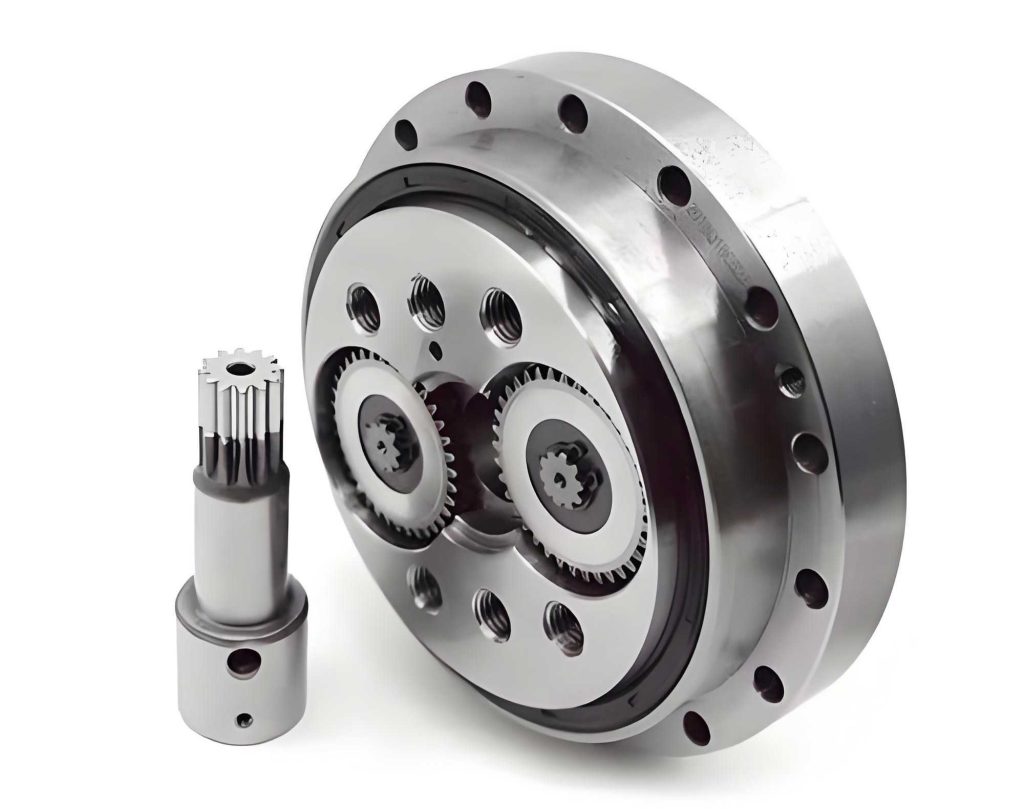
The RV reducer operates on a two-stage reduction principle. The first stage typically involves a planetary gear train, while the second and primary reduction stage is achieved through the cycloidal pinwheel mechanism. A crankshaft, driven by the input, carries eccentric sections on which two cycloidal disks are mounted 180 degrees out of phase. These disks mesh with a stationary ring of needle pins housed in the pin housing. The eccentric motion of the crankshaft causes a compound rolling motion of the cycloidal disks, resulting in a significant speed reduction. The rotation is then output via pins connecting the cycloidal disks to the output flange. This analysis focuses specifically on the second-stage cycloidal drive of a model analogous to the RV-40E, with a total reduction ratio of 121. A single cycloidal disk assembly is analyzed, as the phase-shifted pair exhibits similar dynamic characteristics. Key geometric parameters of the cycloidal pinwheel mechanism are summarized in Table 1.
| Parameter | Symbol | Value |
|---|---|---|
| Number of Cycloidal Disk Teeth | $Z_b$ | 39 |
| Number of Needle Pins | $Z_p$ | 40 |
| Pin Circle Radius | $r_p$ | 64 mm |
| Needle Pin Radius | $r_{rp}$ | 3 mm |
| Cycloidal Disk Pitch Radius | $r_b$ | 50.7 mm |
| Offset (Eccentricity) | $e$ | 1.3 mm |
| Short Width Coefficient | $K_1$ | 0.8125 |
| Tooth Width / Pin Length | $L_b$ | 9 mm |
| Output Torque (Rated) | $T_{out}$ | 412 N·m |
To achieve smooth operation, compensate for manufacturing tolerances, and ensure multiple tooth-pair contact, the theoretical cycloidal tooth profile is often modified. This analysis considers two primary modifications: a pin radius modification ($\Delta r_{rp}$) and a pin circle radius modification ($\Delta r_p$). The initial clearance $\Delta(\phi_i)$ between the modified cycloidal tooth and the i-th needle pin along the common normal at the meshing point is a function of the modification amounts and the angular position $\phi_i$:
$$
\Delta(\phi_i) = \Delta r_{rp}\left(1 – \frac{\sin \phi_i}{\sqrt{1+K_1^2-2K_1\cos\phi_i}}\right) – \Delta r_p\left(\frac{1-K_1\cos\phi_i – \sqrt{1-K_1^2}\sin\phi_i}{\sqrt{1+K_1^2-2K_1\cos\phi_i}}\right)
$$
Under an applied output torque, elastic deformations occur at the contacts between the cycloidal disk and needle pins, and between the needle pins and their housing. These deformations cause the cycloidal disk to rotate slightly relative to the crankshaft. The total elastic deformation $\delta_i$ along the common normal at the i-th meshing point is related to the maximum deformation $\delta_{max}$ at the first contacting pair:
$$
\delta_i = \frac{\sin \phi_i}{\sqrt{1+K_1^2-2K_1\cos\phi_i}} \delta_{max}
$$
A tooth pair is considered to be in load-bearing contact only if the calculated elastic deformation $\delta_i$ exceeds the initial clearance $\Delta(\phi_i)$. The individual meshing force $F_i$ for each contacting pair is proportional to this net deformation. An iterative computational procedure is used to solve for $\delta_{max}$ and the distribution of $F_i$ such that the sum of the moments generated by all contact forces balances the applied torque on the cycloidal disk. The Hertzian contact stress $\sigma_H$ for a pair of contacting cylinders (the needle pin and the cycloidal tooth) can be estimated theoretically by:
$$
\sigma_H = 0.418 \sqrt{\frac{E_e F_i}{\rho_0 C}}
$$
where $E_e$ is the equivalent elastic modulus, $\rho_0$ is the equivalent curvature radius, and $C$ is the effective contact length. For the material GCr15 with a hardness of 62 HRC, the allowable contact stress $\sigma_{HP}$ is typically 1902 MPa. To investigate the influence of load variation on the meshing characteristics of the RV reducer, theoretical calculations were performed for multiple load levels: 0.5, 1, 2, and 3 times the rated output torque ($T_{out}$ = 412 N·m). The calculated distribution of meshing forces at the rated load is presented in Table 2.
| Needle Pin Number (i) | Meshing Force $F_i$ (N) | Contact Stress $\sigma_H$ (MPa) |
|---|---|---|
| 3 | 361.684 | 205.443 |
| 4 | 910.827 | 556.340 |
| 5 | 1025.157 | 901.526 |
| 6 | 939.143 | 1148.438 |
| 7 | 741.630 | 1178.171 |
| 8 | 472.514 | 980.352 |
| 9 | 152.668 | 552.281 |
The results indicate that at the rated load, 7 needle pins (numbers 3 through 9) participate in load sharing simultaneously. The maximum theoretical contact stress is 1178.17 MPa at pin #7, which is below the material’s allowable limit, confirming the basic design strength of the RV reducer components under this condition. A trend of increasing number of contacting tooth pairs with increasing load was also observed theoretically.
To capture the dynamic and non-linear nature of the contact, a detailed three-dimensional finite element model of the cycloidal pinwheel mechanism was developed. The geometry was created considering profile modifications, and the assembly was simplified for computational efficiency: a single cycloidal disk was modeled, the pin housing thickness was simplified, and an eccentric key was used to represent the driving action of the crankshaft’s eccentric segment. The model was imported into Ansys Workbench for transient dynamic analysis. The cycloidal disk and needle pins were modeled using GCr15 steel material properties (Young’s Modulus: 219 GPa, Poisson’s ratio: 0.3, Density: 7830 kg/m³). The pin housing and eccentric key were treated as rigid bodies to focus computational resources on the contact regions. A fine mesh with an element size of 1 mm was applied globally, with local refinement (0.5 mm) on the cycloidal tooth profiles and needle pin edges to accurately resolve contact stresses. The SOLID185 element was primarily used. Contact pairs were established between all 40 needle pins and the cycloidal disk using a surface-to-surface formulation with a friction coefficient of 0.13, solved using the Augmented Lagrange method. Boundary conditions simulated the operational state: the pin housing was fixed, a rotational velocity (61.261 rad/s) was applied to the eccentric key’s center (simulating input), and a torque load was applied between the eccentric key’s eccentric hole and the cycloidal disk’s bearing bores to represent the output resistance. For a single cycloidal disk, this torque $T_b$ was taken as 0.55 times the total output torque ($T_{out}$), equaling 226.6 N·m. The analysis simulated a time period corresponding to one complete meshing cycle of the cycloidal disk—the time it takes for the disk to advance by the angular pitch between two adjacent needle pins (9°). With an output angular speed of 90 °/s, this cycle time is 0.1 seconds. A simulation time of 0.19 s was used, with the load ramping up to its full value within the first 0.01 s. The primary analysis focused on the steady-state meshing cycle from 0.01 s to 0.11191 s. The finite element model successfully replicated the kinematics, with the simulated relative angular velocity between the eccentric key and cycloidal disk (63.205 rad/s) matching the theoretical value (62.831 rad/s) within a 0.6% error, validating the model’s setup. The von Mises stress distribution at different time instants within one meshing cycle clearly shows the progression of the contact zone across the teeth of the cycloidal disk.
The transient FEA provided detailed insights into the dynamic meshing behavior of the RV reducer’s cycloidal stage. A key finding is the periodic variation in the number of simultaneously load-bearing tooth pairs during a meshing cycle. At the rated load ($T_{out}$ = 412 N·m), this number fluctuated, primarily involving pins in the range of #3 to #7. Crucially, the number of meshing pairs increased significantly with the applied load, as shown in the comparison of contact stress contours at the point of highest load concentration under different load levels. The phenomenon of “double fulcrum” contact on the needle pins—where stress concentrates at both ends along their length—was clearly observed. The equivalent stress along the length of a centrally loaded needle pin (#6) at the 0.01 s instant was extracted for different loads, revealing that while stress increases uniformly with load, the distribution tends to become slightly more even, reducing the severity of the end-concentration.
A direct comparison between theoretical Hertzian contact stress and FEA-predicted contact pressure was conducted for the initial loaded state (0.01 s). The trends were consistent: contact stress increased and then decreased across the set of contacting pins, and the overall magnitude rose with increasing load. However, the FEA predicted a lower number of active pairs (e.g., 3 vs. 7 at rated load) and lower absolute stress values (e.g., max of 637.42 MPa vs. 1178.17 MPa at rated load). This discrepancy is attributed to the FEA’s ability to model complex structural details (like the cycloidal disk’s bearing holes), account for friction, and solve the full non-linear contact problem without the simplifying assumptions inherent in the theoretical iterative method, which assumes a continuous, uniformly stiff structure.
Detailed stress analysis along the tooth profile of the cycloidal disk revealed critical regions. For all load cases, peak equivalent stresses occurred not at the very tip or root, but in the transition region between the root and the tip, near the point of inflection where the profile curvature is zero. This region, analogous to a cylinder-on-plane contact, is particularly susceptible to high contact pressure. The stress values at this location for loads of 0.5T, 1T, 2T, and 3T were 219.77 MPa, 301.97 MPa, 405.64 MPa, and 512.8 MPa, respectively. A summary of key findings from the stress path analyses is provided in Table 3.
| Analysis Path | Key Observation | Trend with Increasing Load |
|---|---|---|
| Along Cycloidal Tooth Profile | Maximum equivalent stress occurs in the root-to-tip transition zone near the inflection point. | Stress increases significantly at the critical point. |
| Along Needle Pin Length | Stress distribution shows a “double fulcrum” pattern (high at ends, lower in middle). | Overall stress increases; distribution becomes slightly more uniform, reducing end-concentration ratio. |
The comprehensive finite element analysis of the RV reducer’s cycloidal pinwheel mechanism under transient conditions leads to several important conclusions. First, the meshing characteristics are highly dynamic within a single cycle. The number of simultaneously load-bearing tooth pairs varies periodically with time. Second, there exists a clear and inverse relationship between the number of meshing pairs and the magnitude of meshing stress (both contact and equivalent stress) on individual components. A higher number of sharing pairs leads to lower stress per pair, which is beneficial for longevity. Third, the applied load is a dominant factor. Increasing the output torque causes a greater number of tooth pairs to enter the load-bearing zone and elevates the stress levels throughout the mechanism. Fourth, critical stress zones were identified: the transition region on the cycloidal tooth profile is a potential site for fatigue initiation, and needle pins experience a non-uniform stress distribution along their length. Fifth, while trends aligned, the finite element analysis provided a more conservative and structurally detailed assessment compared to the theoretical method, highlighting the value of numerical simulation in capturing complex contact mechanics. These insights contribute to a deeper understanding of the RV reducer’s operational behavior and provide valuable guidance for its design refinement, analysis, and manufacturing, particularly in optimizing tooth profile modifications, selecting appropriate materials and heat treatments, and ensuring reliable performance under variable loading conditions. Future work could explore the effects of different modification schemes, thermal loads, and the dynamic interaction between the two phase-shifted cycloidal disks within the complete RV reducer assembly.