
The evolution of robotic systems is relentlessly pushing the boundaries of operational environments. A frontier of intense interest lies in enabling seamless operation across disparate media, such as aquatic and aerial domains. The motivation is clear: a single robotic platform capable of stable locomotion in water, agile flight in air, and, critically, the ability to temporarily adhere to surfaces within either medium would dramatically expand mission scope and duration. This convergence of mobility and station-keeping could revolutionize tasks like multi-terrain ecological monitoring, infrastructure inspection spanning waterlines and superstructures, or rapid response in complex disaster scenarios. However, the physical challenges at the interface of water and air are profound, demanding a holistic, bio-inspired redesign of both adhesion and propulsion subsystems. My focus here is to articulate the design philosophy, mechanistic principles, and integrative breakthroughs underpinning a new class of bionic robot engineered for cross-domain adsorption and transit.
The core challenge is twofold. First, an adhesion mechanism must be developed that is simultaneously powerful, reversible, and robust against environmental variability. It must function reliably on wet, dry, rough, or fouled surfaces, and generate sufficient shear resistance to withstand dynamic fluid flows. Second, the bionic robot itself must be untethered and capable of rapid, stable, and continuous transitions across the water-air interface, carrying its adhesion apparatus and payload without compromise. Traditional approaches often treat adhesion and cross-medium transit as separate problems, leading to bulky, inefficient systems. The breakthrough lies in a synergistic biomimetic approach, drawing inspiration from the humble yet extraordinarily capable remora fish for adhesion, and from adaptive aerodynamics for propulsion.
Biomimetic Adsorption: Decoding the Remora’s Secret
The remora’s suction disc is a masterpiece of evolutionary engineering, allowing it to hitchhike on hosts ranging from sharks to whales, withstanding tremendous hydrodynamic forces. My analysis of this biological system revealed a mechanism far more sophisticated than simple suction. The key innovation is a redundant, hydrostatic pressure-enhanced adsorption mechanism facilitated by independent fin chambers.
The disc contains rows of paired, movable lamellae (fin-like structures). Contrary to the assumption of a single, unified suction chamber, I observed that individual pairs of lamellae can form independent, sealed cavities against a substrate. This is possible even on complex surfaces with gaps or curvature, as the soft, fleshy lip seal around the disc’s perimeter maintains a global weak adhesion, while specific lamellae engage locally. This creates a robust, fault-tolerant system: the failure of one or several lamellar seals does not catastrophically compromise overall attachment.
The physics of this mechanism can be modeled. The primary adhesive force (F_ad) for a single lamellar chamber is a combination of pressure differential and frictional interlock:
$$
F_{ad} = (P_{atm} – P_{cav}) \cdot A_{cav} + \mu \cdot F_{lock}
$$
Where P_atm is ambient pressure, P_cav is the cavity pressure, A_cav is the sealed cavity area, μ is the coefficient of friction, and F_lock is the normal force due to mechanical interlocking. The remora actively rotates its lamellae, pressing arrays of tiny spinules (micro-teeth) at their tips into the substrate surface. This active interlocking generates F_lock, which converts into formidable shear resistance through friction. Crucially, the spinule engagement occurs without breaking the seal of the lamellar cavity, allowing simultaneous negative-pressure adhesion and mechanical grip.
To quantify the advantage, I constructed several simplified, bionic robot吸附 disc prototypes and tested them against a traditional single-chamber suction cup. The metrics of interest were attachment time on a leak-prone surface and resistance to tangential shear flow. The biomimetic design, employing the redundant chamber principle, demonstrated superior performance.
| Prototype Type | Avg. Attachment Time (s) | Max. Shear Resistance (N) | Surface Adaptability |
|---|---|---|---|
| Traditional Single-Chamber Suction Cup | 125 | 15.2 | Low (requires smooth, non-porous) |
| Passive Multi-Chamber Disc (No Spinules) | 410 | 18.7 | Medium |
| Active Biomimetic Disc (with Lamellar Rotation & Spinules) | 697 | 21.9 | High (rough, curved, porous) |
The governing equation for the enhanced shear resistance (τ_max) of the biomimetic disc, considering ‘n’ independent chambers, is:
$$
\tau_{max} = \sum_{i=1}^{n} [\mu_s \cdot ( (P_{atm} – P_{cav,i}) \cdot A_{cav,i} + F_{lock,i})]
$$
where μ_s is the static friction coefficient, and the subscript i denotes the i-th lamellar chamber. This redundancy and dual-mechanism approach are the cornerstones for developing a reliable adhesive subsystem for a cross-domain bionic robot.
Cross-Medium Propulsion: The Adaptive Folding Propeller
Transitioning between water and air is notoriously inefficient due to the ~850x difference in density. A propeller optimized for air is grossly inadequate underwater, and vice-versa. The conventional solution is to overpower the problem with high-torque motors and complex transmission systems. My approach was to embrace the disparity through a passively adaptive, folding propeller design.
The propeller blades are hinged at the root. Their hydrodynamic and aerodynamic profiles are carefully tailored so that their equilibrium state differs in each medium. In water, the higher fluid density imposes a significant bending moment, causing the blades to fold inwards towards the rotation axis, reducing their effective radius and solidity. In air, the much lower aerodynamic forces allow centrifugal force and pre-tensioned springs to dominate, deploying the blades to their full, efficient span for aerial flight.
The dynamics of a folding blade can be described by a balance of moments about the hinge:
$$
I \ddot{\theta} = M_{centrifugal} + M_{spring} – M_{fluid\_drag} – M_{hinge\_friction}
$$
Where θ is the folding angle, I is the blade’s moment of inertia about the hinge, and the various M terms represent the torques from different forces. The fluid drag torque M_fluid_drag is highly dependent on fluid density ρ and velocity, creating the medium-dependent behavior:
$$
M_{fluid\_drag} \propto \rho \cdot C_d \cdot A_{blade} \cdot v_{tip}^2
$$
This self-regulating behavior has a profound system-level benefit: it narrows the operational RPM range required for efficient thrust in both media. A fixed-pitch propeller requires a massive shift in RPM (and thus motor drive voltage/current) when transitioning. The folding propeller operates in a more consistent RPM band, drastically reducing the control complexity and transition time. Experimental data confirms this:
| Propeller Type | Optimal Aerial RPM | Optimal Aquatic RPM | RPM Ratio (Water/Air) | Measured Water-to-Air Transition Time (s) |
|---|---|---|---|---|
| Fixed-Pitch (Aero-Optimized) | 8,000 | > 18,000 | > 2.25 | 0.90 |
| Fixed-Pitch (Hydro-Optimized) | < 4,000 | 6,500 | ~1.63 | 1.20 |
| Passive Folding Propeller | 7,200 | 9,500 | ~1.32 | 0.35 |
The transition time T_trans is heavily dependent on the inertia of the motor-propeller system and the required RPM delta. By minimizing the necessary RPM change Δω, the folding design achieves faster transitions:
$$
T_{trans} \approx \frac{J \cdot \Delta \omega}{K_t \cdot I – M_{load}}
$$
where J is rotational inertia, K_t is motor torque constant, and I is current. The bionic robot leverages this rapid (<0.35s), stable transition capability to become a true cross-domain agent.
System Integration and Performance of the Bionic Robot
The full integration marries the biomimetic吸附 disc with a high-maneuverability quadrotor frame equipped with four adaptive folding propellers. The bionic robot is a compact, untethered system where adhesion is not an afterthought but a core operational mode. Its primary performance characteristics are defined by two cycles: the pure medium-transit cycle and the adsorption-augmented mission cycle.
In standardized lab tests, the robot achieves a continuous water-to-air-to-water cycle in 2.9 seconds. More importantly, once adhered to a surface using its biomimetic disc, it enters an ultra-low-power “hitchhiking” mode. The energy savings are staggering and are the primary value proposition for extending mission life. The power consumption P in different states reveals the efficiency of adsorption:
$$
P_{hover} \approx \frac{ (mg)^{3/2} }{ \sqrt{2 \rho_{air} A_{prop}} \cdot \eta } \quad ; \quad P_{adsorbed} \approx P_{sensing} + P_{comm}
$$
$$
P_{swimming} \approx \frac{1}{2} C_D \rho_{water} A_{body} v^3 \quad ; \quad P_{adsorbed} \ll P_{swimming}, P_{hover}
$$
Quantitative measurements show that compared to station-keeping via aerial hovering, the吸附 state reduces energy consumption by approximately 50 times. Compared to maintaining position against currents via underwater swimming, adsorption saves about 19 times the energy. This allows the bionic robot to perform long-duration observation or sensing tasks with a minimal energy budget.
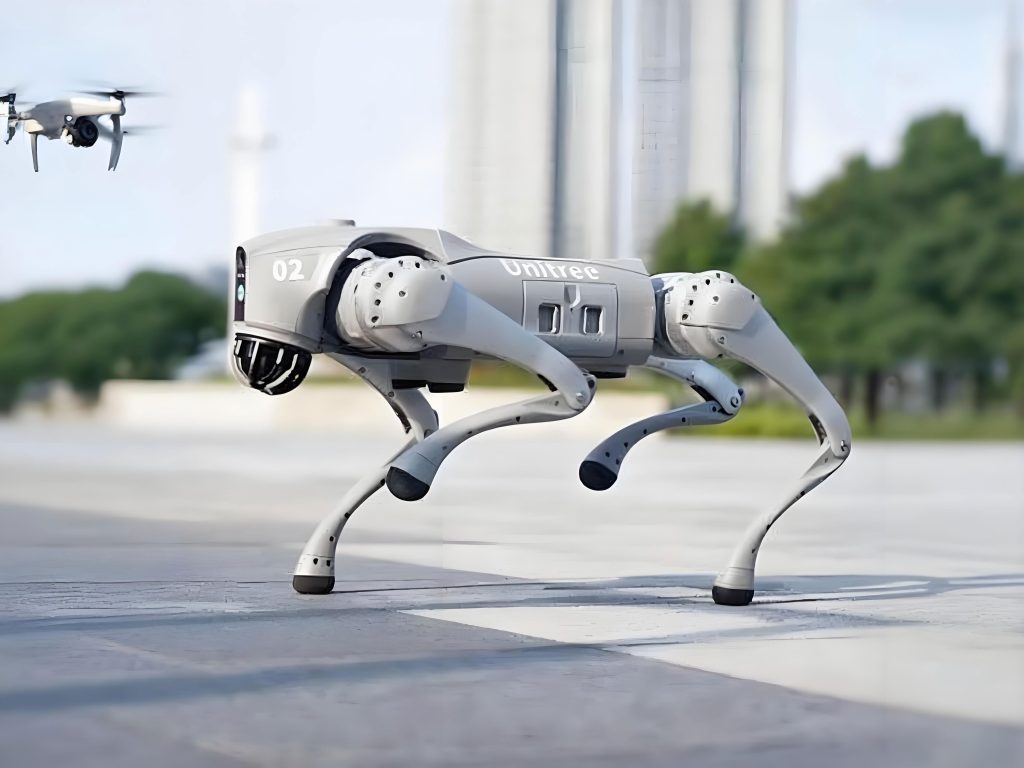
The robot’s robust adhesion enables it to withstand significant normal and shear forces, allowing it to attach to moving hosts like boat hulls or underwater vehicles for “free rides,” or to remain fixed on wet, flowing rock surfaces in riverine environments. This capability transforms the bionic robot from a simple mobile platform into a persistent environmental node.
Applications and Future Trajectory
The implications for this class of bionic robot are wide-ranging. In marine biology, it can attach to a whale or large fish non-invasively for behavioral studies, detach to fly to a new location, and re-attach. For infrastructure inspection, it can fly to a pylon, adsorb onto the wet concrete at the waterline to inspect for corrosion, then dive to inspect the submerged foundation. In search and rescue, it could traverse floodwaters, adsorb to debris or structures to conserve power while scanning, and relay information.
The future development path involves enhancing autonomy through intelligent adhesion decision-making. The robot must be able to assess surface suitability, select optimal吸附 points, and dynamically adjust lamellar engagement in real-time. Furthermore, miniaturization and the development of swarms of such cooperative cross-domain bionic robots could enable distributed sensing over vast and heterogeneous environments.
In conclusion, the synthesis of a redundancy-based, biomimetic吸附 mechanism with a passively adaptive cross-medium propulsion system has given rise to a novel and highly capable bionic robot. This platform fundamentally extends the operational envelope of unmanned systems, enabling persistent presence and action across the critical water-air interface. It stands as a testament to the power of biomimicry in solving core challenges in robotics, paving the way for a new generation of versatile, energy-efficient, and highly adaptive machines capable of operating where few systems have ventured before.